Complete Guide to Eishoji Temple | History, Highlights, and Seasonal Flowers of Kamakura’s Only Nunnery
What is Eishoji Temple? – An Overview of Kamakura’s Only Nunnery
Eishoji Temple is a Jodo sect temple located in Ogigayatsu, Kamakura City, Kanagawa Prefecture. Its mountain name is Tokozan. While many temples exist in Kamakura, Eishoji Temple stands out as the only remaining nunnery in the city.
Founded in 1636 (Kanei 13) by Okatsu-no-kata (Eishoin), a concubine of Tokugawa Ieyasu, the first shogun of the Edo shogunate, the temple grounds are said to be the site of the residence of Ota Dokan, a prominent retainer of the Ogigayatsu Uesugi clan during the late Muromachi period, making it a historically significant place.
Within the temple grounds stand the Buddha Hall, main gate, bell tower, shrine, and Chinese-style gate, all of which are designated as important national cultural properties and preserve the architectural style of the early Edo period. These buildings, featuring Momoyama-style decorations, are highly valued as precious cultural heritage, preserving the layout of temple complexes from the early Edo period in almost perfect form.
The History of Eishoji Temple – The Story of Tokugawa Ieyasu and Okatsu-no-kata
The Lineage of Okatsu-no-kata and Ota Dokan
Indispensable to understanding the history of Eishoji Temple is the existence of Okatsu-no-kata, its founder. Okatsu-no-kata was a descendant of Ota Dokan, whose lineage traces back to Ota Dokan, a senior retainer of the Ogigayatsu Uesugi family and famous for constructing Edo Castle.
Ota Dokan was a samurai who was active in the late Muromachi period and is known for constructing Edo Castle. Okatsu-no-kata, his descendant, was renowned for her intelligence and beauty from a young age. She became a concubine of Tokugawa Ieyasu and enjoyed his favor.
Relationship with Tokugawa Ieyasu and the Path to Buddhism
Although Okatsu-no-kata became Ieyasu’s concubine, it is believed that she had no biological children. However, she became the adoptive mother of Tokugawa Yorifusa (the first lord of the Mito domain), the eleventh son of Ieyasu, thus forging a deep connection with the Mito Tokugawa family. This relationship formed the foundation for the strong ties between Eishoji Temple and the Mito Tokugawa family later on.
When Tokugawa Ieyasu died in 1616, Okatsu decided to enter the Buddhist priesthood. Then, in 1633, the third shogun, Tokugawa Iemitsu, granted her the land where Ota Dokan’s residence had once stood in Ogigayatsu, Kamakura. This granted her permission to build a temple on land associated with her ancestor, Ota Dokan.
Founding of Eishoji Temple and the Origin of its Name
In 1636, Okatsu invited Tamaho Seiin, a princess of the Mito Tokugawa family, to be the founding abbot and founded Eishoji Temple. The temple’s name, “Eishoji,” is derived from the Buddhist name “Eishoin” given to Okatsu-no-kata when she entered the Buddhist priesthood.
Okatsu-no-kata herself died in Edo in 1642, but her remains were buried at Eishoji. The mausoleum of Eishoin still remains on the temple grounds, demonstrating the continued respect for the founder.
The Deep Connection Between the Mito Tokugawa Family and Eishoji
The Reason for Being Called “Mito Palace” and “Mito’s Nunnery”
Throughout the Edo period, Eishoji was known as “Mito Palace” and “Mito’s Nunnery.” This is because Eishoji received patronage from the Mito Tokugawa family, and before the Meiji era, the abbess was successively a princess of the Mito domain lords.
The Mito Tokugawa family held a special position within the Tokugawa shogunate as one of the three main branches of the Tokugawa family. The fact that princesses of the Mito family became abbesses of Eishoji Temple indicates that this temple was not merely a nunnery, but a special institution with direct ties to the Tokugawa shogunate.
Financial Support from the Mito Tokugawa Family
The patronage from the Mito Tokugawa family was not only spiritual. Generous financial support was also provided, including funds necessary for the maintenance and repair of the temple buildings and the development of the temple grounds.
Thanks to this support, Eishoji Temple was able to maintain stable operations throughout the Edo period, and the original buildings were preserved in good condition. The fact that many buildings remain today as important cultural properties is undoubtedly due to the continuous support of the Mito Tokugawa family.
The Mito Family Crest “Ha-aoi” and Eishoji Temple
Walking through the grounds of Eishoji Temple, you can see the “Ha-aoi” (hollyhock leaf) crest of the Mito Tokugawa family in various places. This crest is used in the decoration of buildings and on temple treasures, conveying the deep connection with the Mito Tokugawa family to this day.
The hollyhock crest, with its distinctive design distinct from the Tokugawa family’s representative crest, the “three-leaf hollyhock,” represents the unique identity of the Mito family. The frequent use of this crest at Eishoji Temple is evidence of the temple’s special significance to the Mito family.
Important Cultural Property Buildings – Visiting the Early Edo Period Temple Complex
One of the greatest highlights of Eishoji Temple is its complex of important cultural property buildings, which preserve the architectural style of the early Edo period. The layout of the temple complex from its founding remains almost entirely intact, making it a valuable place to experience temple architecture of that era.
Main Gate – A Dignified Entrance
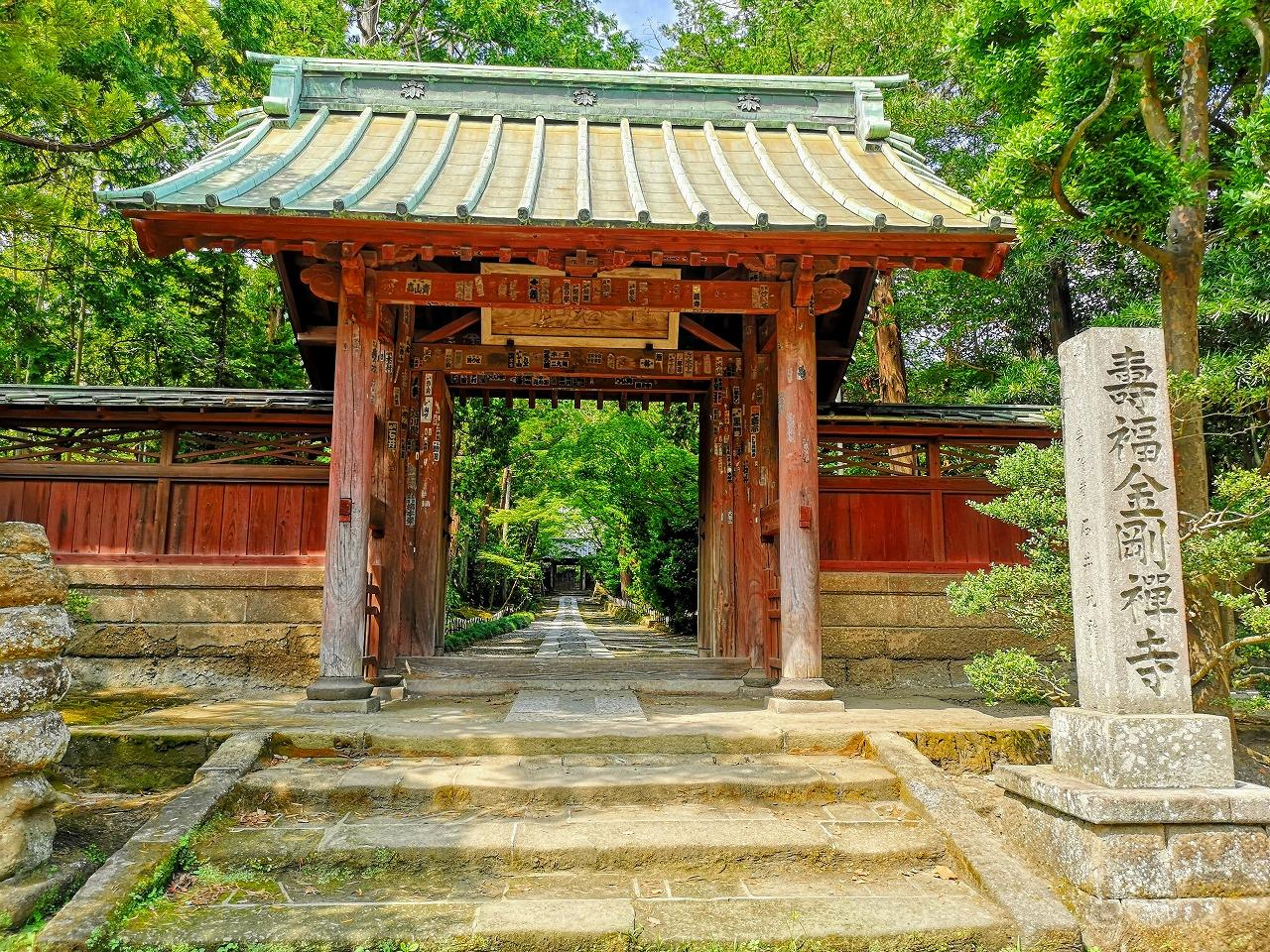
The main gate of Eishoji Temple is an important building, considered the face of the temple. It is a four-legged gate with a gabled roof, strongly reflecting the architectural style of the early Edo period. While the decoration is understated, it exudes dignity and creates a serene atmosphere befitting a nunnery.
Passing through the temple gate, one enters a tranquil space distinct from the secular world. The path leading to the temple grounds has a natural calming effect on visitors.
Buddha Hall – The central building housing the principal image
The Buddha Hall is the central building of Eishoji Temple and houses the principal image, a statue of Amida Buddha. Characterized by its Momoyama-style decoration, it is an architectural masterpiece combining splendor and solemnity.
The interior is adorned with gold leaf and color, clearly demonstrating the characteristics of early Edo period Buddhist temple architecture. The craftsmanship shines through in the details of the ceiling and pillars, allowing one to appreciate the high level of architectural technology of the time.
Shrine and Karamon Gate (Shrine Gate) – A sacred area dedicated to the founder
The Shrine is a building that enshrines the memorial tablet of Eishoin (Okatsu no Kata), the temple’s founder. The Karamon Gate (Shrine Gate), which serves as its entrance, is particularly known for its lavish decoration.
The Karamon Gate features a beautifully curved gable roof and intricate carvings. It strongly reflects the decorative styles of the Momoyama and early Edo periods, making it a valuable architectural relic. While some of the gold leaf and coloring have faded with age, this only enhances its sense of historical significance.
Bell Tower – Architecture that Tells Time
The bell tower stands quietly in a corner of the temple grounds. Its flared base is typical of the early Edo period. The bell is still in use, its sound resonating throughout the grounds.
The bell tower’s structure combines practicality and beauty, demonstrating a high level of architectural perfection. Its harmony with the surrounding trees is also beautiful, revealing different expressions in the changing seasons.
Study and Garden – A Space of Tranquility
The study is where the head priest and trainee monks spend their daily lives. Its architecture incorporates the style of Edo-period samurai residences, conveying a sense of high status.
A garden unfolds in front of the study hall, where seasonal plants delight visitors. In particular, the wisteria trellis in spring is magnificent, making it a popular spot attracting many worshippers.
Seasonal Flowers – Highlights of Eishoji Temple
Eishoji Temple is one of the “100 Flower Temples of Eastern Japan,” and its grounds are adorned with seasonal flowers. Eishoji Temple shows a different face with each season, offering new discoveries with every visit.
Early Spring – A Symphony of Plum and Camellia
Early spring, from January to March, is the season when plum and camellia flowers quietly adorn the garden. White and red plum blossoms bloom in profusion, their pure beauty harmonizing beautifully with the atmosphere of the nunnery.
Camellias are planted throughout the temple grounds, with various colors such as red, white, and pink blooming one after another. From the end of winter to the beginning of spring, Eishoji Temple is enveloped in a tranquil yet vibrant atmosphere. ### Spring – White Wisteria Trellis and Fresh Greenery
Spring, from April to May, is one of the most vibrant seasons at Eishoji Temple. The white wisteria trellis in the study hall is particularly breathtaking; the long, drooping white flower clusters swaying in the wind create a magical scene.
White wisteria is rarer than purple wisteria, and its pure beauty captivates many. Around the time the wisteria blooms, the trees on the temple grounds are enveloped in fresh greenery, creating a vibrant and lively landscape.
Early Summer – Hydrangea Season
During the rainy season from June to July, hydrangeas adorn the temple grounds. While Kamakura is known as a “famous spot for hydrangeas,” Eishoji Temple’s hydrangeas are less crowded with tourists compared to other famous temples, making it a charming place to quietly enjoy the flowers.
Hydrangeas of various colors, including blue, purple, and pink, become even more vibrant when wet with rain. The contrast between the green of the bamboo grove and the vibrant colors of the hydrangeas is beautiful, making it perfect for photography.
Summer – Deep Green Grounds
In summer, Eishoji Temple is enveloped in deep green. The bamboo grove within the temple grounds is especially cool and refreshing; even on hot days, stepping inside provides a sense of coolness.
While there are fewer flowers this season, the beauty of the scenery created by the varying shades of green is exceptional. Spending time leisurely in the quiet temple grounds, where the sound of cicadas resonates, is highly recommended.
Early Autumn – The Season of the Red Spider Lily
In early autumn, from September to October, the red spider lily (Lycoris radiata) takes center stage within the temple grounds. The vivid red flowers bloom throughout the grounds, announcing the arrival of autumn.
Red spider lilies are deeply associated with Buddhism, and their appearance in the temple grounds is particularly evocative. The red flowers, standing out against the green, leave a strong impression on the viewer.
Autumn – Autumn Leaves and Flowers
From November to December, the trees on the temple grounds begin to change color. Maple and ginkgo trees turn red, creating a beautiful landscape unique to autumn.
Autumn flowers such as camellias and cosmos also bloom, adding color to the temple grounds. Walking along the path covered with fallen leaves is a pleasure unique to this season.
Winter – The Beauty of Silence
Winter, from December to January, is the quietest season at Eishoji Temple. While there are fewer flowers, you can savor the beauty of the architecture and the spatial composition of the temple grounds.
Strolling through the temple grounds in the crisp winter air, while admiring the important cultural property buildings, offers a different charm than other seasons. Occasionally, it snows, and Eishoji Temple covered in snow is exceptionally beautiful.
Cultural Properties and Treasures of Eishoji Temple
Nationally Designated Important Cultural Properties
The following buildings at Eishoji Temple are designated as National Important Cultural Properties:
- Buddha Hall
- Temple Gate
- Bell Tower
- Shrine Hall
- Chinese-style Gate (Shrine Gate)
- Study Hall
These buildings are all valuable cultural heritage sites that preserve the architectural style of the early Edo period. It is rare for a single temple to have so many Important Cultural Properties, demonstrating the high historical value of Eishoji Temple.
Temple Treasures and Artworks
Eishoji Temple houses valuable temple treasures, including items related to its founder, Eishoin, and artworks donated by the Mito Tokugawa family.
These temple treasures, encompassing a wide range of items such as Buddhist statues, Buddhist implements, calligraphy, paintings, and crafts, are not usually open to the public, but are sometimes displayed on special occasions. These treasures are important historical materials that tell the story of Eishoji Temple’s history and its deep connection with the Tokugawa family.
Access and Visiting Information for Eishoji Temple
Access Methods
Access by Train
- Approximately 10 minutes on foot from the West Exit (back exit) of Kamakura Station on the JR Yokosuka Line
- After exiting the West Exit of Kamakura Station, turn right at the first traffic light and continue straight to reach Eishoji Temple.
Access by Car
- Approximately 20 minutes from the Asahina Interchange on the Yokohama-Yokosuka Expressway
- *There is no dedicated parking lot, so please use nearby coin parking.
Visiting Hours and Admission Fees
Visiting Hours
- 9:00 AM to 4:00 PM
- Closed on Thursdays (open on national holidays)
Admission Fees
- Adults: 300 yen
- Junior and Senior High School Students: 200 yen
- Elementary School Students: 100 yen
Notes
- Depending on the situation, Goshuin (temple stamps) may be provided on paper.
- Entry to the temple is through the side gate where the temple’s living quarters are located; the main gate is usually closed.
- Photography is permitted within the temple grounds, but may be prohibited inside buildings. Please follow the instructions of the staff.
Nearby Tourist Attractions
Eishoji Temple is located in the Kamakura Station West Exit area, and there are many other attractions nearby.
Jufuku-ji Temple
- Approximately 5 minutes on foot from Eisho-ji Temple
- A Zen temple ranked third among the Five Great Zen Temples of Kamakura
- Attractive for its beautiful approach and tranquil atmosphere
Jokomyo-ji Temple
- Approximately 10 minutes on foot from Eisho-ji Temple
- An ancient Shingon Buddhist temple
- Houses a Buddhist statue designated as a National Important Cultural Property
Zeniarai Benzaiten
- Approximately 15 minutes on foot from Eisho-ji Temple
- Popular as a power spot for financial luck
- A unique belief where money is washed in spring water inside a cave
Genjiyama Park
- Approximately 20 minutes on foot from Eisho-ji Temple
- A park with a statue of Minamoto no Yoritomo
- A famous spot for cherry blossoms and autumn leaves
Points to consider when visiting Eisho-ji Temple
Recommended time to visit
Eisho-ji Temple is beautiful in every season, but the following times are especially recommended.
Spring (Late April to Early May)
- The wisteria trellis is at its most beautiful.
- The fresh greenery is also beautiful, and the entire temple grounds are full of vitality.
Early Autumn (Late September to Early October)
- Spider lilies are in full bloom, allowing you to enjoy the autumn atmosphere.
- The heat has subsided, making it the perfect weather for a stroll.
Early Spring (February to March)
- Plum blossoms and camellias are in bloom, adding vibrancy to the tranquility.
- There are relatively few tourists, allowing for a leisurely visit.
Points to Note When Visiting
Maintaining Silence
- Eishoji Temple is a nunnery that still functions as a place of training.
- Please refrain from loud conversations and noisy behavior, and observe quietly.
Photography Etiquette
- Photography is generally permitted on the temple grounds, but please avoid taking pictures inside buildings or in prohibited areas.
- Please be considerate of other visitors.
Dress Code
- While there are no particularly strict dress code regulations, as a basic courtesy when visiting a temple, please avoid overly revealing clothing.
Estimated Time Required
The grounds of Eishoji Temple are not very large, but to fully appreciate the architecture and enjoy the seasonal flowers, it’s best to allow 30 minutes to an hour.
Including time for photography and obtaining a temple stamp, a stay of 1 to 1.5 hours is recommended.
The Charm of Eishoji Temple – Why is this Temple Special?
Value as Kamakura’s Only Nunnery
While Kamakura has many temples, Eishoji Temple is the only one that continues to operate as a nunnery. This uniqueness is one of Eishoji Temple’s greatest charms.
The tranquil atmosphere and feminine, delicate spatial composition, characteristic of a nunnery, set it apart from other temples in Kamakura. Walking through the grounds, you naturally feel that it is a special place of prayer.
Deep Ties with the Tokugawa Family
Eishoji Temple was founded by Okatsu-no-kata, a concubine of Tokugawa Ieyasu, and flourished under the patronage of the Mito Tokugawa family. This deep connection with the Tokugawa family makes Eishoji Temple more than just a local temple; it’s a special place directly linked to the history of the Edo shogunate.
The Mito Tokugawa family crest, the “Aoi” (hollyhock leaf), seen throughout the temple grounds, commemorates this historical connection.
A Historic Site: The Former Residence of Ota Dokan
The temple grounds of Eishoji Temple are believed to be the former residence of Ota Dokan, known for building Edo Castle. The layered history of a nunnery associated with the Tokugawa family being built in the Edo period on the site of a Muromachi period samurai’s residence makes this place even more fascinating.
The story of Okatsu-no-kata, a descendant of Ota Dokan, establishing a temple on the land of her ancestors evokes a sense of historical romance.
The Preciousness of a Completely Preserved Edo Period Temple Complex
One of the greatest values of Eishoji Temple is that its layout from the early Edo period remains almost completely intact. Few temples have survived fires, war damage, and the waves of modernization to preserve their original appearance.
The group of buildings designated as Important Cultural Properties are a valuable cultural heritage that conveys the architectural techniques and aesthetic sensibilities of the early Edo period to the present day. From an architectural history perspective, Eishoji Temple occupies a very important position.
Harmony of Seasonal Flowers and Tranquility
Eishoji Temple, counted as one of the “100 Flower Temples of Eastern Japan,” is a temple where you can enjoy flowers throughout the four seasons. However, compared to other famous flower temples, it has fewer tourists, making it a great place to quietly appreciate the flowers.
White wisteria, spider lilies, plum blossoms, camellias, hydrangeas, and other flowers adorn the temple grounds in different seasons, offering new discoveries with each visit. The space, where the beauty of the flowers and the tranquility of the temple grounds harmonize, calms the mind and allows you to forget the hustle and bustle of everyday life. ## Summary – The Significance of Visiting Eishoji Temple
Eishoji Temple holds a special place in Kamakura’s history as the only nunnery in Kamakura and as a temple founded by Okatsu, a concubine of Tokugawa Ieyasu. Built on the historical site of Ota Dokan’s residence and developed under the patronage of the Mito Tokugawa family, this temple embodies the flow of history from the Muromachi period to the Edo period and into the present day.
The group of important cultural properties within the temple grounds are a valuable cultural heritage that conveys the architectural style of the early Edo period. The beauty and historical value of each building, including the Buddha Hall, main gate, bell tower, shrine, Chinese-style gate, and study hall, will deeply impress not only those interested in architecture but all visitors.
The temple grounds, adorned with flowers of all seasons, are truly worthy of the name “One Hundred Flower Temples of Eastern Japan.” Eishoji Temple, with its wisteria trellises, clusters of spider lilies, delicate plum and camellia blossoms, and vibrant hydrangea colors, displays a different face with each season, offering new discoveries with every visit.
Despite its convenient location just a 10-minute walk from Kamakura Station’s west exit, the temple grounds are enveloped in tranquility. Unlike other popular tourist spots in Kamakura, Eishoji Temple offers a quiet retreat where you can contemplate history and find peace of mind.
Visiting Eishoji Temple is more than simply admiring beautiful architecture and flowers. It’s an intellectual and spiritual experience, allowing you to reflect on the story of Tokugawa Ieyasu and Okatsu-no-kata, feel the flow of history that began with Ota Dokan, and understand the value of the cultural heritage preserved under the patronage of the Mito Tokugawa family.
When you visit Kamakura, be sure to stop by Eishoji Temple. There, you will be greeted by the serene atmosphere unique to Kamakura’s only nunnery and the weight of history that has continued since the Edo period.