Jojakkoji Temple (Ukyo Ward, Kyoto Prefecture) Complete Guide | Autumn Foliage Spot: Highlights, History, and Access Information
Located on the slopes of Mt. Ogura in the Sagano area of Ukyo Ward, Kyoto City, Jojakkoji Temple is a Nichiren Buddhist temple known as one of Kyoto’s premier autumn foliage spots. Beyond the stunning autumn scenery adorned with approximately 200 maple trees, the temple grounds, where historical buildings such as the important cultural property, the multi-storied pagoda, and the thatched-roof Niomon gate harmonize beautifully with nature, continue to captivate visitors.
This article comprehensively covers everything you need to know before visiting Jojakkoji Temple, from its historical background and highlights to its seasonal charms, visiting information, access methods, and surrounding tourist attractions.
History and Origin of Jojakkoji Temple
Founding Circumstances and Abbot Nisshin
Jojakkoji Temple was founded in 1596 (Keicho 1) by Abbot Nisshin, the 16th abbot of Honkokuji Temple. Abbot Nisshin served as the head priest of Honkokuji Temple, but due to religious differences in opinion regarding Toyotomi Hideyoshi’s policies, he decided to leave Honkokuji Temple in Rokujo Horikawa, Kyoto, and retire to this site on Mount Ogura.
At that time, this area was enveloped in a tranquil and pure atmosphere, resembling the “Jojakkodo” (a pure and ideal utopia where Buddha resides permanently) in Tendai Buddhism. It is said that the temple was named “Jojakkoji” (常寂光寺) because of this.
The Legend of Fujiwara no Teika and the Ogura Hyakunin Isshu
Ogurayama, where Jojakkoji Temple stands, is known as a place associated with Fujiwara no Teika, a poet from the late Heian period to the early Kamakura period. Legend says that Teika had a mountain villa called “Shiguretei” here, and that he compiled the Ogura Hyakunin Isshu (One Hundred Poets, One Poem Each) here.
Teika’s own poem included in the Hyakunin Isshu, “Waiting for someone who does not come, on the evening calm of Matsuho Bay, my body burns like the seaweed salt being roasted,” and numerous poems about Ogurayama, attest to the literary value of this place. The temple grounds also preserve relics of Kogō no Tsubone, conveying the atmosphere of Heian culture to this day.
Development from the Edo Period Onward
In 1604 (Keichō 9), the main hall was built, and the temple took on its formal form. Throughout the Edo period, while attracting followers as a Nichiren Buddhist temple, its grounds, harmoniously integrated with the natural beauty of Mount Ogura, also became a beloved spot for writers and artists.
Despite the impact of the anti-Buddhist movement of the Meiji era, the temple was preserved, and since the Showa era, it has become widely known as a famous spot for autumn foliage in Kyoto. Today, it is one of Kyoto’s representative temples, attracting many tourists from both Japan and abroad.
Highlights of Jojakkoji Temple
The Stone Steps Beginning from the Temple Gate
Visiting Jojakkoji Temple begins at the temple gate located at the foot of Mount Ogura. Passing through this gate, stone steps continue along the slope of Mount Ogura, leading to the temple grounds. Trees grow densely on both sides of the steps, creating a tunnel of autumn foliage, especially in the fall.
The stone steps are constructed from stacked natural stones, giving them a historical and charming feel. Looking back as you climb, the rural landscape of Sagano unfolds below, allowing you to truly appreciate the natural beauty of Kyoto.
Thatched-Roof Niomon Gate
At the top of the stone steps lies the beautiful thatched-roof Niomon Gate. This gate was built during the Nanboku-cho period and originally served as the south gate of Honkoku-ji Temple in Kyoto City, but was later relocated to Jojakko-ji Temple.
As its name suggests, the Niomon Gate houses Nio statues, protecting worshippers. The simple beauty of the thatched roof harmonizes with the dignified style of the historical wooden architecture, creating a picturesque scene, especially during the autumn foliage season when the falling leaves adorn the roof.
Main Hall and the Ten Realms Great Mandala
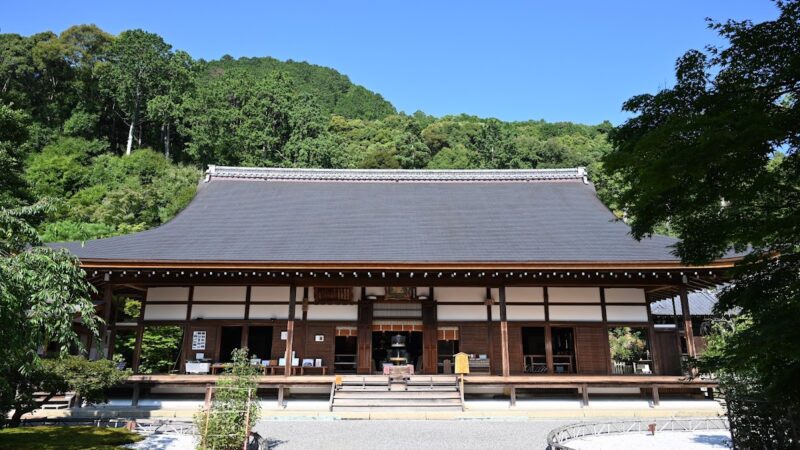
After passing through the Niomon Gate, more stone steps continue, leading to the main hall. Built in 1604, the main hall is simple yet majestic, typical of Nichiren Buddhist temples.
The main hall’s principal image is the Jikkai Daimandara (Great Mandala of the Ten Realms), the most important object of worship in the Nichiren sect. The mandala is a visual representation of the truth of the universe, depicting all ten realms from hell to the Buddha realm.
From the main hall, one can enjoy a panoramic view of Sagano, and the tranquil grounds offer a peaceful place for worship.
Tahōtō (Important Cultural Property)
A symbol of Jōjakkōji Temple is the Tahōtō, located on the slopes of Mt. Ogura, even higher than the main hall. This Tahōtō is designated as a National Important Cultural Property and was built in 1620.
It stands approximately 12 meters tall and is characterized by its well-proportioned and beautiful form. The contrast between the vermilion-painted tower body and the verdigris-colored roof tiles is beautiful and harmonizes with the surrounding nature. The Tahoto pagoda has a unique two-tiered structure, with a square lower level and a circular upper level, making it an excellent example of architecture for a Tahoto pagoda in a Nichiren Buddhist temple.
From the area around the Tahoto pagoda, you can enjoy panoramic views of the Sagano area, including Kyoto city and Mount Hiei, making it a spectacular viewpoint. Especially during the autumn foliage season, the contrast between the vermilion pagoda and the vibrant autumn leaves is breathtaking.
Temple Grounds and Nature
The grounds of Jojakkoji Temple are a lush garden utilizing the slopes of Mount Ogura, with over 200 maple and Japanese maple trees planted there. These trees have been planted since the Edo period, and in autumn, the entire grounds are enveloped in vibrant autumn colors.
Furthermore, moss-covered stones, ancient trees, and bamboo groves are scattered throughout the grounds, reflecting the aesthetic sensibilities of Japanese gardens. The layout, which utilizes the natural terrain, reflects the concept of “borrowed scenery,” emphasizing harmony with nature rather than artificial garden design.
The temple grounds, which display different expressions in each season—fresh greenery in spring, deep green in summer, vibrant autumn leaves, and snowscapes in winter—offer new discoveries with every visit.
Jojakkoji Temple in the Four Seasons
Jojakkoji Temple in Spring
Spring at Jojakkoji Temple is a beautiful season of fresh greenery. The trees, dormant during winter, sprout all at once, enveloping the temple grounds in vivid green. Especially from April to May, the young maple leaves shine with a soft yellowish-green, creating a green tunnel along the stone steps leading up to the temple.
Spring is a time when there are relatively few tourists, allowing for a peaceful and tranquil visit to the temple. Cherry trees are also planted in part of the grounds, providing a beautiful harbinger of spring’s arrival.
Jojakkoji Temple in Summer
Summer at Jojakkoji Temple offers a cool and refreshing space enveloped in deep green. The shade provided by the trees on Mount Ogura offers a cool respite even during Kyoto’s hot summers. The temple grounds, filled with the sound of cicadas, are perfect for a peaceful escape from everyday life.
Summer is also the off-season for tourism, allowing for a leisurely stroll through the grounds. The view from the Tahoto pagoda is magnificent even in summer, offering a panoramic view of the lush Sagano landscape.
Jojakkoji Temple in Autumn (A Famous Spot for Autumn Leaves)
Jojakkoji Temple is most bustling with tourists during the autumn foliage season. Every year from mid-November to early December, the approximately 200 maple trees on the temple grounds change color simultaneously, painting the entire area in shades of red, yellow, and orange.
Particular highlights include:
The stone steps from the main gate to the Niomon gate: These steps form a tunnel of autumn leaves, with the leaves overhead shimmering in the sunlight.
The Niomon gate and autumn leaves: The fallen leaves on the thatched roof create a picturesque scene, attracting many photographers.
Around the Tahoto Pagoda: The contrast between the vermilion pagoda and the autumn leaves is a well-known and iconic sight at Jojakkoji Temple.
Observation Spot: From near the Tahoto Pagoda, you can enjoy both the temple grounds, dyed in autumn colors, and the Sagano landscape simultaneously.
The autumn foliage season is extremely crowded, so visiting early in the morning or on weekdays is recommended. Around 9 AM, right after opening, it’s relatively quiet, allowing you to quietly appreciate the autumn leaves illuminated by the morning sun.
Jojakkoji Temple in Winter
Winter at Jojakkoji Temple offers a peaceful and tranquil atmosphere, with fewer tourists, making it a season for quiet worship. Jojakkoji Temple is especially beautiful on snowy days, with the snow-covered Tahoto Pagoda and Niomon Gate displaying a fantastical beauty.
The view of Kyoto through the bare winter trees is also charming, and visiting in the crisp winter air is a truly refreshing experience.
Visiting Information
Basic Information
Official Name: Ogurayama Jōjakkōji Temple
Sect: Nichiren Buddhism
Principal Image: Ten Realms Great Mandala
Mountain Name: Ogurayama
Founder: Nichitei Shōnin
Established: Keichō 1 (1596)
Cultural Property: Tahōtō Pagoda (Nationally Designated Important Cultural Property)
Visiting Hours and Admission Fee
Visiting Hours: 9:00 AM – 5:00 PM (Last admission 4:30 PM)
Admission Fee: Adults 500 yen, Elementary school students 200 yen
Closed Days: Open all year round
*Please check official information before visiting, as opening hours may change due to special viewings or events.
Location and Contact Information
Address: 3 Ogura-cho, Saga Ogurayama, Ukyo-ku, Kyoto City, Kyoto 616-8397
Phone Number: 075-861-0435
Parking Information
Jojakkoji Temple does not have its own parking lot. There are several paid parking lots in the surrounding area, but they become extremely crowded, especially during the autumn foliage season, so we strongly recommend using public transportation.
There are several paid parking lots around Saga-Arashiyama Station and near Togetsukyo Bridge, but they often fill up early on weekends, so early arrival is necessary.
Access Methods
Access by Train
Using the JR Sagano Line
- Get off at JR “Saga-Arashiyama Station,” approximately 15 minutes on foot.
- Exit the station and walk northwest, enjoying the rural scenery of Sagano.
Using the Randen (Keifuku Electric Railway)
- Get off at “Arashiyama Station” on the Randen Arashiyama Main Line, approximately 20 minutes on foot.
- Cross Togetsukyo Bridge and head north towards the Sagano area.
Using the Hankyu Railway
- Get off at “Arashiyama Station” on the Hankyu Arashiyama Line, approximately 25 minutes on foot.
- Take the Togetsukyo Bridge towards Sagano.
Access by Bus
Using City Buses/Kyoto Buses
- Take Kyoto City Bus Route 28 or Kyoto Bus Route 72 and get off at “Saga Elementary School,” approximately 15 minutes on foot.
- From JR Kyoto Station, City Bus Route 28 is convenient.
Walking Sightseeing Route
The Saga-Arashiyama area is recommended for sightseeing as several temples, including Jojakkoji Temple, are within walking distance.
Recommended Route Example:
JR Saga-Arashiyama Station → Nison-in Temple (10-minute walk) → Jojakkoji Temple (5-minute walk) → Rakushisha (3-minute walk) → Nonomiya Shrine (10-minute walk) → Tenryuji Temple & Bamboo Grove (5-minute walk) → Togetsukyo Bridge
This route allows for approximately 3-4 hours of sightseeing.
Taxi Access
Taking a taxi from JR Kyoto Station takes approximately 30-40 minutes and costs around 3,000-4,000 yen. However, during peak seasons such as autumn foliage season, traffic congestion is expected, so taking the train is recommended.
Nearby Tourist Attractions
Nison-in Temple
Located about a 5-minute walk from Jojakko-ji Temple, Nison-in is a Tendai sect temple known for its beautiful approach, aptly named “Momiji no Baba” (Maple Horse Riding Ground). It is named Nison-in because it enshrines two principal deities: Shakyamuni Buddha and Amida Buddha. It’s a popular spot, often visited in conjunction with Jojakko-ji Temple.
Rakushisha
This is the site of the hermitage of Mukai Kyorai, a disciple of Matsuo Basho, located about a 3-minute walk from Jojakko-ji Temple. It’s a charming thatched-roof building with persimmon trees in its garden. Basho also stayed here and wrote his “Saga Nikki” (Saga Diary). A must-see spot for haiku enthusiasts.
Nonomiya Shrine
Nonomiya Shrine, known as the god of matchmaking and fertility, is about a 10-minute walk from Jojakko-ji Temple. This historical shrine, which also appears in The Tale of Genji, is notable for its black wooden torii gate and moss garden. This is a popular spot, especially among female visitors.
Tenryu-ji Temple
This is the head temple of the Tenryu-ji branch of the Rinzai school of Zen Buddhism, registered as a World Heritage Site, and a representative temple of Arashiyama. The Sogenchi Garden is designated as a Special Place of Scenic Beauty, and visitors can enjoy its beauty throughout the seasons. It’s about a 15-minute walk from Jojakko-ji Temple.
Bamboo Grove Path
A representative tourist spot of Sagano, this is a fantastical path lined with bamboo on both sides. It’s about a 15-minute walk from Jojakko-ji Temple, via Nonomiya Shrine. The quiet early morning hours are especially recommended.
Arashiyama – Togetsukyo Bridge
Togetsukyo Bridge, a symbol of Arashiyama, spans the Katsura River and is about a 20-minute walk from Jojakko-ji Temple. From the bridge, you can enjoy the seasonal scenery of Arashiyama. There are many restaurants and souvenir shops nearby, making it a convenient base for sightseeing.
Jojakkoji Temple Photo Spots
Recommended Photo Spots
1. Niomon Gate and Autumn Leaves
The angle of autumn leaves against the backdrop of the thatched-roof Niomon Gate is a representative composition of Jojakkoji Temple. It is especially beautiful in the morning when the light is favorable.
2. Autumn Leaves Tunnel on the Stone Steps
You can photograph a tunnel of autumn leaves by looking up from the bottom of the stone steps leading from the main gate to the Niomon Gate. Early morning, when there are fewer people, is the best time.
3. Tahoto Pagoda and Autumn Leaves
The contrast between the vermilion Tahoto Pagoda and the autumn leaves is an iconic subject of Jojakkoji Temple. To capture the entire Tahoto Pagoda, it is recommended to shoot from a slightly distant position with a telephoto lens.
4. View from the Tahoto Pagoda
You can enjoy a panoramic view of Sagano from around the Tahoto Pagoda. A wide-angle photo capturing the rural landscape of Sagano and the city of Kyoto will be a memorable travel souvenir.
Precautions when taking photographs
- When using a tripod, please be considerate of other visitors.
- The autumn foliage season is extremely crowded, so visiting early in the morning is recommended.
- Photography may be prohibited inside the main hall; please follow the instructions of the staff.
- Prior permission is required for commercial photography.
Precautions and manners when visiting
Manners for visiting
- Jojakkoji Temple is still a place of worship. As a worshipper, please be mindful of your actions with respect.
- In the main hall, quietly join your hands in prayer and offer your prayers with sincerity.
- Please keep loud conversations and noise to a minimum.
Points to Note on the Temple Grounds
- As there are many stone steps, we recommend wearing comfortable shoes.
- The stone steps can become slippery in rainy weather, so please be careful.
- In the summer, there are many insects such as mosquitoes, so we recommend taking precautions against insects.
- Please be sure to take your trash with you.
Tips for Avoiding Crowds
- The temple is especially crowded during the autumn foliage season (mid-November to early December).
- It is relatively less crowded between 9:00 and 10:00 immediately after opening.
- Visiting on weekdays is recommended.
- There are fewer tourists on rainy days, and the autumn leaves wet with rain have a certain charm.
Annual Events at Jojakkoji Temple
As a Nichiren Buddhist temple, Jojakkoji Temple holds various Buddhist services and events throughout the year.
Main Annual Events:
- January 1st: New Year’s Prayer Service
- February 3rd: Setsubun Festival
- April 8th: Hana Matsuri (Buddha’s Birthday Celebration)
- November: Autumn Leaves Illumination (Availability varies by year)
- December 31st: New Year’s Eve Bell Ringing
*Event dates and content may change, so it is recommended to check before visiting.
Dining and Souvenirs in the Sagano Area
Recommended Gourmet
The Sagano and Arashiyama area around Jojakkoji Temple has a variety of restaurants.
Yudofu (Boiled Tofu): Sagano is an area with many famous Yudofu restaurants. You can enjoy the refined taste that inherits the tradition of Shojin Ryori (vegetarian Buddhist cuisine).
Arashiyama Soba: Local soba restaurants offer soba with a delicate Kyoto flavor.
Matcha Sweets: There are many cafes and sweets shops using matcha around Arashiyama. ### Souvenirs
Yatsuhashi: A representative Kyoto confection, with several specialty shops in Arashiyama.
Sagano Bamboo Products: Bamboo crafts unique to Sagano, famous for its bamboo forests, are popular souvenirs.
Kyoto Pickles: Traditional Kyoto pickles are ideal souvenirs as they have a long shelf life.
Summary: The Charm of Jojakkoji Temple
Jojakkoji Temple, a representative temple of Sagano, Kyoto, is a special place where history, architecture, nature, and culture are all in harmony.
Since its founding in 1596, the temple grounds, which have been preserved for over 400 years, are integrated with the nature of Mt. Ogura, creating a pure space truly befitting the name “Jojakkodo” (the Pure Land of Eternal Tranquility).
The Tahoto pagoda, a nationally important cultural property, the Niomon gate from the Nanboku-cho period, and the seasonal scenery created by approximately 200 maple trees deeply impress visitors. Especially during the autumn foliage season, it continues to attract many tourists as one of Kyoto’s premier spots for viewing autumn leaves.
The temple’s literary background—associated with Fujiwara no Teika and the compilation site of the Ogura Hyakunin Isshu (One Hundred Poets, One Poem Each)—gives it special value. Walking through the tranquil grounds and reflecting on the scenery loved by Heian-period poets is a unique experience only available at Jojakkoji Temple.
Its convenient location, approximately a 15-minute walk from JR Saga-Arashiyama Station, is also a major draw, making it ideal as a centerpiece for exploring Sagano, combined with nearby attractions such as Nison-in Temple, Rakushisha, Nonomiya Shrine, Tenryu-ji Temple, and the Bamboo Grove.
Jojakkoji Temple displays different expressions in each of the four seasons: the fresh green of spring, the deep green of summer, the vibrant autumn leaves, and the snowy landscape of winter. It is a representative Kyoto temple where you can discover and be moved by new things with every visit.
When you visit Kyoto’s Sagano area, be sure to stop by Jojakkoji Temple and experience the tranquil atmosphere nestled amidst the nature of Mount Ogura. In this peaceful space, far removed from everyday life, you can cleanse your soul and feel the depth of Kyoto’s history and culture.