Daikaku-ji Temple (Kyoto Prefecture, Ukyo Ward) Complete Guide | History, Highlights, and Access Explained in Detail
Located in Saga-Osawa-cho, Ukyo Ward, Kyoto City, Daikaku-ji Temple is a prestigious temple with a history of over 1200 years, serving as the head temple of the Daikaku-ji branch of Shingon Buddhism. It is a monzeki temple (a temple formerly headed by a member of the imperial family), originating from the detached palace of Emperor Saga. It boasts Osawa Pond, Japan’s oldest artificial forest pond, numerous important cultural properties, and preserves the tradition of being the head temple of the Saga-ryu school of ikebana (flower arrangement).
This article provides a thorough explanation of everything you need to know before visiting Daikaku-ji Temple, from its deep history and highlights within the temple grounds to its cultural properties, access methods, and visiting information.
Overview of Daikaku-ji Temple
Daikaku-ji Temple is the head temple of the Daikaku-ji branch of Shingon Buddhism, located at 4 Saga-Osawa-cho, Ukyo Ward, Kyoto City, Kyoto Prefecture. The temple’s mountain name is Sagayama, its principal deity is the Five Great Wisdom Kings centered around Fudo Myoo, and its founder was Prince Kōjaku Nyūdō (son of Emperor Saga).
Basic Information
- Official Name: Former Saga Imperial Palace, Daikaku-ji Temple
- Sect: Shingon-shu Daikaku-ji School, Head Temple
- Principal Image: Five Great Wisdom Kings (centered on Fudo Myoo)
- Founded: 876 (Jōgan 18)
- Founder: Emperor Saga
- Founding Priest: Prince Kōjaku Nyūdō
- Alternate Names: Former Saga Imperial Palace, Saga Imperial Palace
- Pilgrimage Site: 7th of the Eighteen Head Temples of the Shingon Sect, 13th of the Thirty-Six Fudo Temples of the Kinki Region
Daikaku-ji Temple, as a “Monzeki temple,” has maintained deep ties with the Imperial family and court nobles. It is also known as the head temple of the Saga Goryu school of ikebana (flower arrangement), playing an important role as one of the centers of traditional Japanese culture.
The History of Daikaku-ji Temple
From Emperor Saga’s Imperial Villa to a Temple
The history of Daikaku-ji Temple dates back to the early Heian period, to Emperor Saga (786-842). Around 810 AD, during his reign, Emperor Saga constructed the “Saga-in” imperial villa on this site. Known as a man of culture, he had a close friendship with Kukai (Kobo Daishi) and conducted many cultural activities at this villa.
After Emperor Saga’s death, in 876 AD, his daughter, Princess Masako, inherited her father’s wishes and converted the villa into a temple. This marked the beginning of Daikaku-ji Temple. With Prince Kōjaku (Emperor Saga’s son) as its founding abbot, it developed as a Shingon Buddhist temple.
Development as a Monzeki Temple
Daikaku-ji Temple developed from the Heian period to the Kamakura period as a “Monzeki temple,” where monks from the imperial family or court nobles served as abbots. Especially in the late Kamakura period, Emperor Go-Uda conducted his cloistered rule at this temple, leading to it also being called “Saga Imperial Palace.”
The Nanboku-cho Period and the Daikaku-ji Lineage
From the late Kamakura period to the Nanboku-cho period, Daikaku-ji Temple played a crucial role in Japanese history. The imperial lineage of Emperor Go-Uda was called the “Daikaku-ji lineage,” and it became one of the two lines of the “Ryōtō Teiritsu” system, where the imperial throne alternated between the Daikaku-ji and Jimyōin lines.
During the Nanboku-cho period, the Daikaku-ji lineage formed the Southern Court and opposed the Jimyōin lineage of the Northern Court. During this period, Daikaku-ji Temple held a politically significant position.
The Ōnin War and Reconstruction
During the Ōnin War (1467-1477) of the Muromachi period, Daikaku-ji Temple suffered significant damage, with many of its buildings being destroyed by fire. Later, in the early Edo period, reconstruction progressed with the support of Emperor Go-Mizunoo and the Tokugawa Shogunate.
Many of the current major buildings were rebuilt during the Edo period. In particular, during the Kan’ei era (1624-1644), buildings from the Imperial Palace were relocated and constructed thanks to a donation from Empress Tōfukumonin, the consort of Emperor Go-Mizunoo, resulting in the current Shinden (main hall) and Shōseiden (main hall).
After the Meiji Era
Following the Meiji Restoration’s separation of Shinto and Buddhism, many temples faced difficulties, but Daikaku-ji Temple maintained its status due to its deep connection with the Imperial family. In 1871 (Meiji 4), it became an independent Shingon sect Daikaku-ji branch and a head temple.
From the Showa to the Heisei era, preservation and repair work on cultural properties progressed, and many buildings and works of art were designated as Important Cultural Properties. Even today, it continues to uphold tradition as the head temple of the Daikakuji branch of Shingon Buddhism and as the head family of the Saga Goryu school of ikebana (flower arrangement).
Highlights of the Temple Grounds
The grounds of Daikakuji Temple are a space where elegant architecture, reminiscent of the time when it was Emperor Saga’s detached palace, harmonizes with the natural landscape centered around the vast Osawa Pond.
Shinden (Imperial Palace)
The Shinden is the central building of Daikakuji Temple. It was relocated from the Seiryoden Palace during the Kan’ei era, thanks to a donation from Empress Tofukumonin, the consort of Emperor Go-Mizunoo. Inside, there are fusuma paintings (Important Cultural Properties) such as “Peony” and “Red and White Plum Blossoms” by Kano Sanraku, allowing visitors to appreciate the magnificent art of the Momoyama period.
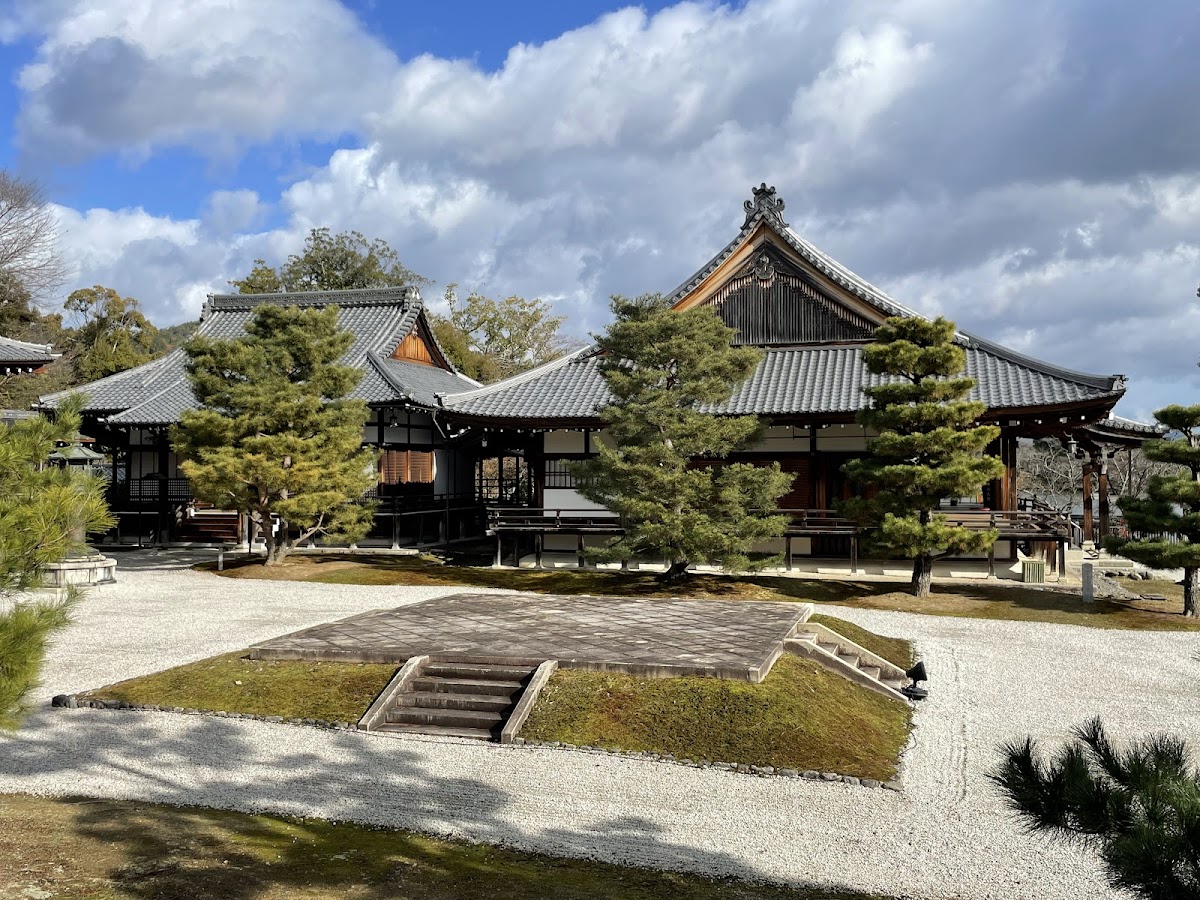
The front garden of the Shinden (main hall) is a beautiful garden covered with white sand, where you can enjoy the scenery of each season.
Shōshinden (Main Sleeping Hall)
The Shōshinden is also a building that was relocated from the Imperial Palace and is decorated with fusuma (sliding door) paintings by the Kano school. The “Autumn Grasses” painting, in particular, is known for its delicate brushwork. From the Shōshinden, you can access other buildings via the Murasame Corridor.
Murasame Corridor
One of the architectural features that represents Daikaku-ji Temple is the “Murasame Corridor.” This corridor, which connects the Shinden, Shōshinden, and the Mikage-dō (Founder’s Hall), has a nightingale floor, which makes a sound when walked on. The low ceiling is said to be designed to prevent swords from being drawn, showing a defensive consideration.
The corridor’s shape, which bends like lightning, is called the “Murasame Corridor,” and its unique structure captivates visitors.
Miedo Hall
The Miedo Hall enshrines portraits of Emperor Saga, Kobo Daishi (Kukai), and Prince Kōjaku Nyūdō. It is the central building of Daikaku-ji Temple’s faith and attracts many worshippers.
Godai-do Hall
The Godai-do Hall is the main hall of Daikaku-ji Temple and houses the principal images of the Five Great Wisdom Kings (Fudo Myoo, Gosanze Myoo, Gundari Myoo, Daiitoku Myoo, and Kongo Yaksha Myoo). These Buddhist statues are said to have been carved by Kobo Daishi Kukai at the command of Emperor Saga, and it is a sacred place where esoteric Buddhist rituals such as the Goma fire ritual are performed.
Shingyo-den Hall
The Shingyo-den Hall was built to house the Heart Sutra (Chokufu Prajnaparamita Sutra) copied by Emperor Saga. This Heart Sutra was copied by Emperor Saga as a prayer for peace throughout the land, and is one of Daikaku-ji Temple’s most important treasures. The Heart Sutra Hall, built in 1931, is a relatively new building, but it is important as a place that represents the core of Daikaku-ji Temple’s faith.
Osawa Pond and the Site of Nagoso Waterfall
History and Characteristics of Osawa Pond
Osawa Pond is an artificial pond, approximately 1 kilometer in circumference, said to have been constructed by Emperor Saga in imitation of Dongting Lake in China. Known as Japan’s oldest artificial forest pond, it is a valuable historical site that preserves the garden style of the Heian period.
In the center of the pond are two islands, Tenjin Island and Kikuga Island, connected by a vermilion bridge. This scenery is known as the “Eight Views of Osawa Pond” and displays beauty in every season.
Site of Nagoso Waterfall
To the north of Osawa Pond is the “Site of Nagoso Waterfall.” This is the remains of a waterfall that existed during the Heian period, and is known from Fujiwara no Kintō’s poem in the Hyakunin Isshu (One Hundred Poets, One Poem Each): “Though the sound of the waterfall has long since ceased, its name still flows on and is heard.”
Although water no longer flows, the stonework remains, making it a valuable historical site for understanding Heian period gardening techniques.
A Famous Moon-Viewing Spot
Ōsawa Pond is also famous as a moon-viewing spot, and every year around the time of the Mid-Autumn Festival, a “Moon-Viewing Evening” is held. “Moon-viewing from a boat,” where people admire the moon from boats floating on the pond, recreates the elegant customs of the Heian period and attracts many participants.
Lotus Flowers and Autumn Leaves
At Ōsawa Pond, lotus flowers bloom profusely in the summer, and in autumn, the surrounding trees turn beautiful autumn colors. Especially during the autumn foliage season, the reflection of the leaves on the water’s surface is a spectacular sight, attracting many photography enthusiasts.
Cultural Properties
Daikaku-ji Temple houses many valuable cultural properties, including National Treasures and Important Cultural Properties.
Important Cultural Properties (Buildings)
- Shinden: An architectural style preserving the Momoyama period
- Seishinden: A building relocated from the Imperial Palace
- Miei-do: Houses the portraits of successive abbots
- Godai-do: The main hall housing the principal image
- Kuri: A building serving as the temple’s kitchen
- Reimei-den: Houses the memorial tablets of successive emperors
Important Cultural Properties (Art and Crafts)
- Portrait of Emperor Go-Uda (painted on silk): A portrait from the Kamakura period
- Portrait of Fudo Myoo and Two Attendants (painted on silk): A Buddhist painting from the Heian period
- Fusuma Paintings by Kano Sanraku: Luxurious screen paintings from the Momoyama period
- “Peony,” “Red and White Plum Blossoms,” “Pine and Hawk,” etc.
- Imperial Letter with Seal of Emperor Go-Uda: A historical document
- Imperial-Sealed Heart Sutra: The Heart Sutra written by Emperor Saga himself (opened only once every 60 years).
Other Cultural Assets
Daikaku-ji Temple also houses many other Buddhist statues, paintings, calligraphic works, and crafts, which are sometimes displayed in special exhibitions.
Headquarters of the Saga-ryu School of Ikebana
Daikaku-ji Temple is also known as the headquarters of the Saga-ryu school of Ikebana. The Saga-ryu school is one of the oldest schools of Ikebana in Japan, originating from Emperor Saga picking chrysanthemums from Osawa Pond and placing them in a vase in the palace.
Even today, the tradition of the Saga-ryu school of Ikebana is continued at Daikaku-ji Temple, with Ikebana classes and exhibitions being held. Beautiful seasonal flower arrangements adorn various locations on the temple grounds, delighting visitors.
Annual Events
Daikaku-ji Temple holds various events throughout the year. ### Main Annual Events
- January: First Shrine Visit of the Year, Shusho-e Ceremony
- February: Setsubun Festival
- April: Saga Emperor Commemoration Ceremony, Hana Matsuri (Flower Festival)
- May: Saga Festival (Joint festival with Atago Shrine and Nonomiya Shrine)
- August: Yoi-Kobo (Evening Kobo Festival), Segaki Ceremony
- September: Moon Viewing Evening (Mid-Autumn Moon)
- November: Saga Chrysanthemum Exhibition, Autumn Leaves Illumination
- December: Soot Cleaning
Special Viewings
Special viewings are held in spring and autumn, allowing visitors to see cultural properties and gardens that are normally closed to the public. Additionally, special nighttime viewings allow visitors to enjoy the illuminated, fantastical atmosphere of the temple grounds.
Visiting Information
Visiting Hours and Fees
- Visiting Hours: 9:00 AM – 5:00 PM (Last entry 4:30 PM)
- Admission Fees:
- Main Hall Area: Adults 800 yen, Elementary/Junior High/High School Students 600 yen
- Osawa Pond Area: Adults 500 yen, Elementary/Junior High/High School Students 300 yen
- Combined tickets are also available (Prices may vary depending on the season)
- Sutra Copying Reception Hours: 9:00 AM – 3:30 PM
Location
4 Saga Osawa-cho, Ukyo-ku, Kyoto City, Kyoto Prefecture 616-8411
Inquiries
Phone Number: 075-871-0071
Access
Daikaku-ji Temple is accessible by both public transport and private car.
Access by Train
By JR
- Get off at JR Sagano Line “Saga-Arashiyama Station”, approximately 20 minutes on foot
- Approximately 15 minutes from Kyoto Station on the JR Sagano Line
By Hankyu Railway
- Get off at Hankyu Arashiyama Line “Arashiyama Station”, approximately 25 minutes on foot
By Randen (Keifuku Electric Railway)
- Get off at Randen Saga Station, approximately 20 minutes on foot
Access by Bus
Kyoto City Bus
- Get off at Route 28 “Daikakuji” bus stop, immediately adjacent
- Approximately 50 minutes from Kyoto Station
Kyoto Bus
- Get off at Routes 61, 62, 63, 64, 65 “Daikakuji” bus stop, immediately adjacent
- Approximately 40 minutes from Shijo Karasuma/Sanjo Keihan area
Access by Private Car
- Approximately 40 minutes from Kyoto Minami IC on the Meishin Expressway
- Parking: Visitor parking available on the temple grounds (approximately 30 spaces for regular cars, fee applies)
Location relative to surrounding tourist spots
Daikaku-ji Temple is located in the Saga Arashiyama area, and there are many tourist spots nearby.
- Arashiyama: Approximately 20 minutes on foot
- Tenryu-ji Temple: Approximately 15 minutes on foot
- Bamboo Grove Path: Approximately 15 minutes on foot
- Seiryo-ji Temple (Saga Shakado): Approximately 10 minutes on foot
- Nison-in Temple: Approximately 15 minutes on foot
- Giō-ji Temple: Approximately 10 minutes on foot
Visiting these temples and tourist spots together as part of a Sagano tour is recommended.
Daikaku-ji Temple and the Nature of Sagano
The area around Daikaku-ji Temple, while within Kyoto City, is blessed with abundant nature. This area, known as Sagano, features bamboo groves and rural landscapes, preserving the original scenery of ancient Kyoto.
Seasonal Scenery
- Spring: A season of beautiful cherry blossoms and fresh greenery. The cherry blossoms around Osawa Pond are particularly magnificent.
- Summer: The lotus flowers around Osawa Pond are in full bloom, and the lush temple grounds offer a refreshing coolness.
- Autumn: Known as a famous spot for autumn foliage, the autumn leaves around Osawa Pond are especially spectacular.
- Winter: The snow-covered temple grounds and Osawa Pond are enveloped in a tranquil and solemn atmosphere.
Points to Note When Visiting Daikaku-ji Temple
Recommended Visiting Time
The early morning hours (immediately after opening) are relatively uncrowded, allowing for a peaceful visit to the temple grounds. Also, while it can get crowded during the autumn foliage season and the moon-viewing evenings, the experience is well worth it.
Sutra Copying Experience
Daikaku-ji Temple offers a sutra copying experience (reception 9:00-15:30). Copying the Heart Sutra can calm the mind and promote mental focus. The experience takes approximately one hour.
Exploring the Surrounding Area
When visiting Daikaku-ji Temple, be sure to explore the surrounding Sagano area. Many sights are within walking distance, including the Bamboo Grove Path, Seiryo-ji Temple, Nison-in Temple, and Giō-ji Temple.
Photo Spots
Daikaku-ji Temple offers many photo opportunities, such as the view overlooking Osawa Pond and Godaido Hall, the Murasame Corridor, and the temple grounds during the autumn foliage season. However, photography is prohibited inside some buildings, so please follow the instructions of the staff.
Films and TV Shows Featured
Due to its historical background and beautiful scenery, Daikaku-ji Temple has been used as a filming location for many movies and TV dramas.
- Frequently used as a filming location for period dramas
- Osawa Pond frequently appears in lake and pond scenes in period dramas
- Famous as a filming location for historical dramas, including NHK Taiga dramas
Furthermore, Daikaku-ji Temple and Osawa Pond have long appeared as settings in waka poetry and stories in literary works, and are positioned as important places in Japanese culture.
Summary
Daikaku-ji Temple is the head temple of the Daikaku-ji branch of Shingon Buddhism, with a history of over 1200 years, originating from the detached palace of Emperor Saga. As a monzeki temple with ties to the Imperial family, and as the head temple of the Saga Goryu school of ikebana, it is a valuable place that conveys traditional Japanese culture to the present day.
Osawa Pond, the oldest artificial forest pond in Japan, important cultural properties such as fusuma paintings by Kano Sanraku, architecture and gardens that retain the atmosphere of the Heian period, and beautiful natural scenery that changes with the seasons all captivate visitors.
Located in Saga, Ukyo-ku, Kyoto City, surrounded by the natural beauty of Arashiyama and Sagano, Daikaku-ji Temple boasts a truly captivating location. Visiting it in conjunction with other nearby temples and tourist attractions will allow you to experience Kyoto’s history and culture more deeply.
Visiting hours are 9:00 AM to 5:00 PM (last entry at 4:30 PM). Access is approximately a 20-minute walk from JR Saga-Arashiyama Station, or a short walk from the “Daikaku-ji” bus stop. With various activities such as sutra copying and seasonal special viewings, Daikaku-ji Temple offers a variety of experiences to enjoy. Be sure to visit!