Ryoanji Temple (Ukyo-ku, Kyoto Prefecture) Complete Guide | A Thorough Explanation of the World Heritage Stone Garden and History
Ryoanji Temple, located in Ukyo-ku, Kyoto City, is a Zen temple that captivates visitors from all over the world. Registered as a World Heritage Site as part of the “Historic Monuments of Ancient Kyoto,” its stone garden, particularly the Hojo Garden, is highly regarded both domestically and internationally as one of Japan’s representative dry landscape gardens. This article comprehensively introduces all the information you need to know before visiting Ryoanji Temple, from its history and highlights to its cultural assets and access methods.
What is Ryoanji Temple?
Ryoanji Temple is a Rinzai Zen temple of the Myoshinji school, located in Ryoanji Goryo-no-shita-cho, Ukyo-ku, Kyoto City. As an outlying sub-temple of the head temple Myoshinji, it is known as an important temple that conveys the spirit of Zen to the present day. Its mountain name is Daiunzan, and its principal image is Shakyamuni Buddha.
Basic Information
- Official Name: Daiunzan Ryōan-ji Temple
- Sect: Rinzai Zen Myoshin-ji School
- Founder: Hosokawa Katsumoto
- First Abbot: Zen Master Giten Genshō (Genshō)
- Established: Hōtoku 2 (1450)
- Principal Image: Shakyamuni Buddha
- Location: 13 Ryōanji Goryōnoshita-chō, Ukyō-ku, Kyoto City
- World Heritage Site Registration: Registered in 1994 (Heisei 6) as a component of “Historic Monuments of Ancient Kyoto”
Ryōan-ji Temple covers a vast area of approximately 500,000 square meters (150,000 tsubo), equivalent to about 10.7 Kyoto Domes. Within this expansive grounds, in addition to the rock garden, there are beautiful Kyōyō Ponds and gardens where one can enjoy the changing seasons.
History of Ryōan-ji Temple
Origins of its Founding
The history of Ryōan-ji Temple dates back to the second year of Hōtoku (1450) during the Muromachi period. At that time, Hosokawa Katsumoto, who served as Kanrei (the most important position assisting the Shogun) of the Ashikaga Shogunate, received a mountain villa from the Tokudaiji family, a noble family, and converted it into a Zen temple.
Hosokawa Katsumoto invited Zen Master Giten Genshō (or Giten Genshō), the 5th abbot of Myōshin-ji Temple, to be the founding abbot, and established Ryōan-ji Temple as a temple of the Myōshin-ji branch of the Rinzai school of Zen Buddhism. Hosokawa Katsumoto is also known as the commander-in-chief of the Eastern Army during the Ōnin War (1467-1477), and was a military commander with excellent cultural knowledge.
The Ōnin War and Reconstruction
Just 17 years after its founding, in 1467 (Ōnin 1), Ryōan-ji Temple was ironically destroyed by fire during the Ōnin War, in which its founder, Hosokawa Katsumoto, was involved as the commander-in-chief of the Eastern Army. This war reduced the entire city of Kyoto to rubble, and many temples and shrines suffered damage.
The reconstruction of Ryōan-ji Temple was carried out by Hosokawa Masamoto, the son of Hosokawa Katsumoto, and his adopted son, Hosokawa Katsuyuki. It is believed that the abbot’s quarters were rebuilt around 1488 (Chōkyō 2), laying the foundation for the present-day temple. The famous rock garden is also thought to have been created during this reconstruction period, but there are various theories regarding the creator and the exact date, and it remains shrouded in mystery.
Changes After the Edo Period
During the Edo period, Ryōan-ji Temple enjoyed a stable period as a sub-temple of Myōshin-ji Temple. However, it faced crises during the anti-Buddhist movement of the Meiji era and the turbulent period after World War II.
A turning point came in 1975 when Queen Elizabeth II of the United Kingdom visited Ryōan-ji Temple. This visit brought the temple’s rock garden to worldwide attention. In 1994, it was registered as a World Heritage Site as part of the “Historic Monuments of Ancient Kyoto,” and today it is a representative tourist destination in Kyoto, attracting hundreds of thousands of visitors annually.
The Charm of the Rock Garden (Hōjō Garden)
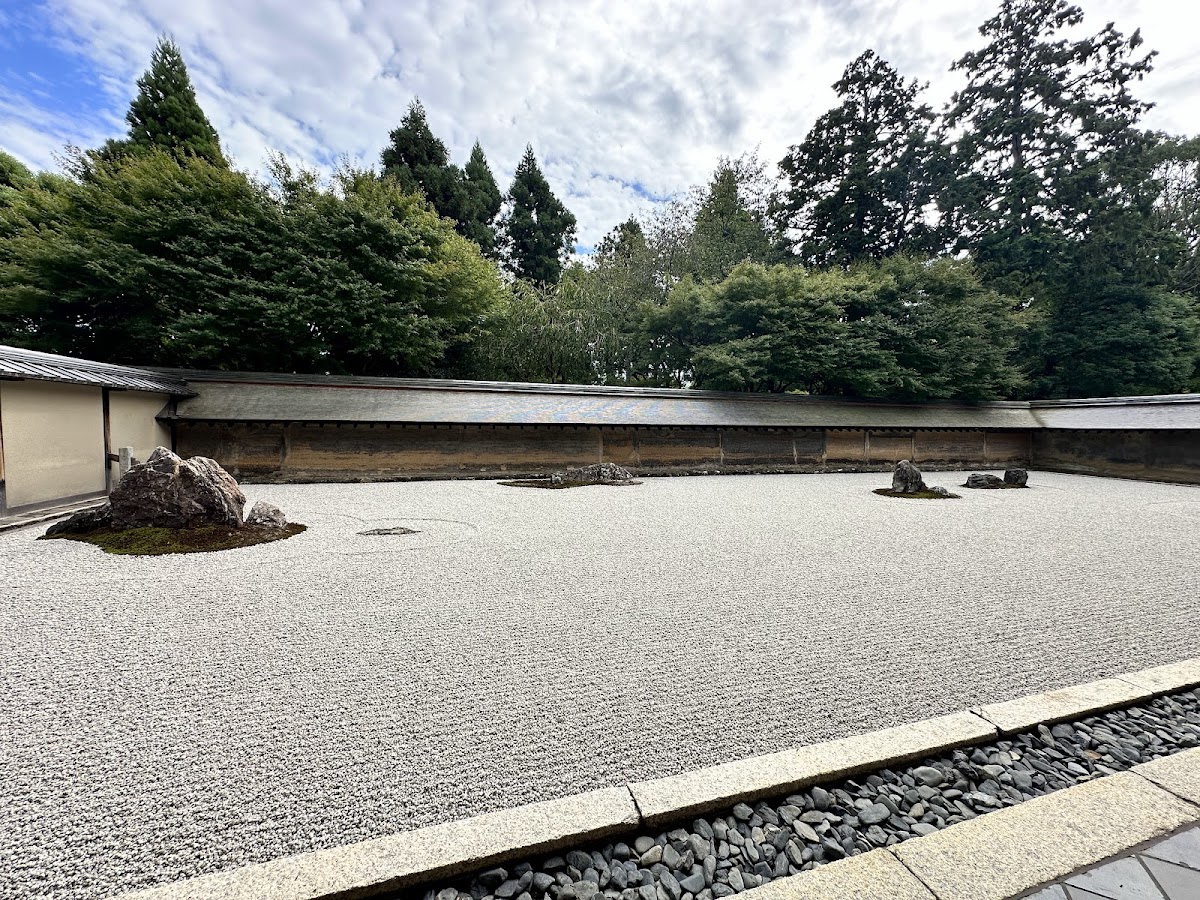
An essential element when discussing Ryōan-ji Temple is the dry landscape rock garden located south of the Hōjō (abbot’s quarters). This garden is designated as a historical site and a special place of scenic beauty, and is known worldwide as a garden symbolizing Japanese Zen culture.
Structure and Characteristics of the Rock Garden
The Hōjō Garden is an extremely simple garden composed of only white sand and 15 stones in a rectangular space approximately 30 meters east-west and 10 meters north-south. It is surrounded on three sides by an oil-walled earthen fence, creating a tranquil space isolated from the outside world.
On the white sand, 15 stones are arranged in five groups: 5, 2, 3, 2, and 3, from east to west. These stones are natural stones of various sizes, each placed in exquisite balance. The white sand is marked with broom marks, representing the flow of water and ripples.
The Mystery of “Not Being able to See All 15 Stones”
The most distinctive feature of this rock garden is that, no matter where you view it from, you cannot see all 15 stones simultaneously. They are cleverly arranged so that at least one stone is always hidden from view by another. There are various interpretations of this design.
In Zen philosophy, there is the idea that “perfection is imperfection.” It is believed that by deliberately avoiding perfection, the garden leaves room for the viewer’s imagination and encourages spiritual awareness. Another interpretation is that it expresses human imperfection and humility.
Another Name: “The Tiger Cub Crossing Garden”
The rock garden is also known by another name: “The Tiger Cub Crossing Garden.” This originates from a Chinese legend in which a mother tiger, carrying three cubs across a river, had to make multiple trips because one of the cubs was ferocious and would eat the others if they were together.
Some believe the arrangement of the stones represents this legend, but in reality, various interpretations are possible, and the charm of a rock garden lies in the fact that each viewer can freely find their own meaning.
Who Created the Rock Garden?
The creator of the rock garden has long been a mystery. Traditionally, it was believed to have been created by a Zen monk of the Muromachi period or by a leading landscape architect of the time, such as Soami.
Recently, during archaeological excavations of the rock garden, the characters “Kotaro” and “□Jiro” were discovered on the back of some stones. This has led to the strong theory that the actual garden construction was carried out by a group of gardeners known as “Kawaramono” at the time. However, the identity of the person who conceived the design remains unknown.
Analysis from Modern Science
A research team from Kyoto University and other institutions has pointed out that the arrangement of the rock garden exhibits mathematical regularity. Mathematical analysis of the stone arrangement revealed characteristics similar to the fractal structure seen in the branching patterns of trees.
This discovery is attracting attention as it suggests that the rock garden is not merely a work of art, but rather a demonstration of the depth of human aesthetic sensibility, unconsciously incorporating the laws of nature. The inexpressible sense of comfort felt by viewers may stem from this reflection of natural order.
How to Appreciate the Rock Garden
The rock garden is best appreciated from the veranda of the Hojo (abbot’s quarters). Sitting and quietly observing allows one to connect with the spirit of Zen. The way light falls changes depending on the time of day, altering the appearance of the stones. A particularly mystical atmosphere can be enjoyed in the early morning and at dusk.
While it can be crowded with tourists during peak times, it is recommended to visit during quieter times and meditate on the garden. Simply gazing at the garden without thinking about anything will bring peace of mind, away from the hustle and bustle of everyday life.
The Contentment Water Basin
Alongside the rock garden, another famous feature of Ryoan-ji Temple is the “Contentment Water Basin,” located near the Zouroku-an tea room behind the Hojo (abbot’s quarters). A water basin is a basin used to cleanse the hands and mouth before entering a tea room.
The Meaning of “I Know Only Contentment”
At the center of this water basin is a square water hole, around which the characters “I Know Only Contentment” are inscribed. This reads “I know only contentment,” meaning “I know that I am already satisfied.”
The square water hole is likened to the character “口” (mouth), and the four characters “五” (five), “隹” (snake), “足” (foot), and “矢” (arrow) are arranged to share the water hole. This ingenious design visually expresses the Zen teaching of “contentment.”
The Philosophy of Contentment
“Contentment” is an important concept in Buddhism, and it resonates with Lao Tzu’s words, “He who knows contentment is rich.” It teaches us to appreciate what we have and cherish inner richness, rather than pursuing material wealth.
In modern society, where there is a constant desire for “more,” the message of this “Contentment Water Basin” deeply resonates with many people. When you visit Ryoan-ji Temple, be sure to see this water basin along with the rock garden and reflect on its meaning.
About the Current Water Basin
The water basin currently located near the tea room is a replica, not the original. The original is kept elsewhere for preservation. However, even though it is a replica, its spirit and beautiful design remain unchanged, continuing to convey the teaching of “contentment” to visitors.
Highlights of the Temple Grounds
The charm of Ryoan-ji Temple is not limited to the rock garden. Within the vast temple grounds, numerous sights await, where the beauty of nature throughout the seasons harmonizes with historical buildings.
Kyoyo Pond
The first thing you see upon passing through the temple gate is the beautiful Kyoyo Pond, located on the south side of the grounds. This pond is believed to be a remnant of En’yūji Temple, the villa of Fujiwara no Saneyoshi, a nobleman from the Heian period, and is a historical pond that existed even before the founding of Ryōan-ji Temple.
Kyoyo Pond is a large pond that forms the center of the strolling garden, and as its name suggests, it reflects the surrounding scenery like a mirror. A walking path is maintained around the pond, allowing visitors to enjoy a stroll while appreciating the nature of each season.
Seasonal Scenery
Spring (late March to mid-April): Approximately 400 Somei Yoshino cherry trees are planted around Kyoyo Pond, offering a magnificent floral landscape during cherry blossom season. The reflection of the cherry blossoms in the pond is exceptionally beautiful.
Summer (June-August): Water lilies float on the water’s surface, and the fresh greenery is vividly reflected. Lotus flowers also bloom, creating a refreshing landscape.
Autumn (Mid-to-Late November): Known as a famous spot for autumn foliage, the maple and Japanese maple trees around the pond turn red and yellow. You can enjoy a gorgeous autumn landscape that is different from the rock garden.
Winter (December-February): The snow-covered pond is a fantastical sight, and you can feel the tranquil atmosphere of winter.
Hojo (Main Hall)
The Hojo, facing the rock garden, is the main hall of Ryoan-ji Temple. The current Hojo is believed to have been relocated in 1606 (Keicho 11) from a building that was originally a sub-temple of Myoshin-ji called Seigen-in.
Inside the Hojo, fusuma paintings by the Kano school remain, creating a simple yet dignified space typical of a Zen Buddhist temple. Sitting on the veranda of the Hojo (abbot’s quarters) and gazing at the rock garden is arguably the highlight of a visit to Ryoan-ji Temple.
Main Gate
The main gate, standing at the entrance to the temple grounds, is a landmark of Ryoan-ji. Its simple yet dignified construction exudes the atmosphere of a Zen Buddhist temple. Passing through the gate, one feels as if they have entered a quiet space, far removed from the hustle and bustle of everyday life.
Buddha Hall and Priest’s Quarters
To the north of the Hojo is the Buddha Hall, where the principal image, the Shakyamuni Buddha, is enshrined. The priest’s quarters, which serve as the temple’s kitchen and offices, also preserve the traditional architectural style of Zen Buddhist temples.
Benzaiten Shrine
On an island in the Kyoyo Pond is a small shrine dedicated to Benzaiten. The vermilion shrine standing by the water’s edge adds color to the pond’s landscape.
Cultural Properties
Ryoan-ji Temple houses numerous valuable cultural properties, including National Treasures and Important Cultural Properties.
Historic Sites and Special Places of Scenic Beauty
- Hojo Garden (Stone Garden): Designated as a national historic site and special place of scenic beauty. It is highly regarded as a masterpiece of Japanese dry landscape gardens, possessing extremely high cultural value.
Important Cultural Properties
Ryoan-ji Temple houses the following important cultural properties:
- Painting of Kannon, Monkey, and Crane on Silk: An excellent Buddhist painting from the Muromachi period.
- Ink and Light Color Painting of Autumn Landscape on Paper: A masterpiece of ink painting characteristic of Zen Buddhist temples.
- Artifacts Excavated from the Ryoan-ji Temple Grounds: A group of medieval artifacts unearthed during archaeological excavations.
World Heritage Site
In December 1994, Ryoan-ji Temple was registered as a UNESCO World Heritage Site (Cultural Heritage) as one of the constituent assets of “Historic Monuments of Ancient Kyoto.” This signifies the international recognition of the universal value of Ryoan-ji Temple.
The “Historic Monuments of Ancient Kyoto” includes 17 temples, shrines, and castles representative of Kyoto, such as Ryoan-ji Temple, Kiyomizu-dera Temple, Kinkaku-ji Temple, Ginkaku-ji Temple, and Nijo Castle. Among them, Ryoan-ji Temple holds a particularly important position as a representative temple of Zen culture.
Visiting Information
Visiting Hours
- March 1st – November 30th: 8:00 – 17:00
- December 1st – End of February: 8:30 – 16:30
*Last admission is 15 minutes before closing time.
Admission Fee
- Adults/High School Students: 600 yen (As of 2024, fees are subject to change, so please check official information before visiting.)
- Elementary/Junior High School Students: 300 yen
*Group discounts and disability discounts are available. Please contact the temple for details.
Location and Contact Information
- Address: 13, Ryōanji Goryōnoshita-chō, Ukyō-ku, Kyoto City, Kyoto 616-8001
- Phone: 075-463-2216
Notes for Visitors
- Smoking is prohibited on the temple grounds.
- Shoes are not allowed inside the main hall.
- Photography is permitted, but permission is required for the use of tripods or commercial photography.
- Please observe quietly and be considerate of other visitors.
- Please do not touch the stones in the rock garden.
Access
The most convenient way to access Ryōanji Temple is by public transportation.
Access by Train and Bus
From Kyoto Station
Using City Bus (Most Common):
- Take City Bus Route 50 bound for Ritsumeikan University from the JR Kyoto Station Bus Terminal
- Get off at the Ryōanji-mae bus stop (approximately 40 minutes), then a short walk.
JR + Bus:
- Take the JR Sagano Line (San’in Main Line) from JR Kyoto Station and get off at Enmachi Station
- Transfer to City Bus Route 26 from Enmachi Station and get off at Ryōanji-mae.
From Hankyu Railway
- Take City Bus Route 26 from Hankyu Omiya Station and get off at Ryōanji-mae.
- Take City Bus Route 26 from Hankyu Saiin Station and get off at Ryōanji-mae.
From Keihan Railway
- Take City Bus Route 59 from Keihan Sanjo Station and get off at Ryōanji-mae.
From Randen (Keifuku Electric Railway)
- Get off at Ryōanji Station on the Randen Line, then walk for about 7 minutes.
Access by Private Car
From Meishin Expressway:
- Approximately 40 minutes from Kyoto Minami IC via National Route 1 and Prefectural Route 181
- Approximately 40 minutes from Kyoto Higashi IC via National Route 161
Parking:
- Ryōanji Temple has a parking lot for visitors (paid, approximately 100 spaces)
- Parking fee: 500 yen for the first hour for regular cars (200 yen for every 30 minutes thereafter)
- During peak seasons (cherry blossom and autumn foliage seasons), it can get crowded, so using public transportation is recommended.
By Taxi
- Approximately 30 minutes by taxi from Kyoto Station, fare approximately 3,000 to 4,000 yen
- Travel time may vary depending on traffic conditions.
Nearby Tourist Attractions
There are many attractive tourist spots around Ryōanji Temple that you might want to visit.
Kinkaku-ji Temple (Rokuon-ji Temple)
A World Heritage Site located about 20 minutes on foot or 5 minutes by bus from Ryoan-ji Temple. The reliquary hall, covered in gold leaf, is a representative Kyoto landscape, and many tourists visit it in conjunction with Ryoan-ji Temple.
Ninna-ji Temple
Located about 10 minutes on foot from Ryoan-ji Temple, this is the head temple of the Omuro branch of Shingon Buddhism and is also a World Heritage Site. It is famous for its late-blooming Omuro cherry blossoms, and is bustling with cherry blossom viewers in spring. There are many sights to see, including the five-story pagoda and the palace.
Kinukake-no-michi Path
A walking path of approximately 2.5 km connecting Kinkaku-ji Temple, Ryoan-ji Temple, and Ninna-ji Temple. The name “Kinukake-no-michi” (meaning “silk-covered path”) originates from a legend that Emperor Uda, wishing to see snow in the middle of summer, draped white silk over Mount Kinugasa. Enjoy a luxurious stroll through World Heritage Sites while appreciating the scenery of each season.
Myoshin-ji Temple
This is the head temple of the Myoshin-ji branch of the Rinzai school of Zen Buddhism, and the main temple of Ryoan-ji Temple. Located about a 15-minute walk from Ryoan-ji Temple, its vast grounds contain numerous sub-temples. The “Cloud Dragon” painting on the ceiling of the main hall is a must-see.
Toji-in Temple
This is the family temple of the Ashikaga shogunate, located about a 15-minute walk from Ryoan-ji Temple. It boasts a beautiful garden and houses wooden statues of successive Ashikaga shoguns.
Ritsumeikan University Kinugasa Campus
Near Ryoan-ji Temple is the Kinugasa Campus of Ritsumeikan University. It has a lively student atmosphere, and there are many affordable restaurants in the surrounding area.
Best Season to Visit Ryoan-ji Temple
Ryoan-ji Temple offers beautiful scenery throughout the year, but each season has its own unique charm.
Spring (Late March to May)
The cherry blossoms around Kyoyo Pond are in full bloom. The contrast between the tranquility of the rock garden and the vibrant cherry blossoms is captivating. However, it gets crowded during cherry blossom season, so visiting early in the morning is recommended.
Summer (June-August)
The fresh greenery is beautiful, and water lilies bloom in Kyoyo Pond. Since there are relatively few tourists during this time, you can enjoy the rock garden at your leisure. Early mornings and evenings are cool, allowing for a peaceful experience.
Autumn (Mid-to-Late November)
During the autumn foliage season, the area around Kyoyo Pond is dyed in red and yellow, creating a spectacular view. The combination of the rock garden and autumn leaves is magnificent. However, this is the most crowded time, so visiting right after opening is recommended.
Winter (December-February)
The snow-covered rock garden presents the most fantastical scenery of the year. With fewer tourists, it’s the perfect season to immerse yourself in the world of Zen in tranquility. However, snowfall is limited, so timing is crucial.
Recommended Time
If you want to avoid crowds and enjoy the garden at your own pace, early morning right after opening is best. Especially on weekday mornings around 8:00 AM, there are fewer tourists, allowing you to quietly appreciate the rock garden.
How to Enjoy and Spend Your Time at Ryoan-ji Temple
Meditation Experience in the Rock Garden
Sit on the veranda of the Hojo (abbot’s quarters) and simply gaze at the rock garden. By clearing your mind and observing the garden, you can connect with the spirit of Zen. Try sitting quietly for 15 to 30 minutes.
Stroll Around Kyoyo Pond
After viewing the rock garden, take a stroll around Kyoyo Pond. It takes about 20-30 minutes to walk around the pond, but you can enjoy a leisurely walk while appreciating the changing seasons.
Photography Tips
While the rock garden is best photographed from the veranda of the Hojo, the appearance of the stones changes depending on the angle. Try taking photos from various positions. For Kyoyo Pond, it’s recommended to aim for the reflection of the scenery on the water’s surface.
Combining with Nearby Temples
If you have time, it’s recommended to combine a visit with Kinkaku-ji Temple or Ninna-ji Temple. You can spend a luxurious day exploring World Heritage sites while strolling along Kinukake-no-michi.
Summary
Ryoan-ji Temple is a representative temple of Kyoto, rich in history and culture, centered around its world-famous rock garden. Founded by Hosokawa Katsumoto, the Zen spirit that has been passed down through the Onin War continues to inspire many people.
From the enigmatic rock garden woven from 15 stones, to the Chisoku Tsukubai (stone basin) conveying the message of “I only know contentment,” and the Kyoyo Pond showcasing its beauty in each season, Ryoan-ji Temple is full of elements that calm the mind and invite reflection on life.
When you visit Kyoto, be sure to visit Ryoan-ji Temple and take some time to quietly contemplate its rock garden. There, you will find a profound sense of awe and peace of mind that cannot be expressed in words.