Complete Guide to Omi Shrine (Iida City, Nagano Prefecture) | History, Deities, Highlights, Goshuin (Shrine Seal), and Access Information
Omi Shrine, located in Zakoji, Iida City, Nagano Prefecture, is a historical shrine said to have been founded before the Tensho era (1573-1593). As the tutelary shrine of the Zakoji area, it boasts approximately 1,400 parishioners and enjoys deep-rooted faith in the community.
This article comprehensively introduces all the information you need to know before visiting Omi Shrine, including its history, deities, highlights within the grounds, goshuin information, and detailed access methods.
Basic Information on Asazumi Shrine
Location: 2516, Zakoji Ichiba, Iida City, Nagano Prefecture 395-0001
Former Shrine Rank: Village Shrine
Deities Enshrined: Takeminakata-no-mikoto, Hondawake-no-mikoto
Founded: Before the Tensho era (1573-1593)
Number of Parishioners: Approximately 1,400 households
Main Festivals: Annual Grand Festival, New Year’s visit, baby blessing ceremony, Shichi-Go-San (7-5-3) festival, etc.
Asazumi Shrine is the tutelary shrine of the Zakoji area and is the center of faith for the local residents. It is located about 1-2 minutes west of Motozenkoji Temple along Prefectural Road 229, and is marked by a large stone torii gate along the road.
History and Origin of Omi Shrine
Origin of the Shrine’s Name
The name “Omi” is deeply connected to the industry of this region. The area from Matsuo in Iida City to Matsukawa Town has long been suitable for hemp cultivation, and it is said that the name “Omi” originated from the process of “spinning hemp.”
Hemp has been cultivated as an important fiber crop in Japan since ancient times and was a sacred plant used in Shinto rituals. The fact that hemp cultivation and processing flourished in this region is reflected in the shrine’s name.
History of Founding
The exact founding date of Omi Shrine is unknown, but it is said to have been established before the Tensho era (1573-1593). This means it existed before the Sengoku period, making it an ancient shrine with a history of at least 400 years.
The Zakoji area has been developed since ancient times, and the presence of Motozenkoji Temple nearby suggests that this area was a center of faith since ancient times. Omizumi Shrine is a shrine that has walked hand in hand with the history of this region.
Connections to the Community
As Omizumi Shrine, as the tutelary shrine of the Zakoji district, has been closely intertwined with the lives of the local residents. The number of parishioners, approximately 1,400 households, speaks to the importance of the shrine in this region.
Omizumi Shrine has played a central role in the milestones and annual events of the lives of the local people, including New Year’s visits, baby blessings, Shichi-Go-San (a traditional rite of passage for children), weddings and funerals, as well as the annual festival praying for a bountiful harvest and family safety.
Deities and Blessings
Takeminakata-no-Mikoto
Takeminakata-no-Mikoto is a deity appearing in the Izumo no Kuniyuzuri myth and is also known as the principal deity of Suwa Grand Shrine. This deity has deep ties to Nagano Prefecture and is worshipped as a god of martial prowess, agriculture, and hunting.
Main Benefits:
- Long-lasting military fortune
- Abundant harvest
- Good fortune and prosperity
- Improved luck in competitions
Hondawake-no-Mikoto
Hondawake-no-Mikoto is the divine name of Emperor Ojin, the 15th emperor, and is worshipped as Hachiman-sama at Hachiman shrines throughout Japan. He is revered not only as a god of war but also as a god of industry and prosperity.
Main Benefits:
- National peace and security
- Long-lasting military fortune
- Industry and prosperity
- Family prosperity
- Protection from evil
Reason for enshrining two deities
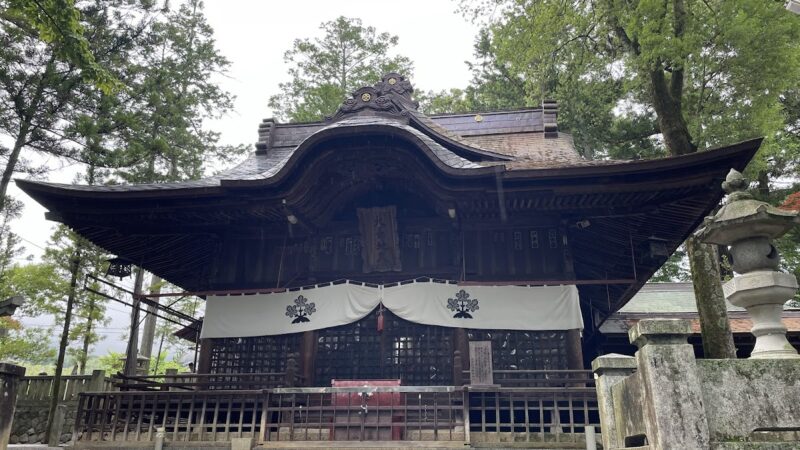
At Asazumi Shrine, two deities, Takeminakata-no-Mikoto and Hondawake-no-Mikoto, are enshrined side by side. This is an unusual form of enshrining two deities in a horizontally long shrine building, representing a regional faith that reveres both the deity of Nagano Prefecture and Hachiman-sama, who is worshipped nationwide.
Highlights of the Shrine Grounds
The “Ina’s Largest” Torii Gate
The first torii gate standing at the entrance to the approach to Asazumi Shrine is considered the largest and most magnificent in the Shimo-Ina region, and has been given the “Ina’s Largest” designation. This grand torii gate, standing along Prefectural Road 229, is a symbol of Asazumi Shrine’s presence.
The imposing stone torii gate is visible from afar, guiding worshippers into the sacred grounds. Passing through this gate evokes a sense of transition from everyday space to a sacred space.
The Worship Hall and Main Shrine
As you proceed along the approach, a magnificent worship hall comes into view. The horizontally elongated shrine building is a unique style designed to enshrine two deities, a style rarely seen in other shrines.
At the worship hall, you can pay your respects to both deities, offering a precious opportunity to pay your respects to both Takeminakata-no-Mikoto and Homutawake-no-Mikoto.
Former Zakoji Omi School Building (Oldest in Nagano Prefecture)
Within the grounds of Omi Shrine, the “Former Zakoji Omi School Building,” the oldest school building in Nagano Prefecture, is preserved. This building is a valuable cultural asset that tells the history of education during the Meiji era.
From the Meiji to the Taisho and Showa periods, Zakoji Elementary School was located on the shrine grounds for a remarkable 110 years. The fact that a school was located on the shrine grounds indicates that the shrine was the center of the local community.
Currently, this school building is preserved as a historical structure and is a valuable resource for understanding the educational environment of that time. When visiting the shrine, be sure to stop by and reflect on what education was like during the Meiji era.
Omi no Sato Butai Sakura (Omi Village Stage Cherry Tree)
Within the grounds of Omi Shrine stands a magnificent cherry tree called “Omi no Sato Butai Sakura” (Omi Village Stage Cherry Tree). In spring, it blooms with beautiful flowers, making it a popular spot for cherry blossom viewing.
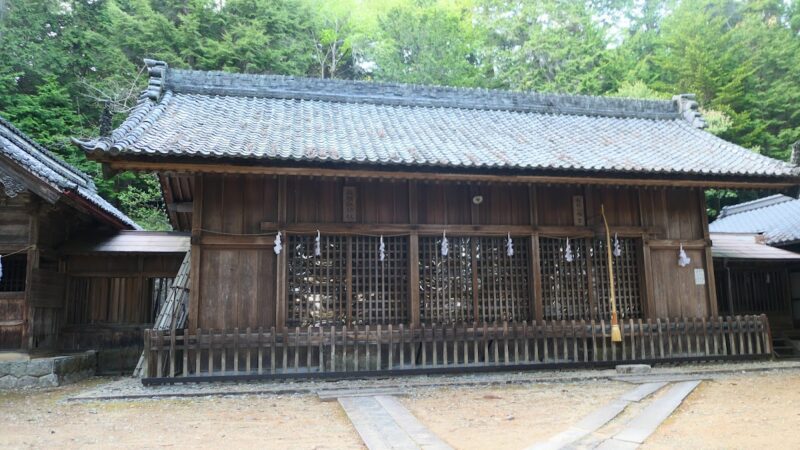
The name “Butai Sakura” (Stage Cherry Tree) comes from its proximity to the shrine’s stage (Kagura-den). During peak bloom, the cherry blossoms adorn the landscape, creating a beautiful scene reminiscent of a cherry blossom stage.
Best time to visit: Early to mid-April
During cherry blossom season, many tourists visit this shrine along with Motozenkoji Temple, making it one of Iida’s representative cherry blossom viewing spots in spring.
Shrine Precincts
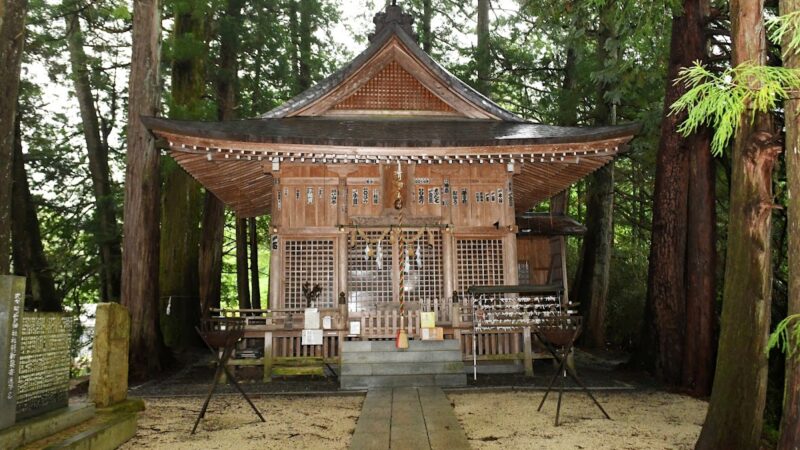
Several subsidiary shrines (subsidiary shrines/outlying shrines) are enshrined within the grounds of Asami Shrine. The main subsidiary shrines include:
- Akiba Shrine: God of fire prevention
- Tenman Shrine: God of learning
- Hachiman Shrine: God of war and prosperity
These subsidiary shrines also attract the faith of local people, who visit them according to their various wishes.
Goshuin (Shrine Seal) Information
Regarding the Issuance of Goshuin
Asami Shrine issues Goshuin, but this is not always the case. Those wishing to receive a Goshuin are advised to check in advance.
Characteristics of the Goshuin (Shrine Seal)
The goshuin of Asazumi Shrine features the shrine’s name, “Asazumi Shrine,” written in ink, along with the shrine’s seal. Its simple yet powerful calligraphy is a distinctive feature, making it a popular memento for many visitors.
As a Record of Visits
In recent years, collecting goshuin has become one of the joys of visiting shrines. Recording the Asazumi Shrine goshuin in a goshuincho (seal book) allows you to preserve the memories of your visit.
Visiting both Asazumi Shrine and Motozenkoji Temple and receiving goshuin from both is also a popular pilgrimage.
Annual Events and Festivals
Grand Festival
The most important festival at Asazumi Shrine is the Grand Festival. Many local residents, including the parishioners’ representatives, participate, praying for a bountiful harvest, family safety, and the prosperity of the community.
Traditional Shinto rituals are performed, and sometimes kagura (sacred dance) is offered. It is an important opportunity to pass on the region’s traditional culture.
New Year’s Visit
As the new year begins, many parishioners and local residents visit the shrine for their first shrine visit of the year. They pray for safety and prosperity throughout the year and report the start of the new year to the gods.
Along with Motozenkoji Temple, it is a popular spot for New Year’s visits in the Zakoji area.
Baby’s First Shrine Visit and Shichi-Go-San Ceremony
At Asazumi Shrine, the local guardian shrine, life-changing rituals such as baby’s first shrine visit and Shichi-Go-San (a traditional Japanese rite of passage for children) are also performed. It is a place used across generations to pray for the healthy growth of children born in the area.
Access Information
Access by Train
Nearest Station: JR Iida Line “Motozenkoji Station”
- Approximately 10 minutes on foot from Motozenkoji Station
- Exit the station and head west; you will see a large torii gate along Prefectural Road 229.
Motozenkoji Station is an unmanned station, but it is conveniently located and easily accessible from the center of Iida City.
Access by Car
From the Chuo Expressway:
- Approximately 15 minutes from Iida IC
- Approximately 5 minutes from Zakoji Smart IC (ETC only)
From National Route 153:
- Enter the Zakoji area and take Prefectural Road 229
Parking
There is parking space for visitors on the temple grounds. However, it may be full during peak seasons such as the annual festival and New Year’s visits, so it is recommended to visit with plenty of time to spare.
Location relative to nearby tourist spots
Moto-Zenkoji Temple: Approximately 5 minutes on foot (approximately 400m)
When visiting Asami Shrine, it is highly recommended to also visit Moto-Zenkoji Temple. Moto-Zenkoji Temple is an important temple known as the place where the principal image of Zenkoji Temple in Nagano City was first enshrined.
There is a saying, “Visiting only Zenkoji Temple is an incomplete pilgrimage,” and it is believed that visiting both Zenkoji Temple and Moto-Zenkoji Temple constitutes a complete pilgrimage.
Map and Navigation
Entering the address “2516 Zakoji Ichiba, Iida City, Nagano Prefecture” into your car navigation system or smartphone map app will display accurate location information. It’s easiest to find by looking for the large torii gate along Prefectural Road 229.
Manners and Etiquette for Worship
Basic Worship Etiquette
- Passing Through the Torii Gate: Bow before passing through the torii gate. The center of the path is the path for the gods, so walk along the side.
- Purifying at the Water Basin: If there is a water basin, purify your left hand, then your right hand, then your mouth.
- Worship at the Main Hall: The basic method is two bows, two claps, one bow (two bows, two claps, one bow).
- Bow deeply twice
- Clap your hands twice
- State your wish silently
- Bow deeply once
Worshiping the Two Deities
At Asami Shrine, two deities are enshrined side by side, so it is advisable to respectfully worship each deity.
Photography Etiquette
Photography is generally permitted on the shrine grounds, but please observe the following:
- Do not photograph areas where entry is prohibited, such as inside the main hall.
- Be considerate of other worshippers.
- Refrain from photography during religious ceremonies.
- Handle cultural properties such as the former Zakoji Asami School building with care.
Nearby Attractions
Moto-Zenkoji Temple
Moto-Zenkoji Temple, located about a 5-minute walk from Asami Shrine, is a must-see spot. It is named “Moto-Zenkoji” (original Zenkoji Temple) because it is the place where the principal image of Zenkoji Temple was first enshrined.
The main hall is a magnificent building, and the grounds are spacious and impressive. Visiting both Asazumi Shrine and Motozenkoji Temple allows you to experience the deep history and faith of the Zakoji district.
Historical Walk in the Zakoji District
Besides Asazumi Shrine and Motozenkoji Temple, the Zakoji district is dotted with historical buildings and sites. A leisurely stroll, exploring the old townscape and historical traces, is sure to be enjoyable.
Iida City Center
The center of Iida City offers various tourist attractions, including the Iida Castle Ruins, the Iida City Museum of Art, and the Apple Tree-lined Street. Enjoying sightseeing in Iida City before or after visiting Asazumi Shrine is highly recommended.
Points to Note When Visiting Asazumi Shrine
Recommended Time to Visit
Spring (Early to Mid-April): The cherry blossoms at Asazumi no Sato Butai are in full bloom, making it the most beautiful season. A visit combined with cherry blossom viewing is recommended.
Autumn (October to November): The autumn foliage is also beautiful, and the pleasant weather makes it ideal for visiting.
New Year’s Visit (January 1st-3rd): Many worshippers visit to pray for the New Year. You can experience the local atmosphere.
Estimated Time Required
- Visiting only Omizumi Shrine: Approximately 20-30 minutes
- Including a visit to the former Zakoji Omizumi School building: Approximately 40-50 minutes
- Visiting both Omizumi Shrine and Motozenkoji Temple: Approximately 1 hour 30 minutes to 2 hours
Clothing and Items to Bring
No special clothing is required for visiting, but clean clothing that is respectful to the gods is desirable.
Items to Bring:
- Goshuincho (stamp book) (if you wish to receive a stamp)
- Camera (for commemorative photos)
- Drinks (especially in summer)
Summary of the Charms of Omizumi Shrine
Omizumi Shrine is a historical shrine located in Zakoji, Iida City, Nagano Prefecture. With its long history dating back to before the Tensho era, the unusual format of enshrining two deities, the oldest school building in the prefecture, and the beautiful Stage Cherry Blossoms, Asami Shrine boasts many attractions.
As the tutelary shrine of the Zakoji district, it has approximately 1,400 parishioners and is deeply rooted in the community’s faith. Visiting it together with Motozenkoji Temple will allow you to gain a deeper understanding of the region’s history and culture.
The magnificent torii gate, said to be the “best in Ina,” the two deities enshrined side-by-side in the long, horizontal shrine building, the grounds that housed a school for 110 years, and the Stage Cherry Blossoms that bloom beautifully in spring—Asami Shrine has many elements that will captivate visitors.
When you visit Iida City, be sure to stop by Asami Shrine. By experiencing the region’s history and faith, and by praying in peace, you will have a valuable experience unlike anything you would find in everyday life.
Asami Shrine is located at 2516 Zakoji Ichiba, Iida City, Nagano Prefecture. Located just a 10-minute walk from Motozenkoji Station, it’s easily accessible and can be visited with the help of a map. Why not get a Goshuin (temple stamp) as a record of your visit and take your time exploring the sights within the temple grounds?