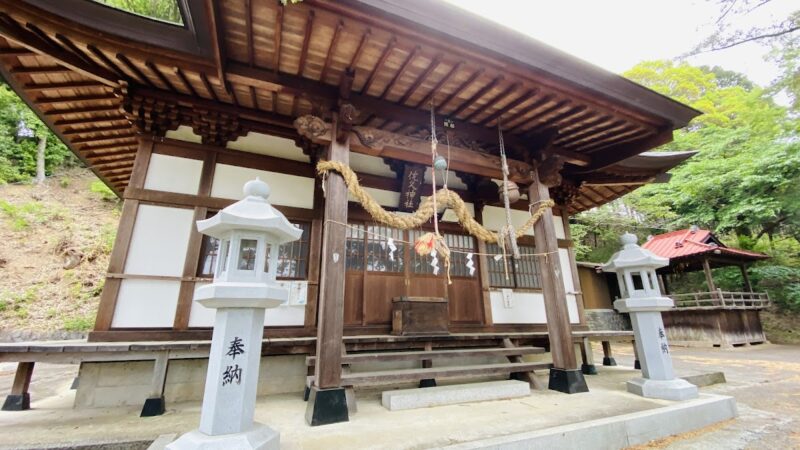
Complete Guide to Saku Shrine (Kofu City, Yamanashi Prefecture) | The History of the Kai Province Shikinaisha Shrine and the Truth Behind the Legend of the Kicking and Splitting
Located in Shimomukoyama-cho, Kofu City, Yamanashi Prefecture, Saku Shrine is a venerable shrine that has been revered since ancient times as one of the twenty Shikinaisha shrines of Kai Province. The legend that the Kofu Basin was once a lake, and the story of Mukoyama Tsuchimoto Hiko-no-Ō, who cut it open, are indispensable to understanding the history of Yamanashi.
This article comprehensively introduces information you should know before visiting Saku Shrine, from its founding to the present day, the origin of its enshrined deities, highlights of the grounds, annual festivals and events, and access methods.
Table of Contents
- Basic Information about Saku Shrine
- History and Origins of Saku Shrine
- The Legend of the Kicking and the Formation of the Kofu Basin
- Deities and Divine Virtues
- Highlights of the Shrine Grounds
- Cultural Properties and Designated Cultural Properties
- Annual Festivals and Events
- Goshuin (Shrine Seal) Information
- Access and Parking
- Nearby Tourist Spots
Basic Information about Saku Shrine
Official Name: Saku Shrine
Location: 1369 Shimomukoyama-cho, Kofu City, Yamanashi Prefecture
Former Shrine Rank: Gosha (Village Shrine)
Shikinaisha (Shrine listed in the Engishiki): Saku Shrine, Yatsushiro District, Kai Province
Deities:
- Mukoyamatsuchimotohiko-no-mikoto
- Amenotajikarao-no-mikoto
- Ōnamuchi-no-Mikoto
Annual Festival Date: October 17th
Shrine Office: Available (may be unattended)
Parking: Several parking spaces available on the shrine grounds
History and Origins of Saku Shrine
Origin of Founding
The founding of Saku Shrine is said to date back to the reign of Emperor Sujin (around 100 BC). This period in ancient Japanese history coincides with the time when the Yamato court was expanding its control over the provinces.
According to the shrine’s history, Mukaiyama-tsuchimoto-biko-ō, a descendant of Hikohodemi-no-Mikoto, entered the area as the governor of Kai Province by imperial decree of Emperor Himeyasu (though the prevailing theory is that this was actually Emperor Sujin). It is said that the Kofu Basin at that time was a vast lake, and that King Tsuchimotohiko undertook a massive construction project to clear it, diverting water into the Fuji River and creating a vast plain.
Because of this great achievement, King Tsuchimotohiko was enshrined as “Saku Daimyojin,” and this became the origin of Saku Shrine.
Status as a Shikinaisha Shrine
The “Saku Shrine in Yatsushiro District, Kai Province” listed in the Engishiki Jinmyocho (compiled in 927) is believed to refer to this Saku Shrine in Kofu City. There are 20 Shikinaisha shrines in Yamanashi Prefecture, and Saku Shrine is one of them, a highly prestigious shrine recognized by the imperial court since ancient times.
A Shikinaisha shrine is a shrine listed in the Engishiki Jinmyocho, compiled during the Heian period, signifying a historically significant shrine officially recognized by the imperial court at the time. The presence of Shikinaisha shrines in Kai Province is evidence that this region was considered important from ancient times.
Changes in the Middle Ages
In the Middle Ages, Saku Shrine came under the protection of the Mukaiyama clan, a powerful local samurai family. In 1543 (Tenbun 13), the shrine was relocated to its current location by Lord Mukaiyama Izumo-no-kami.
The Mukaiyama clan was a branch of the Kai Genji clan and a samurai group that controlled the southern part of the Kofu Basin. Since the shrine bears the name of Mukaiyama Tsuchimotobiko-ō, the deity enshrined there, it is believed that the Mukaiyama clan claimed to be descendants of Tsuchimotobiko-ō. Even during the turbulent Sengoku period, the Mukaiyama clan revered Saku Shrine as their tutelary deity and strived to maintain it.
From the Early Modern Period to the Present
During the Edo period, it served as the guardian shrine for eight surrounding villages, attracting the faith of local residents. Under the Meiji era’s shrine ranking system, it was ranked as a Gosha (village shrine), establishing its position as a central shrine in the region.
After the post-war reforms to the shrine system, it is now a religious corporation and is cherished as the local tutelary deity. Due to its proximity to archaeologically important sites such as Sone Hills Park and Fudoki-no-Oka, it is attracting attention as an important cultural heritage site that conveys the history of ancient Kai Province.
The Legend of the Split Kick and the Formation of the Kofu Basin
What is the Legend of the Split Kick?
The “Legend of the Split Kick,” passed down at Saku Shrine, is one of Yamanashi Prefecture’s representative ancient legends. This legend mythologically explains the formation of the Kofu Basin and is an important story that forms the identity of the region.
According to the legend, in ancient times, the entire Kofu Basin was covered by a huge lake (ancient Lake Kai). The god of Saku (Mukoyama-tsuchi-moto-hiko-ō) was concerned about this situation and, by kicking and splitting the mountain rocks in the southern part of the basin (said to be the origin of the name “Saku”), he caused the lake water to flow into the Fuji River, creating the fertile plains of today.
It has been pointed out that this legend is not merely a myth, but may reflect actual geological changes.
Geological Background
According to modern geological research, the Kofu Basin is a structural basin that began forming approximately 2 million years ago. Geological surveys have revealed that a lake, known as the ancient Lake Kai, once existed within this basin surrounded by mountains.
This lake is thought to have gradually shrunk starting about 100,000 years ago and was eventually drained away by the erosive action of the Fuji River. The legend of the “Kick Split” can be interpreted as an ancient person observing this geological change and passing it down as a myth.
Around the Sone Hills, numerous geological layers showing traces of the lake and archaeological sites of people who lived near the water in ancient times have been discovered, making it a fascinating area where legend and scientific facts intersect.
The True Image of Mukaiyama-tsuchimoto-hiko-ō
While Mukaiyama-tsuchimoto-hiko-ō is considered a mythical figure, his legend is thought to reflect the image of an ancient civil engineer or pioneer.
In ancient Japan, individuals with expertise in irrigation and water management were often deified, and it’s possible that Tsuchimotobiko-ō was a real-life pioneering leader who was mythologized. There’s also a theory that the name “Tsuchimoto” itself was a title related to land development and civil engineering.
The lineage as a descendant of Hikohohodemi-no-Mikoto indicates a connection to the Yamato court, suggesting that regional development was carried out with the authority of the central government as a backdrop.
Deity and Divine Virtues
Main Deity: Mukaiyama Tsuchimotobiko-ō
Mukaiyama Tsuchimotobiko-ō, the main deity of Saku Shrine, is revered as the ancestral deity of the pioneering of Kai Province.
Divine Virtues:
- Good Fortune
- Industrial Development
- Protection of Civil Engineering and Construction
- Regional Peace and Security
- Abundant Harvests
Due to his achievements in developing land and providing people with a place to live, he attracts the faith of those starting new businesses and those working in land and building-related fields. ### Enshrined Deity: Ame-no-Tajikarao-no-Mikoto
Ame-no-Tajikarao-no-Mikoto is known in Japanese mythology as the god who powerfully opened the rock cave when Amaterasu-Omikami hid inside.
Divine Virtues:
- Symbol of Strength
- Overcoming Difficulties
- Improvement in Sports
- Good Fortune
Related to the legend of kicking through mountains with great force, he is worshipped as a god who bestows the power to overcome difficulties.
Enshrined Deity: Ōkuninushi-no-Mikoto
Ōkuninushi-no-Mikoto is another name for Ōkuninushi-no-Mikoto and is known as the principal deity of Izumo Taisha Shrine, a god of nation-building.
Divine Virtues:
- Matchmaking
- Business Prosperity
- Healing from Illness
- National Land Management
Enshrined alongside him as a deity whose role overlaps with the nation-building work of Tsuchimotobiko-ō, he is revered as a god who protects the prosperity of the region and the happiness of the people.
Highlights of the Shrine Grounds
Shrine Architecture
The current shrine buildings of Saku Shrine reflect the architectural style from the late Edo period to the Meiji period. The main hall is a one-bay nagare-zukuri style, and the worship hall is an irimoya-zukuri style, characterized by its simple and sturdy construction.
While the decorations are understated, the carvings in the details showcase the skill of the craftsmen, reflecting the deep faith of the local community.
Stone Sculptures
Stone lanterns and guardian lion-dogs from the Edo to Meiji periods are placed throughout the shrine grounds. The guardian lion-dogs along the approach to the shrine are particularly noteworthy as valuable cultural assets demonstrating the skills of local stonemasons.
The names of the donors are inscribed on the stone lanterns, providing clues to the structure of the parishioners’ organization and the local community at the time.
Sacred Trees
Giant cedar and zelkova trees, estimated to be several hundred years old, stand tall within the shrine grounds. These sacred trees are witnesses to the long history of the shrine, quietly watching over it and evoking a sacred atmosphere for visitors.
In particular, the giant cedar tree behind the main hall has a trunk circumference exceeding 5 meters, exuding an overwhelming presence.
Shrines within the Precincts
Besides the main shrine, several smaller shrines are enshrined within the grounds. These reflect the diversity of local beliefs, enshrining deities closely related to people’s lives, such as Inari and Tenjin.
Cultural Properties and Designated Cultural Properties
City-Designated Cultural Properties
Saku Shrine possesses several cultural properties designated by Kofu City. In particular, the Edo period ridgepole inscriptions and ancient documents are valuable historical materials for understanding the shrine’s history.
Undesignated Cultural Properties
In addition to designated cultural properties, numerous stone structures and offerings of high historical value are preserved within the shrine grounds. These are important materials that tell the story of the region’s history, and further research is anticipated.
Annual Festivals and Events
Grand Festival (October 17th)
The most important festival of Saku Shrine is the Grand Festival, held annually on October 17th. On this day, many local residents, including the head of the parishioners, attend, and a portable shrine procession and devotional performances take place.
As a traditional festival expressing gratitude for the autumn harvest and praying for a bountiful harvest and peace in the community in the following year, it is an important event for the local community.
New Year’s Day Festival (January 1st)
On New Year’s Day, the shrine grounds are bustling with worshippers making their first visit of the year. The New Year’s Day Festival includes Shinto rituals praying for peace and prosperity in the new year.
Spring Harvest Festival
In spring, the Harvest Festival is held to pray for a bountiful harvest of crops for the year. This festival has been particularly important in the local community, which has historically revolved around agriculture.
Monthly Festival
Monthly festivals are held on the 1st and 15th of each month, where prayers are offered for daily peace and the safety of the parishioners.
Goshuin (Shrine Seal) Information
Goshuin (shrine seals) are available at Saku Shrine. However, since there may not always be a resident priest, it is recommended to call ahead to confirm, or you may be able to obtain one at another nearby shrine that is also managed by Saku Shrine.
The goshuin will bear the calligraphy “Shikinai Saku Shrine” and the shrine’s seal. For those visiting the Shikinai shrines of Kai Province, this is a must-have.
Goshuin (temple stamp) reception hours: Irregular (advance contact recommended)
Offering fee: Approximately 300-500 yen
Access and Parking
Access by Car
Via Chuo Expressway:
- Approximately 1km from Kofu Minami IC, about 3 minutes by car
- Head south on National Route 140 and follow the signs
From Tokyo:
- Approximately 90-120 minutes via Chuo Expressway
From Nagoya:
- Approximately 150-180 minutes via Chuo Expressway
Parking: Several parking spaces available on the temple grounds (free)
Access by Public Transportation
From JR Kofu Station:
- Take the Yamanashi Kotsu bus bound for “Sone Kyuryo Park”
- Get off at the “Shimomukoyama” bus stop, about 10 minutes on foot
- Travel time: Approximately 40 minutes
By Taxi:
- Approximately 20 minutes by taxi from JR Kofu Station
- Fare: Approximately 2,500 to 3,000 yen
Access by foot or bicycle
It is also possible to access the area on foot from Sone Hill Park or Fudoki Hill. The surrounding area is a quiet region with sprawling farmland, and a stroll while enjoying the peaceful rural scenery is highly recommended.
Nearby Tourist Spots
Sone Hill Park (approximately 3 minutes by car)
Sone Hill Park, located very close to Saku Shrine, is a vast prefectural park. It is dotted with ancient burial mounds and ruins, making it a place where you can experience the history of ancient Kai Province.
There are also lawn areas and athletic facilities, making it ideal for picnics with families.
Yamanashi Prefectural Archaeological Museum (approximately 5 minutes by car)
The Archaeological Museum, located within Fudoki Hill, exhibits on the ancient history of the Kofu Basin and the legend of the Kicking Ritual. Visiting it in conjunction with a visit to Saku Shrine will allow you to understand the local history more deeply.
Kai Choshizuka Kofun (approx. 5 minutes by car)
This is one of the largest keyhole-shaped burial mounds in eastern Japan, measuring 169 meters in length, and is a nationally designated historical site. It is believed to have been constructed in the late 4th century and is thought to be the tomb of a powerful figure in ancient Kai Province.
Fuefukigawa Fruit Park (approx. 20 minutes by car)
This park is themed around fruits, a specialty product of Yamanashi Prefecture, and offers a spectacular view of the Kofu Basin. It also has hot spring facilities and restaurants, making it a convenient base for sightseeing.
Takeda Shrine (approx. 15 minutes by car)
This shrine, dedicated to Takeda Shingen, is one of Yamanashi Prefecture’s leading tourist attractions. Built on the site of the Tsutsujigasaki Mansion, it allows visitors to experience the history of the Sengoku period.
Contact Information
Saku Shrine
Address: 1369 Shimomukoyama-cho, Kofu City, Yamanashi Prefecture 400-1508
Phone: Please contact the Yamanashi Prefectural Shrine Association (055-252-0472)
*Please note that there may not be a resident priest at the shrine. For matters other than worship, please contact the Yamanashi Prefectural Shrine Association or the affiliated shrine.
Summary
Saku Shrine is a valuable Shikinaisha (shrine listed in the Engishiki) that preserves the legend of the Kick Split, which tells of the formation of the Kofu Basin, and the achievements of Mukoyama Tsuchimotohiko-ō, the pioneer of ancient Kai Province. Despite its convenient location near the Kofu South Interchange, the shrine grounds, nestled in a quiet rural area, allow visitors to feel the weight of ancient history and a sacred atmosphere.
The surrounding area is home to numerous facilities related to ancient history, such as Sone Hills Park, the Archaeological Museum, and ancient burial mounds, making it an ideal base for exploring the history of Yamanashi. For those who enjoy visiting Shikinaisha shrines, those interested in ancient history, and those who want to experience the culture of Yamanashi, Saku Shrine is a must-see spot.
When you visit the Kofu Basin, be sure to stop by this historic shrine and reflect on the region’s history and culture that has continued since ancient times.