Inari Shrine (Shintera-machi, Hirosaki City, Aomori Prefecture) Complete Guide | History, Highlights, and Visiting Information
Located in Shintera-machi, Hirosaki City, Aomori Prefecture, the Inari Shrine is a historic shrine founded during the Edo period at the behest of the Tsugaru feudal lord. It once boasted over 70 red torii gates and flourished as a center of local faith. This article provides a detailed explanation of the shrine’s history, architectural features, and visiting information.
Overview of Shintera-machi Inari Shrine
The Shintera-machi Inari Shrine is located at 33 Shintera-machi, Hirosaki City, and is also known locally as “Shintera-machi Inari Shrine.” Shintera-machi developed as a temple district under Hirosaki Castle, and this Inari Shrine, along with the surrounding temples, has shaped Hirosaki’s religious culture.
The shrine grounds face south, with the torii gate located on the north side of the road. The shrine’s nameplate reads “Inari Shrine,” and it is displayed as “Shintera-machi Inari Shrine” on Google Maps and other platforms.
History and Origins
Founded in 1708
Shin-Teramachi Inari Shrine was founded in 1708 (Hoei 5). This founding was at the behest of Tsugaru Nobumasa, the 4th lord of the Tsugaru domain, and it is considered a prestigious shrine in which the lord himself was involved.
Tsugaru Nobumasa (1669-1710) is known as a wise ruler who advanced the administrative reforms of the Tsugaru domain and also devoted himself to the development of Hirosaki Castle town. The arrangement of temples and shrines in the Shin-Teramachi area is believed to have been established during Nobumasa’s time, and the founding of the Inari Shrine is thought to have been part of this urban planning.
Enshrinement from Kumagaya Inari in Asakusa
A notable feature of Shin-Teramachi Inari Shrine is that its enshrined deity was invited from Asakusa in Edo (present-day Tokyo). Specifically, it was invited from “Kumagaya Inari,” which was located within the grounds of Senso-ji Temple near Kaminarimon Gate.
During the Edo period, the Tsugaru domain traveled to and from Edo (present-day Tokyo) for the sankin-kotai system (alternate attendance system), bringing Edo culture and beliefs to Tsugaru. Senso-ji Temple was a representative temple of Edo, and receiving a divided spirit from its Inari shrine demonstrated the strong connection between the Tsugaru domain and Edo.
Kumagaya Inari Shrine is worshipped as a god of business prosperity and abundant harvests, and in Hirosaki, it attracted the faith of people seeking these blessings.
Former Prosperity and Over 70 Torii Gates
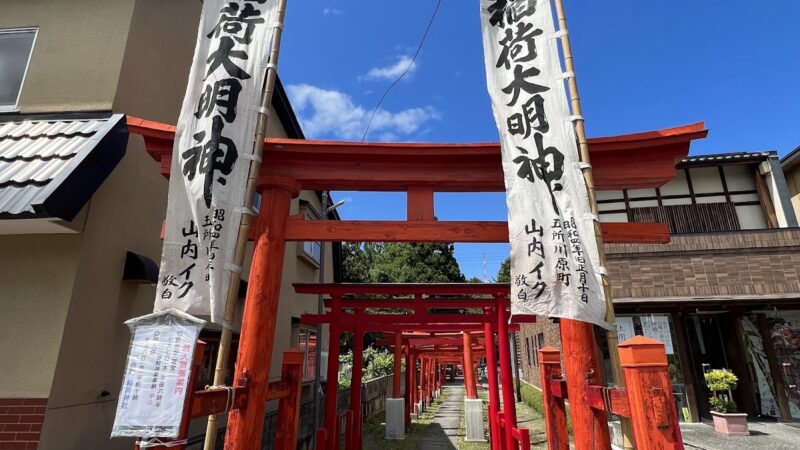
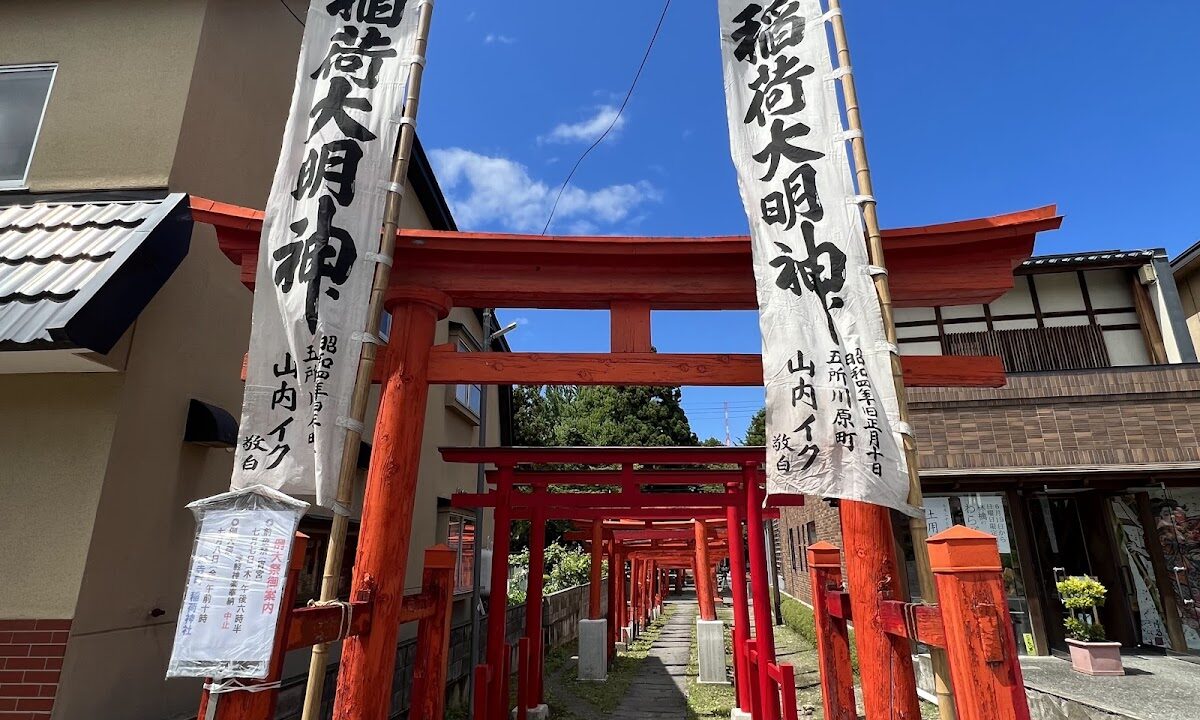
From its founding through the Meiji and Taisho periods, Shin-Teramachi Inari Shrine flourished as a center of local faith. At its peak, it is said that over 70 red torii gates lined the shrine grounds, bustling with worshippers.
The sight of the rows of vermilion torii gates, characteristic of Inari worship, is reminiscent of Fushimi Inari Taisha in Kyoto, and speaks to the flourishing of Inari worship in Hirosaki. These torii gates are thought to have been donated by merchants and townspeople praying for business prosperity and family safety.
Architectural Features and Highlights of the Shrine Grounds
Architectural Style of the Worship Hall
The worship hall of Shin-Teramachi Inari Shrine is built in the irimoya-zukuri (hip-and-gable roof) style with a gable entrance. The roof is covered with copper plates, giving it a dignified appearance due to its age.
The irimoya-zukuri style is considered a highly prestigious roof style in traditional Japanese architecture and is used for the main buildings of temples and shrines. A gable entrance is a style where the entrance is located on the gable end (the triangular gable section) of the building, emphasizing its frontal appearance.
The structure and design of the worship hall reveal characteristics of shrine architecture in the Tsugaru region during the Edo period.
Style of the Main Hall
The main hall is built in the ikkensha-nagare-zukuri style with a copper plate roof.
The Nagare-zukuri style is a representative architectural style adopted by many shrines, including Inari shrines, and is characterized by a long, extended roof that forms an overhang. A “Ikken-sha” refers to a shrine with a front column spacing of one ken (approximately 1.8 meters), a small but dignified main hall style.
The architectural style of the main hall and worship hall reveals a typical configuration of Edo period shrine architecture, making it a historically valuable structure.
Torii Gate and Shrine Name Marker
A torii gate stands at the entrance to the shrine grounds, and beside it is a shrine name marker inscribed with “Inari Shrine.” These have served as the face of the shrine welcoming worshippers and have been cherished by local people for many years.
Although many of the more than 70 torii gates that once existed have been lost, the atmosphere of the shrine grounds evokes its former prosperity.
Annual Festival and Tsugaru Kagura
Summer Annual Festival
At Shin-Teramachi Inari Shrine, a grand annual festival was once held in the summer. Especially on the eve of the festival, many worshippers and spectators gathered, illuminating the shrine grounds with lanterns and lining the streets with stalls, creating a lively atmosphere.
The annual festival was the most important festival for the shrine and also a place to reaffirm the unity of the local community. Located in the temple district of Shin-Teramachi, the Inari Shrine festival was an indispensable annual event for the community.
Dedication of Tsugaru Kagura
Tsugaru Kagura was sometimes dedicated at the annual festival. Tsugaru Kagura is a traditional performing art passed down in the Tsugaru region, a Shinto ritual to worship the gods and pray for a bountiful harvest and the eradication of disease.
The Kagura, danced to the sounds of flutes and drums, added splendor to the shrine’s festival and also expressed the cultural identity of the region. The dedication of Tsugaru Kagura at Shin-Teramachi Inari Shrine was a valuable cultural activity where Tsugaru faith and performing arts were integrated.
Relationship with the Temples and Shrines of Shin-Teramachi
The Shin-Teramachi Area
Shinteramachi is an area that developed as a temple district within Hirosaki Castle. The Tsugaru Domain concentrated many temples in a specific area for the purpose of defending the castle town and for religious policy. Shin-Teramachi is home to temples of various sects, including Jodo, Nichiren, and Soto Zen, creating a unique landscape.
The presence of an Inari Shrine within this temple district is considered both a remnant of the syncretism of Shinto and Buddhism, and a consideration for meeting the diverse religious needs of the local residents.
Major Temples in the Surrounding Area
Several important temples exist around the Shin-Teramachi Inari Shrine.
Taiguji Temple is located a few dozen meters east of the Inari Shrine. When visiting Shin-Teramachi, it is common to visit both Taiguji Temple and the Inari Shrine.
Hoonji Temple, Enmyoji Temple, Hongyoji Temple, Jotokuji Temple, and Honjakuin Temple are also located in Shinteramachi, each with its own history and traditions.
Visiting these temples and Inari shrines allows you to experience the profound depth of Hirosaki’s religious culture.
Deities and Blessings
Ukanomitama-no-Mikoto
The deity enshrined at Shinteramachi Inari Shrine is Ukanomitama-no-Mikoto, the central deity of Inari worship. Ukanomitama-no-Mikoto is the god who presides over grains and food, and is believed to bestow blessings such as abundant harvests, business prosperity, and family safety.
“Uka” is an archaic word meaning food, and “tama” represents the soul. In other words, Ukanomitama-no-Mikoto is the deification of the “spirit of food,” and has been considered one of the most important deities in Japanese society, which is based on agriculture.
The Spread of Inari Worship
Inari worship originally began with Fushimi Inari Taisha in Kyoto as its head shrine, but it spread throughout Japan during the Edo period. It was particularly revered among merchants and townspeople as a god of business prosperity, and Inari shrines were established in various locations.
In Hirosaki, too, as commerce flourished with the development of the castle town, merchants deepened their faith in Inari. Shin-Teramachi Inari Shrine can be said to be a shrine that prospered against the backdrop of Hirosaki’s merchant culture.
Visiting Information and Access
Basic Information
Location: 33 Shinteramachi, Hirosaki City, Aomori Prefecture
Shrine Rank: Equivalent to a Village Shrine (Position under the old shrine ranking system)
Orientation of Grounds: South-facing
Visiting Hours: Grounds are open freely (Please check the hours of the shrine office)
About Goshuin (Shrine Seals)
Shinteramachi Inari Shrine currently does not issue goshuin. Upon checking with the shrine office, we received confirmation that goshuin are not available.
This may be disappointing for visitors collecting goshuin, but regardless of the availability of goshuin, the essence of visiting a shrine lies in experiencing its history and atmosphere.
Access Method
Access by Train and Bus:
Approximately 10 minutes by Konan Bus from JR Hirosaki Station, get off at the “Shinteramachi” bus stop, then approximately 3 minutes on foot. Alternatively, approximately 25 minutes on foot from Hirosaki Station.
Access by Car: Approximately 15 minutes from the Owani-Hirosaki Interchange on the Tohoku Expressway. Approximately 5-10 minutes by car from Hirosaki city center. It is recommended to check in advance whether there is a dedicated parking lot on the temple grounds. Since there are many temples in the surrounding Shin-Teramachi area, it is best to avoid street parking and use nearby coin-operated parking lots.
Nearby Tourist Attractions
When visiting Shin-Teramachi Inari Shrine, we also recommend visiting the surrounding temples. Shin-Teramachi is home to over 30 temples, each with its own unique architecture and gardens.
Hirosaki Castle and Hirosaki Park are also nearby, and especially during cherry blossom season (late April to early May) and autumn foliage season (late October to early November), you can enjoy both the atmosphere of a castle town and the beauty of nature.
Hirosaki city center also retains many modern buildings such as Western-style houses and churches, allowing you to enjoy a stroll through historical buildings in conjunction with your temple and shrine visits.
Other Inari Shrines in Hirosaki City
Besides the Shin-Teramachi Inari Shrine, there are several other Inari shrines in Hirosaki City.
Niisato Inari Shrine
The Inari Shrine located at 77 Nishizato, Niisato, Hirosaki City, is said to have been built or rebuilt in 1661 (Kanbun 1) for the prosperity of the village and the harvest. The enshrined deity is Ukanomitama-no-Mikoto, and a ridge beam inscription from 1854 (Kaei 7) remains.
It is said that all ridge beam inscriptions prior to the fire that destroyed the shrine building in December 1853 (Kaei 6) were lost. In the early Meiji period, it was temporarily merged with Kumano-gu Shrine in Niisato Village, but later became independent and remains so to this day.
This Inari Shrine is sometimes called “Fukushi Hospital Shrine” because it is located near Fukushi Hospital. Its corporate number is 9420005004508.
Other Inari Shrines
Inari shrines are also located at 245 Naraki-Yoda, Hirosaki City, and 88 Tomino, Tomita-cho, Hirosaki City. These Inari shrines also attract local devotion and each has its own unique history and traditions.
Across Aomori Prefecture, there are 2,655 Inari shrines, demonstrating the widespread popularity of Inari worship throughout Japan.
Representative Inari Shrines of Aomori Prefecture
Takayama Inari Shrine
Takayama Inari Shrine in Tsugaru City is famous as a representative Inari shrine of Aomori Prefecture. Takayama Inari Shrine is considered the most sacred shrine in Aomori Prefecture, dedicated to the gods of abundant harvests, maritime safety, and business prosperity.
The sight of the thousands of torii gates is breathtaking, making it a popular power spot attracting many visitors from all over Japan. It can be accessed by rental car from Hirosaki Station, approximately 50km one way, in about 1.5 hours.
The founding of Takayama Inari Shrine is linked to the Akō Domain, according to shrine tradition. In 1701, during the Genroku era, when the Akō Domain was dissolved following the incident in Edo Castle involving Lord Asano Takumi-no-kami Naganori, a retainer of the domain, Terasaka Sangoro, carried the sacred object of Inari Ōkami, which had been enshrined within Akō Castle. After wandering for some time, he arrived in Hirosaki, Tsugaru, and later moved to Ajigasawa, where he established a brewing business under the name “Akōya.”
This legend evokes a sense of historical romance and illustrates the cultural exchange between Tsugaru and other regions.
Inari Faith and Tsugaru Culture
Characteristics of Inari Faith in Tsugaru
In the Tsugaru region, Inari faith developed in close connection with agriculture and commerce. In Hirosaki, where apple cultivation was thriving, Inari, the god of abundant harvests, was particularly important to farmers.
Furthermore, in Hirosaki, which flourished as a castle town, merchants worshipped Inari shrines to pray for business prosperity. Shin-Teramachi Inari Shrine also attracted local devotion within this context.
Remnants of Shinto-Buddhist Syncretism
The presence of an Inari shrine within the temple district of Shin-Teramachi is a remnant of the former syncretism of Shinto and Buddhism. Before the Meiji-era separation of Shinto and Buddhism, shrines and temples had a close relationship, and it was not uncommon for them to coexist within the same grounds.
Shin-Teramachi Inari Shrine has continued to exist as an independent shrine even after the separation of Shinto and Buddhism, and continues to play its unique role within the temple district.
Shin-Teramachi Inari Shrine in Modern Times
As a Place of Local Worship
Even in modern times, Shin-Teramachi Inari Shrine functions as a place of worship for local residents. It is used for daily visits, New Year’s visits, and life-changing rituals such as Shichi-Go-San (a traditional rite of passage for children), serving as a spiritual pillar for the local community.
While the more than 70 torii gates and grand annual festivals of the past are no longer seen, the quiet grounds offer a peaceful space for visitors.
Value as a Cultural Property
The buildings of Shin-Teramachi Inari Shrine are valuable relics that convey the characteristics of Tsugaru shrine architecture that have continued since the Edo period. The irimoya-zukuri style worship hall and the ichikensha nagare-zukuri style main hall are of architectural historical value and deserve preservation as a cultural heritage of Hirosaki.
With appropriate preservation and utilization in the future, Shin-Teramachi Inari Shrine will further enhance its value as a historical building.
Potential as a Tourism Resource
Hirosaki City is a city with abundant tourist resources, including Hirosaki Castle, Western-style buildings, and a temple district. Shin-Teramachi Inari Shrine is increasingly being introduced to tourists as part of the Shin-Teramachi temple tour.
For tourists particularly interested in history and architecture, the history of the shrine, which involved the Tsugaru feudal lord, and its origins as a shrine invited from Asakusa are attractive elements. In the future, it is hoped that the value of Shin-Teramachi Inari Shrine will be conveyed to more people through improved tourist information and the installation of explanatory signs.
Summary
Located in Shin-Teramachi, Hirosaki City, Aomori Prefecture, the Inari Shrine is a historical shrine founded in 1708 (Hoei 5) at the behest of Tsugaru Nobumasa, the 4th lord of the Tsugaru domain. It enshrines Ukanomitama-no-Mikoto, the deity invited from Kumagaya Inari Shrine within the grounds of Senso-ji Temple, and has attracted local devotion for its blessings of abundant harvests and business prosperity.
The shrine grounds, which once boasted over 70 red torii gates and were bustling with activity during the summer festival and Tsugaru Kagura performances, remain a quiet place of worship deeply rooted in the community. The irimoya-zukuri style worship hall and the ichikensha-nagare-zukuri style main hall are valuable relics that convey the characteristics of Tsugaru shrine architecture.
Located within the temple district of Shinteramachi, Shinteramachi Inari Shrine, along with the surrounding temples such as Fukuromiyaji, Hoonji, Enmyoji, and Hongyoji, is an important presence in shaping Hirosaki’s religious culture. When you visit Hirosaki, be sure to stop by this historic shrine and experience the depth of Tsugaru’s faith and culture.