Takateru Shrine (Hirosaki City, Aomori Prefecture) Complete Guide | The Shrine Buildings and History of a Nationally Designated Important Cultural Property Based on Yoshikawa Shinto
What is Takateru Shrine?
Takateru Shrine is a historically important shrine located in Takaoka, Hirosaki City, Aomori Prefecture, dedicated to Tsugaru Nobumasa, the 4th lord of the Hirosaki Domain. Situated at the foot of Mount Iwaki, west of Hirosaki Castle, it is known for its extremely rare shrine building structure, built based on the philosophy of Yoshikawa Shinto.
In July 2006, eight buildings, including the main hall, and the tomb of Lord Tsugaru Nobumasa were designated as National Important Cultural Properties, and are highly valued as a valuable cultural heritage site demonstrating the development of early modern shrine architecture. Even today, it remains an important historical tourist spot in Hirosaki City, attracting many worshippers and history enthusiasts.
History of Takateru Shrine
Founding and Tsugaru Nobumasa
The history of Takateru Shrine begins with the mausoleum of Tsugaru Nobumasa, the 4th lord of the Hirosaki Domain, who died in 1710 (Hoei 7). During his lifetime, Nobumasa studied under Yoshikawa Korezumi, the founder of Yoshikawa Shinto, and was deeply devoted to it.
Nobumasa designated Takaoka at the foot of Mount Iwaki as his burial place and, according to his will, requested a Shinto burial. Following this will, the 5th lord, Tsugaru Nobuhisa, conducted a Shinto funeral ceremony with Yoshikawa Tsugunaga, the second head of the Yoshikawa Shinto school in the shogunate’s Shinto office, as the chief officiant, and buried Nobumasa in Takaoka.
Construction and Development of the Shrine
The mausoleum was constructed in 1711 (Shotoku 1), and the main buildings, including the main hall, were built the following year, 1712 (Shotoku 2). During this period, the unique east-west axis layout of the shrine buildings, based on the philosophy of Yoshikawa Shinto, was completed.
Initially, it was called “Takaoka Reisha” or “Takateru Reisha” and was operated under the generous protection of the domain. In 1877 (Meiji 10), Tsugaru Tamenobu, the first lord of the Hirosaki domain, was enshrined there, strengthening its character as a shrine that enshrines both the founder and the restorer of the domain.
Domain Management of Takateru Reisha
Throughout the Edo period, Takateru Reisha (its name at the time) was positioned as an important religious facility of the Hirosaki domain and was systematically managed by the domain. The lord himself visited the shrine, and regular festivals were held, playing a role as a spiritual pillar of the domain.
Thanks to the domain’s financial support, the shrine buildings were properly maintained and repaired, which is a factor in the good condition of the Edo-period structures that remain to this day.
The Significance of Takateru Shrine
Takateru Shrine was not merely the burial place of the feudal lord, but held significant importance as a place for the practice of Yoshikawa Shinto and as a religious facility embodying the domain’s governing philosophy. It was a symbol of the civilian rule promoted by Nobumasa and functioned as a spiritual anchor for the samurai.
Even after the Meiji Restoration, it continued to exist as a center of local faith and has been passed down to the present-day Takateru Shrine.
Deities Enshrined
The main deities enshrined at Takateru Shrine are as follows:
Main Deities
- Tsugaru Nobumasa no Mikoto: The 4th lord of the Hirosaki Domain. Known as a wise ruler who encouraged learning and culture and solidified the foundation of the domain’s administration.
- Tsugaru Tamenobu no Mikoto: The first lord of the Hirosaki Domain. Enshrined in 1877 (Meiji 10)
Enshrined Deities
- Kasuga Four Deities: Takemikazuchi-no-kami, Amenokoyane-no-mikoto, Iwainushi-no-kami, Himegami
By enshrining these deities, this shrine serves as a place to pray for military success, academic success, and the prosperity of the domain.
Connection to Yoshikawa Shinto
What is Yoshikawa Shinto?
Yoshikawa Shinto is a branch of Shinto founded in the early Edo period by Yoshikawa Koretari. It incorporated the Confucian theory of principle and energy, and developed a unique Shinto theory that fused elements of Ise Shinto and Yoshida Shinto. It was officially recognized by the shogunate as a Shinto authority and had a significant influence on samurai society.
Tsugaru Nobumasa and Yoshikawa Shinto
Tsugaru Nobumasa devoted himself to learning from a young age, and in particular, he studied Yoshikawa Shinto under Yoshikawa Koretari. This faith deeply influenced Nobumasa’s political ideals, leading to the promotion of civilian rule and the advancement of education.
Nobumasa wished for the teachings of Yoshikawa Shinto to be followed even after his death, leaving a will requesting burial according to Shinto funeral rites and the establishment of a shrine. This forms the foundation of the unique character of Takateru Shrine.
Influence of Yoshikawa Shinto on the Shrine’s Structure
The most distinctive feature of Takateru Shrine is its east-west axis layout, based on the philosophy of Yoshikawa Shinto. While typical shrines are based on a north-south axis, at Takateru Shrine, all major buildings, from the Zuishinmon gate to the main hall, the mausoleum and worship hall, and even the tomb of Lord Tsugaru Nobumasa, are arranged in a straight line from east to west.
This arrangement is thought to be linked to the movement of the sun (rising in the east and setting in the west), and is considered to be an architectural expression of the Yoshikawa Shinto worldview. Such a shrine configuration is extremely rare nationwide, enhancing the academic value of Takateru Shrine.
Shrine Grounds Buildings and Important Cultural Properties
Group of Nationally Designated Important Cultural Properties
The following eight buildings were designated as National Important Cultural Properties on July 5, 2006:
Main Hall (Honden)
Built in 1712. A three-bay nagare-zukuri style building with a copper-plated roof (originally cypress bark), it is the central building of Takateru Shrine. It features a chidori-hafu (gable with a curved roof) and a karahafu (gable with a curved roof) on the front, and is adorned with intricate carvings. The sacred object of Tsugaru Nobumasa-no-Mikoto is enshrined inside.
Chumon (Middle Gate)
A one-bay Yakui-mon gate with a gabled roof and copper roofing, located in front of the main shrine. It functions as a sacred entrance to the main shrine and is characterized by its simple yet dignified design.
Higashi-no-kiro (East Corridor)
A connecting corridor between the Chumon and the Heiden (Offering Hall). A three-bay, one-bay, gabled, copper-roofed building, creating architectural continuity.
Heiden (Offering Hall)
A three-bay, two-bay, gabled, copper-roofed building located between the main shrine and the Haiden (Worship Hall). A space that plays an important role in rituals, used as a place to offer sacred food.
Nishi-no-kiro (West Corridor)
A connecting corridor between the Heiden and the Haiden, and a counterpart to the Higashi-no-kiro. It has a structure with three bays in length and one bay in width, a gable roof, and a copper-plated roof.
Haiden (Worship Hall)
This is the building where worshippers perform their prayers. It is a magnificent structure with five bays in length and three bays in width, a hipped roof, and a copper-plated roof. It has a curved gable entrance at the front, indicating its high status.
Zuishinmon (Guardian Deity Gate)
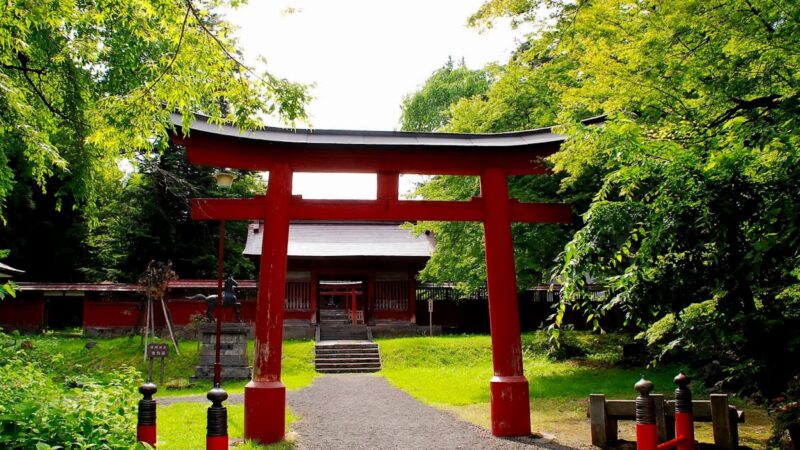
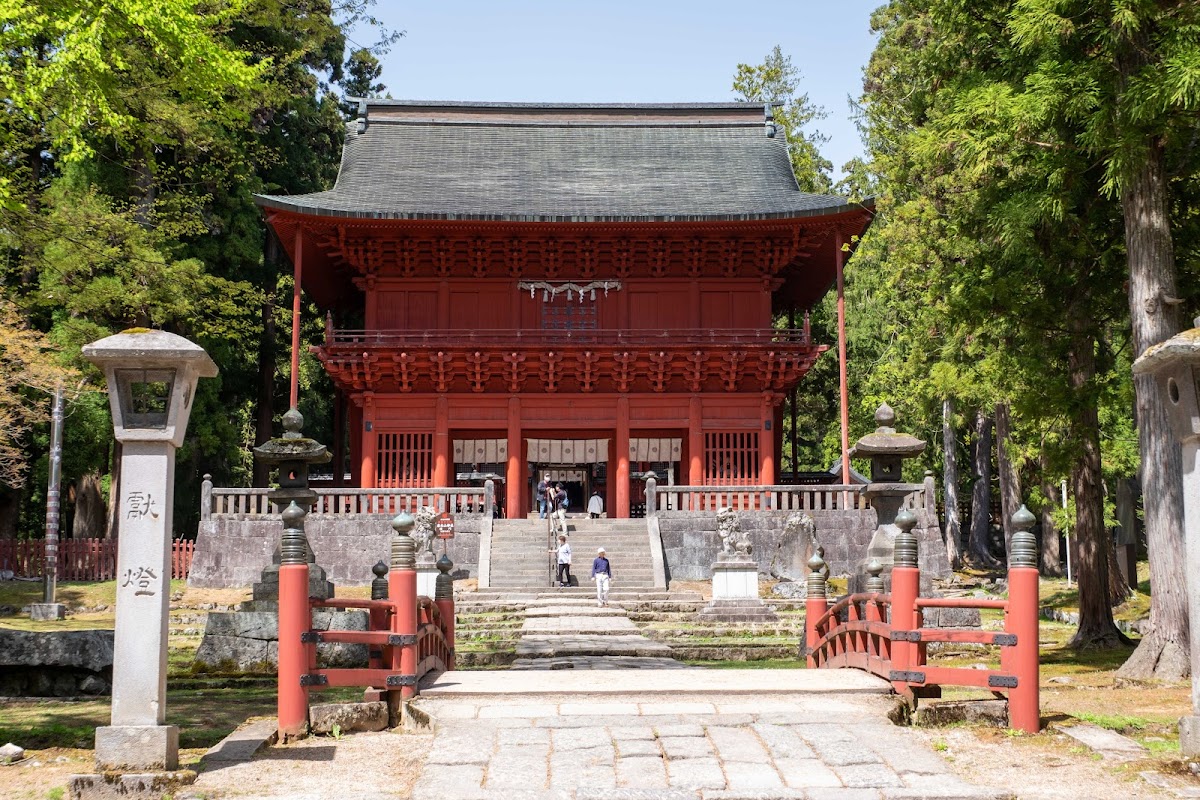
Located at the main entrance of the shrine, this is a three-bay, single-door, eight-legged gate with a hipped roof and a copper-plated roof. Statues of guardian deities are placed on either side, solemnly adorning the entrance to the sacred area. The current building is believed to have been rebuilt in Bunka 12 (1815).
Byosho Haiden (Mausoleum Worship Hall)
This is the worship hall for the mausoleum of Lord Tsugaru Nobumasa, built separately to the west of the main shrine. This building, measuring three bays in length and two bays in width, features a hipped roof and copper roofing, providing a space for worship at the tomb.
Mausoleum Gate (Byoshomon)
Located in front of the mausoleum’s worship hall, this is a one-bay, gabled gate with copper roofing. Built in 1815 (Bunka 12), it exudes a solemn atmosphere as the entrance to the tomb.
Tomb of Tsugaru Nobumasa
Located behind the mausoleum’s worship hall, Nobumasa’s tomb is also designated as an Important Cultural Property. A distinctive feature is the unique tombstone, a combination of octagonal and square stone pillars. This is thought to reflect the philosophy of Yoshikawa Shinto, and its form differs significantly from typical Buddhist tombs.
The tomb is surrounded by a stone fence, maintaining a solemn atmosphere. As a valuable historical site demonstrating the Shinto burial system of the Edo period, it is highly regarded from both architectural and religious history perspectives.
Geography and Location
Location
Takateru Shrine is located at 87 Jinmano, Takaoka, Hirosaki City, Aomori Prefecture. It is situated approximately 8 kilometers west of Hirosaki Castle, at the eastern foot of Mount Iwaki, in a tranquil environment surrounded by abundant nature.
Surrounding Topography and Landscape
The shrine is located on a gentle slope at the foot of Mount Iwaki, with the sacred Mount Iwaki towering behind it. This location is thought to be a result of the combination of the Tsugaru region’s belief in the sacredness of Mount Iwaki and the geographical perspective of Yoshikawa Shinto.
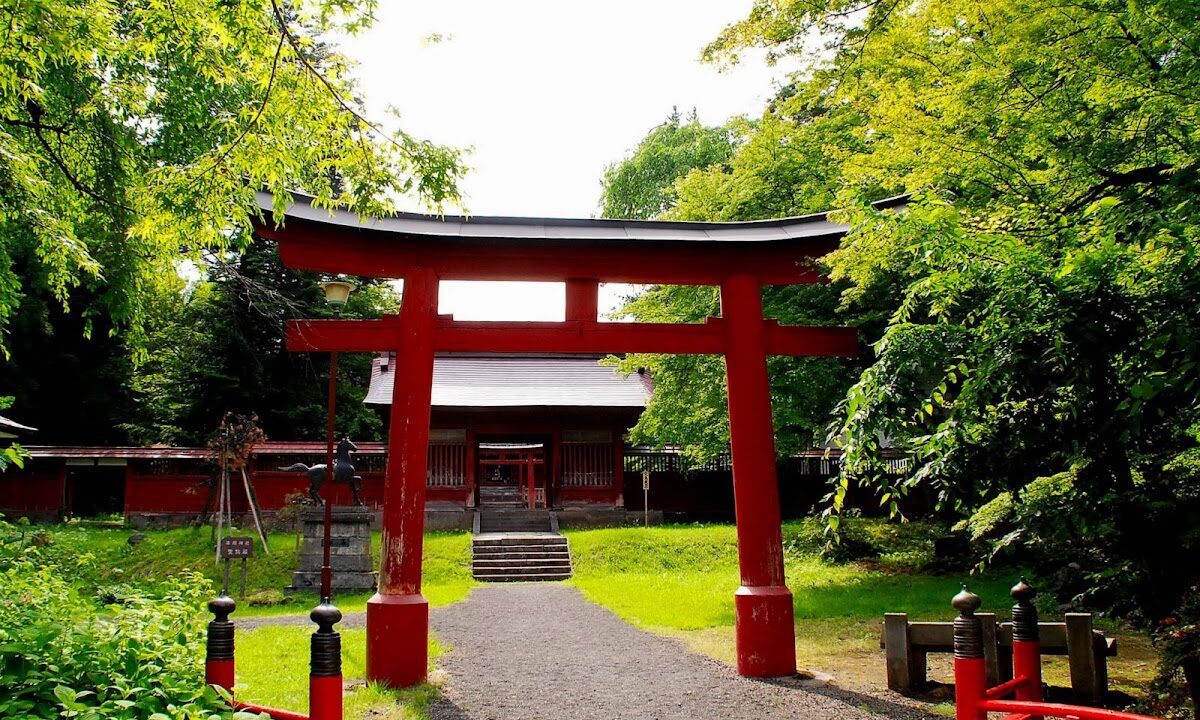
The shrine grounds are surrounded by ancient trees, and the giant cedar trees, in particular, create a solemn atmosphere befitting a sacred place. The changing seasons are beautiful, displaying different expressions depending on the time of year, such as the fresh greenery of spring and the vibrant autumn foliage.
Access
Public Transportation
- Approximately 30 minutes by Konan Bus “Karekidaira Line” from JR Ou Main Line “Hirosaki Station,” get off at “Takateru Shrine Mae” bus stop.
- Approximately 40 minutes on foot (approx. 3.5 km) from Konan Railway Owani Line “Hirokoshita Station.”
By Car
- Approximately 20 minutes from Tohoku Expressway “Owani Hirosaki IC.”
- Parking space for visitors is available beyond the torii gate (free).
Visiting Information
Visiting Hours and Viewing
While you can generally visit the shrine grounds freely, prior confirmation is recommended regarding viewing the interior of the shrine buildings. Especially in winter, visits may be difficult due to snow.
Goshuin (Shrine Seal)
Goshuin can be obtained at the shop (gift shop) in front of the shrine. In addition to the regular goshuin, limited edition goshuin may be given on special days. Bringing your goshuincho (stamp book) is recommended.
Annual Festivals and Events
Takateru Shrine holds various festivals throughout the year. In particular, the festival related to the anniversary of Tsugaru Nobumasa’s death is an important event that has been passed down through generations. As a regional tradition, it attracts the faith of the local people.
Cultural Value of Takateru Shrine
Importance as an Early Modern Shrine Architecture
Takateru Shrine is a valuable example of shrine architecture from the mid-Edo period that has been well preserved. The east-west axis configuration, with the main hall and mausoleum arranged in a straight line, is unique based on Yoshikawa Shinto and is almost unparalleled nationwide.
This arrangement differs from the north-south axis (south-facing orientation) adopted by most shrines and is important evidence of the diversity of early modern shrine architecture. In architectural history research, it is considered valuable material showing how Shinto thought is reflected in architectural space.
Material Heritage of Yoshikawa Shinto
Yoshikawa Shinto held an important position among the various Shinto sects of the Edo period, but very few shrine buildings were constructed based on its philosophy, and Takateru Shrine is a representative surviving example. As an example of how ideas were realized as concrete architectural spaces, it holds high value from the perspectives of religious and intellectual history.
Heritage that conveys the history of the Tsugaru region
Takateru Shrine is an important cultural heritage site that conveys the history of the Hirosaki Domain. The integrated structure of the lord’s tomb and the shrine demonstrates the authority and nature of faith of the domain, making it indispensable for understanding the history of the Tsugaru region.
Highlights and Recommended Points
East-West Straight Line Arrangement of Shrine Buildings
The greatest highlight of Takateru Shrine is experiencing the east-west axis arrangement, starting from the Zuishinmon gate, proceeding to the main hall, and then to the mausoleum and worship hall. By understanding the meaning of this arrangement while visiting, you can experience the worldview of Yoshikawa Shinto.
Group of Important Cultural Property Buildings
Eight important cultural property buildings each demonstrate the excellent architectural techniques of the Edo period. The intricate carvings of the main hall and the majestic appearance of the Zuishinmon gate are particularly noteworthy. By observing the details of the buildings, you can truly appreciate the high level of craftsmanship of the time.
A Tranquil Atmosphere in the Shrine Grounds
Surrounded by ancient trees, the shrine grounds are enveloped in silence, far removed from the hustle and bustle of the city. Visiting early in the morning or on weekdays allows you to experience a deeper spiritual connection. The scenery with Mount Iwaki in the background is also beautiful, making it a popular spot for photography.
Nature in Every Season
The shrine grounds show different expressions with each season—cherry blossoms in spring, lush greenery in summer, autumn leaves, and snowscapes in winter—offering new discoveries with every visit. The autumn foliage season, in particular, offers a rich and beautiful landscape.
Nearby Tourist Attractions
Iwaki-yama Shrine
Located about 15 minutes by car from Takateru Shrine, Iwaki-yama Shrine is an ancient shrine known as the guardian shrine of the Tsugaru region. As the center of Iwaki-yama worship, it is well worth visiting along with Takateru Shrine.
Hirosaki Castle
Located in the heart of Hirosaki City, Hirosaki Castle is one of the 12 remaining original castle keeps and is designated as a National Important Cultural Property. As the former residence of the Tsugaru clan, it is closely linked to the history of Takateru Shrine, and visiting both together is highly recommended.
Saishoin Five-Storied Pagoda
The five-storied pagoda of Saishoin Temple in Hirosaki City is the only five-storied pagoda in the Tohoku region and is designated as a National Important Cultural Property. As a contemporary structure of Takateru Shrine, comparing them during your visit will be fascinating.
Takateru Shrine Management and Preservation Activities
Currently, Takateru Shrine is managed and operated by the Takateru Shrine Management Committee. The committee, composed of local residents and stakeholders, strives to preserve and pass on this valuable cultural property.
They maintain the shrine through various activities, including regular inspections and repairs of the buildings, cleaning and maintenance of the grounds, and execution of festivals. They also disseminate information to widely publicize its value as a cultural property and dedicate efforts to guiding and explaining to visitors.
While the proper preservation of an Important Cultural Property requires considerable expense and effort, efforts continue to ensure its reliable transmission to future generations as a regional treasure and a shared cultural heritage of the nation.
Summary
Takateru Shrine is a precious cultural heritage site that Hirosaki City, Aomori Prefecture, is proud of. It possesses multifaceted value as a place that conveys the history of the Hirosaki Domain, with its unique shrine layout based on Yoshikawa Shinto, its Edo-period buildings designated as a National Important Cultural Property, and its role in preserving the history of the Hirosaki Domain.
Located in the tranquil environment at the foot of Mount Iwaki, Takateru Shrine offers a space where history, faith, and architectural beauty are integrated, making it a must-visit spot when visiting Hirosaki. Rather than simply being a tourist attraction, it is an important place for a deep understanding of Japanese history and culture, and we recommend taking your time to visit and pray there.
Visiting it along with other nearby historical sites such as Hirosaki Castle and Iwakiyama Shrine will allow you to more deeply appreciate the rich history and culture of the Tsugaru region.