Jōkōgū Shrine (Hirosaki City, Aomori Prefecture): A Complete Guide to the Legend of Emperor Chōkei and the History of the Imperial Mausoleum Reference Site
Nestled in the mountains of Kamisukizawa, in the former Sōma Village area of Hirosaki City, Aomori Prefecture, Jōkōgū Shrine is known as a legendary site associated with Emperor Chōkei, a mysterious emperor of the Nanboku-chō period. Behind this shrine lies the “Imperial Mausoleum Reference Site of Emperor Chōkei,” attracting attention from history buffs and researchers as the final resting place of one of the most enigmatic emperors in Japanese history.
This article provides a thorough explanation of this mystical sacred site, covering its historical background, the details of the Emperor Chōkei legend, highlights within the grounds, and access methods.
Basic Information and Access to the Imperial Palace
Location and Transportation Access
Location: 174 Yamakoshi, Kamisukizawa, Hirosaki City, Aomori Prefecture
The Imperial Palace is located in the Soma district, approximately 15 km southeast of Hirosaki city center. The nearest station is Hirokoshita Station on the Konan Railway Konan Line, but the distance from the station to the shrine is considerable, so access by car is recommended.
Access by Car:
- Approximately 30 minutes from central Hirosaki via National Route 102
- Approximately 40 minutes from Kuroishi Interchange on the Tohoku Expressway
- There is some parking space near the temple grounds (unpaved)
Public Transportation:
- Approximately 40 minutes by taxi or on foot after alighting at Hirokoshita Station on the Konan Railway Konan Line
- Buses are also available from Hirosaki Station, but the number of services is limited, so advance confirmation is necessary.
Notes for Visitors
The Imperial Mausoleum is located in a mountainous area, and the path leading to the mausoleum reference site is a steep mountain path. Those planning a visit should note the following:
- Wear comfortable shoes and clothing.
- Visiting may be difficult in winter due to snow.
- The shrine is unmanned, so Goshuin (shrine stamps) are not available.
- Cell phone reception is weak in this area.
History and Origins of Jōkōgū Shrine
Founding and the Worship of Hōryū Gongen
The history of Jōkōgū Shrine dates back to the early Heian period. It is believed to have begun in 807 AD (Daidō 2), when Sakanoue no Tamuramaro, the Seii Taishogun (Commander-in-Chief of the Expeditionary Force against the Barbarians), enshrined Hōryū Gongen in this area during his campaign against the Emishi.
Sakanoue no Tamuramaro was a military commander who played an important role in pacifying the Tohoku region and built shrines and temples throughout the area. The Kamisukizawa area is also thought to have been an important base in his battles against the Emishi.
Emperor Chōkei’s Escape and the Papermaking Museum
The Imperial Palace first appears on the historical stage in the second year of Genchū (1385) during the Nanboku-chō period. Legend has it that Emperor Chōkei, the third emperor of the Southern Court, took refuge in this area.
Emperor Chōkei’s Footsteps:
Emperor Chōkei is said to have ascended the throne in Shōhei 23/Ōan 1 (1368) and reigned until Kōwa 3/Eitoku 3 (1383). However, much about his existence and achievements remains unknown, leading him to be called a “phantom emperor.”
According to tradition, Emperor Chōkei abdicated after 16 years on the throne in favor of his younger brother, Emperor Go-Kameyama, and became a retired emperor. However, due to the machinations of the Ashikaga clan, he was driven out of Kyoto and continued his escape as follows:
- Tamagawa Palace in Kii Province – First place of refuge
- Kongōji Temple on Mount Kōya – Hiding in a sacred Buddhist site
- Ise Province – Beginning of movement to the eastern provinces
- Hitachi Province by sea – Heading north along the Pacific coast
- Shirakawa/Date – To the Tohoku region
- Mutsu Province – Final place of seclusion
From the Namioka Mansion to the Papermaking Museum
In 1385 (Genchū 2), Emperor Chōkei was staying at the Namioka Mansion (present-day Namioka district, Aomori City), but was attacked by the forces of Nanbu Masamitsu and forced to flee, wounded.
The Emperor, accompanied by his loyal retainers, entered the Kamisuki-kan (Kamisukizawa Manor), which was guarded by Nitta Muneoki. The Nitta clan was a branch of Nitta Yoshisada, a powerful general of the Southern Court, and they defended a stronghold of the Southern Court in the Tohoku region.
Death and Establishment of the Jōkō-gū (Emperor’s Palace)
According to tradition, Emperor Chōkei hid himself among Shugendō mountain ascetics in Kamisukizawa and died in 1403 (Ōei 10) at the Kamisukizawa Palace, surrounded by his loyal retainers. While there are various theories regarding his age at death, it is believed to have been around 60 years old.
After the Emperor’s death, a mausoleum was built on this site, and a shrine dedicated to the Emperor was erected. This is the origin of the current Jōkō-gū (Emperor’s Palace). The name “Jōkō-gū” (Emperor’s Palace) derives from the fact that Emperor Chōkei died as a retired emperor.
Highlights of the Shrine Grounds and the Reference Site for the Imperial Mausoleum
The Jōkōgū Shrine
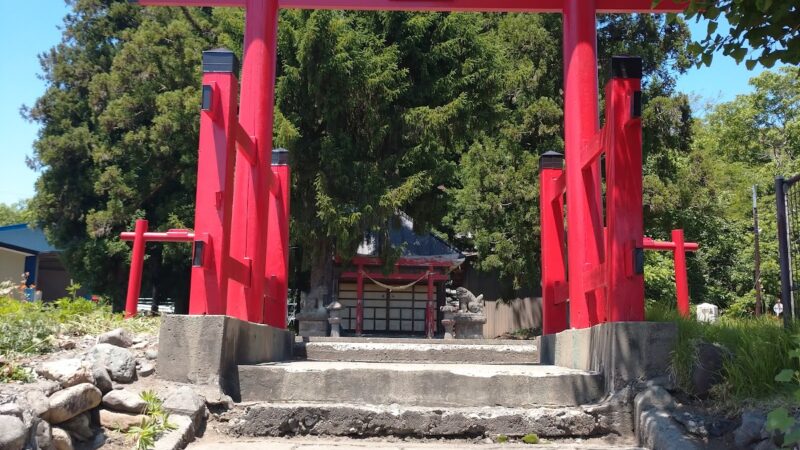
The Jōkōgū Shrine is located at the foot of the mountain and is a simple yet solemn building. The main deity enshrined is Emperor Chōkei, and it has been carefully preserved by the local people.
The shrine is unmanned, but it is regularly cleaned and maintained by local parishioners and history enthusiasts. A small torii gate stands in front of the shrine, beyond which a path leads.
The Path to the Reference Site for Emperor Chōkei’s Imperial Mausoleum
The main highlight of the Jōkōgū Shrine is the “Reference Site for Emperor Chōkei’s Imperial Mausoleum,” located at the top of a steep mountain path that continues from behind the shrine.
Features of the Approach to the Shrine:
- A mountain path that begins behind the shrine building.
- It requires climbing a steep slope, taking approximately 15-20 minutes one way.
- Careful walking is necessary due to uneven footing in some areas.
- A tranquil environment surrounded by trees.
Appearance of the Imperial Mausoleum Reference Site
Upon reaching the top of the mountain path, a space enclosed on all four sides by a fence appears on a small hill. This is the Imperial Mausoleum Reference Site of Emperor Chokei.
Composition of the Imperial Mausoleum Reference Site:
- A sacred area surrounded by a wooden fence
- A wooden post inscribed with “Former Imperial Mausoleum Reference Site of Emperor Chokei” stands in front of the site
- A mound-like earthen mound (imperial mausoleum)
- Surrounded by natural forest, creating a solemn atmosphere
Historical Positioning of the Imperial Mausoleum Reference Site
Regarding Emperor Chokei’s mausoleum, several candidate sites existed until before the war:
- Soma Mausoleum Reference Site (Kamisukizawa, Hirosaki City, Aomori Prefecture) – The location introduced in this article
- Kawane Mausoleum Reference Site (Wakayama Prefecture)
- Saga Tenryuji Mausoleum (Ukyo-ku, Kyoto City, Kyoto Prefecture)
In February 1944, the Imperial Household Agency officially designated the mausoleum in Saga Tenryuji Kakukura-cho, Ukyo-ku, Kyoto City, as the official mausoleum of Emperor Chokei. As a result, the designations of the Soma and Kawane imperial tomb reference sites were removed, but their historical value is still recognized as “former imperial tomb reference sites.”
About Emperor Chokei: A mysterious emperor of the Nanboku-cho period
The life of Emperor Chokei
Emperor Chokei is considered the third emperor of the Southern Court, but his existence has long been debated.
Basic Information:
- Year of Birth: Kōkoku 4th year/Kōei 2nd year (1343)
- Death: Ōei 1st year (1394) or Ōei 10th year (1403) *There are various theories*
- Father: Emperor Go-Murakami
- Mother: Kakimon’in Fujiwara no Katsuko
- Reign: Shōhei 23rd year/Ōan 1st year (1368) – Kōwa 3rd year/Eitoku 3rd year (1383)
Why is he called the “Phantom Emperor”?
The reason Emperor Chōkei is called the “Phantom Emperor” is because there are almost no records of him as emperor in reliable historical sources from his time.
Debate Surrounding His Existence:
- There are no detailed descriptions in the *Jinnō Shōtōki*, the official record of the Southern Court.
- Records of the enthronement ceremony and the establishment of the era name are unclear.
- Records are only found in later compilations.
In the Meiji era, when the legitimacy of the Southern Court was recognized, the existence of Emperor Chōkei was officially acknowledged, and he came to be counted as one of the successive emperors. The current number of emperors is counted including Emperor Chōkei.
Historical Background of the Nanboku-chō Period
The Nanboku-chō period (1336-1392), in which Emperor Chōkei lived, was a period of unprecedented turmoil in Japanese history.
The Circumstances of the Split of the Northern and Southern Courts:
- Emperor Go-Daigo’s Kenmu Restoration (1333)
- Ashikaga Takauji’s Defection and the Enthronement of Emperor Kōmyō (1336)
- Emperor Go-Daigo’s Escape to Yoshino (Establishment of the Southern Court)
- Approximately 60 Years of Conflict Between the Two Courts
- Unification of the Northern and Southern Courts in Meitoku 3 (1392)
The era of Emperor Chōkei coincides with a period of gradual decline in the power of the Southern Court. The imperial family and court nobles of the Southern Court, driven out of Kyoto, scattered throughout the country, relying on local samurai to survive.
The Sōma District and the Legend of Emperor Chōkei
Historical Importance of the Sōma District
The Sōma district of Hirosaki City (formerly Sōma Village) is a region with many historical legacies in addition to the legend of Emperor Chōkei.
Major Historical Sites in the Soma Area:
- Emperor’s Palace – A shrine dedicated to Emperor Chokei
- Mochiyori Castle Ruins (Fujisawa Area) – Ruins of a medieval mountain castle
- Iwaya Fudo-son (Daisuke Area) – A sacred site of Shugendo (mountain asceticism)
- Kakuoin Temple (Yuguchi Area) – An ancient temple
- Funauchi Mine Ruins – Remains of a modern mining operation
Why Did He Flee to Tohoku?
There are several theories as to why Emperor Chokei fled to the far reaches of Tohoku:
- A Base of Southern Court Forces – Many Southern Court generals resided in the Tohoku region, and in particular, the Nitta and Kitabatake clans maintained their power.
- Geographical Isolation – Tohoku, far from Kyoto, was suitable for escaping pursuit by the Ashikaga forces.
- Shugendo Network – The mountains of Shugendo in the Tohoku region were ideal places to hide.
Local Legends
In the Soma area, various legends related to Emperor Chokei are still passed down today:
- Origin of the Place Name Kamisukizawa – From the fact that the Emperor’s attendants made a living by making paper.
- Legend of the Imperial Palace Site – The site where the Emperor’s temporary palace is said to have been located.
- Graves of Loyal Retainers – Stone monuments believed to be the graves of loyal retainers who served the Emperor are scattered throughout the area.
- Legend of the Treasure – A legend that items related to the Emperor are buried underground.
Imperial Palace and Surrounding Attractions
Other Historical Sites in the Soma Area
When visiting the Imperial Palace, we recommend also visiting other historical spots in the Soma area.
Mochiyori Castle Ruins (Fujisawa Area):
This is the site of a medieval mountain castle, believed to have been one of the Southern Court’s strongholds during the reign of Emperor Chokei. Currently, some remains exist, and you can see the baileys and moats.
Iwaya Fudo-son (Daisuke area):
An ancient temple known as a sacred site of Shugendo (mountain asceticism). It is said to be associated with the legend that Emperor Chokei hid himself here as a Shugendo mountain ascetic.
Kakuoin (Yuguchi area):
An ancient temple in the Soma area, a temple that tells the history of the region. Old stone Buddha statues and memorial towers remain on the temple grounds.
Connection to Goshogawara City
Goshogawara City, which borders the Soma area, also has historical sites related to the legend of Emperor Chokei. The two areas have deep historical ties and are thought to have functioned as a unified region during the Nanboku-cho period (Northern and Southern Courts period).
Points to Note and Tips for Visiting
Best Time to Visit
The best time to visit the Imperial Palace is from spring to autumn:
- Spring (April-May): Beautiful fresh greenery, and the mountain paths are easy to walk.
- Summer (June-August): Lush greenery, and the cool mountain air is pleasant. However, insect repellent is necessary.
- Autumn (September-November): The autumn foliage is beautiful, and this is the busiest time of year for visitors.
- Winter (December-March): Heavy snow makes visiting difficult. Even locals avoid this time of year.
Equipment to Bring
If you plan to climb to the Imperial Mausoleum Reference Site, please prepare the following equipment:
- Hiking boots or trekking shoes – Shoes with non-slip soles
- Long-sleeved shirt and long pants – To prevent insect bites and injuries from branches
- Hat – To protect your head from the sun and branches
- Drinking water – There are no vending machines nearby
- Towel – For wiping sweat
- Insect repellent spray – Especially important in summer
- Camera – For documentation (however, please be considerate when taking photos inside the Imperial Mausoleum)
Manners for Visiting
The Imperial Palace is a sacred site associated with the Emperor and an important place of worship for the local people. Please observe the following manners when visiting the site:
- Visit in silence
- Do not enter the fenced area of the Imperial Mausoleum Reference Site
- Always take your trash with you
- Do not collect plants or stones
- Do not make loud noises
- Remember to greet the local residents
Current and Future Research on the Imperial Emeritus
Progress in Historical Research
Research on Emperor Chokei and the Imperial Emeritus continues to this day. In recent years, the following research has been conducted:
- Approach from Documentary History – Re-examination of historical materials from the Nanboku-cho period
- Archaeological Investigation – Possibility of excavation around Kamisukizawa
- Collection of Traditions – Recording and preservation of oral traditions remaining in the region
- Comparative Research with Other Candidate Sites – Comparison with related sites in Wakayama and Kyoto
Utilization for Regional Development
In the Soma area, attempts are being made to utilize the legend of Emperor Chokei as a valuable historical resource for the region:
- Promotion of Historical Tourism – Establishment of historical site tours including the Imperial Palace
- Educational Activities – Local history education in local elementary and junior high schools
- Information Dissemination – Introduction through websites and brochures
- Preservation Activities – Maintenance and environmental improvement of historical sites
Challenges in Preservation and Utilization
On the other hand, there are challenges in the preservation and utilization of the Imperial Palace:
- Difficulties in Management due to Depopulation – Decline in the local population
- Access Issues – Poor accessibility of public transportation
- Aging Facilities – Maintenance of shrine buildings and approach paths
- Lack of Information – Low national recognition
These challenges require cooperation from the government, local residents, researchers, and history enthusiasts.
Access and Sightseeing Information for the Soma District of Hirosaki City
Day Trip Plan from Hirosaki City Center
An example of a day trip plan to the Soma district from Hirosaki city center:
Morning:
- 9:00 Depart from Hirosaki Station (rental car recommended)
- 9:30 Arrive at the Jōkōgū Shrine and pay your respects (1-1.5 hours)
- 11:00 Visit nearby historical sites (e.g., Mochiyori Castle Ruins, Iwaya Fudo-son)
Afternoon:
- 12:00 Lunch in the Soma district or Hirosaki city center
- 13:30 Sightseeing in the city center, including Hirosaki Castle Park
- 16:00 Return to Hirosaki Station
Accommodation
Since accommodation is limited around the Soma district, it is convenient to stay in Hirosaki city center:
- Hotels in Hirosaki City Center – Many options available
- Hot Spring Inns – Ōwani Onsen, Asamushi Onsen, etc. are nearby
- Guesthouses – A few available around the Soma area
Meals and Souvenirs
Specialties of the Soma Area:
- Apples – A representative specialty of Aomori Prefecture
- Soba Noodles – Handmade soba noodles made with locally grown buckwheat
- Wild Vegetables – Enjoy local wild vegetable dishes in spring
Gourmet Food in Hirosaki City:
- Hirosaki Ramen – Characterized by its dried sardine broth
- Tsugaru Soba – Unique soba noodles made with ground soybean broth
- Apple Sweets – A variety of apple sweets including apple pie
Summary: Seeking Historical Romance at the Imperial Palace
The Imperial Palace in Kamisukizawa, Hirosaki City, Aomori Prefecture, is an extremely interesting place in Japanese history as the site of the death of Emperor Chokei, shrouded in mystery during the Nanboku-cho period. The experience of climbing the mountain path from the shrine to the imperial tomb reference site goes beyond mere sightseeing and will be a valuable opportunity to touch the depths of history.
The Charm of Jōkōgu Shrine:
- The historical romance surrounding Emperor Chōkei, the “phantom emperor”
- Historical importance as an official mausoleum reference site until 1944
- A tranquil environment surrounded by nature
- Rich local traditions and culture
- A valuable historical site demonstrating the reality of the Southern Court’s influence in Tohoku during the Nanboku-chō period
While access may be somewhat difficult, the feeling of awe upon visiting is all the more profound. This is a place we highly recommend for those interested in history, those drawn to the romance of the Nanboku-chō period, and those seeking tranquility in a quiet mountain shrine.
Jōkōgu Shrine in the Sōma district of Hirosaki City is a hidden historical spot not yet widely known throughout Japan, but its historical value and cultural significance are immeasurable. A journey tracing the footsteps of Emperor Chōkei will be an intellectually stimulating experience, unraveling a mysterious page in Japanese history.
When you visit Aomori Prefecture, be sure to stop by this hidden historical site, the Jōkōgū, along with famous tourist spots like Hirosaki Castle and the Shirakami Mountains. There, you’ll find a living history that you won’t find in textbooks.