Kumano-gu Shrine (Hinokuchi-cho, Hirosaki City, Aomori Prefecture) | A Thorough Explanation of its History and Architectural Charm
Located in Hinokuchi-cho, Hirosaki City, Aomori Prefecture, Kumano-gu Shrine is a historically significant shrine, with its main hall, built in 1615 (Keicho 20) during the early Edo period, designated as an important cultural property of Aomori Prefecture. Formerly known as “Kumano Sansho Hiryu Daigongen” and affectionately called “Fukuro-no-miya,” this shrine received deep reverence from the Tsugaru family, the lords of the Hirosaki domain, and has a history of over 400 years as a center of local faith.
This article provides a comprehensive explanation of Kumano-gu Shrine’s detailed history, architectural features, cultural value, and its evolution to the present day.
Basic Information and Location of Kumano-gu Shrine
Location: Hinokuchi-cho, Hirosaki City, Aomori Prefecture
Main Deities: Kumano Sansho Gongen (Izanagi-no-Mikoto, Izanami-no-Mikoto, Ietsumiko-no-Okami)
Shrine Rank: Former Village Shrine
Cultural Property Designation: The main hall of Kumano-gu Shrine is designated as an Aomori Prefecture Important Cultural Property (building)
Date of Designation: April 21, 1961
Kumano-gu Shrine is located slightly east of the center of Hirosaki City, situated in the area surrounding the former Hirosaki Castle town. The place name Hinokuchi-cho is said to have historical origins related to waterways and irrigation facilities, and the area is deeply connected to the agricultural development of the region.
The Founding and Historical Background of Kumano Shrine
Origin of the Founding and Kumano Sansho Gongen
The exact founding date of Kumano Shrine is unknown, but based on historical documents and traditions, it is believed to have existed as an object of worship since the late medieval period. The shrine was formerly known by the divine title “Kumano Sansho Hiryu Daigongen” and is rooted in the Kumano Gongen faith, which is based on the Kumano Sanzan faith of Kii Province (present-day Wakayama Prefecture).
Three shrines based on Kumano faith are located around Hirosaki, and these are said to be modeled after the Kumano Sanjo Gongen:
- Shingu: Located in Mongai Village (present-day Mongai, Hirosaki City)
- Hongu: Kumano Okuteru Shrine in Tamachi (present-day Tamachi 4-chome, Hirosaki City)
- Nachigu: Kumano-gu in Hinokuchi-cho (the subject of this article)
This arrangement is modeled after the composition of the Kumano Sanzan (Three Grand Shrines of Kumano): Kumano Hongu Taisha, Kumano Hayatama Taisha (Shingu), and Kumano Nachi Taisha. Kumano-gu in Hinokuchi-cho was built to correspond to Nachigu. This religious system of these three shrines strongly reflects the spread of Kumano faith in the Tsugaru region and the influence of syncretic Shinto-Buddhist thought from the medieval to early modern periods.
Alternative Name: “Fukuro-no-miya”
Kumano-gu has been affectionately known locally as “Fukuro-no-miya.” There are several theories regarding the origin of this name, but one theory suggests it is related to the bag-shaped topography of the shrine grounds or to the shape of the area the shrine protects. Such a friendly name can be seen as evidence that the shrine was closely intertwined with the lives of the local residents.
Deep Connection with the Tsugaru Family
Kumano Shrine received deep reverence from the Tsugaru clan after they came to rule the Hirosaki Domain. In particular, there is an interesting legend concerning Tsugaru Tamenobu (Oura Tamenobu), the first lord of the Tsugaru family.
In 1569, a series of incidents occurred where people, regardless of their social status, fell from their horses as they passed in front of the Kumano Shrine grounds. Hearing of this strange phenomenon, Tamenobu himself mounted his beloved horse and passed in front of the shrine, but it is said that he also fell and suffered serious injuries.
This incident led Tamenobu to recognize the powerful spiritual energy of Kumano Shrine, and thereafter, the Tsugaru family revered this shrine for generations. Successive feudal lords donated shrines and statues, establishing Kumano Shrine’s position as a place of prayer for the Tsugaru family.
Thanks to the patronage of these feudal lords, the shrine buildings were properly maintained and repaired, laying the foundation for the preservation of these valuable structures to this day.
Architectural Features of the Kumano Shrine Main Hall
Constructed in Keicho 20 (1615)
The current Kumano Shrine Main Hall is believed to have been constructed in Keicho 20 (1615), based on records in the ridge beam inscription. This year marked the death of Tokugawa Ieyasu and the end of the Summer Siege of Osaka, a crucial period in the establishment of the Edo Shogunate’s rule.
The construction date of Keicho 20 is extremely valuable for understanding early Edo period shrine architecture in the Tohoku region. The architectural techniques and styles of the early 17th century are well-preserved, making it a significant site in architectural history research.
Architectural Style and Structure
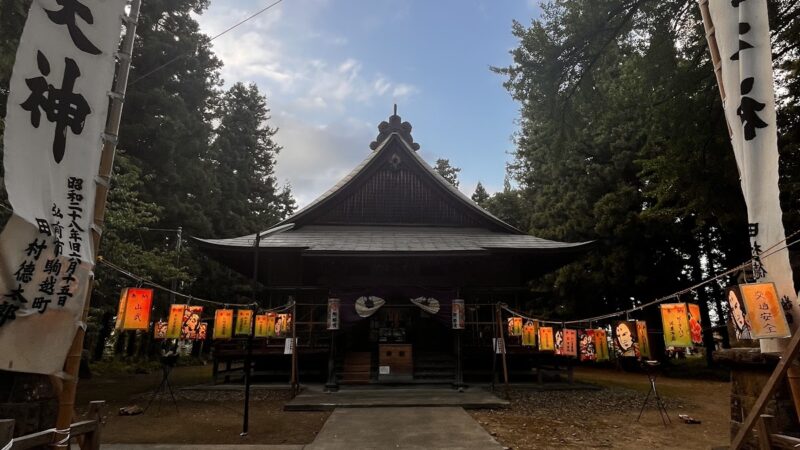
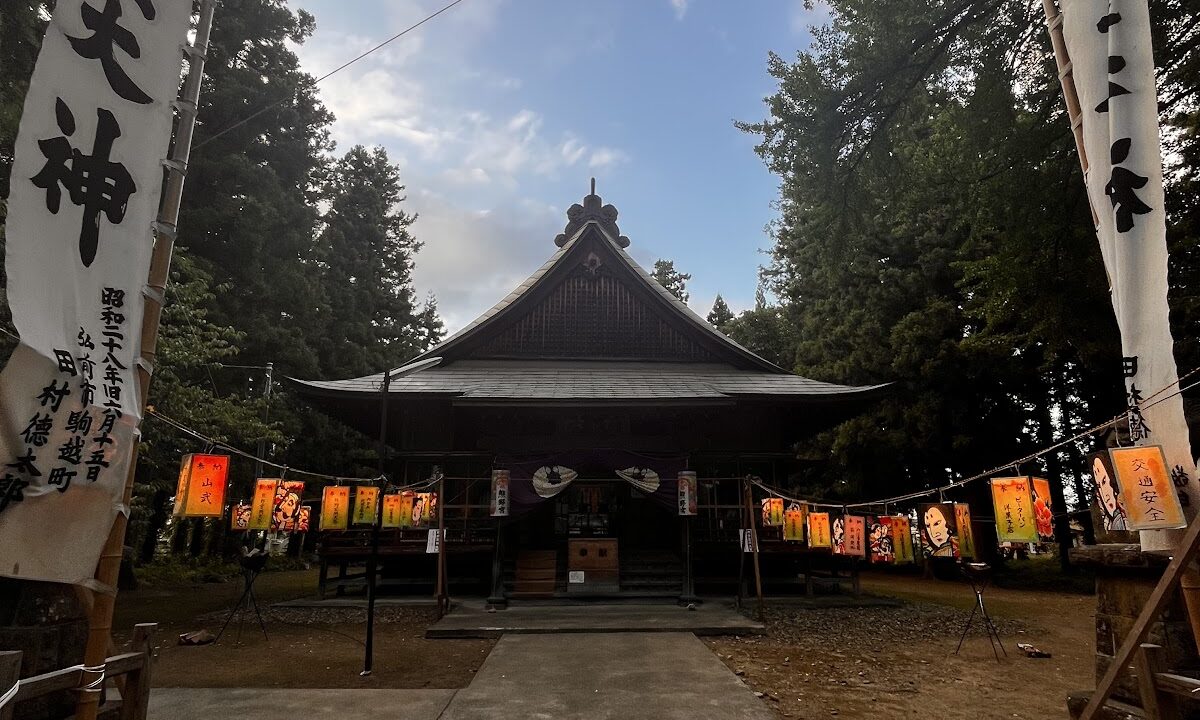
The main hall of Kumano-gu Shrine employs the Ikkensha Nagare-zukuri style. Nagare-zukuri is one of the most common styles in Japanese shrine architecture, characterized by a long, extended roof that forms a portico (kohai).
Main Structural Features:
- Scale: Ikkensha (one bay between pillars at the front)
- Roof: Currently covered with iron sheets, but likely originally covered with cypress bark or persimmon bark shingles
- Portico: A worship space located at the front
- Bracket System: An elaborate structure using brackets (tokyo)
Features of Decorative Sculpture
One of the major highlights of the main hall of Kumano-gu Shrine is the sculptural decorations found throughout. The following elements are particularly noteworthy:
Sculpture of the Gegyo (Dango Ornament):
The gegyo, attached below the gable, features intricate carvings. The kakegyo (decorative gable ornament) is a decorative element with the meaning of warding off fire, and often uses motifs such as fish, plants, and mythical creatures. The kakegyo of the main hall of Kumano Shrine is a valuable example that conveys the carving techniques of the early Edo period.
Elephant Trunk (Zōbana):
The elephant trunk is a decorative element installed in the bracket system supporting the pillars of the portico, and is a component that curves like an elephant’s trunk. The elephant trunk of the main hall of Kumano Shrine is adorned with magnificent carvings, demonstrating a high level of perfection as architectural decoration.
These carvings convey the skills of excellent craftsmen from the Keichō period and are highly valued from both architectural and art history perspectives. They are also valuable historical materials for understanding the level of carving techniques in the Tsugaru region during the early Edo period.
Preservation and Restoration History
Although more than 400 years have passed since its construction, the main hall of Kumano Shrine remains in a relatively good state of preservation. This is due to proper maintenance and management under the patronage of the Tsugaru family and the continued faith of the local residents.
Since being designated a Cultural Property of Aomori Prefecture in 1961, protective measures have been taken as a cultural property, including regular inspections and necessary repairs. During the Heisei period, preservation and repair work, such as roof replacement and structural reinforcement, was carried out, ensuring the transmission of this valuable cultural property to future generations.
Value as a Cultural Property
Significance of Designation as a Cultural Property of Aomori Prefecture
The main hall of Kumano-gu Shrine was designated a Cultural Property (building) of Aomori Prefecture on April 21, 1961. This designation indicates that the main shrine building possesses high historical and academic value in the following respects:
- Chronological Value: An early Edo period building with a clear construction date of Keicho 20 (1615)
- Stylistic Value: An excellent example of the typical shrine architecture style, Ikkensha Nagare-zukuri
- Technical Value: A valuable example conveying early Edo period architectural and sculptural techniques
- Regional Historical Value: An important remains showing the development of Kumano faith in the Tsugaru region
- Preservation Status: A rare example of a building that remains in excellent condition after more than 400 years
Position in the Tohoku Region
While many shrine buildings from the medieval to early modern periods remain in the Tohoku region, examples of buildings from the very beginning of the Edo period, the Keicho era, that are so well preserved are limited. The Kumano-gu Main Shrine is attracting attention from architectural historians as an important document that fills a gap in the history of shrine architecture in the Tohoku region.
Furthermore, it is valuable from the perspective of religious history and folklore as a concrete example showing how Kumano faith spread to the Tohoku region and was incorporated into the local belief system.
Kumano Shrine Grounds and Surrounding Environment
Appearance of the Shrine Grounds
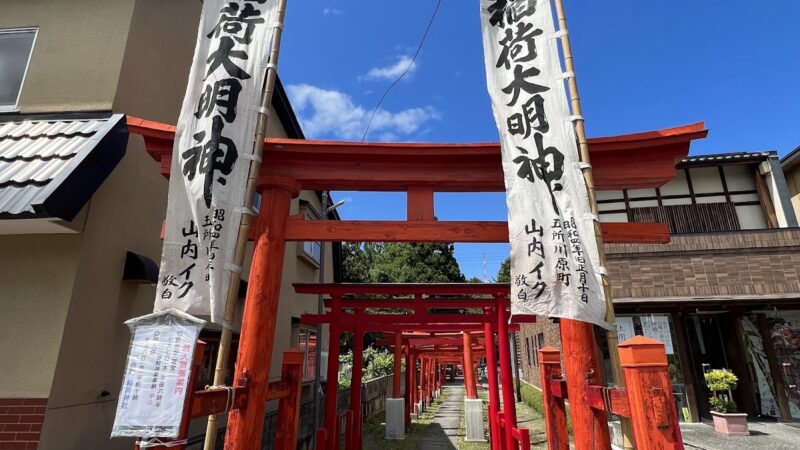
The grounds of Kumano Shrine are quietly situated in a residential area of Hirosaki City. Passing through the torii gate, the path leads to the main shrine, and the ancient trees within the grounds create a sacred atmosphere.
The main shrine is protected by a protective structure, ensuring an appropriate environment for its preservation as a cultural property. The protective structure shields the main shrine from wind and rain and is an essential facility for the long-term preservation of this valuable building.
Festivals and Annual Events
Various festivals and religious ceremonies are held at Kumano Shrine throughout the year. The annual grand festival, in particular, is an important event where local residents gather, and traditional religious ceremonies are passed down. These festivals demonstrate that the shrine functions not merely as a cultural property, but as a living place of faith. ### Surrounding Historical Environment
The area around Hinokuchi-cho is located on the outskirts of Hirosaki Castle town and developed as an agricultural area during the Edo period. Numerous other historical temples and shrines are scattered throughout the vicinity, forming Hirosaki’s rich cultural heritage.
Within walking distance of Kumano-gu Shrine are Mongai Shingu Shrine and Kumano Okuteru Shrine (Hongu) in Tamachi, both of which are part of the Kumano Sansho Gongen complex. A “Kumano Sansha Pilgrimage” visiting these sites would be an interesting historical exploration.
Kumano Faith and the Tsugaru Region
Spread of Kumano Faith
From the late Heian period to the Kamakura period, Kumano faith spread from the imperial family and nobility to samurai and commoners, reaching such prosperity that it was described as “an ant-like pilgrimage to Kumano.” This faith spread throughout Japan, and many Kumano shrines were established in the Tohoku region.
The development of Kumano faith in the Tsugaru region is an interesting example from the perspective of the acceptance and regionalization of central culture. The arrangement of three shrines in the form of Kumano Sansho Gongen demonstrates an intention to faithfully imitate the original Kumano Sanzan, reflecting the deep devotion of the people of that time to Kumano faith.
Influence of Shinto-Buddhist Syncretism
Kumano Gongen faith is a typical example of Shinto-Buddhist syncretism. The term “Gongen” itself is based on the Honji Suijaku theory, which posits that Buddhas appear in the form of gods. Before the Meiji-era separation of Shinto and Buddhism, Kumano Shrine also maintained a form of Shinto-Buddhist syncretism, and it is possible that a betto-ji (a temple that managed the shrine) existed.
Although Kumano Shrine was transformed into a purely Shinto shrine after the Meiji-era separation of Shinto and Buddhism, a long history of Shinto-Buddhist syncretism underlies its faith.
Visiting Information and Access
Access Methods
Public Transportation:
- Take a Konan Bus from JR Hirosaki Station, then walk from the nearest bus stop.
- If using the Konan Railway Konan Line, walk from the nearest station.
By Car:
- Approximately 20 minutes from the Tohoku Expressway Owani-Hirosaki Interchange.
- Approximately 10 minutes from Hirosaki city center.
- It is recommended to check parking availability in advance.
Points to Note When Visiting
The main hall of Kumano Shrine is a valuable cultural property designated as an important cultural property of Aomori Prefecture. Please observe the following points when visiting:
- The main hall is protected within a protective structure, and normally only the exterior can be viewed.
- Please maintain silence on the grounds and be considerate of other visitors.
- Photography is permitted only for personal use, and flash photography should be kept to a minimum.
- Please refrain from touching the buildings to protect the cultural property.
Points to Note When Visiting Kumano Shrine
Main points of interest when visiting Kumano Shrine:
- Architectural Style of the Main Hall: The elegant form of the Ikkensha Nagare-zukuri style
- Carvings and Decorations: Exquisite carvings such as the Kakegyo and Zōbana
- Atmosphere of the Grounds: A tranquil space that evokes a sense of history
- Kumano Sanzan Pilgrimage: If time permits, please visit the other two shrines as well.
Exploring the Cultural Properties and History of Hirosaki City
Hirosaki City’s Rich Cultural Heritage
Hirosaki City, as the central city of the Tsugaru region, has accumulated a diverse cultural heritage from the Edo period through the Meiji, Taisho, and Showa eras. Hirosaki boasts a wealth of well-preserved buildings from various eras, including Hirosaki Castle, a nationally designated Important Cultural Property, numerous temples and shrines, Western-style architecture, and samurai residences.
Kumano-gu Shrine’s main hall is also part of this group of Hirosaki cultural properties, playing a vital role in conveying the region’s history.
Urban Development Utilizing Cultural Properties
Hirosaki City is actively promoting urban development that utilizes cultural properties, aiming to preserve and utilize historical buildings. Cultural properties rooted in the community, such as Kumano-gu Shrine, are appropriately protected within this framework, and a system is in place to ensure their transmission to future generations.
Summary: The Historical Significance of Kumano-gu Shrine
Kumano-gu Shrine, located in Hinokuchi-cho, Hirosaki City, Aomori Prefecture, is a historically and architecturally extremely valuable shrine, with its main hall, built in 1615 (Keicho 20), designated as an Aomori Prefecture Important Cultural Property.
Built as the Nachi Shrine of the Kumano Sanjo Gongen, and revered by the Tsugaru family, Kumano Shrine has a history spanning over 400 years and holds significant value in the following respects:
- Architectural Historical Value: An outstanding example of early Edo period shrine architecture
- Technical Value: A valuable historical structure that conveys the architectural and sculptural techniques of the Keicho period
- Religious Historical Value: A concrete example demonstrating the spread of Kumano faith to the Tohoku region
- Regional Historical Value: A historical witness that tells the story of the relationship between the Tsugaru family and the local community
Currently functioning as a center of local faith and appropriately protected as a valuable cultural asset, Kumano Shrine is an indispensable spot when exploring the history of Hirosaki. When you visit Hirosaki, be sure to visit this historic shrine and experience the architectural beauty and religious history that has been passed down for over 400 years.
The exquisite carvings of the main hall of Kumano Shrine, the elegant architectural style, and the tranquil atmosphere of the grounds will convey to visitors the profoundness of traditional Japanese culture and the feelings of the people who have preserved and passed it down.