Complete Guide to Kiso Sansha Shrine (Gunma Prefecture) | A Shrine Associated with Kiso Yoshinaka, Goshuin (Shrine Seal), and Access Information
Kiso Sansha Shrine, located in Shimohakoda, Kitatachibana-cho, Shibukawa City, Gunma Prefecture, is a historically significant shrine founded by Kiso Yoshinaka, a military commander of the late Heian period, and his retainers. Also known as “Takinomiya” and “Kiso Daimyojin,” this shrine, with its rare “descending shrine” design, is known as a representative power spot in Gunma Prefecture, enveloped in a mystical atmosphere nurtured by the spring water of Mount Akagi and surrounded by abundant nature.
This article comprehensively introduces information you should know before visiting Kiso Sansha Shrine, including its history, highlights within the grounds, goshuin information, and access methods.
History and Origins of Kiso Sansha Shrine
Founding Circumstances and Deep Connection to Kiso Yoshinaka
The founding of Kiso Sansha Shrine dates back to the first year of the Genryaku era (1184). This year also marked the death of Kiso Yoshinaka, a military commander of the late Heian period, at the young age of 31, after being defeated in battle against Minamoto no Yoshitsune’s army at Awazu in Omi Province (present-day Otsu City, Shiga Prefecture).
After Yoshinaka’s death, his retainers—the Imai, Takanashi, Machida, Onozawa, Hagiwara, Morota, and Kushibuchi clans—fled to this area (present-day Kitatachibana-cho, Shibukawa City, Gunma Prefecture) to escape the pursuit of the Minamoto clan. They then enshrined three Engishiki-listed shrines from Chikuma District, Shinano Province (Nagano Prefecture), which their lord Kiso Yoshinaka deeply revered, in this location.
The three shrines are:
- Okada Shrine (Okada Shimo-Okada, Matsumoto City, Nagano Prefecture)
- Sata Shrine (Shimadate, Matsumoto City, Nagano Prefecture)
- Are Shrine (Soga, Shiojiri City, Nagano Prefecture)
These are all historically significant shrines listed in the Engishiki Jinmyocho, compiled in 927 AD. They were shrines that Kiso Yoshinaka enshrined and revered within his castle in Kiso Kashiwabara, Shinano Province. It is said that his retainers, in order to comfort their lord’s spirit and commemorate his virtues, enshrined divided spirits of these three shrines in this location, thus establishing the Kiso Sansha Shrine.
The Legend of Tomoe Gozen and Kiso Yoshimoto
The legend surrounding the founding of the Kiso Sansha Shrine also mentions the existence of Tomoe Gozen, known as Kiso Yoshinaka’s concubine. According to one theory, Tomoe Gozen also fled to this area with Yoshinaka’s third son, Kiso Yoshimoto, and was involved in the founding of the shrine.
Within the shrine grounds is a stone called “Yoshimoto’s Resting Stone,” and legend remains that Kiso Yoshimoto rested on this stone. This stone is still carefully preserved as a historical site visited by worshippers.
Former Shrine Rank and Historical Changes
Kiso Sansha Shrine was ranked as a Prefectural Shrine under the shrine ranking system of the Meiji era. Prefectural Shrines are the highest-ranking shrines managed by prefectures and have played an important role as a center of faith in the region.
During the Edo period, it was also known as “Takinomiya” and “Kiso Daimyojin,” and attracted the faith of local residents. The alternative name “Takinomiya” in particular is deeply connected to the pure spring water flowing through the shrine grounds, indicating that it also possessed characteristics as a water deity.
Deities and Divine Virtues
Kiso Sansha Shrine enshrines the deities of the three shrines that were established through invitation.
Main Deities
- Susanoo-no-Mikoto: God of protection against misfortune, eradication of disease, and matchmaking
- Hikohodemi-no-Mikoto: Known as Yamasachihiko, god of fertility and good fortune
- Toyotama-hime-no-Mikoto: Daughter of the sea god, goddess of safe childbirth and child-rearing
- Ukemochi-no-Kami: God of food and abundant harvests
These deities are believed to possess a wide range of divine virtues, including protection against misfortune, family safety, abundant harvests, matchmaking, and safe childbirth, and have protected the lives of the local people since ancient times.
Highlights and Features of the Shrine Grounds
A Rare “Descending Shrine” Approach
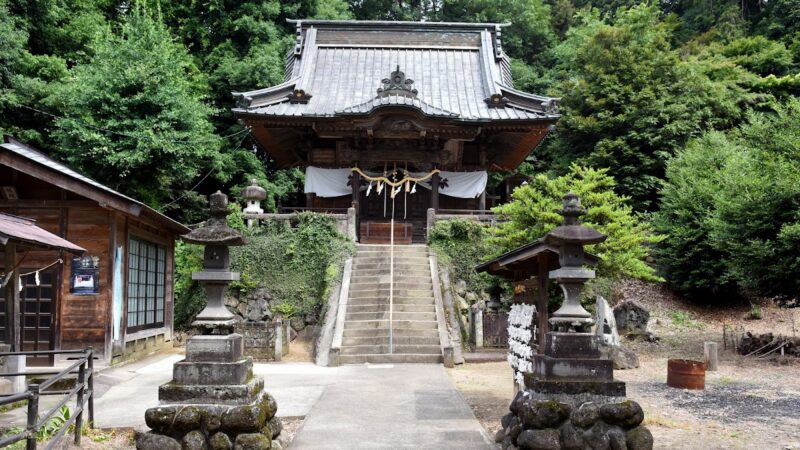
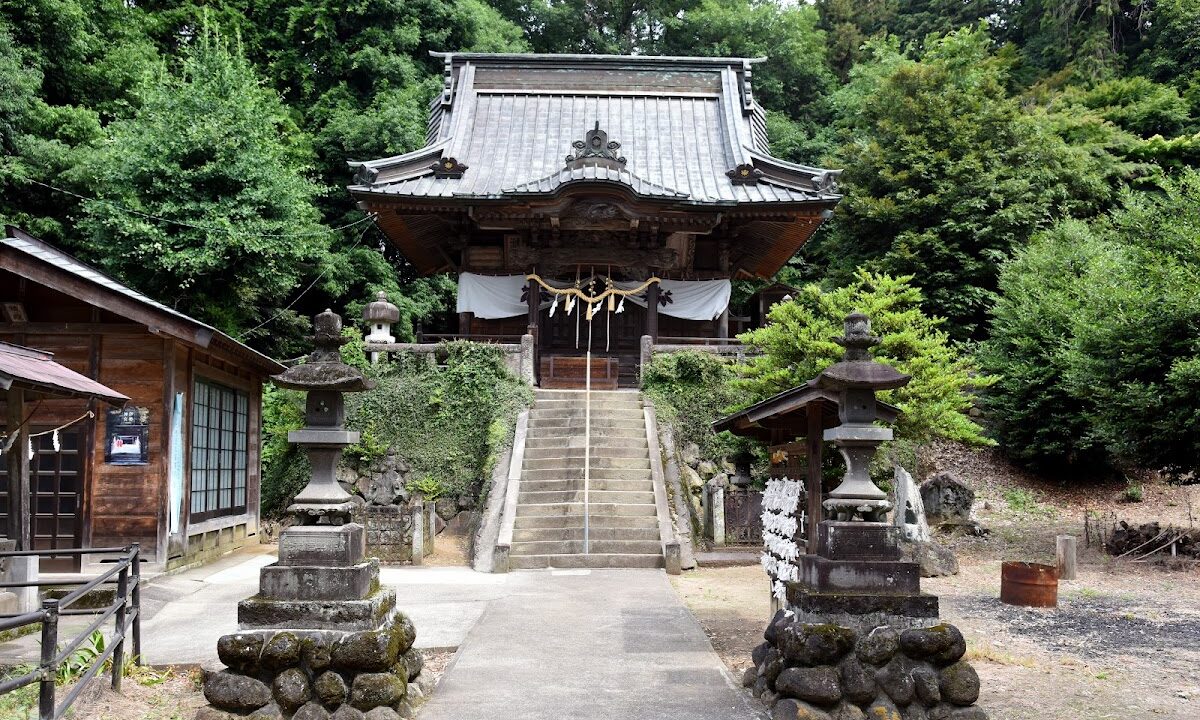
The most distinctive feature of Kiso Sansha Shrine is its “descending shrine” form, which is rare throughout Japan. Normally, shrines are situated on mountains or hills, and worshippers ascend stairs to reach the main hall. However, at Kiso Sansha Shrine, worshippers descend stairs to enter the grounds.
After passing through the torii gate at the entrance to the approach, stone steps descend, and as you descend, you experience a不思議な感覚 (mysterious feeling) as if you are being invited to another world. This descending shrine structure indicates that the shrine grounds are located at a lower elevation than the surrounding area, and is deeply related to the topography rich in spring water.
Upon reaching the bottom of the stairs, a vast and tranquil sacred area unfolds, exceeding all expectations. The deep forest and clear flowing water, unimaginable from the entrance, surprise visitors.
A Mysterious Space Nurtured by the Spring Water of Mount Akagi
From right to left within the shrine grounds, pure spring water originating from Mount Akagi flows gently. This abundant water envelops the entire grounds in a moist, mystical atmosphere, and is the origin of the shrine’s alternative name, “Takinomiya” (Waterfall Shrine).
The spring water never dries up throughout the year, nourishing the ponds and streams within the grounds. Moss-covered stones and ancient trees are placed along the water’s edge, creating a beautiful landscape reminiscent of a Japanese garden. This pure flow of water also functions as a place for purification, offering deep healing to visitors.
The Architectural Beauty of the Shrine Buildings and Main Hall
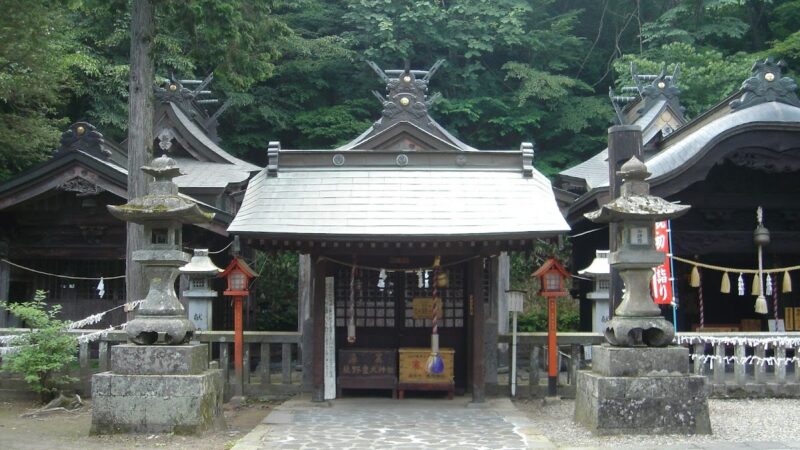
The shrine buildings of Kiso Sansha Shrine were constructed from the late Edo period to the Meiji era, preserving the traditional style of shrine architecture. The main hall is protected by a protective structure, allowing visitors to admire its exquisitely carved architecture up close.
The worship hall has an open design that warmly welcomes visitors, and the majestic appearance of the main shrine viewed from there inspires deep reverence in those who visit. Giant trees, some hundreds of years old, stand around the shrine, creating a space that evokes a long history.
Designation as a Gunma Prefecture Green Space Environmental Conservation Area
The grounds of Kiso Sansha Shrine have been designated as a Gunma Prefecture Green Space Environmental Conservation Area in recognition of their rich natural environment. This is a system designed to preserve areas with outstanding natural environments and pass them on to future generations.
The grounds are lush with giant trees such as cedar, zelkova, and camphor trees, and are adorned with seasonal flowers. Especially during the seasons of fresh greenery in spring and vibrant autumn foliage, many worshippers and nature lovers visit. The tranquil space, where only the chirping of wild birds and the sound of water can be heard, is a precious healing spot that allows one to forget the hustle and bustle of the city.
Yoshiki’s Resting Stone and Historical Sites
Within the shrine grounds is the “Yoshiki’s Resting Stone,” where it is said that Kiso Yoshiki, the third son of Kiso Yoshinaka, rested. This stone is a valuable historical site that conveys the history of the time of the shrine’s founding and attracts the attention of visitors.
Furthermore, stone monuments and lanterns believed to have been dedicated by retainers remain throughout the grounds, allowing visitors to feel the deep loyalty and faith towards Kiso Yoshinaka.
Cultural Properties
Kiso Sansha Shrine preserves cultural properties of historical and cultural value.
Main Hall and Ancillary Buildings
The main hall retains a strong architectural style from the late Edo period and is protected as a cultural property of Shibukawa City. In particular, the carvings on the main hall are a culmination of the craftsmanship of the time, featuring intricate designs of dragons, lions, flowers and birds.
Ancient Documents and Ridgepole Inscriptions
The shrine office stores ancient documents and ridgepole inscriptions that record the history since the shrine’s founding. These historical materials are valuable resources for understanding the footsteps of Kiso Yoshinaka’s retainers and the history of local religious beliefs.
Votive Items
Votive items such as swords, mirrors, and votive tablets donated by successive parishioners and devotees are preserved, and some are displayed during festivals and other events.
Festivals and Annual Events
Kiso Sansha Shrine holds various festivals and events throughout the year.
##### Spring Grand Festival (April 15th)
This festival celebrates the arrival of spring and prays for a bountiful harvest and peace in the region. Kagura (sacred dance) performances and a portable shrine procession take place, attracting many worshippers.
##### Autumn Grand Festival (October 15th)
This grand autumn festival expresses gratitude for the year’s harvest and prays for a good harvest in the following year. Traditional local performing arts are offered, and Shinto rituals are solemnly performed by the parishioners.
New Year’s Visit, Setsubun Festival, and Summer Purification Ceremony
In addition, seasonal Shinto rituals such as the New Year’s visit, Setsubun bean-throwing ceremony, and the summer purification ceremonies in June and December are continued, and the shrine functions as a center of local faith.
Goshuin (Shrine Seals) and Goshuincho (Shrine Seal Books)
About Goshuin
Kiso Sansha Shrine offers goshuin as proof of worship. The goshuin includes the calligraphy of “Kiso Sansha Shrine,” the shrine’s seal, and the date.
Location for receiving Goshuin (temple/shrine stamp): Shrine office (Please speak to the staff after your visit)
Offering fee: Approximately 300-500 yen (at your discretion)
Reception hours: 9:00 AM – 4:00 PM (Please check in advance as priests may be absent)
Original Goshuin Notebook
Kiso Sansha Shrine also offers original goshuin notebooks featuring designs of the shrine’s spring water and buildings (availability may vary). Special designs featuring Kiso Yoshinaka and Tomoe Gozen are popular as souvenirs of your visit.
Points to note when receiving a Goshuin
A goshuin is proof of your visit, not a stamp rally. Always complete your prayers before receiving your goshuin with gratitude. Also, priests may be absent due to festivals or other outings, so if you definitely want a goshuin, it is recommended to check by phone in advance.
Access Information
Basic Information
Location: 1 Shimohakoda-ko, Kitatachibana-cho, Shibukawa City, Gunma Prefecture
Phone Number: 0279-52-2240 (Shrine Office)
Visiting Hours: Grounds are freely accessible (Shrine office is open from 9:00 to 16:00)
Admission Fee: Free
Parking: Available (Free, approximately 20 spaces)
Access by Train
From JR Joetsu Line “Yagihara Station”:
- Approximately 25 minutes on foot (approximately 2km)
- Approximately 5 minutes by taxi
From JR Joetsu Line “Shibukawa Station”:
- Approximately 15 minutes by taxi
- Local buses are also available, but the number of services is limited, so advance confirmation is necessary.
Access by Car
From Kan-Etsu Expressway “Shibukawa-Ikaho IC”:
- Approximately 15 minutes (approximately 8km)
- Via National Route 17, then using the prefectural road
From Kan-Etsu Expressway “Komayose Smart IC”:
- Approximately 10 minutes (approx. 5 km)
- A shorter route is available
Car Navigation Settings
Searching by address “1 Shimohakoda-ko, Kitatachibana-cho, Shibukawa City, Gunma Prefecture” or phone number “0279-52-2240” will provide accurate directions.
Parking Information
Free parking is available near the shrine entrance. Approximately 20 regular cars can park; large vehicles require prior consultation. Temporary parking may be opened during peak times such as festivals.
Points and Manners for Visiting a Shrine
Etiquette for Visiting a Shrine
- When passing through the torii gate: Bow before entering the shrine grounds.
- Purifying yourself at the water basin: Purify your left hand, then your right hand, then your mouth.
- Walking along the approach: Walk along the sides of the approach, as the center is considered the path for the gods.
- Worship at the main hall: Worship using the two bows, two claps, and one bow ritual.
- Behavior within the shrine grounds: Be quiet and respectful.
Photography
Photography is generally permitted within the shrine grounds, but refrain from taking photos inside the main hall or during Shinto rituals, or obtain permission from a Shinto priest before taking pictures. Also, remember to be considerate of other visitors.
Attire
There are no specific dress code requirements, but clean clothing appropriate for a sacred place is desirable. Since you will be descending stairs, comfortable shoes are recommended.
Nearby Tourist Attractions
Here are some nearby tourist attractions you might want to visit in conjunction with your visit to Kiso Sansha Shrine.
Ikaho Onsen (approx. 20 minutes by car)
A representative hot spring resort in Gunma Prefecture, where you can enjoy the charming scenery of the stone steps and high-quality hot springs. There are also plenty of day-trip bathing facilities.
Mount Akagi (approx. 30 minutes by car)
A famous mountain with an elevation of 1,828m offering panoramic views of the Kanto Plain. It boasts beautiful lakes such as Onuma and Konuma, making it ideal for hiking and driving.
Shibukawa Skyland Park (approx. 15 minutes by car)
A popular amusement park for families. Enjoy spectacular views of the Kanto Plain from the Ferris wheel.
Mizusawa Kannon (approx. 20 minutes by car)
The 16th temple of the Bando Thirty-Three Kannon Pilgrimage. A famous tourist spot also known for Mizusawa Udon noodles.
A Summary of the Charms of Kiso Sansha Shrine
Kiso Sansha Shrine is a historically valuable shrine that tells the story of Kiso Yoshinaka, a tragic warrior from the late Heian period, and his retainers. It boasts a unique charm unlike any other shrine, including a rare downward-sloping approach to the shrine, a mystical grounds nurtured by the pure spring water of Mount Akagi, and a rich natural environment designated as a Gunma Prefecture Green Space Environmental Conservation Area.
Spending time in the shrine grounds, away from the hustle and bustle of the city and enveloped in silence and pure water, will heal and refresh your mind and body. This shrine is recommended for history buffs, power spot enthusiasts, and anyone seeking quiet time in nature.
When visiting Shibukawa City, Gunma Prefecture, be sure to visit Kiso Sansha Shrine, experience the spirit of Kiso Yoshinaka and his retainers, and enjoy a special time soothed by the pure spring water and deep forest. Don’t forget to get a Goshuin (shrine stamp) as a memento of your visit.