Complete Guide to Ogo Shrine (Maebashi City, Gunma Prefecture) | History, Goshuin (Shrine Seals), Cultural Properties, and Access Information
Ogo Shrine, located in Kawarahama-cho, Maebashi City, Gunma Prefecture, is a historical shrine founded as the guardian deity of Ogo Castle, a famous castle from the Sengoku period. Its former shrine rank was Gosha (village shrine), and it was formerly known as Chikato Shrine. Within the shrine grounds stands a giant soapberry tree over 300 years old, and the Taidai Kagura, a Maebashi City-designated Important Intangible Cultural Property, is still passed down. This article comprehensively introduces information you should know before visiting Ogo Shrine, including its detailed history, enshrined deities, cultural properties, goshuin information, and access methods.
Overview and Basic Information of Ogo Shrine
Ogo Shrine is located in Kawarahama-cho, Maebashi City, Gunma Prefecture, and is situated north of the Ogo Castle ruins. It is located west of the Aratogawa River, approximately 1 km north of Ogo Station on the Jomo Electric Railway. Even today, this shrine remains a center of local faith, attracting many worshippers.
Location: 640 Kawarahama-cho, Maebashi City, Gunma Prefecture
Former Shrine Rank: Gosha (Village Shrine)
Main Cultural Properties:
- Taidai Kagura (Maebashi City Designated Important Intangible Cultural Property)
- Mukuroji Tree (Maebashi City Designated Natural Monument)
- Wasan Sangaku (The only one in the prefecture)
History of Ogo Shrine
Founding and Relationship to Ogo Castle
There are various theories regarding the founding of Ogo Shrine, but the only reliable record is a document from Tensho 17 (1589). It is believed that Ogo Hitachi-no-suke Takashige, the lord of Ogo Castle, invited a divided spirit from Akagi Shrine, located in Miyazawa-cho, Maebashi City, and enshrined it as the guardian deity of Ogo Castle.
Ogo Castle was a fortress that flourished as a strategic point in Kōzuke Province (present-day Gunma Prefecture) during the Sengoku period. Ogo Shrine was located on the north side of the castle and served as its guardian deity. This location is thought to have held significant meaning from both a feng shui and military defense perspective.
From Chikato Shrine to Ogo Shrine
Initially, this shrine was called “Chikato-sha” or “Chikato Shrine.” This name was used until the mid-Meiji period, and it was also known as “Akagi Daimyōjin” by the local people.
With the reform of the shrine system during the Meiji era, the name was changed to the current “Ogo Shrine.” This name change clarified the shrine’s character as one deeply connected to the place name Ogo. It was formerly ranked as a village shrine, positioning it as an important shrine in the region.
Changes since the Modern Era
From the Meiji era to the Showa era, Ogo Shrine merged with several smaller shrines in the surrounding area. Several shrines, including Yasaka Shrine, were merged, resulting in the current layout of the shrine grounds. This merger strengthened Ogo Shrine’s role as the guardian shrine of the region.
During the Showa era, its cultural value was recognized, with the Taidai Kagura (a type of Shinto ritual dance) being designated as an Important Intangible Cultural Property of Maebashi City. Even today, it remains central to local festivals and events, supported by many parishioners and worshippers.
Deities Enshrined
Ogo Shrine enshrines the following two deities:
Ōnamuchi-no-Mikoto
Ōnamuchi-no-Mikoto is also known as Ōkuninushi-no-Mikoto. He is widely worshipped as the god of nation-building, agriculture, commerce, and medicine. He is also the principal deity of Akagi Shrine, indicating that Ogo Shrine was established by inviting the deity from Akagi Shrine.
Toyokiirihiko-no-Mikoto
Toyokiirihiko-no-Mikoto was a prince of Emperor Sujin, the 10th emperor of Japan, and a legendary figure said to have pacified the eastern provinces. He is considered the founder of Kamitsukenu Province (present-day Gunma Prefecture) and is enshrined in many shrines within Gunma Prefecture. He is worshipped as a god of martial prowess and pioneering, and as a guardian figure watching over the development of the region.
The combination of these two deities symbolizes the history of Akagi faith and regional development, and well represents the character of Ogo Shrine.
Highlights of the Shrine Grounds
Approach and Torii Gate
The approach to Ogo Shrine has a calm atmosphere, leading through a quiet residential area. Passing through the torii gate, you are enveloped in the refreshing air unique to a sacred place. Trees grow lushly on both sides of the approach, allowing you to experience the changing seasons.
Worship Hall and Main Shrine
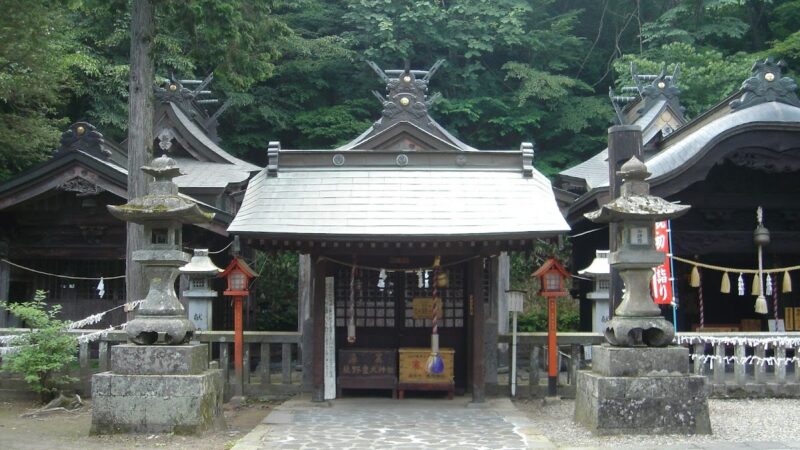
The worship hall is built in the traditional style of shrine architecture, simple yet dignified in its design. Behind the worship hall sits the main shrine, where the enshrined deity is worshipped. Worshippers perform the ritual of two bows, two claps, and one bow in front of the worship hall.
Kagura Hall
Within the shrine grounds is the Kagura Hall, where the Taidai Kagura dance is performed. The Kagura Hall plays an important role during festivals and serves as a place for the transmission of traditional performing arts.
Giant Soapberry Tree (Maebashi City Designated Natural Monument)
The most striking feature of the Ogo Shrine grounds is the giant soapberry tree, estimated to be around 300 years old. This soapberry tree is designated a natural monument by Maebashi City and is a symbolic presence of Ogo Shrine.
The soapberry tree is also called the “soap tree” because its fruit was used as a substitute for soap. Furthermore, the black seeds inside the fruit have been used as weights for shuttlecocks in the game of battledore and shuttlecock. This giant tree is a living witness that has watched over the changing history from the time of Ogo Castle to the present day.
Its majestic appearance is awe-inspiring, leaving a deep impression on visitors. It displays different expressions with each season: the fresh green of spring, the deep green of summer, the yellow leaves of autumn, and the shape of its branches in winter.
Cultural Property
Taidai Kagura (Maebashi City Designated Important Intangible Cultural Property)
The Ogo Shrine Taidai Kagura is a valuable traditional performing art designated as an Important Intangible Cultural Property of Maebashi City. This kagura has been passed down since the Edo period and has been carefully preserved by the local people.
The Taidai Kagura is a dance and music offered to the gods, imbued with the meaning of praying for a bountiful harvest and good health. It consists of multiple performances, each with a narrative based on myths and legends. It is still performed at festivals today and is an important element supporting the cultural identity of the region. ### Wasan Sangaku (Mathematical Tablet)
Ogo Shrine houses a Wasan Sangaku (mathematical tablet) by Ohara Fukutaro. A Sangaku is a votive tablet from the Edo period inscribed with mathematical problems and solutions, dedicated to shrines and temples.
This Sangaku is said to be the only one of its kind in Gunma Prefecture, making it a valuable historical document that conveys the mathematical culture of the Edo period. Wasan is a unique Japanese mathematical system, and the dedication of a Sangaku was a cultural act demonstrating the development of learning and gratitude to the gods and Buddhas. The Sangaku at Ogo Shrine speaks to the high level of learning in this region.
Mukuroji Tree (Maebashi City Designated Natural Monument)
As mentioned above, the large Mukuroji tree on the shrine grounds is a Maebashi City designated natural monument. With a long history of approximately 300 years, it is a valuable natural heritage that has grown alongside the history of Ogo Shrine.
Festivals and Annual Events
Ogo Shrine holds various festivals and events throughout the year.
Annual Grand Festival
The annual grand festival, held every autumn, is the most important festival at Ogo Shrine. During this festival, the Taidai Kagura (a type of Shinto ritual dance) is performed, attracting many worshippers and spectators. The entire community participates in the preparations, making it an important opportunity to pass on traditions to the next generation.
Other Events
The shrine holds various annual events, including the New Year’s Day Festival, Setsubun Festival, and Summer Purification Ceremony. These events also play a role in strengthening community ties.
Goshuin (Shrine Seal) Information
Ogo Shrine offers Goshuin. Goshuin are given by the shrine as proof of worship, and in recent years, the number of worshippers enjoying Goshuin pilgrimages has increased.
The Goshuin at Ogo Shrine features the shrine’s name and the date of visit written in ink, followed by a red seal. It has a simple yet dignified design.
Goshuin (Shrine Stamp) Reception: At the shrine office (Please check in advance as staff may be absent).
Offering Fee: Usually around 300-500 yen.
You can bring your own goshuincho (stamp book) or receive a pre-printed goshuin. It is customary to visit the main shrine first before receiving your goshuin.
Access Method
Access by Train
From Jomo Electric Railway Ogo Station:
- Approximately 15 minutes on foot north from Ogo Station (approx. 1 km)
- Approximately 5 minutes by taxi
The Jomo Electric Railway runs from JR Maebashi Station to Ogo Station, making it conveniently accessible from central Maebashi. The walk from Ogo Station to Ogo Shrine also offers a pleasant stroll via the Ogo Castle ruins.
Access by Car
From the Kan-Etsu Expressway:
- Approximately 20 minutes from Maebashi IC on the Kan-Etsu Expressway
- Via National Route 17 and prefectural roads
Parking: Parking space available for visitors on the shrine grounds (limited number of spaces)
Car Navigation Setting: Search for “640 Kawarahama-cho, Maebashi City, Gunma Prefecture” or “Ogo Shrine”
Combining with Nearby Facilities
The area around Ogo Shrine has historical sites, including the ruins of Ogo Castle. If you have time, visiting these facilities in conjunction with the shrine will allow you to gain a deeper understanding of Ogo’s history.
Nearby Attractions
Ogo Castle Ruins
Located south of Ogo Shrine, the ruins of Ogo Castle are a historical site with remnants of a castle from the Sengoku period. It flourished as the residence of the Ogo clan and is now maintained as a park. Earthworks and moat remains remain, allowing visitors to imagine the castle’s former glory.
Ogo Shrine and the ruins of Ogo Castle are within walking distance of each other, so we recommend visiting them together. The path from the castle ruins to the shrine is a walking trail where you can feel the atmosphere of the former castle town.
Akagi Shrine (Miyazawa)
Akagi Shrine (Miyazawa), the original shrine where the deity of Ogo Shrine was enshrined, is about a 20-minute drive away. As the central shrine of Akagi Mountain worship, it has a more magnificent shrine building and grounds. By visiting both Ogo Shrine and Akagi Shrine, you can experience the spread of Akagi worship.
Manners and Points for Visiting
How to Visit
- Bow before passing through the torii gate
- Cleanse your hands and mouth at the water basin
- Bow twice, clap twice, and bow once in front of the main hall
- Turn around and bow once when leaving the torii gate
Regarding Photography
Photography is generally permitted on the shrine grounds, but consideration is needed during festivals and religious ceremonies. The giant soapberry tree, in particular, is a popular photo spot, but please be careful not to disturb other visitors.
Best Season to Visit
Ogo Shrine can be visited throughout the year, but each season has its own unique charm.
- Spring: Beautiful fresh green soapberry trees
- Summer: Enjoy the coolness of the deep green grounds
- Autumn: You can see the annual festival and the Taidai Kagura dance, and enjoy the autumn foliage
- Winter: A peaceful atmosphere for a tranquil visit
Summary of Ogo Shrine’s Charms
Ogo Shrine is a historic shrine that has attracted the faith of the local community for over 400 years since its founding as the guardian deity of Ogo Castle during the Sengoku period. It boasts numerous attractions, including a 300-year-old soapberry tree, the Taidai Kagura dance (a designated important intangible cultural property of Maebashi City), and the only Japanese mathematical tablet in Gunma Prefecture.
Nestled in a quiet residential area, the shrine grounds are an ideal place to escape the hustle and bustle and find peace of mind. Visiting Ogo Shrine in conjunction with the Ogo Castle Ruins will allow you to gain a deeper understanding of the region’s history.
When you visit Maebashi City, be sure to stop by Ogo Shrine. You’re sure to have a memorable pilgrimage experience where the weight of history and the beauty of nature harmonize. For those collecting Goshuin (shrine stamps), it will be an important stop on your Gunma Prefecture shrine tour.
Ogo Shrine, protected by the local community, continues to warmly welcome visitors, just as it has in the past. Spend some time in its tranquil grounds and gain a valuable opportunity to experience traditional Japanese culture and history.