Akagi Shrine (Miyazawa-cho, Maebashi City, Gunma Prefecture) Complete Guide | History, Benefits, and Highlights of the Shrine Grounds
Akagi Shrine, located in Miyazawa-cho, Maebashi City, Gunma Prefecture, is an ancient shrine situated at the southern foot of Mount Akagi, one of the three famous mountains of Joshu (Gunma Prefecture). While its official name is “Akagi Shrine,” it is also known as “Miyazawa Akagi Shrine” to distinguish it from the approximately 300 Akagi Shrines located throughout Japan. It has long been revered as a candidate for a Shikinaisha (a shrine listed in the Engishiki, an ancient Japanese legal code) and the second-ranked shrine of Kōzuke Province.
This article comprehensively introduces information you should know before visiting Akagi Shrine, including its history, enshrined deities, benefits, highlights of the grounds, cultural properties, festivals, and access information.
Overview and Positioning of Akagi Shrine
Akagi Shrine is one of the shrines believed to be the main shrine among the approximately 300 Akagi Shrines located throughout Japan, primarily in the Kanto region. There are several Akagi Shrines in Gunma Prefecture, each claiming to be the “main shrine,” but the Akagi Shrine in Miyazawa is considered the most likely candidate.
Status as a Shikinaisha (Shrine Listed in the Engishiki) and a Candidate for Myojin Taisha (Great Shrine)
It is a candidate for the “Akagi Shrine, Myojin Taisha (Great Shrine)” listed in the Engishiki Jinmyocho (Register of Shrines in the Engi Era). Myojin Taisha is a rank highly valued by the imperial court, signifying a shrine with particularly powerful spiritual efficacy. It is also known as a candidate for the second-ranked shrine of Kōzuke Province, and is considered to hold the second-highest rank in Kōzuke Province (present-day Gunma Prefecture), after the Ichinomiya (first-ranked shrine).
Its former rank was Prefectural Shrine, and under the modern shrine ranking system of the Meiji era, it was positioned as a representative shrine of Gunma Prefecture.
Location and Natural Environment at the Southern Foot of Mt. Akagi
Akagi Shrine is located at the southern foot of Mt. Akagi, at an altitude of approximately 300 meters. Heading north along the pine-lined side road from National Route 353, a magnificent shrine grounds surrounded by giant cedar trees appears. Nurtured by the lush forests nourished by the spring water of Mount Akagi, the shrine retains a pure and sacred atmosphere.
The grounds are covered with trees and filled with tranquil air, making it a well-known power spot that brings peace of mind to visitors. It is especially bustling with worshippers during the New Year’s holiday season.
Deities and Blessings of Akagi Shrine
Main Deities
The main deities of Akagi Shrine are the following three:
Akagi-no-kami
A deity who personifies Mount Akagi itself, and has been revered as an object of mountain worship since ancient times. Mount Akagi is one of the three sacred mountains of Jomo and a representative sacred peak of Gunma Prefecture, and the worship of its mountain spirit is said to date back to the Jomon period.
Ōnamuchi-no-mikoto
Another name for Ōkuninushi-no-mikoto, also known as the main deity of Izumo Taisha Shrine. As a god of nation-building, he is believed to offer a wide range of blessings, including matchmaking, marital harmony, business prosperity, and abundant harvests.
Toyokiirihiko-no-Mikoto
He was a prince of the 10th Emperor Sujin and, having received orders to pacify the eastern provinces, became the founder of Kamitsukeno Province (present-day Gunma Prefecture). As a god of martial prowess, he is believed to offer blessings for victory in battle, good fortune, and protection from evil.
Expected Blessings
The following blessings can be expected at Akagi Shrine:
- Matchmaking and marital harmony: Divine virtue of Ōkuninushi-no-Mikoto
- Business prosperity and abundant harvest: Divine virtue of Ōkuninushi-no-Mikoto
- Prayers for victory in battle and good fortune: Divine virtue of Toyokiirihiko-no-Mikoto
- Good fortune, protection from evil, and family safety: Divine virtue of Akagi-no-Kami
- Purification of mind and body and power charge: By the spiritual energy of Mt. Akagi
History of Akagi Shrine
Founding and ancient beliefs
The founding date of Akagi Shrine is unclear, but it is believed to originate from mountain worship of Mt. Akagi that has continued since the Jomon period. Mt. Akagi has been revered as a sacred mountain since ancient times, and it is thought that the shrine began with the establishment of a place of worship at its foot.
The fact that it is listed as “Akagi Shrine, Myōjin-taisha, Seta-gun, Kōzuke Province” in the Engishiki Jinmyōchō (compiled in 927) indicates that it was already established as a shrine of importance to the imperial court during the Heian period. Myojin Taisha is a highly prestigious shrine, particularly revered for its miraculous powers, and was the subject of the Myojin Festival, a special festival.
Development in the Middle Ages
During the Middle Ages, it received the reverence of the powerful samurai clan of Kozuke Province, the Kozuke Provincial Governor. In particular, its connection to Fujiwara no Hidesato (Tawara Tota), who quelled the rebellion of Taira no Masakado, remains as a legend, and the “Tawara Sugi” (rice bale cedar) on the shrine grounds is said to have been donated by Hidesato when he prayed for victory in battle.
Furthermore, from the Kamakura period to the Sengoku period, it also functioned as a place for samurai of Kozuke Province to pray for victory in battle, and many warlords are said to have visited the shrine.
Development in the Early Modern Period
During the Edo period, it received the patronage of the Tokugawa Shogunate, and the shrine buildings were improved. In 1684, the Taidai Kagura, a type of Kagura dance originating from the Iwato Kagura of Kyoto, was introduced and has been passed down to the present day. This Taidai Kagura dance is recorded in the “Shrine Family Chronicle” owned by Akagi Shrine and is protected as an important intangible cultural property of Gunma Prefecture.
Throughout the Edo period, Akagi Shrine was widely revered as the second-ranked shrine of Kōzuke Province and as the center of Akagi Mountain worship.
Modern Era
With the Meiji-era separation of Shinto and Buddhism, Akagi Shrine, which had previously practiced a syncretic form of Shinto and Buddhism, clearly established itself as a Shinto shrine. In 1871 (Meiji 4), under the modern shrine ranking system, it was ranked as a prefectural shrine, establishing its position as a representative shrine of Gunma Prefecture.
From the Showa and Heisei eras to the present day, it continues to welcome many worshippers as a guardian deity of the region and as the center of Akagi Mountain worship. Since the Heisei era, the shrine buildings have been continuously restored and the grounds maintained, preserving tradition and passing it down to the present day.
Highlights of the Shrine Grounds
The grounds of Akagi Shrine contain numerous buildings and natural monuments of high historical and cultural value.
Pine Trees Along the Approach
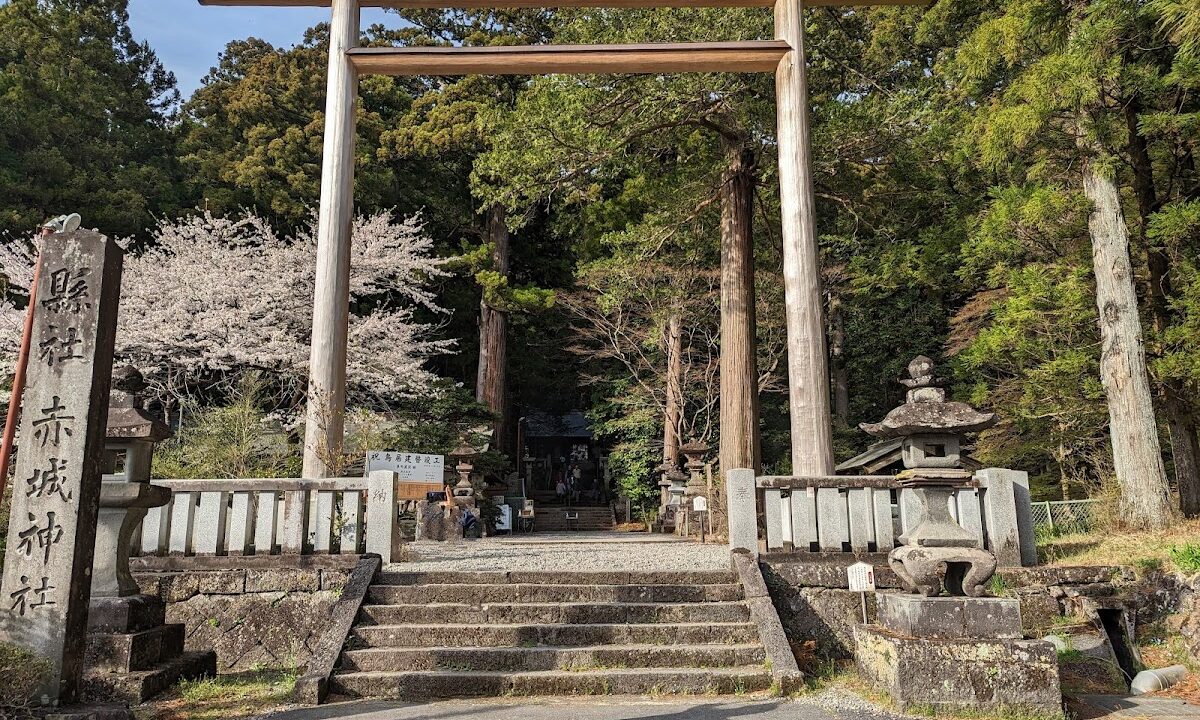
A magnificent row of pine trees lines the approach to the shrine from National Route 353. These pine trees have been planted since the Edo period, creating a solemn atmosphere as an entrance to the sacred grounds. Walking north along the side path beside the pine trees, you can feel the atmosphere gradually transform into that of a sacred area.
Main Gate (Sōmon)
The main gate, the formal entrance to the shrine grounds, is a magnificent gate that signifies the status of Akagi Shrine. Passing through this gate marks the beginning of the sacred realm. Giant cedar trees tower around the main gate, testifying to the shrine’s long history.
Torii Gates
Several torii gates are placed within the shrine grounds, and as you proceed along the approach, you feel the profound depth of the sacred area. Passing through each torii gate represents the gradual transition from the secular world to the sacred realm, reflecting the Shinto worldview.
Worship Hall
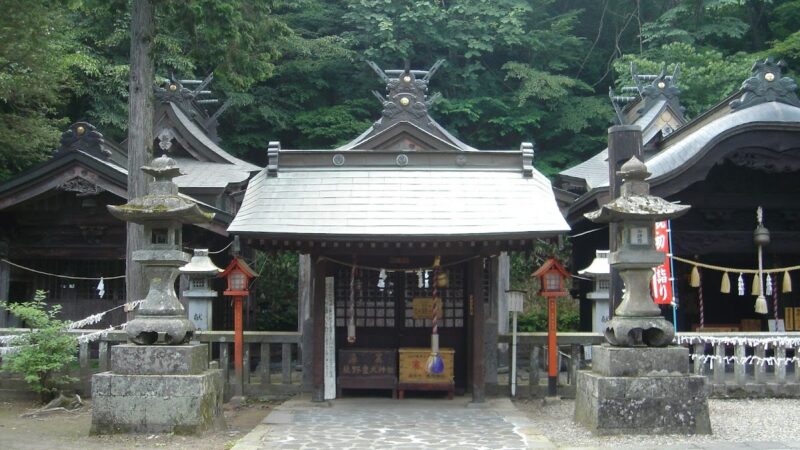
The worship hall is where worshippers offer their prayers, and when viewed from the front, it exudes a solemn atmosphere. The architectural style of the worship hall follows the traditional style of shrine architecture, with meticulous attention to detail.
Many worshippers can be seen offering heartfelt prayers in front of the worship hall. It is especially crowded during the New Year’s visit period.
Main Sanctuary (Shinmei-zukuri)
Behind the worship hall, on a slightly elevated position, is the middle gate, and beyond that, within a fence, sits the main sanctuary. The main sanctuary is built in the Shinmei-zukuri architectural style, a highly dignified style similar to that of Ise Grand Shrine.
Shinmei-zukuri is one of the oldest shrine architectural styles in Japan, featuring a gable roof, a flat entrance, and roof ornaments (chigi and katsuogi). Akagi Shrine’s main sanctuary is designated as a Prefectural Important Cultural Property, possessing significant architectural and historical value.
Tawara-sugi (Rice Bale Cedar) – Gunma Prefecture Designated Natural Monument
The most impressive feature within the shrine grounds is the “Tawara-sugi” (Rice Bale Cedar), towering in front of the main gate. This giant cedar, estimated to be well over 1000 years old, is designated a Gunma Prefecture Natural Monument.
According to legend, it was donated by Fujiwara no Hidesato (Tawara Tōta), who quelled the rebellion of Taira no Masakado, when he prayed for victory, and is named “Tawara-sugi” after him. With a trunk circumference exceeding 10 meters and a height of over 40 meters, this colossal tree possesses an overwhelming presence.
More than just a natural monument, the Tawara-sugi is a living witness that has watched over the long history of Akagi Shrine, deeply moving visitors.
Other Shrines and Points of Interest
Besides the main shrine, several smaller shrines and stone monuments are located within the grounds, each with its own history.
- Mountain Azalea Grove: A beautiful cluster of mountain azaleas grows in part of the shrine grounds, and during the blooming season, the vibrant vermilion flowers adorn the grounds.
- Spring Water: Spring water from Mount Akagi nourishes the shrine grounds, and the soothing sound of the water deepens the tranquility of the sacred area.
- Stone Lanterns and Komainu (Guardian Dogs): Stone lanterns and guardian dogs, donated by successive generations of worshippers, are placed throughout the grounds, telling the story of the shrine’s history.
Cultural Properties
Akagi Shrine possesses several cultural properties designated by Gunma Prefecture and Maebashi City.
Prefecturally Designated Important Cultural Properties
Main Hall (Shinmei-zukuri Style)
The main hall of Akagi Shrine is built in the dignified Shinmei-zukuri architectural style and is designated as a Gunma Prefecture Important Cultural Property. Its construction date, architectural techniques, and state of preservation have been evaluated, making it a valuable cultural property representing Gunma Prefecture’s shrine architecture.
Prefectural Designated Natural Monument
Tawara Cedar
As mentioned above, the Tawara Cedar, believed to be over 1000 years old, is a Gunma Prefecture designated natural monument. It is a giant tree with high historical and cultural value, and is said to have been donated by Fujiwara no Hidesato.
Intangible Cultural Property
Daidai Kagura
The Daidai Kagura, introduced from Kyoto in 1684, is a traditional performing art that follows the lineage of the Iwato Kagura. Records of it remain in the “Shrine Family Chronicle” owned by Akagi Shrine, and it is still performed at the annual festival.
The Daidai Kagura is a Shinto ritual performing art that expresses the world of mythology through dance, and is protected and passed down as a regional intangible cultural property.
Festivals and Annual Events
Akagi Shrine holds various festivals throughout the year.
Annual Festival
The Akagi Shrine Annual Festival is the most important festival of the year. During the annual festival, the Taidai Kagura dance is performed, attracting many worshippers and parishioners. The portable shrine procession and Shinto rituals are conducted solemnly, providing a valuable opportunity to experience the region’s traditional culture.
New Year’s Visit
Many worshippers visit the shrine for their first shrine visit of the year during the New Year period. Akagi Shrine is known as one of the leading New Year’s visit spots in Gunma Prefecture, bustling with people praying for safety and prosperity in the new year.
Other Festivals
- Spring Festival
- Autumn Festival
- Monthly Festival
- Niiname-sai (Harvest Festival)
Traditional shrine festivals are held throughout the year.
Goshuin (Shrine Seal) Information
Goshuin (shrine seals) are available at Akagi Shrine.
Goshuin Reception Hours
Shrine Office Hours: 9:30 AM – 4:30 PM (Subject to change depending on the season)
Goshuin are available at the shrine office. After visiting the shrine, please go to the shrine office to request a Goshuin (shrine stamp). You can bring your own Goshuincho (stamp book) or receive a pre-printed Goshuin.
Offering Fee
The usual offering fee is around 300 to 500 yen. It’s best to have small change ready to avoid needing change.
Access and Parking Information
Location and Contact Information
Location: 114 Miyazawa-cho, Maebashi City, Gunma Prefecture
Phone Number: 027-283-1268 (Akagi Shrine Office)
Shrine Office Hours: 9:30 AM – 4:30 PM (Subject to change depending on the season)
Access by Train and Bus
From Jomo Electric Railway “Ogo Station”
- Approximately 20 minutes by taxi
- Approximately 20 minutes by Furusato Bus (demand bus)
Public transportation is limited, so it is recommended to check the timetable in advance. If you are using a taxi, you can board one at the taxi stand in front of Ogo Station.
Access by Car
Kita-Kanto Expressway
- Approximately 30 minutes from Isesaki Interchange
- Approximately 30 minutes from Komagata Interchange
Take National Route 353 and follow the signs to reach the entrance to the Akagi Shrine approach. Head north along the side road lined with pine trees to reach the shrine’s parking lot.
Parking
First Parking Lot: 60 spaces
Second Parking Lot: 20 spaces
A total of 80 free parking spaces are available. During busy periods such as New Year’s, the parking lots may be full, so it is recommended to visit with plenty of time to spare.
Nearby Tourist Attractions
When visiting Akagi Shrine, it is recommended to also visit nearby tourist attractions.
Mount Akagi
Mount Akagi, towering behind Akagi Shrine, is one of the three famous mountains of Jomo and a representative mountain of Gunma Prefecture. Near the summit are caldera lakes such as Onuma and Konuma, offering beautiful scenery throughout the seasons. Hiking and mountain climbing are popular activities, and ice fishing for smelt is popular in winter.
Akagi Shrine (Odō)
Akagi Shrine is also located on the summit of Mount Akagi, on the shore of Onuma Lake. This is one of the shrines claiming to be the main shrine of Akagi Shrine, and its beautiful lakeside scenery makes it a popular tourist spot.
Tourist Spots in Maebashi City
Maebashi city offers various tourist spots, including the Gunma Prefectural Government Observation Hall, Maebashi Tōshōgū Shrine, and Rinkōkaku. As the capital of Gunma Prefecture, Maebashi is a fascinating city where history and culture blend seamlessly.
Points and Manners for Visiting Shrines
Etiquette for Visiting Shrines
Please observe the basic etiquette for visiting shrines.
- Bow before passing through the torii gate: This is a courtesy before entering the sacred area.
- Avoid walking in the center of the approach to the shrine: The center is considered the path of the gods.
- Purify yourself at the water basin: Purify your left hand, then your right hand, then your mouth.
- Worship at the main hall: Two bows, two claps, and one bow is the basic procedure.
Attire
There are no particularly strict dress code regulations, but it is desirable to wear clothing that is mindful of the sacred nature of the place. Avoid revealing or overly flashy clothing.
Photography Manners
Photography is generally permitted within the shrine grounds, but photography inside the main hall or during festivals may be restricted. Please check with the shrine office before taking photos or follow the signs. Also, please be considerate of other worshippers.
Enjoying the Shrine as a Power Spot
Akagi Shrine is known as a power spot where you can feel the spiritual energy of Mount Akagi. Take a deep breath in the tranquility of the shrine grounds and feel the energy of nature. In particular, you can feel the power of this giant tree, over 1000 years old, in front of the Tawara Cedar.
Summary
Akagi Shrine (Miyazawa-cho, Maebashi City, Gunma Prefecture) is a prestigious ancient shrine believed to be the main shrine of the approximately 300 Akagi Shrines nationwide. As a candidate for a Shikinaisha (a shrine listed in the Engishiki, an ancient Japanese legal code), a Myojin Taisha (a major shrine), and a candidate for the second-ranked shrine of Kōzuke Province, it has attracted deep reverence from ancient times to the present day.
Nestled in a rich natural environment at the southern foot of Mount Akagi, it boasts numerous attractions, including natural monuments such as the Tawara Cedar (over 1000 years old), the main hall (a prefecturally designated important cultural property), and the traditional Taidai Kagura (a type of Shinto ritual dance).
It is popular as a power spot where you can purify your mind and body, and is believed to offer various blessings such as matchmaking, business prosperity, victory in battle, good fortune, and protection from evil. When you visit Gunma Prefecture, be sure to visit Akagi Shrine and experience its long history and the pure air of its sacred grounds.
While access by car is convenient, you can also reach the shrine by bus or taxi from Ogo Station on the Jomo Electric Railway. There is a free parking lot with space for 80 cars, allowing you to leisurely explore the grounds.
We hope your visit to Akagi Shrine will be a memorable experience.