Complete Guide to Kumano Shrine (Matsuida-cho Toge, Annaka City, Gunma Prefecture) | The Charm and Visiting Information of One of Japan’s Three Great Kumano Shrines Located on the Prefectural Border
Introduction
Kumano Shrine, located in Toge, Matsuida-cho, Annaka City, Gunma Prefecture, is known as an extremely rare shrine built on a prefectural border. Situated near the summit of Usui Pass, at an altitude of approximately 1,200 meters, its most distinctive feature is its unique location, with the main shrine straddling both Gunma and Nagano prefectures.
It is counted as one of the “Three Great Kumano Shrines of Japan,” alongside the Kumano Sanzan in Kishu and Kumano in Nanyo City, Yamagata Prefecture, and has attracted worshippers since ancient times. This shrine boasts many attractions and points of interest, including a founding legend attributed to Yamato Takeru, a history as the birthplace of marathon running, and numerous prefectural important cultural properties.
This article comprehensively explains information useful for visiting Kumano Shrine, including its history, enshrined deities and blessings, points of interest within the grounds, annual events, and access methods.
History and Origins of Kumano Shrine
Founding Legend by Yamato Takeru
Kumano Shrine is said to have been founded in the 40th year of Emperor Keiko’s reign (110 AD). According to shrine tradition, when Yamato Takeru was returning from pacifying the eastern provinces, he encountered a dense fog while crossing the Usui Pass and became lost. At that moment, a Yatagarasu (three-legged crow), a messenger of the Kumano deities, appeared with a Nagi leaf in its beak and safely guided Yamato Takeru to the top of the pass.
Grateful for this divine favor, Yamato Takeru is said to have enshrined the Kumano deities at the top of the pass, marking the beginning of the shrine. The Yatagarasu is an important divine messenger in Kumano faith, and this legend demonstrates the deep connection between Kumano Shrine and the Kumano Sanzan (Three Grand Shrines of Kumano in Kishu).
The Connection Between Usui Pass and Kumano Faith
Usui Pass has been an important transportation route connecting eastern Japan and Kyoto since ancient times, and was known as a difficult section of the Nakasendo road. Due to its rugged mountain paths and foggy climate, it was a dangerous place for travelers. Therefore, a faith praying for safe travels naturally developed, and Kumano Shrine came to be revered as a guardian deity of travelers.
From the medieval period onward, Kumano faith spread throughout Japan, and its connection to Shugendo (mountain asceticism) in particular strengthened. Kumano Shrine at Usui Pass also flourished as a training ground for Shugendo practitioners, attracting many pilgrims.
History Since the Modern Era
With the Meiji-era separation of Shinto and Buddhism, Kumano Shrine established itself as an independent shrine. Under the modern shrine ranking system, it was ranked as a prefectural shrine, positioning it as an important regional shrine.
Even since the Showa era, it has continued to attract many worshippers and tourists as a tourist spot at Usui Pass, and due to its unique location on the prefectural border. Currently, the Gunma Prefecture side is called “Usui Pass Kumano Shrine” and the Nagano Prefecture side is called “Kumano Kōtaijinja Shrine,” but in reality, they are one shrine.
Unique Location on the Prefectural Border
Main Shrine Structure Spanning Both Prefectures
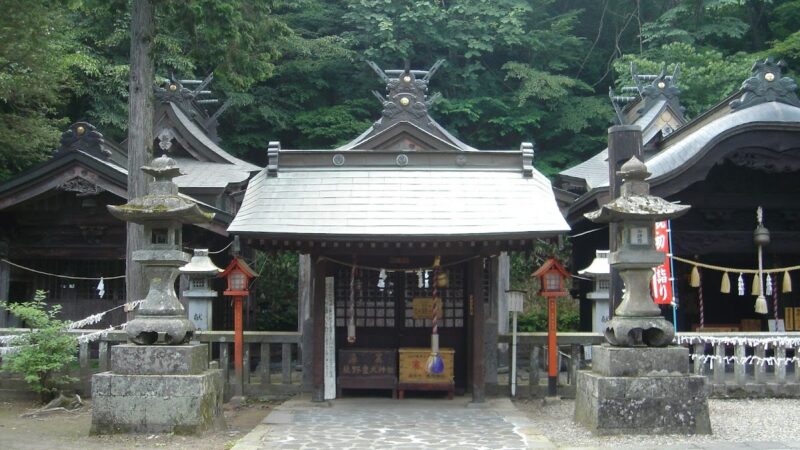
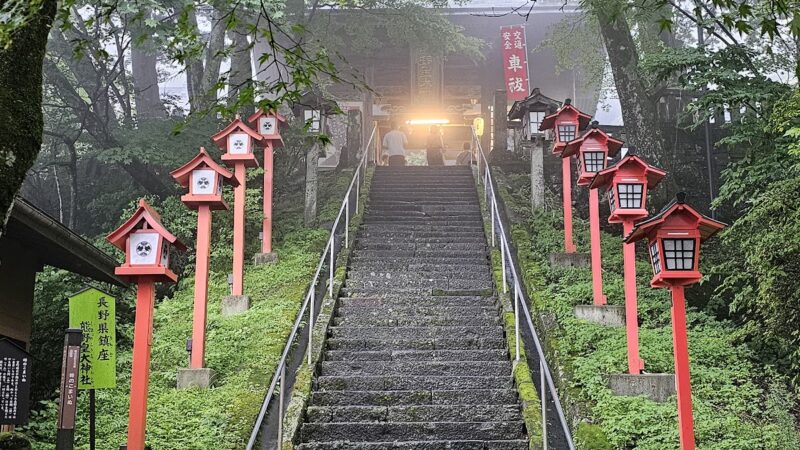
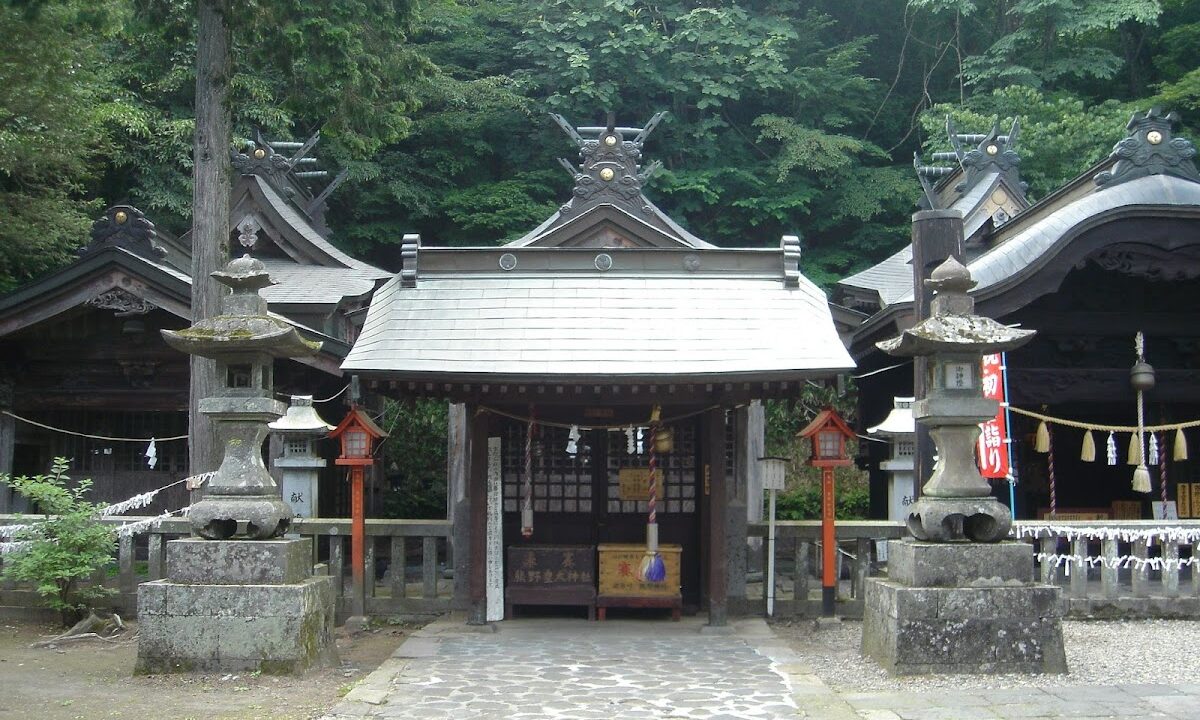
The most distinctive feature of Kumano Shrine is that its main shrine is built straddling the border between Gunma and Nagano Prefectures. The center of the approach to the shrine and the center of the main shrine are precisely located on the prefectural border, meaning that worshippers cross both prefectures in a single visit.
Such a shrine on a prefectural border is extremely rare nationwide and is a major attraction of Kumano Shrine. There is a sign marking the prefectural border within the shrine grounds, and it is a popular spot for many worshippers to take commemorative photos.
Differences Between the Gunma and Nagano Prefecture Sides
The Gunma Prefecture side, known as “Usui Pass Kumano Shrine,” is located at 9 Toge-machi, Matsuida-machi, Annaka City. On the Nagano Prefecture side, the shrine is called “Kumano Kōtaijinja” and is located at 1 Tōge-machi, Karuizawa-machi, Kita-Saku-gun.
The shrine office is located on the Nagano Prefecture side, where you can receive Goshuin (shrine stamps) and various other items. Reception hours are from 10:00 to 16:00, but these may change during winter or inclement weather, so it is recommended to check in advance.
Attractiveness as a Power Spot
Due to its unique location on the prefectural border, Kumano Shrine has recently attracted attention as a power spot, considered a place where the energies of two lands intersect. The pure air at an altitude of 1,200 meters and the tranquil environment surrounded by deep forests are believed to have the power to purify the mind and body.
In particular, there is a legend that standing on the prefectural border line in front of the main shrine allows you to receive the energy of both prefectures simultaneously, and many worshippers offer their prayers at this spot.
Deities and Benefits
Main Deities
The main deities of Kumano Shrine are as follows:
Izanami-no-Mikoto
In Japanese mythology, she is the goddess of creation and revered as the mother goddess who gives birth to all things. She is worshipped as the goddess of matchmaking, safe childbirth, and child-rearing.
Yamato Takeru-no-Mikoto
A heroic deity appearing in the founding legend, he is known as the god of martial prowess and pioneering. He is believed to bring blessings for safe travel, good fortune in competitions, and protection from evil.
Enshrined Deities
In addition, deities of the Kumano Sanzan (Three Grand Shrines of Kumano), such as Kumano Hayatama-no-Okami and Kumano Fusumi-no-Okami, are also enshrined, allowing visitors to receive the comprehensive blessings of Kumano faith.
Expected Benefits
The main benefits you can expect at Kumano Shrine are as follows:
- Safe Travels and Traffic Safety: Protecting travelers since ancient times as the guardian deity of Usui Pass
- Matchmaking and Successful Relationships: Through the divine virtues of Izanami-no-Mikoto
- Safe Childbirth and Child-Rearing: Faith in the shrine as the god of creation
- Protection from Evil and Good Fortune: The power of Yamato Takeru as a god of war
- Health and Longevity: Purification of mind and body through pure spiritual energy
- Business Prosperity: Protection of trade as a shrine on a highway
Highlights and Cultural Assets within the Shrine Grounds
Gunma Prefecture Important Cultural Property: Temple Bell
Kumano Shrine preserves a temple bell from the Kamakura period, considered the oldest in Gunma Prefecture. This bell is designated as an important cultural property of Gunma Prefecture and is a valuable cultural asset that conveys the excellent casting techniques of the medieval period.
The temple bell bears an inscription, offering insights into the religious practices of the time and the names of the donors. While it cannot be rung for preservation purposes, its beautiful form can be admired up close.
Stone Windmill
Within the temple grounds is a rare “stone windmill.” Carved from stone, this windmill is known as a unique offering of Kumano Shrine. It is believed to ward off evil and attract good fortune, serving to convey the wishes of worshippers to the gods.
Nanboku-cho Period Pagoda
The multi-story pagoda, believed to have been built during the Nanboku-cho period, is another important cultural asset of Kumano Shrine. This stone pagoda demonstrates the high level of stonemasonry at the time and serves as a valuable historical artifact illustrating the spread of Kumano faith.
Mathematical Tablet
Kumano Shrine houses a mathematical tablet (sangaku) considered one of the most difficult problems to solve. Sangaku are mathematical problems and their solutions that were dedicated to shrines in the Edo period, much like votive tablets. They are valuable historical documents that convey the mathematical culture of that time.
The sangaku at Kumano Shrine are particularly noteworthy for their difficult problems and have attracted attention from researchers of the history of mathematics. The sangaku are preserved in the shrine’s votive tablet hall and can be viewed.
Kagura Hall
Within the shrine grounds is the Kagura Hall, where kagura (sacred Shinto dance and music) are performed. During annual events, traditional kagura are performed here, offering gratitude and prayers to the gods. The simple yet solemn atmosphere of the kagura deeply moves visitors.
Annual Events and Festivals
Wakaba Festival (May 15th)
Held annually on May 15th, the Wakaba Festival is a major spring festival held during the season of fresh greenery. At this time, when the young leaves of Usui Pass are beautifully sprouting, the shrine grounds are enveloped in refreshing green.
At the festival, Kagura (sacred Shinto music and dance) is performed, and worshippers celebrate the arrival of the new season and pray for a safe year. Many worshippers visit not only from the local area but also from far away, creating a lively atmosphere.
Autumn Leaves Festival (October 15th)
The Autumn Leaves Festival, held on October 15th, is a major autumn festival. Usui Pass is known as a famous spot for autumn foliage, and at this time of year, the temple grounds are surrounded by trees colored in red and yellow, creating a breathtakingly beautiful scene.
At the Autumn Leaves Festival, Kagura is also performed, expressing gratitude for the autumn harvest and praying for a bountiful harvest in the coming year. It is a simple and warm festival where time seems to flow slowly, and participants can enjoy a peaceful and relaxing time.
Other Annual Events
- New Year’s Day Festival: A first shrine visit of the year to pray for happiness in the new year.
- Setsubun Festival: A festival to ward off evil and invite good fortune.
- Annual Grand Festival: The shrine’s most important festival.
These events may be subject to change due to weather or other circumstances, so it is recommended to check before visiting.
The Birthplace of Japanese Marathons
The History of the Ansei Marathon and Marathons
Kumano Shrine is also known as the “Birthplace of Japanese Marathons.” In 1855 (Ansei 2), Itakura Katsuaki, the lord of the Annaka Domain, conducted the “Ansei Marathon,” a run of approximately 30 kilometers from Annaka Castle to Kumano Shrine at Usui Pass, for the training of his samurai.
This is considered the first recorded organized long-distance run in Japan and is the prototype of the modern marathon. Therefore, Kumano Shrine is positioned as the birthplace of the marathon.
The Modern Ansei Marathon
Even today, this tradition is carried on in the “Ansei Marathon Samurai Marathon” held every May. Many participants run in costumes as samurai, princesses, and other characters, making it a unique and popular marathon.
The finish line is the same as it was in the past, Kumano Shrine, where finishers share their joy of completion. For marathon enthusiasts, Kumano Shrine holds special significance as a sacred place.
Nearby Tourist Attractions
Touge no Chikara Mochi (Mountain Pass Power Mochi)
Near Kumano Shrine is a teahouse famous for its “Touge no Chikara Mochi” (Mountain Pass Power Mochi). This teahouse, with a history of over 200 years, offers its specialty, Chikara Mochi, a simple yet exquisite Japanese confection consisting of freshly pounded, soft mochi topped with kinako (roasted soybean flour) and kuromitsu (brown sugar syrup).
Enjoying Chikara Mochi while gazing at the spectacular view of Usui Pass is a special experience, attracting many tourists. It’s the perfect spot to take a break after visiting the shrine.
Usui Pass Observation Deck
Located within walking distance of Kumano Shrine, the Usui Pass Observation Deck offers panoramic views of majestic mountains such as Mount Asama and Mount Myogi. On clear days, Mount Fuji can even be seen in the distance, making it a popular spot for breathtaking scenery.
Old Usui Pass Scenic Walking Trail
Starting from Kumano Shrine, a scenic walking trail follows the old Nakasendo Usui Pass road. Walking along this historic path allows you to reflect on the travelers of yesteryear. It’s especially beautiful during the seasons of fresh greenery and autumn leaves, making it ideal for hiking.
Karuizawa
Descending towards Nagano Prefecture lies Karuizawa, one of Japan’s leading summer resorts. With numerous tourist attractions such as Old Karuizawa Ginza, Shiraito Falls, and Kumoba Pond, many tourists visit Karuizawa in conjunction with a visit to Kumano Shrine.
Access Information
Location
Gunma Prefecture Side
9 Toge-machi, Matsuida-machi, Annaka City, Gunma Prefecture 389-0121
Nagano Prefecture Side (Shrine Office)
1 Toge-machi, Karuizawa-machi, Kita-Saku-gun, Nagano Prefecture 389-0121
Phone: 0267-42-3490 (Shrine Office)
Access by Car
From Tokyo
- Approximately 30 minutes from Usui-Karuizawa IC on the Kan-Etsu Expressway/Joshin-Etsu Expressway
- Via the Old Usui Pass from Naka-Karuizawa
From Nagano
- Approximately 25 minutes from Usui-Karuizawa IC on the Joshin-Etsu Expressway
- Via the Old Usui Pass from Karuizawa town center
Parking
Free parking available (approximately 5 cars)
*Parking may be full during peak hours, so early arrival is recommended. *Please note that roads may be closed during winter due to snow and ice.
Access by Public Transportation
By JR
- Get off at Karuizawa Station on the JR Hokuriku Shinkansen, then take a taxi for approximately 20 minutes.
- Get off at Yokokawa Station on the JR Shin’etsu Main Line, then take a taxi for approximately 30 minutes.
By Bus
Public transportation access is limited; taking a taxi is recommended. Tourist buses may operate depending on the season, so it is advisable to check in advance.
Access on Foot
It is also possible to visit the shrine on foot along the old Nakasendo road.
- Approximately 2 hours and 30 minutes on foot from Karuizawa Station
- Approximately 3 hours on foot from Yokokawa Station
A visit combined with a hike is also enjoyable and recommended for those confident in their physical fitness.
Points to Note and Manners for Visiting the Shrine
Visiting Hours
While you can generally visit the shrine grounds freely, the shrine office is open from 10:00 to 16:00. Those wishing to receive a Goshuin (temple/shrine stamp) or other offerings should visit during these hours.
Clothing and Items to Bring
Located at an altitude of 1,200 meters, the temperature is lower than in the lowlands. Warm clothing is especially necessary in spring and autumn. Also, as there are stone steps and slopes within the shrine grounds, comfortable walking shoes are recommended.
Visiting in Winter
From December to March, there is snowfall, and roads may freeze. If visiting in winter, snow tires or chains are essential. Also, the shrine office may be closed, so please check in advance.
Photography
Photography is generally permitted within the shrine grounds, but please observe proper etiquette, such as refraining from taking photos inside the main hall or during Shinto rituals. The area near the prefectural border marker is a popular photo spot, but please be considerate of other visitors.
Goshuin and Offerings
Goshuin
Kumano Shrine offers Goshuin (temple/shrine stamps). You can receive Goshuin (temple/shrine stamps) from both the Gunma and Nagano prefectures. Please apply during the shrine office’s reception hours (10:00 AM to 4:00 PM).
The offering fee is usually around 300-500 yen. You can bring your own Goshuincho (stamp book) or purchase one on the spot.
Amulets and Items Available
- Traffic Safety Amulet: As befits a shrine for travelers, a traffic safety amulet is popular.
- Matchmaking Amulet: A matchmaking amulet based on the divine virtues of Izanami-no-Mikoto.
- Safe Childbirth Amulet: An amulet for safe childbirth and child-rearing.
- Victory Amulet: An amulet for good luck in competitions, related to Yamato Takeru.
- Marathon Amulet: An amulet unique to the birthplace of marathon running.
These items are also available at the shrine office.
Recommended Itinerary for Visiting Kumano Shrine
Day Trip Itinerary
Morning
- Depart from Karuizawa Station or Yokokawa Station
- Drive or hike along the old Usui Pass
- Visit Kumano Shrine (Duration: 30 minutes to 1 hour)
Lunch
- Take a break and have lunch at Touge no Chikara Mochi (a local rice cake shop)
Afternoon
- Enjoy the spectacular view from Usui Pass Observation Deck
- Sightseeing in Karuizawa (Old Karuizawa Ginza, Shiraito Falls, etc.)
- Alternatively, descend towards Yokokawa and visit Meganebashi Bridge and Usui Pass Railway Culture Village
Enjoying the Seasons
Spring (April-May)
A beautiful season of fresh greenery. Participating in the Wakaba Festival (May 15th) is recommended. Cheering on the Ansei Enso Samurai Marathon is also fun.
Summer (June-August)
An ideal summer resort. Due to its high altitude, it’s cool and you can enjoy a refreshing forest bath amidst the deep green foliage.
Autumn (September-November)
Popular as a spot for viewing autumn leaves. Especially beautiful during the Autumn Leaves Festival (October 15th). Mid-to-late October is the best time to see the leaves.
Winter (December-March)
A mystical atmosphere with snowscapes. However, caution is needed regarding snow and ice.
Summary
Kumano Shrine, located on the Toge Pass in Matsuida-cho, Annaka City, Gunma Prefecture, is a shrine with many attractions, including its unique location on the prefectural border, its history as one of Japan’s three major Kumano shrines, and its cultural value as the birthplace of marathon running.
It boasts a long history beginning with the founding legend of Yamato Takeru, a faith centered on Izanami-no-Mikoto and Yamato Takeru, cultural assets such as the temple bell and mathematical tablet (both designated as important cultural properties of the prefecture), annual events like the Wakaba Festival and Momiji Festival, and the magnificent natural scenery of Usui Pass. All of these elements come together to create the unique charm of Kumano Shrine.
When you visit, be sure to fully enjoy the prayers at the main shrine, which straddles the prefectural border, the sightseeing spots in the surrounding area, and the beauty of nature in every season. In the pure air of Usui Pass, you will be able to spend a special time refreshing both your mind and body.
Standing on the border between Gunma and Nagano prefectures, and offering your prayers while feeling the energy of both prefectures, is a precious experience unlike any other. Please do visit this special shrine at least once.