Complete Guide to Tatsunokuchi Hachimangu Shrine (Okayama Prefecture) | An Ancient Mountain Shrine Known as the God of Examinations
Located on Mount Tatsunokuchi in Naka Ward, Okayama City, Tatsunokuchi Hachimangu Shrine is a historic shrine situated at an altitude of approximately 200 meters. As an ancient shrine dating back to the Nara period, it is widely revered as the “god of examinations.” This article comprehensively introduces information you should know before visiting Tatsunokuchi Hachimangu Shrine, including its history, blessings, access methods, and points to note when visiting.
History and Origins of Tatsunokuchi Hachimangu Shrine
Origins of an Ancient Shrine Dating Back to the Nara Period
The exact founding date of Tatsunokuchi Hachimangu Shrine is unknown, but it is said that a shrine building already existed during the Tenpyo-Shoho era of the Nara period (749-757). Records show that when Hoon Daishi opened Kanayama-ji Temple and Saidai-ji Kannon-in Temple in Okayama City during the reign of Empress Koken, he spoke of the miraculous powers of this shrine, suggesting that it had many worshippers even then.
Restoration in the Edo Period and the Reverence of the Ikeda Family
Throughout its long history, Tatsunokuchi Hachimangu Shrine fell into a state of near-abandonment for a time. However, during the Edo period, it was restored through the fervent reverence of Ikeda Mitsumasa, the lord of the Okayama domain. The shrine received 15 koku of land in Yubako from the Ikeda family, and under the patronage of the lord, it was able to establish itself as a proper shrine. This Edo period restoration forms the foundation of the present-day Tatsunokuchi Hachimangu Shrine.
Development and Spread of Faith After the Meiji Era
After the Meiji era, the number of worshippers gradually increased. As a shrine for family safety, protection from disaster, and lasting military fortune, it came to be widely revered not only within Okayama Prefecture but also by people from neighboring prefectures. Especially before the war, many worshippers visited the shrine to pray for military success. After the war, the focus shifted to prayers for family safety and traffic safety. In modern times, it has become particularly known as the “God of Exams,” and during exam season, many students and their parents visit to pray for success.
Benefits and Faith of Tatsunokuchi Hachimangu Shrine
Exam Success and Academic Achievement
Tatsunokuchi Hachimangu Shrine is best known for its blessings of passing exams. Climbing the steep 200-meter-high approach to the shrine is considered a form of asceticism, and the belief that this effort leads to success in exams is deeply rooted. Many students visit to pray for success, and numerous ema (votive tablets) praying for success are offered at the ema rack before exams.
Family Safety and Protection from Misfortune
Since ancient times, it has been worshipped as a shrine for family safety and protection from misfortune. Worshippers constantly visit to pray for the health and safety of their families and protection from disaster. Many people visit this shrine at significant life events, such as for exorcism during their unlucky years, or for purification rites when building a new house or moving.
Traffic Safety
In modern times, the shrine is also known for its blessings of traffic safety. With car access becoming commonplace, the number of visitors praying for safe driving and accident-free trips is increasing. Traffic safety amulets and stickers are also available.
Long-lasting Military Fortune and Success in Competitions
Historically, the shrine was revered as a place for long-lasting military fortune. This belief has transformed into prayers for success in competitions and achieving goals, and it is now visited by people praying for victory in sports or success in their work.
Highlights of the Shrine Grounds
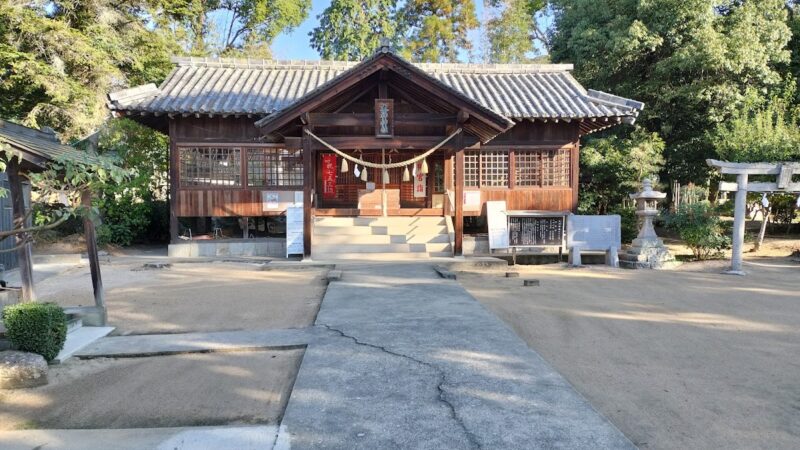
Main Hall and Shrine Buildings
The main hall, built on the summit of Mt. Tatsunokuchi, presents a majestic presence in harmony with the surrounding nature. The shrine buildings, renovated during the Edo period’s reconstruction, retain the characteristics of Okayama’s shrine architecture and are of high historical value. From behind the main shrine, you can enjoy a panoramic view of Okayama city, and on clear days, you can even see the Seto Inland Sea.
Approach and Stone Steps
One of the distinctive features of Tatsunokuchi Hachimangu Shrine is its steep approach, reaching an altitude of approximately 200 meters. The rugged path, including rocky sections, is a kind of spiritual training for worshippers. Climbing this path is considered a demonstration of one’s determination to pass exams, and many students attempt it. There are resting places along the way, allowing you to climb at your own pace.
Views and Natural Scenery
From the shrine grounds at an altitude of 200 meters, a spectacular view of Okayama city unfolds. The view from behind the main shrine is particularly magnificent, offering a panoramic view of the Okayama Plain and the Seto Inland Sea. On clear winter mornings, a sea of clouds sometimes spreads out below, creating a fantastical sight.
Nature Through the Seasons
The grounds of Tatsunokuchi Hachimangu Shrine are maintained as the “Tatsunokuchi Green Shower Forest,” where you can enjoy the beauty of nature throughout the seasons. In spring, mountain cherry blossoms and mountain azaleas bloom in profusion, and in early summer, the fresh green trees create a refreshing green tunnel. In autumn, the autumn leaves color the grounds, and in winter, you can visit the shrine in a tranquil atmosphere.
Ancient Burial Mounds
Many ancient burial mounds remain around the shrine, indicating that this area was an important place since ancient times. Those interested in history are encouraged to visit the surrounding burial mounds in conjunction with their visit to the shrine.
Access and Visiting Information
Basic Information
Location: 996 Gion, Naka-ku, Okayama City, Okayama Prefecture 703-8207 (within Ryunokuchiyama National Forest)
Phone Number: 086-275-3332
Visiting Hours: Open during the day (Please check the shrine office’s reception hours)
Admission Fee: Free
Access by Car
Approximately 20-30 minutes by car from Okayama city center. You will need to drive up a mountain road, so please drive carefully. Setting “Ryunokuchi Hachimangu Shrine” on your car navigation system or smartphone map app will allow you to arrive relatively smoothly.
Parking
Parking is available at the foot and mid-slope of the shrine. Since you will be hiking from the parking lot to the main shrine, we recommend wearing comfortable shoes. Parking can get crowded during peak seasons (New Year’s visits and exam seasons), so we recommend visiting with plenty of time to spare.
Access by Public Transportation
Public transportation access is limited. Since it’s a distance from the nearest bus stop, access by car is the most common method. If using a taxi, it takes approximately 30 minutes from Okayama Station.
Attire and Preparations for Visiting the Shrine
Visiting Tatsunokuchi Hachimangu Shrine involves climbing a mountain 200 meters above sea level. The following preparations are recommended:
- Comfortable shoes: Sneakers or hiking boots are ideal.
- Comfortable clothing: Since there are rocky areas, comfortable clothing is necessary.
- Hydration: Especially in summer, bring a water bottle or plastic bottle.
- Rain gear: The weather can change quickly, so a folding umbrella or raincoat is recommended.
- Plenty of time: Plan for a climb of 30 minutes to 1 hour.
Annual Festivals and Events
Spring Grand Festival
In spring, the Spring Grand Festival is held to pray for safety and prosperity in the new year. Many worshippers visit during the beautiful season when cherry blossoms and mountain azaleas are in bloom.
Autumn Grand Festival
The Autumn Grand Festival is one of the important festivals of Tatsunokuchi Hachimangu Shrine. Traditional rituals are performed to pray for a bountiful harvest and the safety of the parishioners. Coinciding with the beautiful autumn foliage season, the shrine grounds are enveloped in a particularly solemn atmosphere.
New Year’s Visit
Many worshippers visit for their first shrine visit of the New Year. Because it coincides with the exam season, it is bustling with worshippers praying for both success in exams and good fortune in the new year. It is especially crowded from New Year’s Day to the third day, so it is recommended to visit with plenty of time to spare.
Special Prayers During Exam Season
During the exam season from January to March, many students and their guardians visit. Special prayers for success in exams are accepted, and votive tablets are offered and good luck charms are distributed.
Prayers and Amulets
Information on Prayers
Ryūnokuchi Hachimangu Shrine accepts various types of prayers. The main types of prayers are as follows:
- Prayer for Success in Exams/Academic Achievement
- Family Safety
- Traffic Safety
- Protection from Evil Spirits
- Business Prosperity
- Prayer for Safe Childbirth
- First Shrine Visit for a Newborn
- Shichi-Go-San (7-5-3 Festival)
If you wish to request a prayer, we recommend contacting us by phone in advance. You can also confirm reception hours and prayer fees.
Amulets and Souvenirs
Ryūnokuchi Hachimangu Shrine offers a variety of amulets and souvenirs:
- Success Amulet: The most popular amulet for praying for success in exams
- Academic Success Amulet: An amulet for praying for daily academic success
- Traffic Safety Amulet: For praying for safety when driving or cycling
- Family Safety Amulet: For praying for the health and safety of the family
- Exorcism Amulet: For warding off misfortune for those in their unlucky year
- Ema (Votive Tablet): For writing prayers for success or other wishes and offering them at the shrine
- Goshuin (Shrine Seal): Given as a memento of your visit
Nearby Attractions and Tourist Information
Ryūnokuchi Green Shower Forest
The area around the shrine has been developed as “Ryūnokuchi Green Shower Forest,” a place of relaxation for Okayama citizens. Hiking trails are also available, allowing visitors to enjoy nature walks.
Kinzanji Temple
Kinzanji Temple, said to have been founded by Hoon Daishi, is a temple with historical ties to Tatsunokuchi Hachimangu Shrine. Located in Okayama City, visiting both together will give you a deeper understanding of the region’s history.
Saidaiji Kannon-in Temple
Saidaiji Kannon-in Temple, also associated with Hoon Daishi, is an important temple in Okayama. Known for the “Saidaiji Eyo (Naked Festival),” visiting both Tatsunokuchi Hachimangu Shrine and Saidaiji Kannon-in Temple will allow you to experience Okayama’s religious culture.
Sightseeing in Okayama City
It takes about 30 minutes by car from Tatsunokuchi Hachimangu Shrine to Okayama city center. A sightseeing plan combining visits to Okayama’s representative tourist spots such as Okayama Castle, Korakuen Garden, and Okayama Prefectural Museum of Art is also recommended.
Manners and Precautions for Visiting a Shrine
Basic Manners for Visiting a Shrine
- When passing through the torii gate: Bow before entering the shrine grounds.
- How to walk along the approach: The center of the approach is considered the path of the gods, so walk along the sides.
- How to use the purification fountain: Cleanse your left hand, then your right hand, then your mouth, and finally wash the handle of the ladle.
- Worship at the main hall: Two bows, two claps, and one bow is the basic procedure.
- Be quiet: This is a sacred place, so refrain from speaking loudly.
For a Safe Visit
- Health Management: Since the visit involves mountain climbing, do not push yourself if you are not feeling well.
- Weather Check: The ground can be slippery in rainy weather, so extra caution is needed.
- Time Management: Allow ample time to descend before sunset.
- Precautions for Solo Visits: If possible, it is safer to visit with multiple people.
- Emergency Contact Information: Check your mobile phone’s signal strength and ensure you have a means of contact in case of emergency.
Photography
Photography is generally permitted on the shrine grounds, but please note the following:
- Refrain from taking photos during festivals or prayers.
- Be considerate of other worshippers.
- Do not take photos in areas where photography is prohibited, such as inside the main hall.
- Use flash photography sparingly.
The Charm of Tatsunokuchi Hachimangu Shrine
A Pilgrimage as a Spiritual Practice
Climbing the steep 200-meter-high approach to the shrine is a valuable spiritual experience for modern worshippers. The sense of accomplishment and the refreshing feeling after reaching the top are special experiences that cannot be obtained through mere sightseeing. For students taking exams, climbing this approach is an opportunity to renew their determination to pass.
A Sense of Oneness with Nature
Located amidst the rich nature of Mount Tatsunokuchi, Tatsunokuchi Hachimangu Shrine showcases its beauty in every season. Despite its proximity to the city, the shrine grounds offer a sense of tranquility and the breath of nature. Especially during early morning visits, the only sounds are the chirping of birds and the rustling of trees, creating a truly soul-cleansing experience.
The Weight of History
Ryūnokuchi Hachimangu Shrine, with its long history dating back to the Nara period, has attracted the faith of people throughout the ages. From its restoration in the Edo period, to its development after the Meiji era, and its modern-day reverence as a god of academic success, it has evolved with the times, yet remains a spiritual haven for people. Visiting while feeling the weight of this history offers many insights for those of us living in the modern age.
A Breathtaking Panorama
The panoramic view of Okayama city from behind the main hall is a breathtaking sight that makes you forget the fatigue of your visit. On clear days, you can see all the way to the Seto Inland Sea, and on early winter mornings, a sea of clouds sometimes spreads out. This view is a unique charm of Ryūnokuchi Hachimangu Shrine and continues to captivate many visitors.
Summary: Visiting Tatsunokuchi Hachimangu Shrine
Located in Naka Ward, Okayama City, Okayama Prefecture, Tatsunokuchi Hachimangu Shrine is a historic shrine dating back to the Nara period, and is widely revered today, especially as a deity of academic success. Situated on the summit of Mt. Tatsunokuchi, approximately 200 meters above sea level, it offers a challenging pilgrimage experience with its steep approach, breathtaking views from the summit, and the rich natural beauty of the four seasons.
Known for its various blessings, including family safety, protection from misfortune, traffic safety, and academic success/passing exams, the shrine attracts many visitors from both within and outside Okayama Prefecture. It has a history of being restored during the Edo period by Ikeda Mitsumasa, the lord of the Okayama domain, and since the Meiji era, the number of visitors has gradually increased, leading to its current status.
Comfortable shoes and clothing are essential for visiting. Since the visit involves mountain climbing, it is recommended to allow ample time and physical stamina. Parking is available, but congestion is expected during exam season and the New Year’s pilgrimage period. Tatsunokuchi Hachimangu Shrine is more than just a tourist attraction; it’s a place where each visitor can reflect on themselves and renew their resolve to achieve their goals. It’s a shrine recommended for a wide range of people, from students preparing for exams to those reaching a milestone in their lives, those praying for safety in their daily lives, and those who want to experience Okayama’s history and nature.
When you visit Okayama, be sure to stop by Tatsunokuchi Hachimangu Shrine and experience the breathtaking views from the mountaintop and the sacred atmosphere.