Complete Guide to Kongoji Temples: A Thorough Explanation from Famous Temples Across Japan to the Women’s Koya
While there are many temples named “Kongoji” throughout Japan, some are particularly historically and culturally significant. This article will thoroughly introduce the charms of Kongoji temples throughout the country, focusing on Amanosan Kongoji Temple in Kawachinagano City, Osaka Prefecture, known as the “Women’s Koya.”
Amanosan Kongoji Temple (Kawachinagano City, Osaka Prefecture): The History and Charm of the Women’s Koya
Overview of Amanosan Kongoji Temple
Located in Amanomachi, Kawachinagano City, Osaka Prefecture, Amanosan Kongoji Temple is a renowned temple boasting a history of over 1,200 years as the head temple of the Omuro branch of Shingon Buddhism. Its mountain name is Amanosan, its principal image is Dainichi Nyorai, and it is widely known by the alternative name “Women’s Koya.” This name originates from its important role as a sacred site accessible to women during a time when Mount Koya was off-limits to women.
The temple grounds preserve numerous national treasures and important cultural properties, making it a valuable site that conveys Japanese Buddhist culture to the present day. The Gobutsudo Hall is also the 7th temple on the New Saigoku Thirty-Three Kannon Pilgrimage, attracting many pilgrims.
The Founding and History of Amanoyama Kongoji Temple
Kongoji Temple’s founding dates back to the Tenpyo era (729-749). It is said to have been founded by Gyoki Bodhisattva at the behest of Emperor Shomu, and later developed by Kobo Daishi Kukai as a sacred site for esoteric Buddhist practice.
At the end of the Heian period, after a period of decline of approximately 400 years, the temple complex was restored by the monk Akan Shonin of Koyasan. This restoration allowed Kongoji Temple to once again flourish as an important center of Shingon Esoteric Buddhism.
From the Kamakura period to the Nanboku-cho period, it had deep ties with the Kusunoki clan and functioned as the family temple of Kusunoki Masashige and his son Masayuki. Especially during the Nanboku-chō period (Northern and Southern Courts period), Emperor Go-Murakami used Kongōji Temple as a temporary imperial residence, playing a politically significant role. During this time, Kongōji Temple functioned as both a spiritual pillar and a de facto political center for the Southern Court.
Role as a Women’s Koyasan
While Mount Kōya was off-limits to women until 1872 (Meiji 5), Kongōji Temple had long welcomed female pilgrims. Therefore, women wishing to visit Mount Kōya would visit Kongōji Temple and offer their prayers there.
The designation “Women’s Koyasan” indicates not only that women could visit, but also that the temple possessed a spiritual power and prestige comparable to Mount Kōyasan. Indeed, the layout of Kongōji Temple’s buildings and the level of its Buddhist art are on par with the major temples of Mount Kōyasan.
National Treasures and Important Cultural Properties of Amanosan Kongoji Temple
National Treasure Buildings: Main Hall and Pagoda
Kongoji Temple possesses two National Treasure buildings.
The Main Hall is the main hall housing the principal image, Dainichi Nyorai, and is a valuable building that preserves the architectural style of the late Kamakura period. Inside, a seated statue of Dainichi Nyorai is enshrined at the center, flanked by Fudo Myoo and Gosanze Myoo, creating a solemn space befitting a Shingon Buddhist temple.
The Pagoda was built between the late Heian period and the early Kamakura period, making it one of the oldest existing pagodas. The first floor houses the Taizokai Dainichi Nyorai, expressing the cosmology of Shingon Buddhism. Its unique double-roofed shape makes it a recognizable symbol of Kongoji Temple, visible even from afar.
National Treasure Painting: Sun, Moon, and Four Seasons Landscape Screen
The “Sun, Moon, and Four Seasons Landscape Screen,” owned by Kongoji Temple, is a masterpiece of Muromachi period ink painting and is designated a National Treasure. The six-panel screen depicts the moon and spring/summer scenery on the right panel, and the sun and autumn/winter scenery on the left panel, beautifully expressing the changing seasons and Japanese view of nature.
This screen is usually stored in a repository, but is open to the public during special exhibition periods in spring and autumn. The later exhibition period (around May 3rd to May 5th) offers a rare opportunity to view the Sun, Moon, and Four Seasons Landscape Screen up close.
Other Important Cultural Properties
In addition to the National Treasure, Kongoji Temple also houses numerous other Important Cultural Properties.
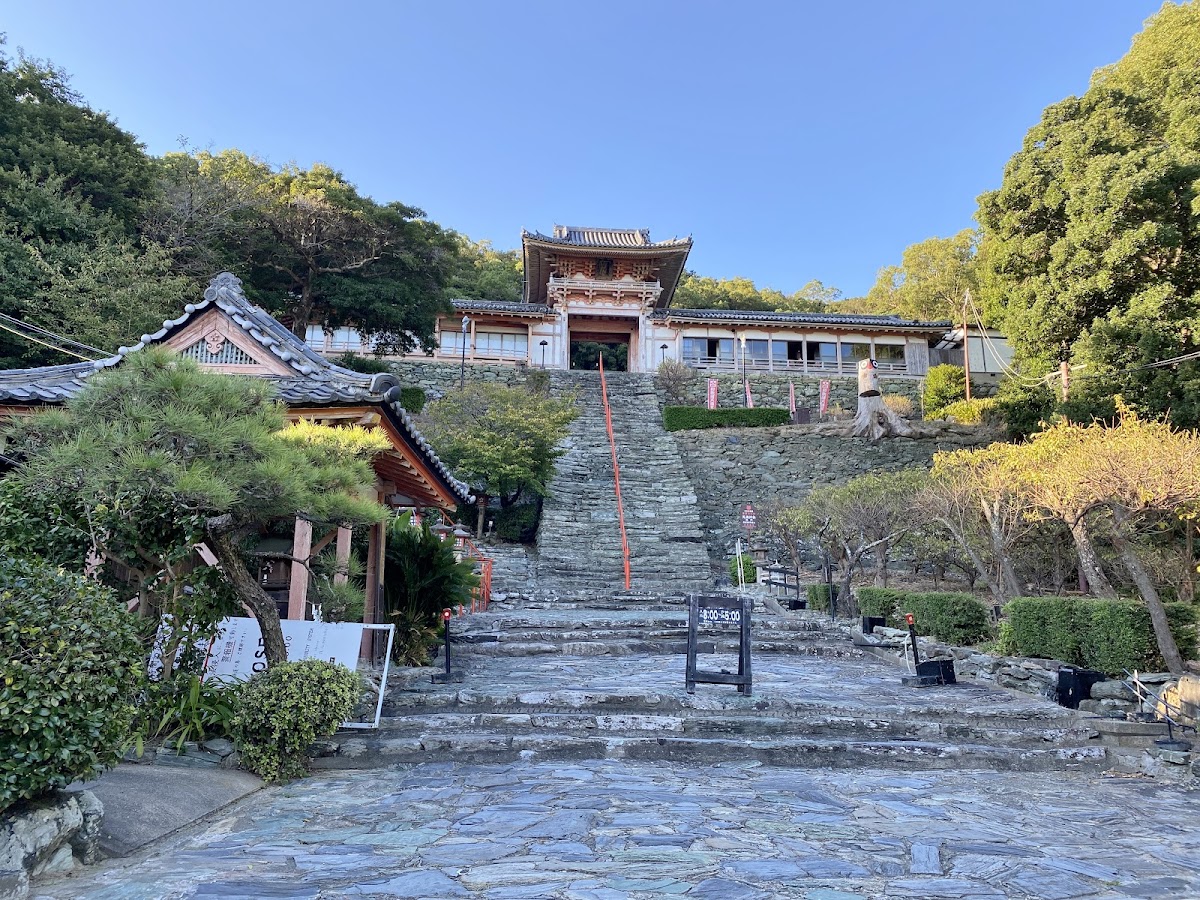
The Romon Gate is a Kamakura period building and houses statues of the Two Heavenly Kings (Zōchōten and Jikokuten). This gatehouse serves as the main entrance to Kongoji Temple, playing a vital role in welcoming visitors.
The refectory is a building of extremely high historical value, having been used as a temporary residence for Emperor Go-Murakami during the Nanboku-cho period. The space, which was the stage for politics at the time, remains remarkably well-preserved.
The main hall houses numerous fusuma paintings and wall paintings designated as Important Cultural Properties, allowing visitors to trace the history of painting from the Muromachi to the Edo period.
Layout and Grounds Guide of Amanosan Kongoji Temple
Layout of Main Buildings
Kongoji Temple maintains a typical layout for a Shingon Buddhist temple. As you proceed along the approach, the gatehouse appears first, and beyond it are the main buildings such as the main hall, the pagoda, and the Five Buddha Hall.
The temple grounds are vast, and by exploring the buildings scattered throughout the rich natural environment, you can enjoy the scenery of each season. Especially during the cherry blossom season in spring, the fresh greenery of early summer, and the autumn foliage season, you can enjoy a beautiful landscape where the buildings and nature are in harmony.
Gobutsudo Hall and Pilgrimage
Gobutsudo Hall is the 7th temple on the New Saigoku Thirty-Three Kannon Pilgrimage, and enshrines the principal image, the Thousand-Armed Kannon. This Kannon Hall attracts many worshippers as part of a pilgrimage route similar to the Saigoku Thirty-Three Kannon Pilgrimage, and pilgrims continue to visit it.
Inside the hall, various Buddhist statues are enshrined, centered around the Thousand-Armed Kannon, and it serves as a sacred site for Kannon worship.
Chinju Bridge and Temple Grounds Development
Within the grounds of the historic site of Kongoji Temple lies the Chinju Bridge, an important historical structure. In recent years, repair work on this bridge has been carried out, and development is progressing based on the temple grounds preservation and utilization plan. The bridge may be closed to traffic during repair periods, but this is an important effort to pass on this valuable cultural asset to future generations.
In the Reiwa era, the “Kongoji Temple Preservation and Utilization Plan” was officially formulated, clarifying the long-term policy for the preservation and utilization of the temple grounds.
Events and Special Openings at Amanoyama Kongoji Temple
National Treasure Spring Special Opening
Kongoji Temple holds a special opening of its national treasures every spring. This special opening is divided into two periods, allowing visitors to view different national treasures in each period.
First Period (Around April 17th-18th): The National Treasure Triad (Dainichi Nyorai and the two attendant bodhisattvas) is on special display. This is a rare opportunity to view the Buddha statues, which are usually viewed from a distance, at a closer range.
Second Period (Around May 3rd-5th): The National Treasure “Sun, Moon, and Four Seasons Landscape Screen” is on display. This is a once-a-year opportunity to view the pinnacle of Muromachi period ink painting up close.
Sutra Copying Sessions and Dharma Talks
Kongoji Temple regularly holds sutra copying sessions. Special sessions are held in May, June, and July, offering the experience of carefully copying scriptures in the tranquil setting of the main hall. Sutra copying is a Buddhist practice believed to promote mental concentration and inner peace.
Furthermore, special lectures combining Dharma talks and traditional performing arts are held as part of the “Women’s Koya: Amanoyama Kongoji Temple Veda Lecture Series.” For example, in the “Kodansha: Kongoji Temple and the Kusunoki Family” lecture, participants can learn about the historical relationship between Kongoji Temple and the Kusunoki family through storytelling by Tamada Gyokuhide IV.
Annual Events Schedule
As a Shingon Buddhist temple, Kongoji Temple holds various annual events. Many worshippers visit for seasonal services such as the New Year’s visit, Setsubun (bean-throwing festival), the spring and autumn equinox services, and the Obon (Buddhist festival) Segaki (feeding of hungry ghosts) service.
Prayers are accepted at any time, and prayers can be offered for various wishes, such as family safety, business prosperity, academic success, and recovery from illness.
Amanoyama Kongoji Temple Visiting Information and Access
Visiting Information
Visiting Hours: Normally 9:00~16:30 (Last entry 16:00)
Admission Fee: Adults 300 yen, Junior and Senior High School Students 200 yen, Elementary School Students 100 yen (During normal visiting hours)
*Special opening periods have different fees
Access Method
By Train and Bus:
- Get off at Kawachinagano Station on the Nankai Koya Line or Kintetsu Nagano Line
- Take Nankai Bus Route 425 bound for “Asahigaoka” or “Cycle Sports Center” from Bus Stop No. 3 in front of the station
- Get off at the “Amanoyama” bus stop and walk for about 5 minutes
*Please check the latest timetable as a timetable revision was implemented on October 1, 2023.
By Car:
- Approximately 30 minutes from the Mihara Kita Interchange on the Hanwa Expressway
- Parking available (free)
Major Kongoji Temples Nationwide
Kongoji Temple (Gojo City, Nara Prefecture): Kansai Flower Temple
Kongoji Temple, located in Gojo City, Nara Prefecture, is a Shingon sect Koyasan school temple known as the “Kansai Flower Temple.” It is said to have been founded by Taira no Shigemori, a cultural figure of the Heian period, and boasts a history of approximately 800 years.
This Kongoji Temple is the 9th temple on the Saigoku Forty-Nine Yakushi Pilgrimage, serving as a center of Yakushi worship. In the early Edo period, it was restored as the family temple of Hatakeyama Yoshiharu, the lord of Nohara Castle, and developed from the late Edo period through the Meiji and Taisho periods with the support of figures such as the abbot of Toshodai-ji Temple.
The temple grounds are filled with flowers blooming throughout the seasons, with peonies in spring, hydrangeas in early summer, and cosmos in autumn being particularly famous. As its nickname “Temple of Flowers” suggests, you can enjoy beautiful floral scenery throughout the year.
Takahata Fudo-son Kongoji Temple (Hino City, Tokyo)
Kongoji Temple, located in Takahata, Hino City, Tokyo, is a special head temple of the Shingon Chizan sect, widely known by its nickname “Takahata Fudo-son.” Its official name is “Takahata-san Myooin Kongoji,” and its principal image is Dainichi Nyorai, with Fudo Myoo enshrined in the main hall.
It is counted as one of the three great Fudo temples in the Kanto region, and as a center of Fudo Myoo worship, it is bustling with many worshippers throughout the year. On the 28th of each month, a Goma prayer ceremony is solemnly performed, attracting people praying for business prosperity and family safety.
The temple grounds contain numerous buildings, including the Niomon Gate, a designated Important Cultural Property, and it is particularly known as the family temple of Hijikata Toshizo, the vice-commander of the Shinsengumi. A bronze statue and memorial tablet of Hijikata Toshizo are enshrined here, making it a sacred site for fans of the Bakumatsu period (late Edo period).
Kongoji Temple (Hadano City, Kanagawa Prefecture)
Kongoji Temple, located in Hadano City, Kanagawa Prefecture, is a temple with a history dating back to the Kamakura period. Originally a small temple, it became historically important after Taketsune Haru brought Sanetomo’s head (a symbol of Sanetomo) to the temple for burial following the assassination of the third shogun of the Kamakura shogunate.
Due to this legend, Kongoji Temple is known as a temple associated with Minamoto no Sanetomo and is a valuable historical site that conveys the history of the Kamakura period. A memorial tower for Sanetomo stands on the temple grounds, and a memorial service is held every year on the anniversary of his death.
Akakurayama Kongoji Temple (Hirakawa City, Aomori Prefecture)
Akakurayama Kongoji Temple, located in Hachimanzaki, Hirakawa City, Aomori Prefecture, is a Shingon Buddhist temple with Manjushri Bodhisattva as its principal deity. Founded by its first head priest, Shosei Shojo, this temple has developed into a center of local faith.
It has a history of receiving prayers from the local people as a base for Shingon Esoteric Buddhism in the Tohoku region. Manjushri Bodhisattva is known as the Buddha of wisdom, and the temple attracts many worshippers praying for academic success and passing exams.
Kongoji Temple (Nenpo Shinkyo)
Located in Osaka City, Osaka Prefecture, Ogurayama Kongoji Temple is the head temple of the religious corporation Nenpo Shinkyo. It boasts a magnificent temple complex built over many years by the founder and the second head priest to embody the sect’s mission of “constructing a Pure Land in this world.”
Its architectural style and gardens, reminiscent of the Pure Land, are attracting attention as a pinnacle of modern religious architecture. It has a unique form of worship that differs from typical traditional Buddhist temples, and many believers visit it for worship.
The Origin and Meaning of the Temple Name “Kongoji”
The name “Kongoji” originates from the concept of “Kongō,” a crucial concept in Buddhism, particularly Esoteric Buddhism. Kongō is a Chinese translation of the Sanskrit word “Vajra,” meaning something as strong and unbreakable as a diamond.
In Esoteric Buddhism, Kongō is an important concept symbolizing the unchanging wisdom and truth of the Buddha. The Kongōsho (a ritual implement) is also an embodiment of this concept of Kongō, representing the power of wisdom that shatters worldly desires.
Many temples bearing the name “Kongoji” belong to the Shingon sect (Esoteric Buddhism) due to the importance of Kongō in Esoteric Buddhism. By prefixing their name with “Kongō,” they express their commitment to seeking unchanging truth and upholding unwavering faith.
How to Enjoy Visiting Kongoji Temples
Perspectives on Cultural Heritage Appreciation
When visiting Kongoji temples throughout Japan, pay attention to the cultural properties each temple possesses. Each temple preserves valuable cultural heritage, such as the national treasure buildings and paintings at Amanosan Kongoji Temple and the important cultural properties at Takahata Fudoson Temple.
In particular, comparing the architectural styles of the buildings allows you to understand the development of architectural technology and regional characteristics across different eras. Furthermore, differences in the styles and expressions of Buddhist statues can reveal the changing forms of faith and aesthetic sensibilities throughout different eras.
Perspectives on Historical Exploration
Each Kongoji temple is deeply connected to the history of its region. Each temple has its own unique historical narrative, such as the relationship between Amanosan Kongoji Temple and the Kusunoki clan and the Southern Court, the connection between Takahata Fudoson Temple and the Shinsengumi, and the legend of Minamoto no Sanetomo at Hadano Kongoji Temple.
Researching the historical figures and events associated with the temple before visiting will make your visit a deeper experience.
Seasonal Events and Nature
Many Kongoji temples are located in environments where you can enjoy the beauty of nature throughout the four seasons. Some temples, like Kongoji Temple (Nara), known as the Kansai Flower Temple, are famous for their seasonal flowers.
By visiting during annual events or special openings, you can experience cultural artifacts not usually on display and special religious ceremonies. Check the event schedule in advance and plan your visit accordingly, such as the spring special opening or sutra copying sessions at Amanoyama Kongoji Temple.
Etiquette and Manners for Visiting Kongoji Temples
Basic Etiquette for Visiting Temples
When visiting temples, please observe the following basic manners.
- Bow at the Temple Gate: Before entering the temple grounds, bow at the main gate or tower gate.
- Proper Hand-Washing Etiquette: Cleanse your hands and mouth at the water basin.
- Respect: Walk quietly within the temple grounds, being considerate of other visitors.
- Consideration for Photography: Refrain from taking photos in areas where photography is prohibited, and do not use flash even in permitted areas.
- Offering: Quietly place your offering in the offering box and bow with clasped hands.
Application for Prayer and Sutra Copying
If you wish to participate in a special prayer or sutra copying session, contact the temple in advance to confirm reservation and application procedures. Sutra copying sessions, in particular, may have limited capacity, so early application is necessary.
When receiving prayers, it is helpful to clearly state your wishes (the content of your prayers) and to check the typical prayer fees beforehand.
Cooperation in Cultural Property Preservation
Many Kongoji temples are treasure troves of valuable cultural properties, including national treasures and important cultural properties. To preserve these cultural properties for future generations, we ask for your cooperation in their preservation by paying the entrance fee and refraining from touching the exhibited cultural properties.
In particular, Amanosan Kongoji Temple is undergoing maintenance based on a preservation and utilization plan for its grounds, and there may be some areas that are inaccessible due to repair work. Please follow the signs and cooperate with the construction work.
Summary: Diversity and Commonality of Kongoji Temples
Kongoji temples, scattered throughout Japan, each possess their own unique history and culture, yet they share the commonality of bearing the fundamental Buddhist concept of “Kongo” in their temple names.
Amanosan Kongoji Temple in Kawachinagano, Osaka, has played a crucial role in Japanese history as a women’s Koyasan and a base for the Southern Court. Its numerous national treasure buildings, paintings, and important cultural properties represent the pinnacle of Japanese Buddhist art.
Kongoji Temple in Gojo, Nara, is known as a temple of flowers; Takahata Fudoson in Hino, Tokyo, is a center of Fudo Myoo worship; and Kongoji Temple in Hadano, Kanagawa, is a historical site associated with Minamoto no Sanetomo. Each of these temples serves as a center of local faith and culture.
Visiting these Kongoji temples allows you to experience the diversity of Japanese Buddhist culture and the layered history of each region. Kongoji temples continue to hold significant meaning in modern times as places for appreciating cultural assets, exploring history, connecting with nature, and seeking inner peace.
Take advantage of special openings and events to visit and experience the profound charm of Kongoji temples firsthand.