Complete Guide to Ani Shrine | The Charm and Visiting Information of Bizen Province’s Former Ichinomiya, Boasting a 2600-Year History
Ani Shrine, located in Saidaiji Ichinomiya, Higashi-ku, Okayama City, Okayama Prefecture, is one of the oldest shrines in the prefecture, with a history of over 2600 years since its founding. It boasts high status as a Shikinaisha (Myojin Taisha), Bizen Province’s Former Ichinomiya, and former Kokuhei Chusha, and is currently designated as a Beppyo Jinja (Special Shrine) by the Association of Shinto Shrines. This article comprehensively introduces information useful for visiting Ani Shrine, including its history, enshrined deities, highlights of the grounds, annual events, and access methods.
What is Ani Shrine? | A Historic Shrine Representing Bizen Province
Ani Shrine is a historical shrine located on Miyashiroyama (also known as Tsuruyama). The name “Ani” is said to originate from the kana writing of “elder brother” of Emperor Jimmu. It was formerly known as “Ani Shrine” or “Hisakata-no-miya.”
A bronze bell has been unearthed from the shrine grounds, indicating that its founding dates back to ancient times. The earliest documented mention is in the *Shoku Nihon Koki*, in the entry for February 8, 841 (Jōwa 8), which states, “The Anjin Shrine in Ōku District, Bizen Province, is designated as a Myōjin (a shrine of high status).” Furthermore, in the *Engishiki Jinmyōchō*, it is listed as the only Myōjin Taisha (a major shrine of high status) in Bizen Province, demonstrating its high prestige.
Status as a Shikinaisha and Myōjin Taisha
Anjin Shrine is a Shikinaisha listed in the *Engishiki Jinmyōchō*, compiled during the Heian period, and is classified as a “Myōjin Taisha,” a particularly high-ranking shrine. In Bizen Province, Anjin Shrine was the only shrine designated as a Myojin Taisha (a major shrine), indicating its importance as a central place of worship in the region since ancient times.
Under the modern shrine ranking system of the Meiji era, it was ranked as a Kokuhei Chusha (a national shrine of the second rank), and after World War II, it was included under the Association of Shinto Shrines as a Beppyo Jinja (a specially designated shrine). While it was once considered the Ichinomiya (first-ranked shrine) of Bizen Province, the current Ichinomiya of Bizen Province is Kibitsuhiko Shrine, and Anjin Shrine is sometimes referred to as the “original Ichinomiya” or “second-ranked shrine of Bizen.”
Main Deity and Enshrined Deities | A Shrine Dedicated to the Brother of Emperor Jimmu
The main deity of Anjin Shrine is Itsuse-no-Mikoto. Itsuse-no-Mikoto was a member of the imperial family and the brother of Emperor Jimmu, the first emperor of Japan, and played an important role in Jimmu’s eastern expedition. According to the *Nihon Shoki* (Chronicles of Japan), he was defeated in battle at Kumano-nada in Kii Province (present-day Wakayama Prefecture) during the expedition and died from an arrow wound.
About the Enshrined Deities
Along with the main deity, Itsuse-no-Mikoto, the following two deities are enshrined as enshrined deities:
- Inahi-no-Mikoto: A deity considered to be the brother of Itsuse-no-Mikoto
- Mikenu-no-Mikoto: A deity considered to be the brother of Itsuse-no-Mikoto
All three of these deities are elder brothers of Emperor Jimmu and are revered as members of the imperial family who were involved in Jimmu’s eastern expedition. These deities were officially designated as the enshrined deities when the deities were formally established during the Meiji era.
The Identity of “Anjin-no-Kami”
Ancient documents mention the name “Anjin-no-Kami,” but the identity of this deity has long been debated. Currently, it is identified with Itsuse-no-Mikoto, but the possibility that it was a unique deity rooted in the region has also been pointed out. In any case, it is considered certain that “Ani,” meaning “elder brother” of Emperor Jimmu, is the origin of the shrine’s name.
Highlights of the Shrine and Grounds
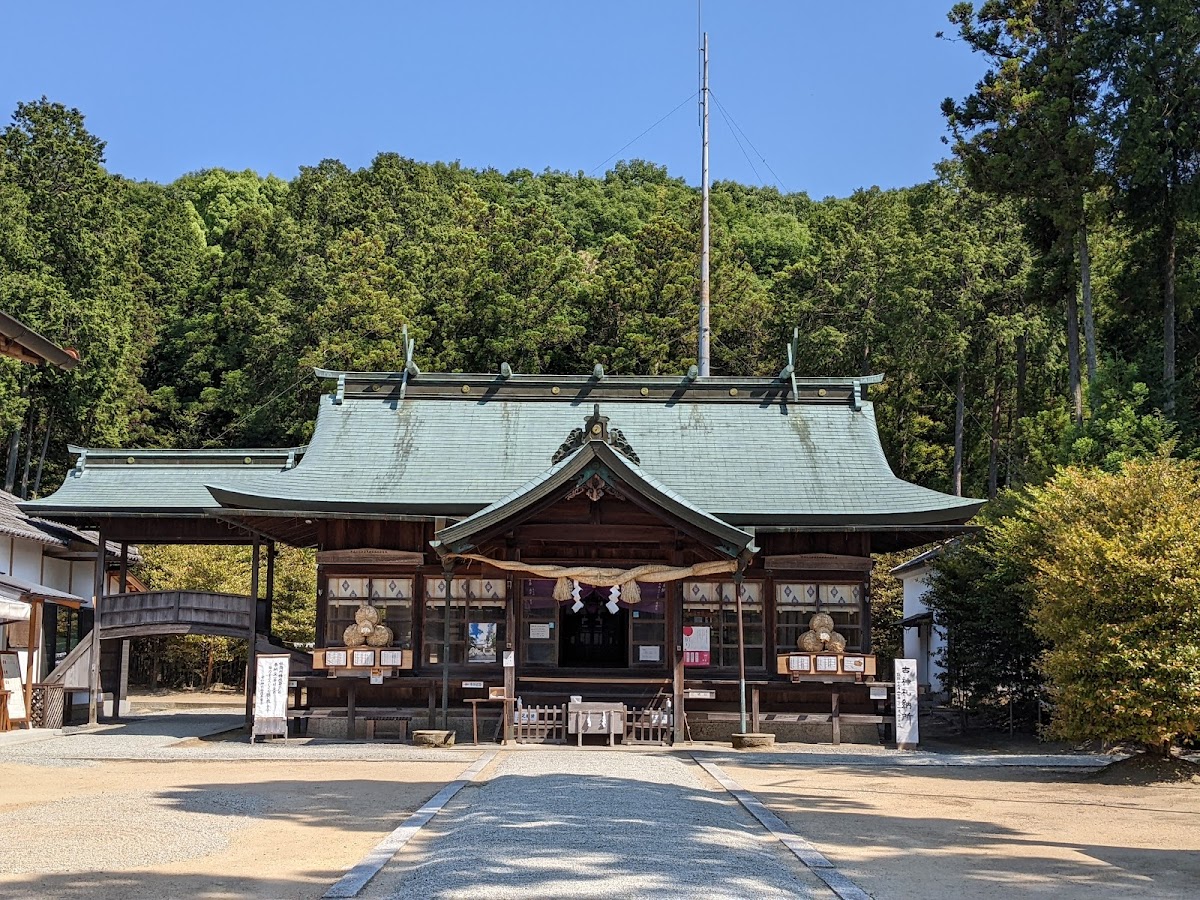
The grounds of Anjin Shrine are vast and enveloped in a tranquil atmosphere amidst a solemn ambiance. Located on the slopes of the lush Miyagiyama mountain, the majestic shrine buildings come into view as you ascend the approach path.
Main Hall and Worship Hall
The current shrine buildings were constructed in 1705 (Hoei 2), making them buildings with a history of over 300 years. They retain the dignified appearance of a shrine building and clearly convey the characteristics of shrine architecture from the mid-Edo period. The main hall adopts the nagare-zukuri style, and together with the worship hall, it exudes a solemn atmosphere.
Forest on the Shrine Grounds
The forest surrounding the shrine is designated as a natural environment conservation area by Okayama Prefecture, and its valuable vegetation is protected. The forest forms a two-tiered forest, a mix of coniferous trees such as Japanese red pine, Japanese black pine, Japanese cedar, and fir, and evergreen broad-leaved trees such as Japanese holly, Japanese evergreen oak, and Japanese laurel, making it a forest of high ecological value.
Walking through the shrine grounds, you are enveloped in a tranquil space lined with ancient trees, and you can feel the special atmosphere of a sacred place. Enjoying the changing seasons is one of the charms of Anjin Shrine.
Stone Steps and Approach
Anjin Shrine, located on the mountainside of Miyagiyama, is accessed by climbing a long stone staircase. These steps have a historical charm, and with each step you climb, you feel as if you are leaving the secular world behind. Lanterns line the approach, creating a magical atmosphere at night.
Annual Festivals and Rituals | Chino-wa Kuguri and Autumn Festival
Anjin Shrine holds various festivals and rituals throughout the year. The most famous events are the summer “Chino-wa Ritual” and the autumn festival.
Chino-wa Ritual (Summer Festival)
At the summer festival held every year on July 11th, the “Chino-wa Kuguri” ritual, praying for good health and protection from illness, is performed. This ritual is a traditional event said to have been passed down for over 2600 years. By passing through a large ring woven from cogon grass (chigaya), one purifies oneself of the impurities accumulated over the past six months and prays for good health for the remaining half of the year.
The Chino-wa Ritual has been cherished by local residents as a ceremony to purify “kegare” (impurity). Worshippers chant, “Those who perform the summer purification ritual in the month of Minazuki (June) are said to have their lives extended by a thousand years,” as they pass through the Chino-wa three times, drawing a figure eight. Many worshippers visit this traditional event every year, and it has become a well-established summer tradition.
Annual Festival (Autumn Festival)
The annual festival is held every year on October 11th. It is an important festival to give thanks for a bountiful harvest and the prosperity of the region, and is conducted with solemn rituals by Shinto priests. A distinctive feature is the “Toya Festival” that follows the annual festival, where local parishioners play a central role in enlivening the festivities.
The autumn festival includes a procession of portable shrines and dedication ceremonies, enveloping the entire region in a festive atmosphere. As a traditional festival deeply rooted in the community, it has been passed down through generations.
National Foundation Day Festival
On National Foundation Day, February 11th, a festival is held to celebrate the enthronement of Emperor Jimmu. As a shrine dedicated to Itsuse-no-Mikoto, Emperor Jimmu’s elder brother, National Foundation Day holds special significance. A solemn festival is held to celebrate the founding of the nation and pray for the peace and security of the state.
History and Origins of Anjin Shrine
The exact founding date of Anjin Shrine is unclear, but archaeological evidence, such as bronze bells unearthed from the shrine grounds, suggests its origins date back to ancient times. The tradition, which boasts a history of over 2600 years, is believed to originate from the reign of Emperor Jimmu (around 660 BC).
From Ancient to Medieval Times
The earliest documented mention is in the “Shoku Nihon Koki” (Later Chronicles of Japan), dated to the 8th year of the Jōwa era (841 AD), but it is certain that it was an important center of local faith even before that. In the Heian period’s “Engishiki Jinmyōchō” (Register of Shrines in the Engi Era), it was listed as the only Myōjin Taisha (Great Shrine) in Bizen Province, indicating its importance to the imperial court.
In the medieval period, it was revered as the Ichinomiya (first-ranked shrine) of Bizen Province and received protection from samurai and feudal lords. Although affected by the turmoil of the Sengoku period (Warring States period), it continued to be protected by the faith of the local residents.
From Early Modern to Modern Period
In 1705 (Hoei 2) of the Edo period, the current shrine building was constructed, establishing its status as a dignified shrine. During this time, it received deep reverence from the Ikeda family, the lords of the Okayama domain, who donated land and carried out repairs to the shrine buildings.
With the Meiji Restoration’s Separation of Shinto and Buddhism, the shrine’s independence was established, and under the modern shrine ranking system, it was ranked as a National Shrine of the second rank. This represented a high status nationwide, signifying its position as a nationally important shrine.
After World War II, with the dismantling of State Shinto, it became an independent religious corporation and a special shrine under the Association of Shinto Shrines. Even today, it continues to attract many worshippers as a local tutelary shrine and a historically significant shrine.
Connection with the Community | As the Chief Guardian Shrine of Bizen Province
Anjin Shrine has long been worshipped as the “Chief Guardian Shrine of Bizen Province,” the guardian deity of the entire region. It is a central shrine visited by worshippers not only from the Saidaiji area but from all over Bizen Province.
A Shrine Deeply Connected to the Community
The local parishioners’ organization remains active, participating in the management of festivals and the maintenance of the shrine grounds. Especially during the summer Chino-wa ritual and the autumn annual festival, local residents work together to support the events.
The shrine also functions as a central hub for the local community, attracting many visitors at various life milestones such as New Year’s visits, Shichi-Go-San (a traditional rite of passage for children), and exorcisms. It also plays a vital role in preserving and passing on the region’s traditional culture.
Cultural Value
The shrine grounds are designated as a natural environment conservation area by Okayama Prefecture, protecting a valuable natural environment. Furthermore, many cultural assets of high historical and cultural value remain, including the shrine buildings and stone structures within the grounds.
It is an indispensable part of the region’s history and is carefully preserved as a source of local pride.
Visiting Information and Access
For those planning a visit to Anjin Shrine, we provide detailed access information and points to note during your visit.
Basic Information
- Location: 743 Ichinomiya, Saidaiji, Higashi-ku, Okayama City, Okayama Prefecture
- Phone Number: 086-942-2058
- Visiting Hours: Grounds are freely accessible (please check the shrine office hours)
- Parking: Available (for visitors)
Access by Public Transportation
The nearest station is Saidaiji Station on the JR Ako Line. The following are ways to reach the shrine from the station:
- Walking: Approximately 25 minutes (approximately 2 km)
- Taxi: Approximately 5 minutes
- Bus: Take a Ryobi Bus and get off at the “Ichinomiya” bus stop, then walk for approximately 5 minutes.
The path from Saidaiji Station is relatively flat, but you will need to climb stone steps from the shrine entrance to the main hall. Comfortable walking shoes are recommended.
Access by Car
- Sanyo Expressway: Approximately 30 minutes from “Okayama IC” or approximately 20 minutes from “Bizen IC”
- National Route 2: Accessible via prefectural road from the Saidaiji area.
The shrine has a parking lot for visitors, but congestion is expected on festival days, so it is recommended to visit with plenty of time to spare.
Manners and Precautions for Visiting
- The shrine grounds are a sacred place, so please visit in silence.
- The stone steps are long, so those who are not confident in their physical strength should not push themselves and should climb while taking breaks.
- In the summer, it is recommended to take precautions against insects such as mosquitoes.
- If you wish to receive a Goshuin (shrine stamp), it is recommended to check the reception hours of the shrine office in advance.
Nearby Tourist Attractions
When visiting Anjin Shrine, you can also visit nearby tourist attractions.
Saidaiji Kannon-in Temple
Located in the heart of the Saidaiji district, this ancient Shingon Buddhist temple is famous for the “Saidaiji Eyo” festival held every February, one of Japan’s three most unusual festivals. It’s about a 10-minute drive from Anjin Shrine.
Around the Former Hoden Beach
This beautiful coastline facing the Seto Inland Sea was once a bustling beach resort. Even today, it’s known as a scenic area, perfect for walks and drives. It’s about a 15-minute drive from Anjin Shrine.
Historical Walk in Higashi Ward, Okayama City
Higashi Ward is dotted with other historical temples, shrines, and historical sites. A leisurely day-long historical walk is highly recommended.
Summary | A Pilgrimage Experience Feeling 2600 Years of History
Anjin Shrine is one of the oldest shrines in Okayama Prefecture, with a history of over 2600 years since its founding. As the former Ichinomiya (first-ranked shrine) of Bizen Province, it has attracted the faith of the local community. The shrine boasts numerous attractions, including its high status as a Shikinaisha (a major shrine listed in the Engishiki) and former Kokuhei Chusha (a medium-ranking national shrine), its historical significance as a shrine dedicated to Itsuse-no-Mikoto, the elder brother of Emperor Jimmu, and its magnificent shrine buildings constructed in 1705.
The annual Chino-wa Shinto ritual on July 11th is a traditional event that has been passed down for over 2600 years, and is a local tradition where people pray for good health and protection from illness. The annual festival on October 11th is a solemn ceremony expressing gratitude for a bountiful harvest and the prosperity of the region.
The lush forest surrounding the shrine grounds is designated as a natural environment conservation area by Okayama Prefecture, forming a valuable forest environment where coniferous trees such as Japanese red pine, Japanese black pine, Japanese cedar, and fir are mixed with evergreen broad-leaved trees such as Japanese holly, Japanese evergreen oak, and Japanese laurel.
Located approximately 25 minutes on foot from JR Ako Line’s Saidaiji Station, or accessible by car, Anjin Shrine offers ample parking for visitors. Situated on Miyagiyama (Tsuruyama) in Saidaiji Ichinomiya, Higashi-ku, Okayama City, it offers a chance to experience firsthand the timeless history and dignified atmosphere of the shrine.
As a historically significant shrine deeply rooted in the community, Anjin Shrine attracts many visitors at various milestones in life, such as New Year’s visits, Shichi-Go-San (a traditional rite of passage for children), and exorcisms. As the principal guardian shrine of Bizen Province, it will undoubtedly continue to be revered as the protector of the region.