Complete Guide to Yamanashioka Shrine | A Thorough Explanation of its History, Cultural Assets, and the Charm of its Taidai Kagura
Yamanashioka Shrine is an ancient shrine located in Shizume, Kasugai-cho, Fuefuki City, Yamanashi Prefecture, and is known as a Shikinaisha (shrine listed in the Engishiki Jinmyocho). This article will introduce the charm of Yamanashioka Shrine in its entirety, from its historical background to its cultural assets and traditional events.
What is Yamanashioka Shrine?
Yamanashioka Shrine is one of the 20 Shikinaisha in Kai Province listed in the Engishiki Jinmyocho, which was compiled in 927 (Encho 5). Formerly known as “Yamanashi Myojin,” it is a historically significant shrine said to be the origin of the name of Yamanashi Prefecture. Its former shrine rank was Gosha (village shrine), and it continues to receive deep devotion from the local people.
Origin of the Shrine Name
The name Yamanashioka Shrine originates from the fact that there were once many Yamanashi (pear) trees growing in this area. It is said that during the reign of Emperor Seimu, the thirteenth emperor, the shrine was relocated to its current location after clearing a grove of trees in Yamanashi, and was named “Yamanashioka Shrine.” Behind the shrine grounds, a single Japanese pear tree (a member of the Rosaceae family) still remains, and in spring, one can see its white blossoms.
Location and Access
Yamanashioka Shrine is located in Shizume, Kasugai-cho, Fuefuki City, approximately a 12-minute walk from the north exit of JR Isawa Onsen Station. Its location in the eastern part of the Kofu Basin, at the foot of Mount Omuro, suggests that this area has been recognized as a sacred place since ancient times.
Deities and Divine Virtues
The deities enshrined at Yamanashioka Shrine are the following three:
- Ōyamatsumi-no-Mikoto: Known as the god of mountains, and the guardian deity of agriculture and forestry.
- Takaokami-no-Kami: A dragon god who controls water, and the god of rainmaking and flood control.
- Wakeikazuchi-no-Kami: A thunder god, and the god of protection against evil and good fortune.
These enshrined deities reflect the religious practices of Kai Province, where mountain worship and water deity worship are fused. Especially in the Kofu Basin, where agriculture was thriving, the worship of gods who controlled mountains and water was closely intertwined with people’s lives.
Origins and History
Legend of Founding
The founding of Yamanashioka Shrine is said to date back to the reign of Emperor Sujin, the tenth emperor (according to one theory, the late 3rd century). At that time, an epidemic was rampant throughout Japan, and disasters were frequent in various regions. Concerned about this, Emperor Sujin issued an imperial decree to establish a shrine on the slopes of Mount Omuro behind the shrine.
Later, during the reign of Emperor Seimu, the thirteenth emperor, the shrine was relocated to its current location after clearing a large forest in Yamanashi, and it came to be known as “Yamanashioka Shrine.” This relocation transformed the shrine from a place of mountain worship to a center of faith closer to people’s daily lives.
Status as an Engishiki Shrine
The Engishiki Jinmyocho (a list of shrines compiled in the Heian period) lists 20 official shrines in Kai Province, and Yamanashioka Shrine was among them, listed alongside Mononobe Shrine and Kaina Shrine, making it an important shrine. Its status as an Engishiki shrine indicates that it is a historically significant shrine recognized by the imperial court since ancient times.
Deep Connection with the Takeda Family
From the medieval period onward, Yamanashioka Shrine flourished as a place of prayer for successive generations of the Takeda family. Takeda Shingen, in particular, deeply revered this shrine and is said to have always prayed for victory before going into battle. The Taidai Kagura, which is believed to have originated from Shingen’s prayer for victory, is also known as the “Takeda Shingen’s Battle Departure Kagura” and is still preserved today as a prefecturally designated intangible folk cultural property.
Relationship with the Tokugawa Family
Even after the fall of the Takeda clan, Yamanashioka Shrine received strong devotion from the Tokugawa family. Tokugawa Ieyasu considered Kai Province important and implemented protective policies for major shrines in Kai Province, and Yamanashioka Shrine was one of the shrines that benefited from this.
Cultural Properties
Yamanashioka Shrine possesses nationally designated important cultural properties, prefecturally designated tangible cultural properties, and prefecturally designated intangible folk cultural properties, and is known as a shrine of high historical and cultural value.
Main Hall (Nationally Designated Important Cultural Property)
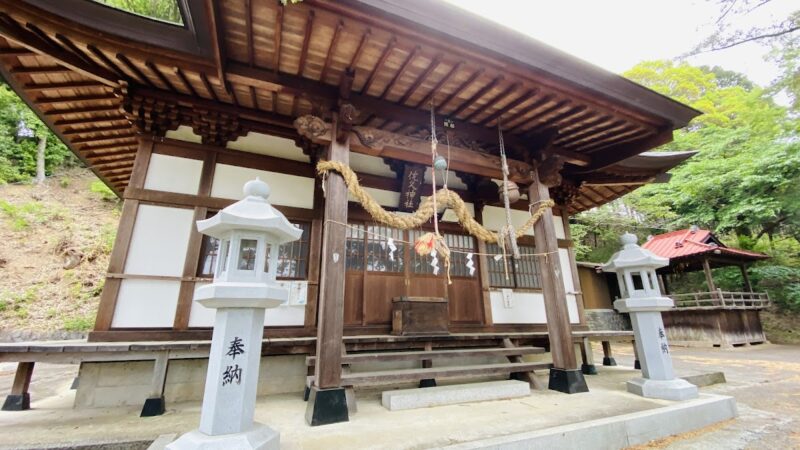
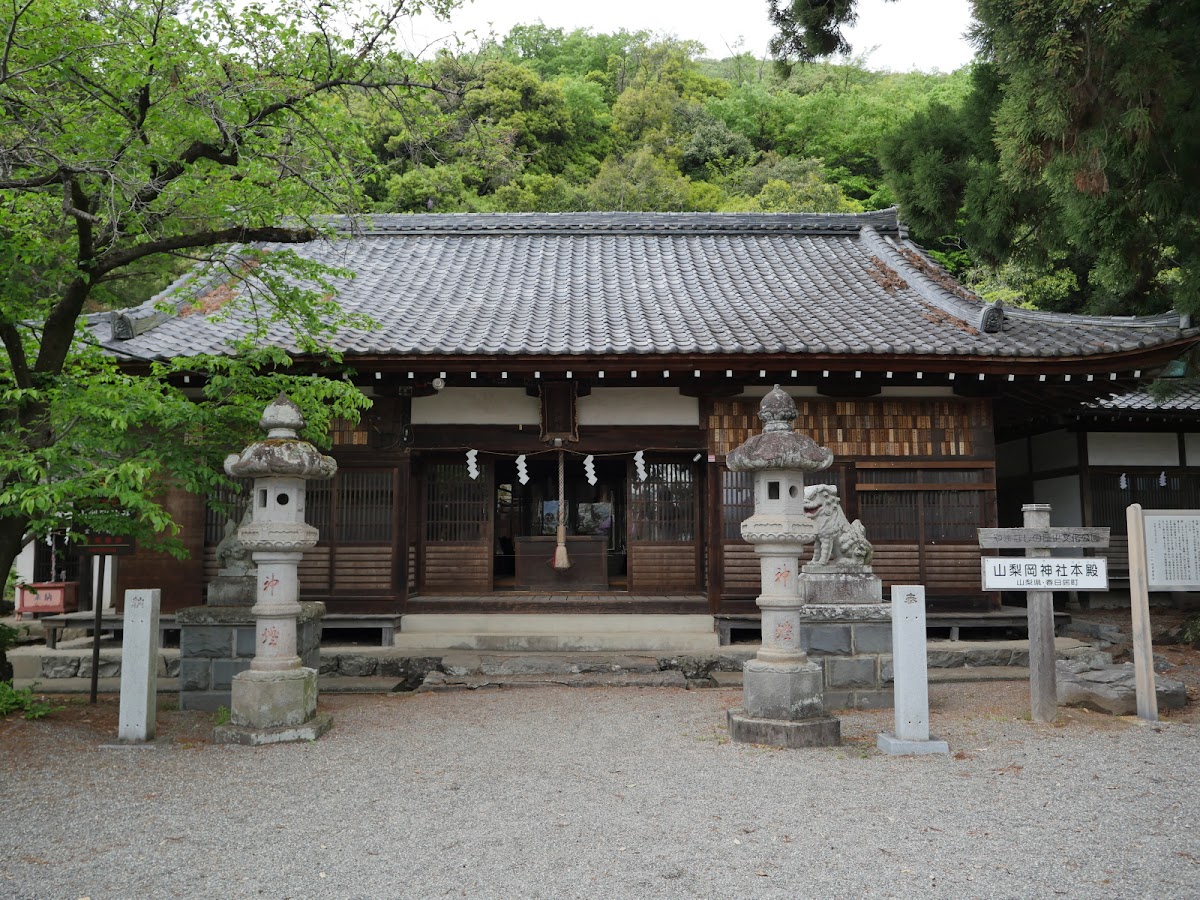
The main hall of Yamanashioka Shrine is designated as a nationally designated important cultural property (building). This is a valuable building that preserves the architectural style from the late Muromachi period to the Azuchi-Momoyama period, employing the typical form of shrine architecture known as Ikkensha Nagare-zukuri.
The main hall is characterized by its exquisite carvings and graceful curves. The excellent architectural techniques of the time can be seen in every detail, from the curve of the roof and the overhang of the eaves to the construction of the portico. In particular, the decorative carvings such as the kaerumata (frog-leg brackets) and kibana (wooden carvings) demonstrate the high skill of the craftsmen of the time.
Other Prefectural Designated Cultural Properties
Besides the main hall, there are other tangible cultural properties (buildings) designated by the prefecture within the shrine grounds. These buildings are valuable resources for understanding the changes in shrine architecture from the Edo period to the Meiji period.
Gunseki (County Stone)
Within the shrine grounds, there is a stone called “Gunseki.” This is said to be the keystone of Yamanashi County, and is believed to have been an important marker stone in the ancient county system. This stone is one piece of evidence indicating that Yamanashioka Shrine was the central shrine of Yamanashi County in ancient times.
Natural Landscape of the Shrine Grounds
The shrine grounds are rich in unusual rock formations and are also famous for their azaleas. In spring, colorful azaleas bloom, attracting many worshippers and tourists. There is also a magnificent wisteria trellis, and during the wisteria season, the purple flower clusters create a beautiful landscape.
Daidai Kagura (Prefectural Designated Intangible Folk Cultural Property)
The Yamanashioka Shrine Daidai Kagura is a prefecturally designated intangible folk cultural property and is also known as “Takeda Shingen’s Kagura of Departure for Battle.”
Origin of the Kagura
The Daidai Kagura is said to have originated when Takeda Shingen offered it as a prayer for victory before going into battle. It belongs to the Izumo Kagura lineage and is a valuable folk performing art that preserves ancient forms to this day.
24 Types of Dances
The Taidai Kagura consists of 24 types of dances (24 performances), each with its own meaning and role. These dances are based on myths and legends, and are dedicated to offerings to the gods and prayers for a bountiful harvest and good health.
The Dance of the Four Swords (Kume Dance)
The 24th performance, the “Kume Dance,” also known as the “Dance of the Four Swords,” is particularly renowned for its valiant energy. The sight of four dancers, each holding a sword, performing with such power is breathtaking. This dance evokes the bravery of Takeda Shingen’s march into battle and captivates the audience.
Performance Period of the Kagura
The Taidai Kagura is performed at the Kagura Hall within the shrine grounds during the Spring Grand Festival (Azumaya-miya Spring Grand Festival). The 24 dances are performed one after another starting at 8:00 AM, continuing throughout the day. Many people from within and outside the prefecture visit to witness this Kagura.
Shinto Rituals and Annual Festivals
Azumaya-gu Spring Annual Festival
The most important Shinto ritual at Yamanashioka Shrine is the Azumaya-gu Spring Annual Festival, held in spring. During this festival, the aforementioned Taidai Kagura is performed, along with various other rituals. The local community participates wholeheartedly in the festival, making it a place for the transmission of traditional culture.
Other Annual Events
In addition to the Spring Annual Festival, Yamanashioka Shrine holds various Shinto rituals throughout the year, including the New Year’s Day Festival, the Setsubun Festival, and the Autumn Annual Festival. These rituals strengthen the bonds of the local community and play an important role in passing on traditions to future generations.
Shrine Buildings and Grounds Highlights
Worship Hall
Located in front of the main shrine, the worship hall is where worshippers offer their prayers. From the worship hall, one can worship the main shrine, and the atmosphere is solemn and serene.
Kagura Hall
Within the shrine grounds is the Kagura Hall, where the Taidai Kagura dance is performed. The Kagura Hall functions as a stage, designed to allow spectators to enjoy the dance.
Subsidiary Shrines
Besides the main shrine, several subsidiary shrines are enshrined within the grounds. These shrines enshrine various deities and cater to the diverse wishes of worshippers.
Relationship with Mount Omuro
Mount Omuro rises behind Yamanashioka Shrine. This mountain is considered the site of the shrine’s founding and is still revered as a sacred mountain. Midway up Mount Omuro is a place believed to be the original site of the shrine, where traces of mountain worship can be seen.
Information for Visitors
Visiting Hours
Yamanashioka Shrine is generally open for free visits. However, the shrine office’s operating hours may be limited, so it is recommended to check in advance if you wish to obtain a Goshuin (shrine stamp) or amulet.
Parking
The shrine has a parking lot for visitors. During events such as the annual festival, congestion is expected, so please consider using public transportation.
Nearby Tourist Attractions
Near Kasugai-cho in Fuefuki City is Isawa Onsen, a famous hot spring resort. After visiting Yamanashioka Shrine, relaxing at Isawa Onsen is highly recommended. Fuefuki City is also known for its peaches and grapes, and fruit picking is available depending on the season.
Cultural Significance of Yamanashioka Shrine
Importance as the Origin of the Place Name
Yamanashioka Shrine is an indispensable part of Yamanashi Prefecture’s history as the shrine from which the place name “Yamanashi” originates. The history of the shrine is deeply intertwined with the formation of Yamanashi Prefecture.
Value as a Shikinaisha Shrine
Shikinaisha shrines, listed in the Engishiki Jinmyocho (a list of shrines compiled in the Heian period), were high-ranking shrines recognized by the state in ancient times. Yamanashioka Shrine was one of the 20 shrines of Kai Province, and was one of the religious and political centers of ancient Kai Province.
Relationship with Takeda Shingen
The deep connection with Takeda Shingen, a representative warlord of the Sengoku period, further enhances the historical value of Yamanashioka Shrine. As a place associated with Shingen, it is an attractive spot for history enthusiasts.
Preservation of Folk Culture
The preservation of the Taidai Kagura, an intangible folk cultural asset, is crucial for maintaining the region’s cultural identity. Even today, the way the local people work together to protect this tradition serves as a model for cultural transmission.
Basic Information
Location: 1696 Shizume, Kasugai-cho, Fuefuki City, Yamanashi Prefecture
Access:
- Approximately 12 minutes on foot from the north exit of Isawa-Onsen Station on the JR Chuo Main Line
- Approximately 15 minutes by car from Ichinomiya-Misaka IC on the Chuo Expressway
Shrine Rank: Former Village Shrine, Shikinaisha (Shrine listed in the Engishiki)
Main Cultural Properties:
- Main Hall (Nationally Designated Important Cultural Property)
- Taidai Kagura (Prefecturally Designated Intangible Folk Cultural Property)
- Other Prefecturally Designated Tangible Cultural Properties
Main Events:
- Azumaya-gu Spring Grand Festival (Taidai Kagura Dedication)
- New Year’s Day Festival
- Autumn Grand Festival
Contact Information
Yamanashioka Shrine
Address: 1696 Shizume, Kasugai-cho, Fuefuki City, Yamanashi Prefecture 406-0004
For detailed information and event schedules, please contact the Fuefuki City Tourism Division or the Yamanashi Prefectural Shrine Association.
Fuefuki City Tourism Division
Information about Yamanashioka Shrine can also be found on Fuefuki City’s official tourism information website, “Fuefuki Tourism Navi.”
Yamanashi Prefecture Shrine Association
Comprehensive information about shrines in Yamanashi Prefecture can be found on the Yamanashi Prefecture Shrine Association website.
Summary
Yamanashioka Shrine, a Shikinaisha (shrine listed in the Engishiki) with a history of over 1000 years, is an important shrine that conveys the history and culture of Yamanashi Prefecture to the present day. It boasts many attractions, including the main hall, a nationally designated important cultural property, the Taidai Kagura (a type of Shinto ritual dance), a prefecturally designated intangible folk cultural property, and its deep connection to Takeda Shingen.
The natural scenery within the shrine grounds is also beautiful, and it is especially bustling with visitors during the azalea and wisteria seasons. It is a recommended spot not only for history buffs, but also for those interested in shrine architecture, traditional performing arts, and nature.
When visiting Yamanashi Prefecture, be sure to visit Yamanashioka Shrine and experience its history, culture, and sacred atmosphere. At this place of worship that has continued since ancient times, you will be able to feel the depth and richness of Japan’s traditional culture.