Complete Guide to Minami Hokkeji Temple (Tsubosaka-dera) | History, Highlights, and Access to the 6th Temple of the Saigoku Thirty-Three Kannon Pilgrimage
Minami Hokkeji Temple is an independent Shingon Buddhist temple located in Tsubosaka, Takatori-cho, Takaichi-gun, Nara Prefecture. It is commonly known as “Tsubosaka-dera” and attracts many pilgrims from all over Japan as the 6th temple of the Saigoku Thirty-Three Kannon Pilgrimage. Its mountain name is Tsubosaka-san, and its principal image is the Eleven-Faced Thousand-Armed Thousand-Eyed Kannon Bodhisattva. It has long been revered as a temple with particularly miraculous powers for healing eye diseases.
Located on the slopes of Mount Takatori (elevation 584m), the temple grounds offer a spectacular panoramic view of the Nara Basin. To the south lies Mount Yoshino, famous for its cherry blossoms, and to the north, the Yamato Sanzan mountains are visible, making it a renowned temple situated in a scenic location.
Table of Contents
- History of Nanhokkeji Temple
- The Miraculous Tale of Tsubosaka and the Belief in Healing Eye Diseases
- Highlights of the Temple Grounds
- Cultural Properties and Temple Treasures
- Annual Events
- Access and Visiting Information
- Nearby Famous Places and Historical Sites
- Frequently Asked Questions
History of Nanhokkeji Temple
Founding and the Abbot Benki
According to the temple’s “Nanhokkeji Koroden” (Records of Ancient Abbots of Nanhokkeji Temple), the founding of Nanhokkeji Temple dates back to the 3rd year of the Taiho era (703 AD). It is said that the temple began when the monk Benki, a member of the Gangoji Temple, was practicing asceticism on this mountain. He placed his favorite crystal vase in a hermitage on the hill and carved and enshrined a statue of Kannon (Goddess of Mercy) that he had perceived. The “vase” and “hill” became the origin of the temple’s name, giving rise to the common name “Tsubosaka-dera” (Tsubosaka Temple).
Benki Shonin is known as a high-ranking priest of the Nara period. After training at Gangoji Temple, he established a Kannon (Goddess of Mercy) worship hall in this area. As an ancient temple with a history of over 1300 years since its founding, it has been a place of worship since the Nara period.
As the Prayer Temple of Empress Gensho
Shortly after its founding, Nanhokkeji Temple became the prayer temple of Empress Gensho. With the patronage of the imperial family, the temple flourished, and during the Heian period, it became a large temple complex with many halls and pagodas. Pilgrims, both nobles and commoners, constantly visited to pray for the healing of eye diseases, and it became widely known as a sacred site of Kannon worship.
History of War and Reconstruction
In the Middle Ages, Nanhokkeji Temple was also affected by war. In particular, during the Meio era (1492-1501), it was struck by a large fire, and many halls and pagodas were destroyed. However, due to the strong devotion to Kannon (Goddess of Mercy), efforts toward restoration continued, and during the Edo period, the reconstruction of the temple complex was carried out in earnest.
Many of the current main buildings were rebuilt between the Edo and Meiji periods. The three-story pagoda, after being destroyed by fire during the Meio era, was rebuilt after many years and has become a symbolic presence on the temple grounds.
From Modern to Contemporary Times
Despite the impact of the anti-Buddhist movement of the Meiji era, Nanhokkeji Temple continued to maintain its faith as a sacred site for healing eye diseases. From the Showa to the Heisei period, Buddhist exchanges with India deepened, and the temple took on an international aspect, with large stone Buddha statues being erected on the grounds.
In particular, since 1983, large stone statues of Kannon and Nirvana, gifted from India, have been enshrined on the temple grounds, becoming symbols of Buddhist cultural exchange between Japan and India.
The Tale of Tsubosaka’s Miracles and the Belief in Healing Eye Diseases
The Story of Tsubosaka’s Miracles
What made Nanbokuji Temple famous throughout Japan is the “Tsubosaka Miracles,” a story written during the Edo period. This story has been frequently performed as a puppet play and Kabuki performance, and has been loved by many people.
The protagonists of the story are Sawachi, a blind shamisen player, and his wife, Osato. Osato secretly visited Tsubosaka Temple every night, praying for her husband’s eye disease to be cured. Her husband misunderstood her going out as infidelity and confronted her, but upon learning the truth, Sawachi was moved by his wife’s devoted love. After the couple visited Tsubosaka Temple together, Sawachi’s eyes were restored through the miraculous power of Kannon (Goddess of Mercy), and the couple’s bond deepened—a truly moving story.
This “Tsubosaka Miracles,” a masterpiece depicting marital love and the faith in Kannon, has been loved from the Edo period to the present day.
Miraculous Healing of Eye Diseases
The principal image of Nanhokkeji Temple, the Eleven-Faced Thousand-Armed Thousand-Eyed Kannon Bodhisattva, as its name “Thousand-Eyed” suggests, has been revered since ancient times as a Kannon Bodhisattva with miraculous healing powers for eye diseases. People suffering from eye diseases from all over Japan visit the temple, and many stories of its miraculous healing are told.
Even today, there is a constant stream of visitors praying for healing from eye diseases, and people continue to come seeking amulets and prayers. Ema (votive tablets) inscribed with the Japanese character for “eye” (め), symbolizing wishes for healthy eyes, are also offered.
Highlights of the Temple Grounds
Main Hall (Octagonal Hall)
The main hall is built in an octagonal style, and the principal image, the Eleven-Faced Thousand-Armed Thousand-Eyed Kannon Bodhisattva, is enshrined in the inner sanctuary. This principal image is considered a hidden Buddha and is usually kept in a shrine, but it is sometimes unveiled during special religious ceremonies.
The architectural style of the main hall strongly reflects the characteristics of Shingon Esoteric Buddhism, and the interior is adorned with mandalas and Buddhist paintings, creating a solemn atmosphere.
Three-Storied Pagoda
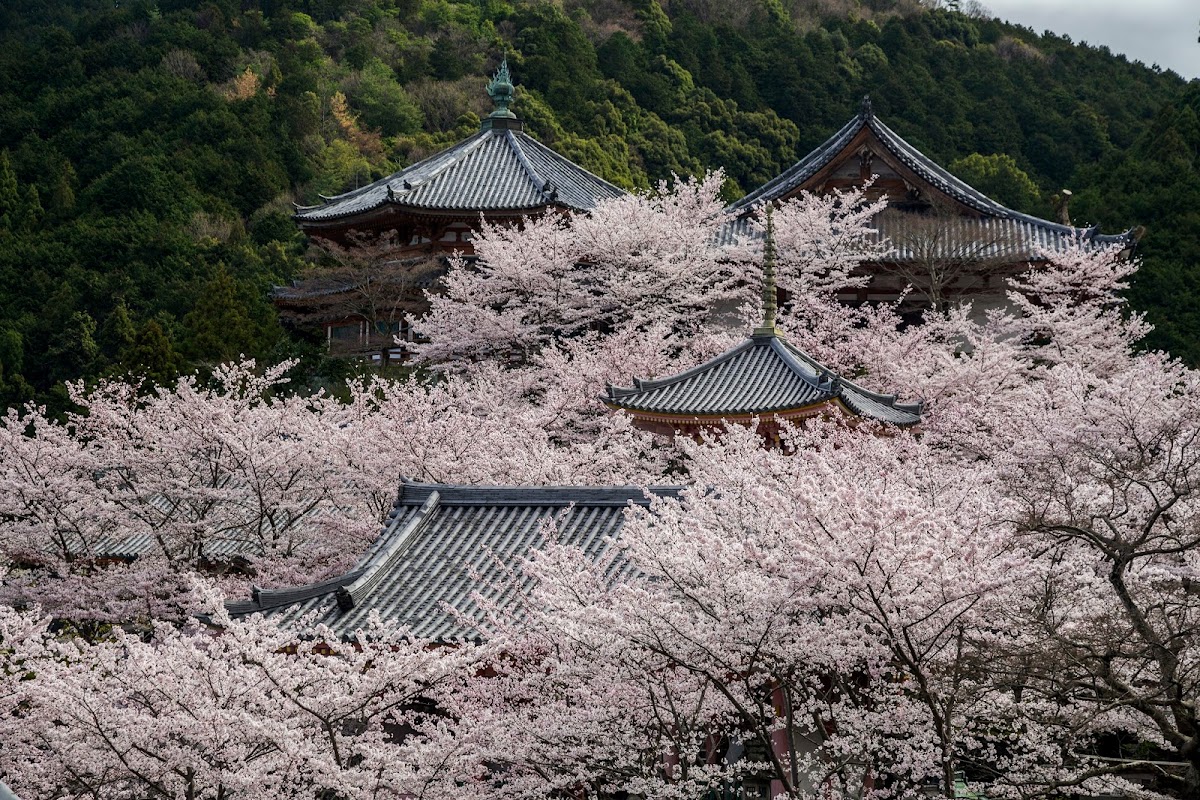
The three-storied pagoda, a symbol of the temple grounds, is a structure rebuilt after a fire during the Meio era. Its elegant form, approximately 18 meters tall, harmonizes with the surrounding nature, making it an excellent photo spot, especially during cherry blossom and autumn foliage seasons.
Inside the pagoda is enshrined Dainichi Nyorai, representing the cosmology of Esoteric Buddhism. The curve of the roof and the intricate workmanship of the brackets showcase the pinnacle of Edo period architectural techniques.
Prayer Hall
The prayer hall is a building where worshippers pay their respects to the principal image, located in front of the main hall. Its spacious interior can accommodate many worshippers and plays a central role during religious services and ceremonies.
The ceiling of the prayer hall features a beautiful coffered ceiling adorned with colorful paintings of flowers and birds. This is a valuable decoration demonstrating the high level of craftsmanship of Edo period artisans.
Great Kannon Stone Statue (Great Kannon Stone Statue from India)
The Great Kannon Stone Statue, a gift from India in 1983, is a colossal stone statue of Kannon, measuring approximately 20 meters in length. Made from Indian white granite, its magnificent scale overwhelms visitors.
This statue was erected as a result of Nanhokkeji Temple’s international contribution activities, such as supporting schools for the blind in India. It serves as an important landmark on the temple grounds, symbolizing Buddhist exchange between Japan and India.
Great Nirvana Stone Statue
Completed in 1999, the Great Nirvana Stone Statue is a statue of Shakyamuni Buddha in Nirvana, approximately 8 meters long and 3 meters high. Also made from Indian stone, it depicts the scene of Shakyamuni Buddha’s death.
The serene expression on Shakyamuni’s face as he lies down conveys deep peace and the teachings of Buddhism to those who behold it.
Tahōtō Pagoda
Located on a hill within the temple grounds, the Tahōtō pagoda offers a breathtaking panoramic view of the Nara Basin. In spring, cherry blossoms adorn the surroundings, and in autumn, the vibrant autumn leaves create a beautiful spectacle throughout the seasons.
Water for Curing Eye Diseases
Within the temple grounds is a sacred spring known as “Water for Curing Eye Diseases.” It is believed that washing one’s eyes with this water cures eye diseases. Many worshippers visit to obtain this water and pray for healing from eye ailments.
Cultural Properties and Temple Treasures
Important Cultural Properties
Minami-Hokkeji Temple houses valuable cultural properties designated as Important Cultural Properties of Japan.
Wooden Eleven-Headed Kannon Standing Statue
This wooden Eleven-Headed Kannon standing statue, believed to be from the late Heian period, is known for its elegant form and exquisite carving techniques. It is a separate Kannon statue from the main deity and is carefully preserved as a temple treasure.
Prayer Hall The prayer hall itself is designated as an Important Cultural Property and is a valuable building that preserves the architectural style of the Edo period.
Other Temple Treasures
Ancient Documents and Records Many ancient documents and records that tell the history of the temple are preserved, including the “Nanhokkeji Koroden” (Biographies of the Elders of Nanhokkeji Temple). These are valuable materials for the study of the history of Nanhokkeji Temple.
Buddhist Paintings and Mandalas Numerous Buddhist paintings and mandalas created from the Muromachi period to the Edo period are housed here and are highly regarded as masterpieces of esoteric Buddhist art.
Temple Bell The temple bell, cast during the Edo period, is known for its beautiful sound and still serves to tell the time.
Annual Events
Spring Grand Memorial Service (March)
Every year in March, the Spring Grand Memorial Service is held, attracting many worshippers. Often coinciding with the cherry blossom season, the service is conducted in a vibrant atmosphere.
Prayer Service for Protection from Eye Diseases (Ongoing)
Special prayer services for healing eye diseases are held regularly. Individual prayers are also accepted, and people suffering from eye diseases come from all over Japan.
Kannon Festival (18th of Every Month)
The 18th of every month is considered the festival day of Kannon (Goddess of Mercy), and a special memorial service is held. It is believed that visiting on this day brings special blessings.
Autumn Grand Memorial Service (October)
In October, the Autumn Grand Memorial Service is held, a solemn ceremony taking place in the temple grounds amidst the beautiful autumn foliage. Many pilgrims of the Saigoku Thirty-Three Kannon Pilgrimage visit during this time.
New Year’s Eve Bell Ringing (December 31st)
On New Year’s Eve, the temple bell is rung, and general visitors are welcome to ring it. Many people gather in the solemn atmosphere of welcoming the New Year.
Access and Visiting Information
Access by Train and Bus
Using the Kintetsu Yoshino Line
- Get off at Tsubosakayama Station on the Kintetsu Yoshino Line
- Approximately 20 minutes by Nara Kotsu bus bound for Tsubosakadera-mae from the station
- Get off at the last stop, Tsubosakadera-mae, and it’s a short walk.
Since the number of buses is limited, it is recommended to check the timetable in advance. Particular caution is needed on weekdays due to the limited number of buses.
Access by Car
From Osaka
- Approximately 30 minutes from Katsuragi IC on the Minami-Hanna Expressway
- Approximately 40 minutes from Koriyama IC on the Nishi-Meihan Expressway
From Kyoto/Nara
- Approximately 50 minutes via National Route 24 and National Route 169
There is a free parking lot (approximately 80 cars) on the temple grounds. During cherry blossom and autumn foliage seasons, and special viewing periods for the Saigoku Thirty-Three Kannon Pilgrimage, congestion is expected, so early arrival is recommended. ### Visiting Hours and Fees
Visiting Hours
8:30 AM – 5:00 PM (Open year-round)
Entrance Fee
Adults: 600 yen
Children: 100 yen (Elementary school students)
Infants: Free
Group discounts (30 or more people) are available.
Goshuin (Temple Stamp)
You can receive a Goshuin stamp for the 6th temple of the Saigoku Thirty-Three Kannon Pilgrimage. Reception hours are the same as visiting hours.
Location and Contact Information
Location
3 Tsubosaka, Takatori-cho, Takaichi-gun, Nara Prefecture 635-0102
Phone Number
0744-52-2016
Official Website
https://www.tsubosaka1300.or.jp/
Nearby Historical Sites and Places
Takatori Castle Ruins
Located approximately 2km east of Minami-Hokkeji Temple, on the summit of Mt. Takatori, are the ruins of Takatori Castle, one of Japan’s three great mountain castles. The stone walls remain in excellent condition, conveying the grandeur of the mountain castle. In spring, you can enjoy the spectacular view of cherry blossoms and stone walls, making it known as the “Castle in the Sky.”
Takatori Town Historic Preservation District
Takatori Town has a historic preservation district where Edo-period townhouses remain, allowing you to experience the atmosphere of a castle town. Old merchant houses and samurai residences are scattered along the Tosa Kaido road, making it ideal for a stroll.
Asuka Village
Located about 20 minutes north of Minami-Hokkeji Temple by car, Asuka Village is a historical village with many historical sites from the Asuka period. You can visit sites that evoke ancient Japan, such as the Ishibutai Kofun, Takamatsuzuka Kofun, and Asuka-dera Temple.
Yoshino Mountain
Located about 30 minutes south of Minami-Hokkeji Temple, Yoshino Mountain is known as one of Japan’s most famous cherry blossom viewing spots. In spring, approximately 30,000 cherry trees cover the mountain, creating a spectacular view. Historic temples such as Kinpusen-ji Temple are also scattered throughout the area.
Temples before and after the 33 Kannon Pilgrimage Sites
Temple No. 5: Kuzui-ji Temple (Fujiidera City, Osaka Prefecture)
Located about 40km northwest of Minami-Hokkeji Temple, this ancient temple is known for its eleven-faced, thousand-armed Kannon seated statue (National Treasure).
Temple No. 7: Okadera (Asuka Village, Nara Prefecture)
Located approximately 10km north of Nanhokkeji Temple. It is famous for its seated statue of Nyoirin Kannon, the largest clay statue in Japan.
Those undertaking the Saigoku Thirty-Three Kannon Pilgrimage are recommended to visit these temples as well.
Summary
Nanhokkeji Temple (Tsubosaka-dera) has been a center of Kannon worship for over 1300 years since its founding in 703 AD. As the 6th temple on the Saigoku Thirty-Three Kannon Pilgrimage, and as a temple renowned for its miraculous healing powers for eye diseases, it continues to attract many worshippers from all over Japan.
Its location on the slopes of Mount Takatori offers breathtaking panoramic views of the Nara Basin, allowing visitors to enjoy the beauty of nature throughout the seasons. Within the temple grounds, diverse cultural assets coexist, from Edo-period buildings to modern Indian stone statues, creating a sense of layered history.
The story of marital love depicted in the “Tsubosaka Miracle Chronicle” continues to touch the hearts of many and conveys the power of Kannon faith. Minami Hokkeji Temple is a special place for those who visit not only to pray for healing from eye diseases, but also to seek inner peace.
When sightseeing in Nara, be sure to visit Minami Hokkeji Temple in conjunction with exploring the history of the Asuka and Yoshino areas. This ancient temple, nestled quietly on the mountainside, will allow you to experience the depth of Japanese Buddhist culture and the compassion of Kannon.
Frequently Asked Questions (FAQ)
Q1: Are Minami Hokkeji Temple and Tsubosaka-dera Temple the same temple?
A1: Yes, they are the same temple. Its official name is “Minami Hokkeji,” but it is widely known by its common name, “Tsubosaka-dera.” Its mountain name is Tsubosaka-yama, and the name is said to originate from the fact that a crystal vase was placed on the slope at the time of its founding.
Q2: Is it true that the temple offers healing for eye diseases?
A2: The Eleven-Faced, Thousand-Armed, Thousand-Eyed Kannon Bodhisattva, the principal image of Nanhokkeji Temple, has long been revered as a Kannon with miraculous powers to cure eye diseases. Many tales of its miraculous powers, including the “Tsubosaka Mirai-ki,” have been passed down, and even today, worshippers from all over Japan visit the temple seeking healing for eye diseases. Many pray, believing in the power of faith and the compassion of Kannon.
Q3: How long does it take to visit the temple?
A3: If you take your time to visit the temple grounds, it takes approximately 1 to 1.5 hours. This includes visiting the main attractions such as the main hall, the three-story pagoda, and the large Kannon stone statue, as well as the time to receive a temple stamp. If you include time for photography and exploring the surrounding area, it’s best to allow about 2 hours.
Q4: Is it possible to visit the temple in a wheelchair?
A4: The temple grounds are located on the mountainside, and there are some stairs and slopes, but the main pilgrimage routes are being made barrier-free. There is also a relatively flat route from the parking lot to the main hall. For details, we recommend contacting the temple office (0744-52-2016) in advance.
Q5: Can I get a Goshuin (temple stamp)?
A5: Yes, you can get a Goshuin for the 6th temple of the Saigoku Thirty-Three Kannon Pilgrimage. The reception hours are the same as the visiting hours (8:30 to 17:00). If you do not have a Goshuincho (stamp book), you can purchase one at the temple office. There are also Goshuincho specifically for the Saigoku Thirty-Three Kannon Pilgrimage.
Q6: When is the best time to see the cherry blossoms and autumn leaves?
A6: The best time to see the cherry blossoms is usually from late March to early April, and the best time to see the autumn leaves is from mid to late November. The temple grounds and surrounding mountains are beautifully colored, attracting many worshippers and tourists. Especially during cherry blossom season, many people visit in conjunction with the Takatori Castle ruins, enjoying the view of the “castle in the sky.”
Q7: Are there temple lodgings?
A7: Nanhokkeji Temple does not have temple lodgings, but there are inns and hotels in the nearby towns of Takatori, Kashihara, and Asuka. Those undertaking the Saigoku Thirty-Three Kannon Pilgrimage often use accommodations in Nara City or the Yoshino area.
Q8: Please tell me about the relationship with India.
A8: Nanhokkeji Temple has deepened its Buddhist exchange with India since the Showa era, and has engaged in international contribution activities such as supporting schools for the blind in India. Because of this connection, a large stone statue of Kannon was gifted from India in 1983, and a large stone statue of Nirvana was erected in 1999. These have become symbols of Buddhist cultural exchange between Japan and India.