Complete Guide to Jison-in Temple: History and Highlights of the World Heritage Temple Known as “Women’s Koyasan”
Located in Jison-in, Kudoyama-cho, Ito-gun, Wakayama Prefecture, Jison-in Temple is a Shingon Buddhist temple of the Koyasan sect, founded by Kobo Daishi Kukai as the main entrance when he established Koyasan. Its mountain name is Mannen-zan, and its principal image is Miroku Buddha (Jison). Widely known as “Women’s Koyasan,” it was registered as a component of the World Heritage Site “Sacred Sites and Pilgrimage Routes in the Kii Mountain Range” in 2004.
This article comprehensively explains everything you need to know before visiting Jison-in Temple, from its history and highlights to its cultural properties and access methods.
History of Jison-in Temple
Founding as the Koyasan Administrative Office
The founding of Jison-in Temple dates back to the 7th year of the Konin era (816 AD). When Kobo Daishi Kukai founded Mount Koya, this area was considered a key point for pilgrims, and he established the temple complex as the main entrance. Initially, it functioned as the administrative office (mandokoro) for the entire Mount Koya, and was also used as lodging for pilgrims and a place for winter ascetic practices.
The mandokoro was an important facility that oversaw the administrative affairs of the temple and played a central role in the operation of Mount Koya. While Mount Koya developed as a sacred site on the mountain, Jison-in continued to function as a base at the foot of the mountain.
The Mother of Kobo Daishi and the Origin of “Kudoyama”
The reason Jison-in became known as “Women’s Koya” lies in the presence of Kobo Daishi’s mother, Tamayori Gozen. After the founding of Mount Koya, Kobo Daishi’s mother, longing to see the mountain her son had established, traveled from Sanuki Province (present-day Kagawa Prefecture) to Mount Koya despite her advanced age.
However, at that time, Mount Koya had a seven-ri (approximately 28 km) radius around it where women were forbidden from entering. Therefore, Kobo Daishi welcomed his mother to this place at the foot of Mount Koya. It is said that the Daishi visited his mother nine times a month, descending the treacherous mountain path of over 20 kilometers, fulfilling his filial duty. Because of this story, this place came to be called “Kudoyama” (Nine-Time Mountain).
Kobo Daishi’s mother passed away here on February 5, 835 (Jōwa 2), at the age of 86. To mourn his mother, the Daishi built the Miroku-dō (Maitreya Hall) and enshrined Maitreya Bodhisattva as the principal image. Since Maitreya Bodhisattva is also known as “Jison,” this temple came to be called “Jison-in.”
Development of Faith as a Women’s Koyasan
Because Mount Koya was off-limits to women, female pilgrims could only enter as far as Jison-in Temple. Therefore, Jison-in became a place of worship for women, known as “Women’s Koyasan” and “Temple of Connection.” Especially from the Edo period onward, it became a temple where many female pilgrims visited to pray for fertility, safe childbirth, and other wishes specific to women.
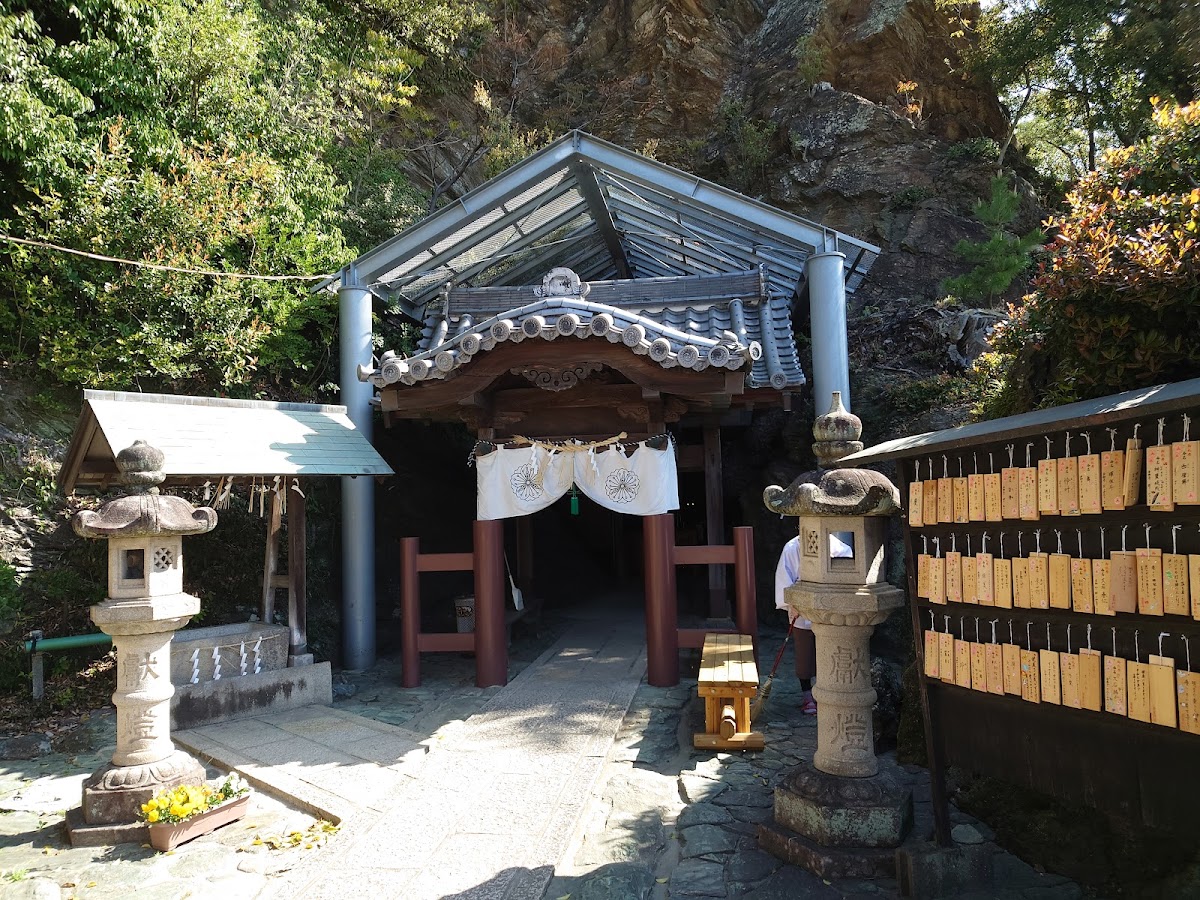
Even today, the custom of offering breast-shaped votive tablets remains, and the faith of women praying for recovery from breast cancer and increased milk production continues. Numerous votive tablets hang on the temple grounds, conveying its role as a guardian deity for women.
Changes in the Modern Era
Due to the Meiji-era separation of Shinto and Buddhism, Jison-in faced a difficult period, but it survived thanks to the faith of the local people. During the Showa period, improvements were made to the temple grounds, and efforts were made to preserve cultural properties.
In July 2004, the Miroku-do Hall of Jison-in Temple was registered as a component of the UNESCO World Heritage Site “Sacred Sites and Pilgrimage Routes in the Kii Mountain Range.” This led to Jison-in Temple being recognized internationally as an important cultural heritage site, attracting many worshippers and tourists from both Japan and abroad.
Highlights of the Temple Grounds
The grounds of Jison-in Temple are dotted with buildings and historical sites of high historical and cultural value.
Miroku-do Hall (Main Hall)
The Miroku-do Hall is the main hall of Jison-in Temple and is a building included in the World Heritage site. The current building was rebuilt during the Edo period, and houses a national treasure: a wooden seated statue of Miroku Buddha.
While the interior is usually closed to the public, special viewing opportunities allow visitors to see this valuable cultural artifact up close. Many breast-shaped votive tablets are dedicated in front of the Miroku-do Hall, testifying to the deep faith of women.
Tahōtō Pagoda
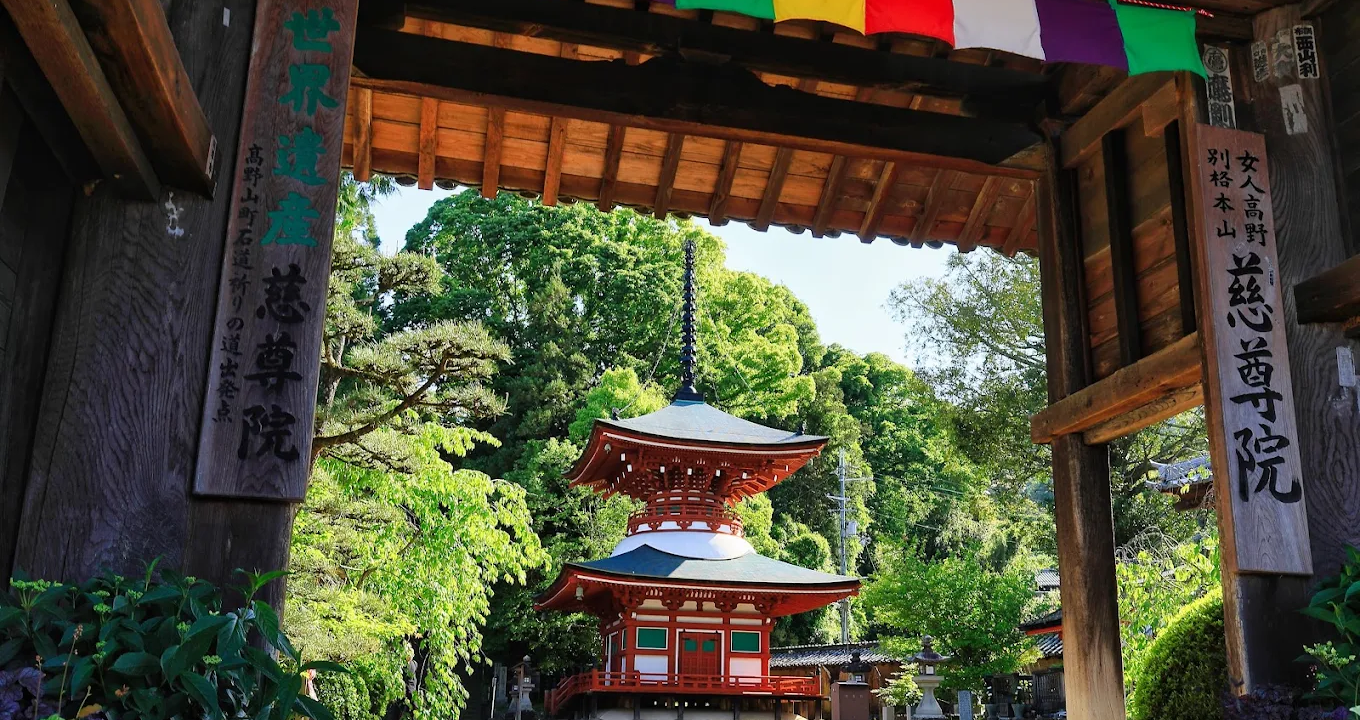
Within the temple grounds stands a Tahōtō pagoda, its elegant form making it one of the symbols of Jison-in Temple. The Tahōtō is a multi-story pagoda exhibiting characteristics of esoteric Buddhist architecture, with a unique shape: a circular upper story and a square lower story.
Although the current Tahōtō is a relatively recent construction, it harmonizes with the temple grounds and soothes the hearts of visitors.
Starting Point of the Kōyasan Chōishi-michi Trail
Jison-in Temple is located at the starting point (more precisely, the end point) of the Kōyasan Chōishi-michi trail. The Chōishi-michi is an ancient path, approximately 24 kilometers long, serving as the main pilgrimage route to Kōyasan, stretching from Jison-in Temple to Kōyasan Okunoin.
Along the trail, 180 Chōishi (stone markers) are erected, placed every 109 meters (approximately 109 meters). These markers indicate the distance to Kōyasan and have served as guideposts for pilgrims. Walking the Choishi-michi trail from Jison-in Temple is a valuable experience, tracing the path walked by Kobo Daishi.
Stone Steps to Niu Kanshobu Shrine
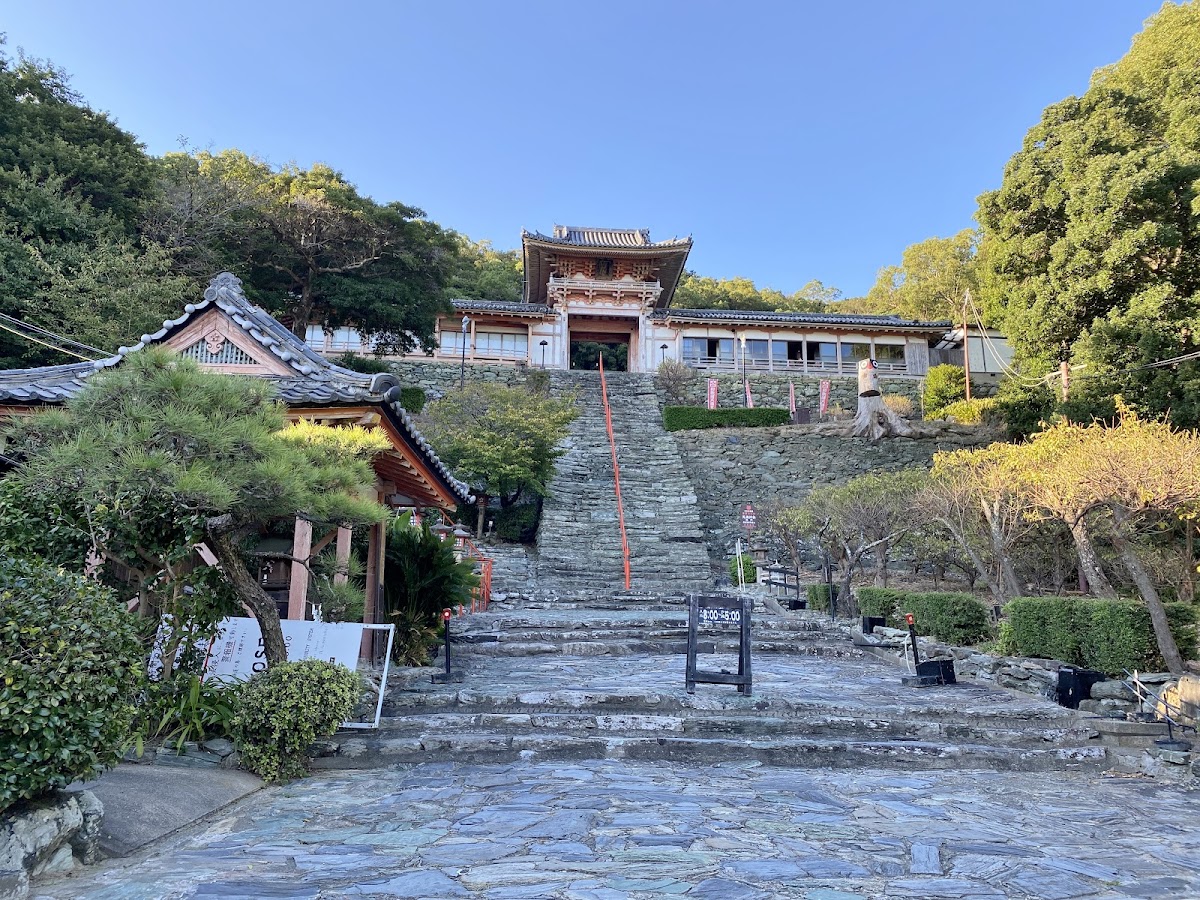
From the grounds of Jison-in Temple, 119 steep stone steps lead to Niu Kanshobu Shrine. This shrine is also a component of the World Heritage Site and is said to have been founded by Kobo Daishi when he established Mount Koya.
Partway up the steps, you can overlook the townscape of Kudoyama, offering a welcome respite from your pilgrimage. The syncretic form of Shinto-Buddhist worship, where shrines and temples are adjacent, is a valuable example of the characteristics of Japanese religious culture.
Cultural Properties
Jison-in Temple houses many valuable cultural properties of extremely high historical and artistic value.
National Treasure
Wooden Seated Maitreya Buddha Statue
The wooden seated Maitreya Buddha statue, the principal image of Jison-in Temple, is designated as a National Treasure. This elegant Buddha statue, approximately 90 centimeters tall, is believed to have been created in the late Heian period. Carved from a single piece of cypress wood, it features a serene expression and well-proportioned posture.
Maitreya Bodhisattva is worshipped as the Buddha of the future, believed to appear 5.67 billion years from now to save all sentient beings. The Maitreya Buddha at Jison-in Temple was enshrined by Kobo Daishi to commemorate his mother, and is considered a statue imbued with his deep love for her.
Important Cultural Property
Maitreya Hall
The Maitreya Hall itself is designated as an Important Cultural Property. It is a valuable building that conveys the architectural style of the Edo period and is registered as a component of a World Heritage Site.
Painted Silk Image of Maitreya Bodhisattva
The painted image of Maitreya Bodhisattva on silk is also an Important Cultural Property. Dating from the Heian to Kamakura periods, it is characterized by its delicate brushwork and colors. Normally closed to the public, it may be opened during special exhibitions.
Other Cultural Properties
Jison-in Temple also houses numerous other cultural properties, including ancient documents, Buddhist implements, and scriptures. These are carefully preserved as valuable materials that tell the history of Koyasan and Jison-in Temple.
World Heritage Site “Sacred Sites and Pilgrimage Routes in the Kii Mountain Range”
In July 2004, the Miroku-do Hall of Jison-in Temple was registered as a UNESCO World Heritage Site as a component of “Sacred Sites and Pilgrimage Routes in the Kii Mountain Range.”
Significance of Registration
This World Heritage Site encompasses the three sacred sites of “Yoshino-Omine,” “Kumano Sanzan,” and “Koyasan” spread across the Kii Mountain Range, and the pilgrimage routes connecting them (Kumano Pilgrimage Route, Omine Okugake Route, and Koyasan Pilgrimage Route). Its cultural landscape, where nature and faith are integrated, was highly valued, making it Japan’s 12th World Heritage Site.
Jison-in Temple is an important component of the World Heritage Site, serving as the starting point of the Choishi-michi (stone marker path), a part of the Koyasan pilgrimage route, and as a place where a unique religious culture has flourished as a women’s Koyasan.
Designation as a National Historic Site
The grounds of Jison-in Temple are designated as part of the “Choishi-michi,” which constitutes the “Koyasan Pilgrimage Route,” a national historic site. This designation protects the entire temple grounds as a cultural property, ensuring the preservation of its historical landscape.
Annual Events and Festivals
Jison-in Temple holds various events and festivals throughout the year.
Main Annual Events
New Year’s (January 1st-3rd)
The temple is bustling with New Year’s worshippers, attracting many visitors for their first shrine visit of the year.
Spring Grand Festival (April)
A memorial service held around the anniversary of the death of Kobo Daishi’s mother.
Kobo Daishi Memorial Service (May)
This service is held around the time of Kobo Daishi’s death anniversary, which is the 21st day of the 3rd month of the lunar calendar.
Autumn Grand Festival (October)
A memorial service is held to give thanks for the autumn harvest.
During these events, special memorial services and prayers are performed, and many worshippers visit.
Visiting Information and Access
Basic Information
Location
832 Jison-in, Kudoyama-cho, Ito-gun, Wakayama Prefecture 648-0151
Visiting Hours
8:00 AM – 5:00 PM (May vary depending on the season)
Admission Fee
Free entry to the grounds (A separate admission fee may be required for the Treasure Hall)
Inquiries
TEL: 0736-54-2214
Transportation Access
Access by Train
- Approximately 20-minute walk from Kudoyama Station on the Nankai Koya Line
- Approximately 5-minute taxi ride from Kudoyama Station
Access by Bus
- Immediately after alighting at the Jison-in-mae bus stop on the Kudoyama Town Community Bus (Note operating days and times)
Access by Car
- Approximately 15 minutes from the Kihoku Katsuragi Interchange on the Keina-Wa Expressway
- Parking: Free parking available (approximately 20 spaces for regular cars)
Nearby Tourist Attractions
Niu Kanshofu Shrine
A World Heritage shrine located at the top of the stone steps leading to Jison-in Temple. It is revered as the guardian shrine of Koyasan.
Sanada-an (Zenmyoin)
A temple built on the site where Sanada Masayuki and his son Yukimura lived in seclusion. A popular pilgrimage site for Sanada fans.
Roadside Station “Kaki no Sato Kudoyama”
Sells local agricultural products and specialties, including persimmons, a specialty of Kudoyama Town. Well-equipped rest facilities are also available.
Koyasan Choishi-michi
An ancient path leading from Jison-in Temple to Koyasan. Walking the entire route takes more than a day, but partial hiking is also enjoyable.
Etiquette and Manners for Visiting the Temple
Clothing and Items to Bring
Jison-in Temple is located at the foot of the mountain, but there are stone steps within the temple grounds. If you climb to the Niu Kanshofu Shrine, you will need to ascend 119 steep steps. We recommend wearing comfortable shoes and clothing suitable for walking.
If you plan to walk the Choishi-michi trail, you will need proper hiking gear. Prepare water, snacks, rain gear, and a map.
Photography
Photography is generally permitted within the temple grounds, but it may be prohibited inside the main hall and the treasure hall. Please check before taking photos and be considerate of other visitors.
Amulets and Souvenirs
Jison-in Temple offers amulets to grant women’s wishes, as well as amulets for safe childbirth and fertility. Also, the breast-shaped ema (votive tablets) are known as a unique offering of Jison-in Temple.
Jison-in Temple and Koyasan Faith
Jison-in Temple occupies a unique position in the history of Koyasan faith. While Mount Koya developed as a training ground primarily for men, Jison-in Temple functioned as a place that welcomed the faith of women.
The Ban on Women and Women’s Koyasan
The ban on women entering Mount Koyasan continued until 1872 (Meiji 5). During that time, female pilgrims could only enter as far as “women’s halls,” including Jison-in Temple. However, this was not intended to exclude women, but rather a distinction based on the religious views of the time.
Jison-in Temple became a center of faith for women, fostering a unique religious culture as “Women’s Koyasan.” Kobo Daishi’s spirit of filial piety towards his mother has been passed down as a faith that respects motherhood and femininity.
Significance in Modern Times
In modern times, Jison-in Temple is a temple open to many people regardless of gender. However, its tradition as a guardian deity for women is still cherished, and many pilgrims, especially those with specific wishes for women, visit the temple.
The temple features votive tablets (ema) wishing for early detection and successful treatment of breast cancer, as well as prayers for safe childbirth and successful child-rearing, incorporating modern wishes and creating a place of worship where tradition and modernity harmonize.
The Significance of Visiting Jison-in Temple
Visiting Jison-in Temple is not simply about seeing a World Heritage Site; it is a valuable opportunity to experience Japanese religious culture and history.
It is a place where layers of history and culture intertwine, encompassing Kobo Daishi’s deep filial piety to his mother, the tolerance shown in accepting women’s faith, and its role as the main pilgrimage route to Koyasan.
In the tranquil atmosphere of the temple grounds, one can reflect on over a thousand years of religious history. It is also the starting point of the Choishi-michi pilgrimage route, marking the first step on a pilgrimage to Koyasan.
Nestled amidst the rich nature and historical townscape of Kudoyama, Jison-in Temple offers a precious healing space for modern people seeking peace of mind and spiritual fulfillment.
Summary
Jison-in Temple is a historic temple founded by Kobo Daishi Kukai when he established Mount Koya, and has fostered a unique faith culture as “Women’s Koya.” It houses valuable cultural assets, including the National Treasure wooden seated statue of Miroku Buddha and the Important Cultural Property Miroku-do Hall, and is internationally recognized as a component of the World Heritage Site “Sacred Sites and Pilgrimage Routes in the Kii Mountain Range.”
As the starting point of the Koyasan Choishi-michi pilgrimage route and a center of faith for women, Jison-in Temple remains beloved by many. When visiting Wakayama Prefecture, be sure to visit Jison-in Temple and experience its history and culture.