Complete Guide to Ninna-ji Temple (Kyoto Prefecture) | Thorough Explanation of World Heritage Site Highlights, Omuro Cherry Blossoms, and Visiting Information
Located in Ukyo-ku, Kyoto City, Ninna-ji Temple is a prestigious monzeki temple (a temple formerly headed by a member of the imperial family) that has existed since the Heian period. In 1994, it was registered as a World Heritage Site as part of the “Historic Monuments of Ancient Kyoto.” Famous for its Omuro cherry blossoms, this temple is the head temple of the Omuro branch of Shingon Buddhism, boasting numerous historical buildings, including the National Treasure Golden Hall and the Important Cultural Property Five-Storied Pagoda. This article comprehensively introduces everything you need to know before visiting Ninna-ji Temple, from its history and highlights to visiting information and access methods.
What is Ninna-ji Temple? | The History of a Monzeki Temple with Imperial Family Ties
Founding History and Emperor Uda
The history of Ninna-ji Temple dates back to 886 AD (Ninna 2), when its construction began at the behest of Emperor Koko. However, Emperor Kōkō died before its completion, and Emperor Uda, who inherited his will, completed it in 888 (Ninna 4). The temple’s name derives from the year of its completion, “Ninna.”
After his abdication, Emperor Uda became a monk in 897 (Kanpyō 9), and in 904 (Engi 4), he established an imperial residence (Omuro) at Ninna-ji Temple and moved there. As a result, Ninna-ji Temple also came to be known as “Omuro Gosho,” and from then until the Meiji Restoration, it boasted an extremely high status as the foremost of the monzeki temples, where imperial princes and grandsons served as abbots for generations.
Reconstruction after the Ōnin War
During the Ōnin War, which began in 1467 (Ōnin 1), Ninna-ji Temple lost almost all of its main buildings, including the main hall, to fire. This state of dilapidation continued for a long time, but during the early Edo period, from the Kan’ei era to the Shōhō era (1624-1648), Prince Kakushin, with the support of the Tokugawa shogunate, undertook a large-scale restoration project.
This restoration resulted in the construction of major buildings such as the Niomon Gate, the Kondo Hall, and the Five-Storied Pagoda, which can be seen today. The Kondo Hall, in particular, was relocated from the Shishinden Hall of the Kyoto Imperial Palace and is designated a National Treasure as the oldest existing Shishinden Hall.
Role as the Head Temple of the Omuro School of Shingon Buddhism
Although its direct relationship with the Imperial Family weakened after the Meiji Restoration, Ninna-ji Temple remains the head temple of the Omuro School of Shingon Buddhism, with approximately 30 branch temples throughout Japan. It inherits the teachings of Kūkai Kōbō Daishi and functions as a training ground for esoteric Buddhism. It is also known as the head temple of the Omuro School of Ikebana (flower arrangement), playing an important role in the preservation of traditional culture.
Highlights of Ninna-ji Temple | Exploring National Treasures and Important Cultural Properties
1. National Treasure “Kondo” (Golden Hall) | The Main Hall, a Relocated Shishinden (Imperial Palace Hall) of Ninna-ji Temple
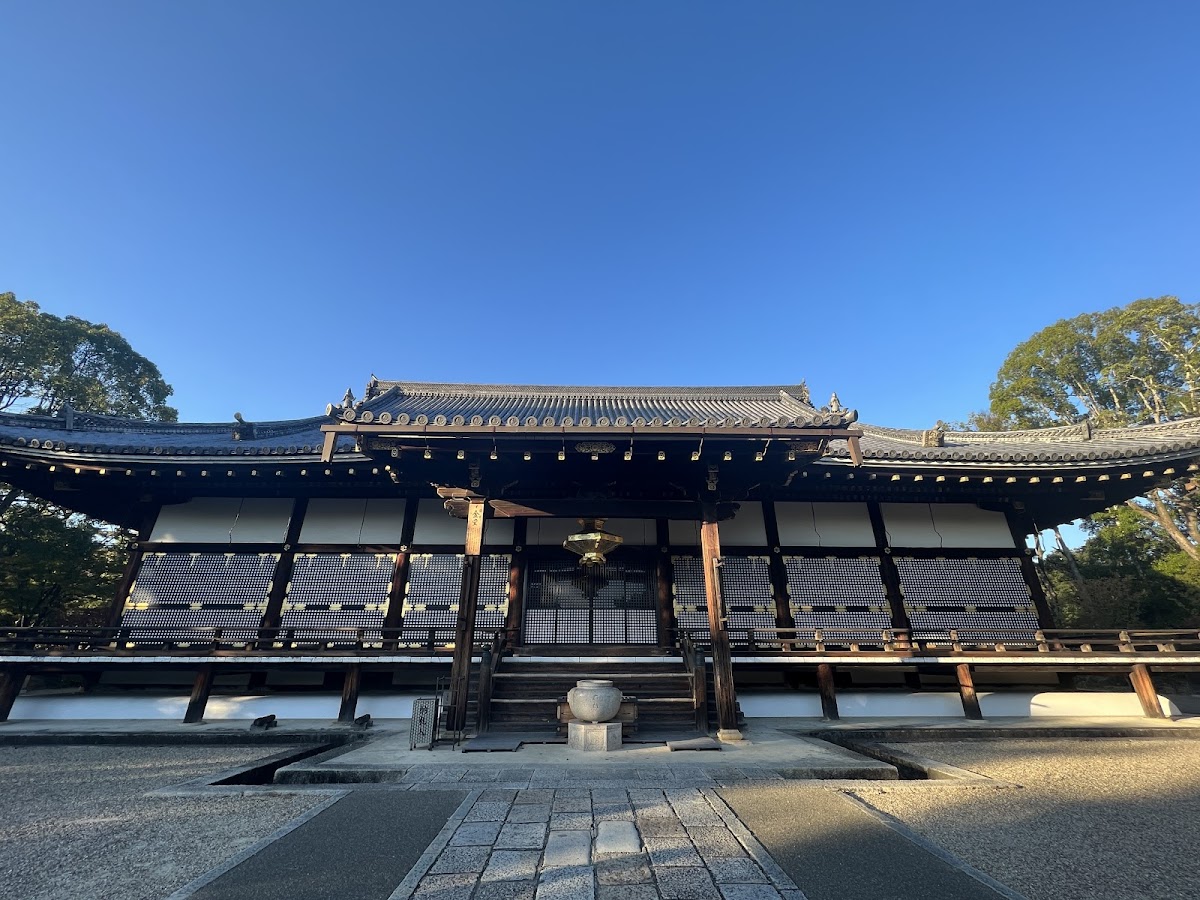
The Kondo, the main hall of Ninna-ji Temple, was relocated during the Kan’ei era from the Shishinden of the Kyoto Imperial Palace, which was built in 1613. It is the oldest existing Shishinden architecture and is designated a National Treasure.
The Kondo retains strong characteristics of Momoyama period palace architecture, with its beautiful cypress bark roof and vermilion-painted pillars. Inside, the principal image, the Amida Triad (a National Important Cultural Property), is enshrined. The walls of the hall are adorned with vividly colored murals, conveying the splendor of its past. Standing before the Kondo, one can feel the elegant and dignified atmosphere befitting a temple with ties to the Imperial family.
2. Five-Storied Pagoda | A Magnificent 36-Meter-Tall Pagoda
The five-storied pagoda, towering on the east side of the temple grounds, is a magnificent structure built in 1644 (Kanei 21), standing approximately 36 meters tall, and designated as an Important Cultural Property. It is considered one of the most beautiful five-storied pagodas still existing in Kyoto City and is a symbolic presence of Ninna-ji Temple.
It possesses a unique symmetrical beauty, with the roofs of each story being almost the same size, and built with the same width from top to bottom, resulting in a form that combines stability and elegance. Inside the first story, the Five Wisdom Buddhas, centered around Dainichi Nyorai, are enshrined, representing the world of Esoteric Buddhism. During cherry blossom season, the pagoda and the Omuro cherry blossoms create a spectacular scene, attracting many photography enthusiasts.
3. Omuro Cherry Blossoms | Late-Blooming Cherry Blossoms Designated as a National Scenic Spot
What makes Ninna-ji Temple famous throughout Japan is the “Omuro cherry blossoms.” Approximately 200 cherry trees are planted in the western area within the main gate, and the area is designated as a national scenic spot. The most distinctive feature of the Omuro cherry trees is their low height of 2-3 meters, earning them affectionate nicknames such as “Otafuku cherry” and “low-nosed cherry.”
The Omuro cherry trees are known as the latest-blooming cherry trees in Kyoto City, reaching their peak bloom from mid- to late April each year. Because they bloom after the Somei Yoshino cherry trees have fallen, they are considered the “culmination of Kyoto’s cherry blossom season,” attracting many visitors. The view with the five-story pagoda in the background is spectacular, and the area has been a popular cherry blossom viewing spot since the Edo period.
During the blooming season, the “Omuro Cherry Blossom Festival” is held, and the trees are illuminated at night. When in full bloom, a tunnel of cherry blossoms unfolds, captivating visitors.
4. Kannon-do Hall (Kannon Thirty-Three Manifestations Hall) | A Hall with Beautifully Colorful Decorations
The Kannon-do Hall, formally known as the “Kannon Thirty-Three Manifestations Hall,” is designated as an Important Cultural Property. Built during the temple’s reconstruction in the Kan’ei era, this building has a simple exterior, but its interior is a magnificent space adorned with vividly colored decorations.
Inside the hall, a standing statue of the Thousand-Armed Kannon Bodhisattva is enshrined as the principal image, along with statues representing the thirty-three manifestations of Kannon Bodhisattva. The ceiling and pillars are adorned with vibrant colors, creating a solemn atmosphere characteristic of esoteric Buddhist temples. While normally closed to the public, it is sometimes possible to view the interior during special viewing periods, allowing for close-up appreciation of the precious statues and decorations.
5. Nio-mon Gate | One of Kyoto’s Three Great Gates
The Nio-mon Gate, the main gate of Ninna-ji Temple, is a magnificent gate approximately 18 meters tall, built during the Kan’ei era, and is designated as an Important Cultural Property. Along with the Sanmon Gate of Chion-in Temple and the Sanmon Gate of Nanzen-ji Temple, it is counted as one of the “Three Great Gates of Kyoto.”
It is a two-story gatehouse, with Kongo Rikishi statues (Nio statues) on either side. The contrast between the vermilion pillars and white walls is beautiful, and passing through the gate reveals the vast grounds of Ninna-ji Temple. The path from this gate to the main hall offers particularly beautiful scenery during the cherry blossom and autumn foliage seasons.
6. Nationally Designated Scenic Spots: “North Garden and South Garden” | The Beauty of Dry Landscape and Pond Gardens
Ninna-ji Temple has two gardens adjacent to the palace, both designated as national scenic spots.
The South Garden is a dry landscape garden with white sand and pine trees, planted with a cherry tree on the left and a mandarin orange tree on the right. This is modeled after the Shishinden Hall of the Kyoto Imperial Palace, conveying a sense of formality befitting a temple associated with the Imperial family. It possesses a simple yet refined beauty, and its appearance can be enjoyed in every season.
The North Garden is a pond-centered strolling garden where visitors can enjoy the changing scenery as they walk around the central pond. The composition, which incorporates the five-story pagoda as borrowed scenery, is magnificent. Carp swim in the pond, and seasonal flowers adorn the garden. Especially during the seasons of fresh greenery and autumn leaves, the reflections on the water are beautiful, attracting many visitors.
7. Reihokan (Treasure Hall) | Houses Valuable Buddhist Statues and Crafts
The Reihokan houses valuable Buddhist statues, paintings, calligraphy, and crafts passed down through Ninna-ji Temple. It contains outstanding Buddhist art from the Heian to Edo periods, including the National Treasure “Amida Triad” and the Important Cultural Property “Seated Yakushi Nyorai Statue.”
During the special spring and autumn opening periods, these cultural artifacts can be viewed up close. The spring opening, in particular, coincides with the blooming of the Omuro cherry blossoms, so a visit in conjunction with cherry blossom viewing is highly recommended.
8. Sutra Repository | A Treasure House for Precious Scriptures
The Sutra Repository is a building that houses Buddhist scriptures and is designated as an Important Cultural Property. Inside is a revolving bookshelf called a “Rinzo,” and it is believed that rotating it once grants the same merit as reading all the scriptures.
Normally closed to the public, it may be possible to view the interior during special viewing periods. The Rinzo is a masterpiece of Edo period woodworking techniques and is a culturally valuable asset from an architectural history perspective.
Estimated Time Required, Tips for Visiting, and How to Enjoy Your Visit
Estimated Time Required for Visiting
The grounds of Ninna-ji Temple are vast and have many points of interest, so the following time is a good guideline for a thorough visit.
- Regular Visit (Palace and Gardens Only): Approximately 45 minutes to 1 hour
- Visiting the Entire Temple Grounds: Approximately 1 hour 30 minutes to 2 hours
- During the Omuro Cherry Blossom Season: Approximately 2 hours to 2 hours 30 minutes (considering crowds)
- Including the Special Opening of the Reihokan (Treasure Hall): Approximately 2 hours 30 minutes to 3 hours
Best Season for Visiting
Ninna-ji Temple offers beautiful scenery throughout the four seasons, but the following times are particularly recommended:
Spring (Mid-to-Late April): The best time to see the Omuro cherry blossoms. Famous as the latest-blooming cherry blossoms in Kyoto, the sight of them together with the five-story pagoda is breathtaking. However, it gets crowded, so early morning visits right after opening are recommended.
Early Summer (May-June): Beautiful fresh greenery, a relatively less crowded time to visit. The contrast between the green maple leaves and the buildings is refreshing.
Autumn (Mid-to-Late November): Known as a famous spot for autumn foliage, the entire temple grounds are dyed in red and yellow. The autumn leaves in the North Garden are particularly magnificent.
Winter (January-February): Ninna-ji Temple, covered in snow, is exceptionally beautiful. There are fewer tourists, allowing you to slowly appreciate the historical buildings in tranquility.
Efficient Visiting Route
- Enter through the Niomon Gate: First, pass through the magnificent main gate and proceed along the approach.
- Palace Area: Pay the entrance fee at the reception and admire the palace and the South and North Gardens.
- Visit the Main Hall: Admire the main image of Buddha in the National Treasure Main Hall.
- Five-Storied Pagoda: Admire the five-storied pagoda on the east side of the temple grounds from the outside.
- Omuro Cherry Blossom Area: In spring, stroll through the cherry blossom grove inside the Middle Gate.
- Kannon-do Hall and Sutra Repository: Interior viewing is available during special public viewing periods.
- Reihokan Hall: Valuable cultural artifacts can be viewed during public viewing periods.
Photography Tips
- Five-Storied Pagoda and Omuro Cherry Blossoms: Photographing the cherry blossoms with the five-storied pagoda in the background from near the middle gate makes for a picturesque scene.
- Front View of the Main Hall: Photographing the main hall through the vermilion-painted middle gate creates a composition with depth.
- View from the North Garden: The reflection of the five-storied pagoda and autumn leaves in the pond is beautiful.
- Nio-mon Gate: The angle looking up from the approach to the temple is impressive.
Temple Lodging Experience “Omuro Kaikan”
At Ninna-ji Temple, you can stay overnight at the temple lodging “Omuro Kaikan” located within the temple grounds. You can participate in morning services, stroll through the quiet grounds outside of general visiting hours, and enjoy special experiences that cannot be experienced on a day trip. You can also enjoy vegetarian cuisine, and participate in ascetic training and sutra copying experiences. ## Visiting Information & Access
Visiting Hours & Admission Fees
Visiting Hours
- March to November: 9:00 AM – 5:00 PM (Last entry 4:30 PM)
- December to February: 9:00 AM – 4:30 PM (Last entry 4:00 PM)
Admission Fees
- Main Hall (Regular Season): Adults 500 yen, Elementary & Junior High School Students 300 yen
- Main Hall (Omuro Cherry Blossom Season): Adults 800 yen, Elementary & Junior High School Students 500 yen
- Treasure Hall (Special Opening Period Only): Adults 500 yen
- Special Entrance Fee to the Temple Grounds (Omuro Cherry Blossom Season Only): Adults 500 yen, Elementary & Junior High School Students 200 yen
Closed Days
- Open all year round (However, the Treasure Hall is open only during the special opening periods in spring and autumn)
Access Methods
Access by Train and Bus
The most convenient way to get there is by using Kyoto City Bus, Kyoto Bus, or JR Bus.
- From Kyoto Station: Take City Bus No. 26 and get off at “Omuro Ninna-ji” bus stop (approximately 40 minutes)
- From Shijo Karasuma: Take City Bus No. 26 and get off at “Omuro Ninna-ji” bus stop (approximately 30 minutes)
- From Sanjo Keihan: Take City Bus No. 10 or 59 and get off at “Omuro Ninna-ji” bus stop (approximately 35 minutes)
Using Keifuku Electric Railway (Arashiyama Line)
- Get off at Omuro Ninna-ji Station and walk approximately 3 minutes
- Convenient for accessing from the Arashiyama area.
Using JR
- Get off at Enmachi Station on the JR Sagano Line, then transfer to City Bus No. 26 (approximately 10 minutes).
Access by Car
- Approximately 40 minutes from Kyoto Minami IC on the Meishin Expressway.
- Parking: 100 spaces for regular cars (fee: 500 yen per visit).
- However, during peak seasons such as the Omuro cherry blossom season, the parking lot is often full, so we recommend using public transportation.
Address and Inquiries
- Address: 33 Omuro Ouchi, Ukyo-ku, Kyoto City, Kyoto Prefecture 616-8092
- Phone: 075-461-1155
- Official Website: https://ninnaji.jp/
Nearby Tourist Attractions
Ryoanji Temple (approximately 15 minutes on foot)
Ryoanji Temple, a World Heritage Site, is famous for its dry landscape garden known as the “rock garden.” The garden, featuring 15 stones, is highly acclaimed both domestically and internationally as a masterpiece expressing the spirit of Zen. Visiting it together with Ninna-ji Temple allows for an efficient tour of Kyoto’s World Heritage sites.
Kinkaku-ji Temple (approx. 10 minutes by bus)
Kinkaku-ji Temple (Rokuon-ji Temple), a representative tourist attraction of Kyoto, is about 10 minutes from Ninna-ji Temple by city bus. The reliquary hall, covered in gold leaf, boasts overwhelming beauty, including its reflection in the pond. It is a World Heritage site and an essential spot for Kyoto sightseeing.
Myoshin-ji Temple (approx. 10 minutes on foot)
Myoshin-ji Temple is the head temple of the Myoshin-ji branch of the Rinzai school of Zen Buddhism, and its vast grounds contain 46 sub-temples. The “Cloud Dragon” painting on the ceiling of the main hall is a must-see and is known as a masterpiece by Kano Tan’yu. You can experience the tranquil atmosphere unique to Zen temples.
Kinukake-no-michi
This approximately 2.5-kilometer walking path connects Ninna-ji Temple, Ryoan-ji Temple, and Kinkaku-ji Temple, and is known as “Kinukake-no-michi.” Along this path, you’ll find other historical sites such as Toji-in Temple and Hirano Shrine, allowing you to enjoy a stroll while experiencing Kyoto’s history and culture. The scenery is especially beautiful during the cherry blossom season in spring and the autumn foliage season.
Omuro Eighty-Eight Sacred Sites
Behind Ninna-ji Temple, there is a pilgrimage route modeled after the Shikoku Eighty-Eight Sacred Sites. The course is approximately 3 kilometers long and can be completed in about 2 hours. Soil brought back from the Shikoku pilgrimage sites is buried at each site, and it is believed that completing this pilgrimage grants the same merit as completing the Shikoku pilgrimage. Walking along the nature-rich mountain path will refresh both your mind and body.
Annual Events and Festivals at Ninna-ji Temple
Main Annual Events
January
- Shusho-e (January 1st-3rd): A Buddhist service praying for peace in the new year
March
- Nirvana Ceremony (March 15th): A Buddhist service commemorating the passing of Buddha
April
- Omuro Cherry Blossom Festival (during cherry blossom season): Illumination and special viewing
- Hana Matsuri (April 8th): A Buddhist service celebrating the birth of Buddha
May
- Godai Myo-o Grand Festival (May 28th): An important Buddhist service including a Goma fire ritual
- Omuro-ryu Ikebana Exhibition: The national competition of Omuro-ryu Ikebana
July
- Mikage-ku (July 21st): A monthly memorial service for Kobo Daishi
October
- Omuro Eighty-Eight Pilgrimage Walk: The pilgrimage route on the back mountain is open to the public.
November
- Autumn Foliage Illumination: Special viewing period in autumn
December
- Jodo-e (December 8th): A Buddhist service commemorating the enlightenment of Buddha
Special Viewings and Events
Ninna-ji Temple holds special openings of the Reihokan (Treasure Hall) in spring and autumn. In addition, limited-time events such as the opening of the Sutra Repository and special nighttime viewings and illuminations are held. It is recommended to check the official website for the latest information.
Summary | Experiencing the Elegant World of the Imperial Family at Ninna-ji Temple
Ninna-ji Temple boasts a history of over 1000 years as a prestigious monzeki temple with ties to the Imperial family, dating back to the Heian period. Within its grounds, registered as a World Heritage Site, stand important cultural properties such as the National Treasure Kondo (Main Hall), the Five-Storied Pagoda, and the Niomon Gate, making it a valuable place to experience the history of Japanese architecture.
The Omuro cherry blossoms, in particular, are a representative cherry blossom viewing spot in Kyoto, attracting many tourists every year. As a late-blooming variety, they reach their peak from mid- to late April, and their beauty in conjunction with the five-story pagoda is breathtaking. Furthermore, Ninna-ji Temple’s charm lies not only in its spring cherry blossoms, but also in its seasonal beauty: the fresh greenery of summer, the vibrant autumn leaves, and the snowy winter landscapes.
There are countless other attractions, including the nationally designated scenic garden and the precious Buddhist art artifacts housed in the Reihokan (Treasure Hall). Staying at a temple lodging allows you to experience the tranquil grounds outside of general visiting hours, allowing you to appreciate the charm of Ninna-ji Temple more deeply.
With easy access from Kyoto Station, and numerous World Heritage sites such as Ryoan-ji Temple and Kinkaku-ji Temple scattered throughout the surrounding area, you can efficiently enjoy sightseeing in Kyoto. Ninna-ji Temple, where history, architecture, nature, and culture harmonize, is a must-visit temple when visiting Kyoto. Be sure to take your time to leisurely explore and enjoy the elegant world associated with the Imperial family.