Kamo Mioya Shrine (Shimogamo Shrine) Complete Guide: The History and Charm of Kyoto Prefecture’s World Heritage Site
What is Kamo Mioya Shrine?
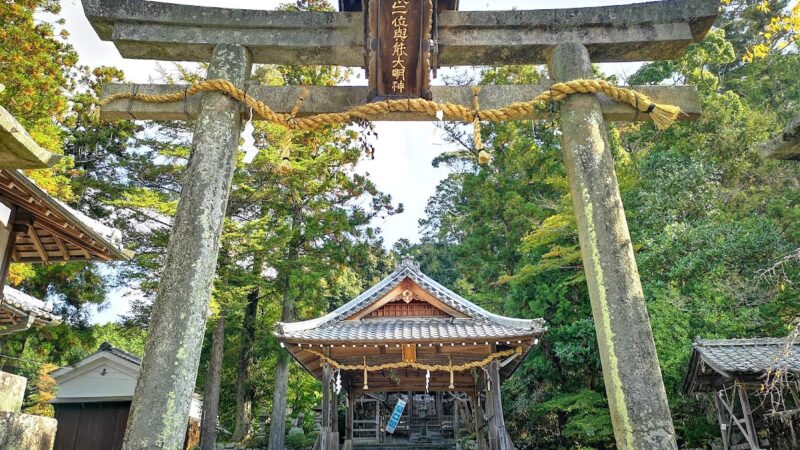
Kamo Mioya Shrine (Kamomioya Jinja) is a shrine located in Shimogamo Izumikawa-cho, Sakyo-ku, Kyoto City, and is commonly known as “Shimogamo Jinja.” It is one of the oldest shrines in Kyoto, existing even before the relocation of the capital to Heian-kyo, and was registered as a World Heritage Site in 1994 as part of the “Historic Monuments of Ancient Kyoto.”
The official name, “Kamo Mioya Shrine,” derives from the fact that it enshrines the mother and grandfather of Kamo Wakeikazuchi no Mikoto, the deity of Kamo Wakeikazuchi Shrine (Kamigamo Shrine). As a Shikinaisha (Myojin Taisha), the Ichinomiya of Yamashiro Province, and one of the Twenty-Two Shrines (Upper Seven Shrines), it has long been deeply revered by the imperial court and the people. Its former shrine rank was Kanpei Taisha, and it is currently designated as a Beppyo Jinja by the Association of Shinto Shrines. The temple grounds cover a vast area of approximately 124,000 square meters and are surrounded by a primeval forest called Tadasu no Mori, located at the confluence of the Kamo River and Takano River. This Tadasu no Mori forest is roughly the size of three Tokyo Domes and is designated a national historical site as a rare primeval forest in an urban area.
Deities and Divine Virtues
West Main Hall: Kamo Taketsunumi no Mikoto
The West Main Hall enshrines Kamo Taketsunumi no Mikoto. Kamo Taketsunumi no Mikoto is a deity said to have transformed into a Yatagarasu (three-legged crow) to guide Emperor Jimmu during his eastern expedition. As the god of pioneering Yamashiro Province (present-day southern Kyoto Prefecture), he is said to have developed this land and promoted agriculture and industrial development.
Divine Virtues include protection against misfortune, warding off evil, success in entrance exams and job applications, and traffic safety. She is particularly revered as a guiding deity, believed to show the right direction at important turning points in life.
East Main Shrine: Tamayorihime-no-Mikoto
The East Main Shrine enshrines Tamayorihime-no-Mikoto. Tamayorihime-no-Mikoto is the daughter of Kamo-Taketsunomi-no-Mikoto and the mother of Kamo-Wakeikazuchi-no-Mikoto. According to legend, while Tamayorihime-no-Mikoto was playing in the Kamo River, she picked up a white-feathered arrow that had floated down from upstream. She placed it on the floor, became pregnant, and gave birth to Kamo-Wakeikazuchi-no-Mikoto.
Her divine blessings include matchmaking, safe childbirth, child-rearing, and parenting. As a guardian deity of women, she has long attracted many female worshippers, especially those praying for safe childbirth and fertility. Within the shrine grounds is the Aioi Shrine, known as a shrine for matchmaking, making it popular among young people seeking good relationships.
History of Kamo Mioya Shrine
Founding and Ancient History
The exact founding date of Kamo Mioya Shrine is unclear, but according to shrine tradition, it began during the reign of Emperor Jimmu (around 660 BC) when Kamo Taketsunumi no Mikoto descended to Yamashiro Province. Archaeologically, Jomon period ruins have been discovered within the shrine grounds, confirming that this area has been an object of worship since ancient times.
It is said that the shrine buildings were constructed at the present location in the 7th year of Emperor Sujin’s reign (91 BC). A surviving fragment of the “Yamashiro no Kuni Fudoki” (a regional gazetteer) describes Kamo Taketsunumi no Mikoto moving from Tanba Province to Yamashiro Province and taking up residence at the confluence of the Kamo River and Takano River.
Prosperity during the Heian Period
With the relocation of the capital to Heian-kyo (794 AD), Kamo Mioya Shrine received special reverence from the imperial court as a shrine protecting the nation. During the reign of Emperor Saga (810 AD), the “Kamo Saiin System” was established, creating a system where unmarried imperial princesses served at the shrine as Saio (high priestesses). This system lasted for approximately 400 years, with 35 Saio serving.
In the early 11th century, the layout of the shrine buildings, similar to its current form, was established, and the “Shikinen Sengu System” (periodic rebuilding of the shrine buildings) was also enacted. At that time, Kamo Mioya Shrine held a status second only to Ise Grand Shrine and played an important role in the imperial court’s rituals.
From the Medieval to the Early Modern Period
During the Ōnin War (1467-1477), many of the shrine buildings were destroyed by fire, but they were later rebuilt with the support of the imperial court and samurai families. During the Edo period, the shrine received protection from the Tokugawa shogunate, and repairs and reconstructions of the shrine buildings were carried out.
In 1863 (Bunkyu 3), the main shrine was rebuilt, and the two main shrine buildings constructed at that time, one east and one west, are now designated as National Treasures.
Modern Era
In 1871 (Meiji 4), it was ranked as a Kanpei Taisha (Grand Imperial Shrine), positioning it as an important national shrine. In 1983 (Showa 58), the shrine grounds were designated a National Historic Site, and in 1994 (Heisei 6), it was registered as a component of the World Heritage Site “Historic Monuments of Ancient Kyoto.”
Highlights of the Shrine Grounds
Tadasu no Mori Forest
Tadasu no Mori is a primeval forest covering approximately 124,000 square meters, nestled between the Kamo River and the Takano River. It is home to approximately 600 trees ranging in age from 200 to 600 years, primarily deciduous broad-leaved trees such as zelkova, hackberry, and Chinese hackberry.
The name “Tadasu” means “to correct falsehoods,” and it has been believed that passing through this forest purifies the mind and body. A stream flows through the forest, and in summer, a fantastical scene of fireflies flitting about can be seen. In 2015, the “Shimogamo Shrine Tadasu no Mori Light Festival,” a light art exhibition, was held in Tadasu no Mori, captivating many people.
National Treasure – Main Hall
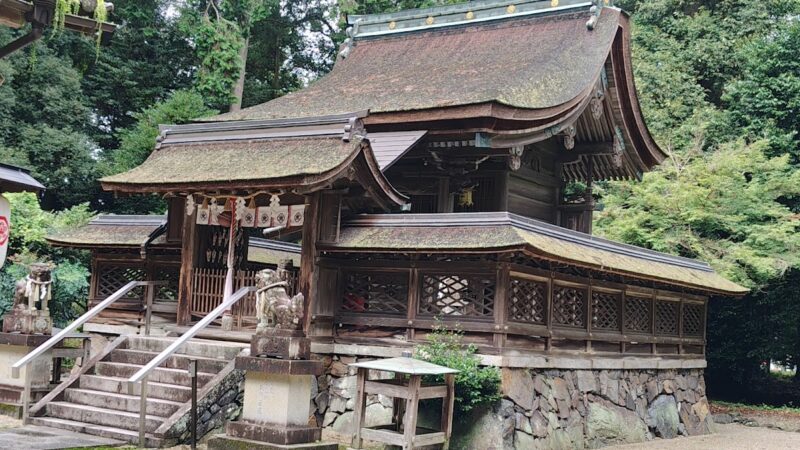
The two main halls, east and west, were rebuilt in 1863 and designated as National Treasures in 1953. They are built in the Sangensha Nagare-zukuri architectural style, with cypress bark roofs forming beautiful curves.
While the main halls are usually closed to the public, it is possible to view them from the middle gate by applying for a special visit. The vividly vermilion-painted shrine buildings are valuable cultural assets that convey the style of Heian period shrine architecture to the present day.
Important Cultural Property Shrine Buildings
Besides the main shrine building, 31 other structures within the grounds, including the Tower Gate, Dance Hall, Divine Clothing Hall, and Four-Legged Middle Gate, are designated as Important Cultural Properties.
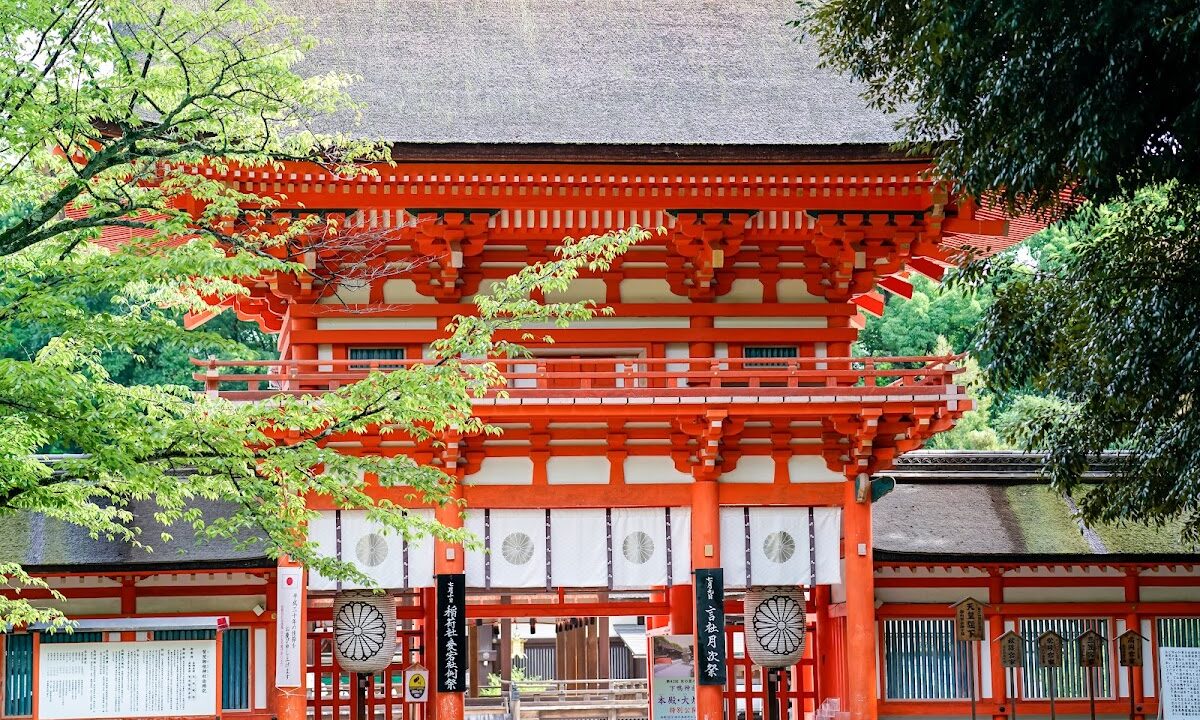
The Tower Gate is a two-story, vermilion-painted gate built in 1628 (Kanei 5), and is an iconic structure of Shimogamo Shrine. Standing approximately 13 meters tall, its imposing presence overwhelms visitors.
The Dance Hall is a building where Shinto rituals and dance performances are held, and during the Aoi Festival in May each year, it is where the Imperial Envoy recites the prayer.
The Divine Clothing Hall is a building where the clothing of the gods is prepared, and was once a place where the Saio (Imperial Princess serving at the Ise Shrine) served.
Mitarashi River and Mitarashi Shrine
The Mitarashi River flows along the eastern side of the shrine grounds, and the Mitarashi Shrine is situated on its banks. Mitarai Shrine is dedicated to the water god, and the Mitarai Festival is held there every year around the Doyo no Ushi no Hi (Day of the Ox in July).
During this festival, worshippers dip their feet in the Mitarai Pond to pray for good health and protection from illness. The water temperature remains a cool 17 degrees Celsius throughout the year, making it a popular event that offers a respite from the summer heat.
Mitarashi dango (rice dumplings with sweet soy sauce glaze), made with spring water from the Mitarai River, is said to have originated at this shrine and can be enjoyed at the tea house on the shrine grounds.
Aioi Shrine (Shrine of Matchmaking)
Located within the Tadasu no Mori forest, Aioi Shrine enshrines Kamimusubi no Kami, known as the god of matchmaking. In front of the shrine stands a mysterious tree called “Renri no Sakaki,” two trees joined together, symbolizing matchmaking.
It is said that if you dedicate an ema (votive tablet) for matchmaking and walk around the Renri no Sakaki tree twice while reciting your wish, you will be blessed with a good match.
Kawai Shrine
Located on the south side of the shrine grounds, Kawai Shrine is a subsidiary shrine dedicated to Tamayorihime-no-Mikoto and is popular among women as a shrine for praying for beauty. It has a unique method of worship where you draw your face on an ema shaped like a hand mirror called a “kagami ema” (mirror ema) and pray for beauty.
Aoi Festival and Annual Events
Aoi Festival (Kamo Festival)
The Aoi Festival is the annual festival of Kamo Mioya Shrine and Kamo Wakeikazuchi Shrine, held every May 15th, and is considered one of Kyoto’s three major festivals. Its official name is “Kamo Festival,” but it is called the “Aoi Festival” because participants wear hollyhock leaves.
The origins of the festival date back to the time of Emperor Kinmei (6th century). The festival is said to have originated when, after a series of poor harvests, it was believed to be the curse of the Kamo gods, and an imperial envoy was dispatched to perform a ritual, which resulted in a bountiful harvest.
The highlight of the Aoi Festival is the “Roto no Gi” procession, in which approximately 500 people dressed in Heian period costumes depart from the Kyoto Imperial Palace, pass through Shimogamo Shrine, and proceed to Kamigamo Shrine. The procession includes various roles such as the imperial envoy, the Kebiishi (police and judicial officials), and the Saio-dai (representative of the Saio), and features ox-drawn carriages and horses, creating a magnificent historical spectacle.
At Shimogamo Shrine, the “Shato no Gi” ceremony takes place, in which the imperial envoy recites a prayer and dances are performed. This ritual is a valuable intangible cultural asset that conveys the court culture of the Heian period.
Kemari Hajime (First Kemari Game)
Every year on January 4th, the “Kemari Hajime” (First Kemari Game) is held. Kemari is a traditional ball game that has been passed down since the Heian period. Members of the Kemari Preservation Society, dressed in eboshi (traditional hats) and suikan (traditional robes), kick the ball while chanting the distinctive calls of “Ari,” “Yaa,” and “Ou.”
Formally, kemari is played by eight people, who continuously kick the ball without letting it touch the ground. It’s a New Year’s tradition that attracts many visitors.
Nagashi-bina (Floating Dolls)
On March 3rd, the Peach Festival (Hina Matsuri), the Nagashi-bina ritual takes place. This traditional event involves floating hina dolls made of washi (Japanese paper) down the Mitarai River to pray for the health and well-being of children. It preserves the Heian period custom of “Hina-nagashi” (floating dolls), and visitors can also float their own hina dolls.
Other Annual Events
- Hatsumode (January 1st onwards): One of Kyoto’s leading Hatsumode spots
- Setsubun Festival (around February 3rd): Bean-throwing and exorcism ceremony
- Okage Festival (May 12th): A Shinto ritual held as a prelude to the Aoi Festival
- Natsukoshi Shinto Ritual (June 30th): Purification of the impurities accumulated over the past six months by passing through a ring of reeds
- Meigetsu Kangensai (Mid-Autumn Moon Festival): Gagaku (ancient Japanese court music) performance
Visiting Information and Access
Basic Information
- Location: 59 Shimogamo Izumikawa-cho, Sakyo-ku, Kyoto City, Kyoto Prefecture
- Phone: 075-781-0010
- Visiting Hours: 6:30 AM – 5:00 PM (may vary depending on the season)
- Admission Fee: Free entry to the grounds (special visits require a separate fee)
- Parking: West Parking Lot available (paid, approximately 300 spaces)
Access Methods
Access by Train/Bus
- Approximately 12 minutes on foot from Keihan Railway’s Demachiyanagi Station
- Immediately after alighting at Shimogamo Shrine bus stop (Kyoto City Bus)
- Approximately 5 minutes on foot from Tadasu-no-Mori bus stop (Kyoto City Bus)
- Approximately 30 minutes by Kyoto City Bus No. 4 or 205 from Kyoto Station
Access by Car
- Approximately 30 minutes from Kyoto Minami Interchange (Meishin Expressway)
- Approximately 25 minutes from Kyoto Higashi Interchange (Meishin Expressway)
Points to Note When visiting the shrine, it is recommended to first purify your mind and body by passing through Tadasu-no-Mori forest before proceeding to the shrine. The grounds are spacious, so it is recommended to visit with ample time. Especially during the Aoi Festival and New Year’s visits, it gets very crowded, so visiting early in the morning is recommended.
Goshuin (temple/shrine stamps) can be obtained at the reception area. In addition to regular goshuin, seasonal special goshuin are sometimes available.
Nearby Tourist Attractions
Kamigamo Shrine (Kamo Wakeikazuchi Shrine)
Located approximately 3.5 kilometers north of Shimogamo Shrine, Kamigamo Shrine is also a World Heritage Site and, together with Shimogamo Shrine, is collectively known as “Kamo Shrine.” Visiting both shrines, known as “Kamo Ryosha Mairi,” is a classic Kyoto sightseeing route.
Kyoto Gyoen National Garden
Located approximately 2 kilometers south of Shimogamo Shrine, Kyoto Gyoen National Garden was developed on the site of former court noble residences. Its vast grounds are filled with flowers blooming throughout the seasons.
Kamo River Delta
The confluence of the Kamo River and Takano River is called the “Kamo River Delta,” a popular recreational spot for citizens. Stepping stones allow visitors to cross to the opposite bank, and it is particularly popular in the summer months, attracting many people seeking respite from the heat.
Demachiyanagi Shopping Street
Around Keihan Demachiyanagi Station, there is a traditional shopping street where you can experience the everyday life of Kyoto. There are famous Japanese confectionery shops, including one known for its specialty, mame mochi (bean rice cakes).
Cultural Value of Kamo Mioya Shrine
World Heritage Site Recognition
Kamo Mioya Shrine was registered as a World Heritage Site because it is a valuable cultural asset that preserves the architectural style of shrines from the Heian period, and because of the importance of the ritual culture that has been passed down for over 1000 years.
In particular, the Tadasu no Mori forest is ecologically valuable as a primeval forest remaining in an urban area, and the entire shrine grounds form a historical landscape.
Archaeological Significance
Jomon period ruins have been discovered within the shrine grounds, proving that this area was a place of human habitation since ancient times. Numerous Heian period remains have also been discovered, providing important information for understanding the appearance of the shrine at that time.
Value as an Intangible Cultural Heritage
The annual events, including the Aoi Matsuri (Aoi Festival), are intangible cultural heritage that convey traditions dating back to the Heian period. In particular, the “Roto no Gi” (procession of the procession) of the Aoi Matsuri is highly regarded both domestically and internationally as a valuable opportunity to experience Heian-period court culture.
Summary
Kamo Mioya Shrine (Shimogamo Shrine) occupies an extremely important historical and cultural position as a representative shrine of Kyoto Prefecture. Its long history, dating back to before the relocation of the capital to Heian-kyo, its group of buildings designated as National Treasures and Important Cultural Properties, the precious Tadasu no Mori primeval forest, and the Aoi Matsuri, which has continued for over a thousand years, offer countless attractions.
It offers various divine blessings, including good fortune, protection from evil, matchmaking, safe childbirth, and child-rearing, attracting many worshippers not only from the local area but also from all over Japan. Its designation as a World Heritage Site has increased its international recognition, leading to a rise in overseas tourists.
When visiting Kyoto, be sure to visit Kamo Mioya Shrine and spend a special time enveloped in its long history and sacred atmosphere. Walking through Tadasu no Mori forest, you can forget the hustle and bustle of the city and feel a refreshing sense of peace.
Kamo Mioya Shrine is a symbol of Japan’s spiritual culture, spanning from the past to the present and into the future, and can be said to be a place that encapsulates the charm of Kyoto, the ancient capital.