Complete Guide to Idoji Temple | History, Highlights, and Visiting Information for the 17th Temple of the Shikoku 88 Temple Pilgrimage
Idoji Temple is a Shingon sect Zentsuji school temple located in Idoji, Kofu-cho, Tokushima City, Tokushima Prefecture. Also known as Rurizan and Shinpukuin, it is the 17th temple of the Shikoku 88 Temple Pilgrimage and is visited by many pilgrims. It is characterized by the legend of the “Well of Reflection,” said to have been dug by Kobo Daishi in a single night, and by being the only temple on the Shikoku pilgrimage to have seven Yakushi Nyorai (Medicine Buddhas) as its principal image.
This article comprehensively introduces useful information for visiting Idoji Temple, from its history to its highlights, cultural assets, and access methods.
Basic Information about Idoji Temple
- Mountain Name: Rurizan
- Temple Name: Shinpukuin
- Temple Name: Idoji
- Sect: Shingon-shu Zentsuji-ha
- Principal Image: Seven Buddhas of Yakushi Nyorai (attributed to Prince Shotoku)
- Pilgrimage Site: 17th temple of the Shikoku 88 Temple Pilgrimage, 33rd temple of the Awa Saigoku 33 Kannon Pilgrimage (Eastern Region)
- Location: 80-1 Kitayashiki, Idoji, Kofu-cho, Tokushima City, Tokushima Prefecture
- Founder: Emperor Tenmu (Imperial Prayer Temple)
- Established: Hakuhō 2 (673)
History of Idoji Temple
Establishment in the Hakuhō Period
Idoji Temple’s establishment dates back to the late 7th century during the Hakuhō period. The Hakuhō period (645-710) was a time when a fresh Japanese culture was created following the Taika Reforms. The Ritsuryo system (a legal and administrative system) emerged, and a provincial governor was appointed to Awa Province (present-day Tokushima Prefecture).
Idoji Temple originated in 673 (Hakuhō 2), when it was established as a temple commissioned by Emperor Tenmu (reigned 673-686), the 40th emperor of Japan. Initially called “Myōshōji,” it was a magnificent temple boasting seven main halls and twelve branch temples. By imperial decree of Emperor Tenmu, it functioned as an important place of worship for the peace of the nation and the happiness of the people.
The Legend of Kōbō Daishi’s Pilgrimage and the Well
The name Idoji Temple originates from the pilgrimage of Kōbō Daishi (Kūkai) in the spring of 815 (Kōnin 6). When the Great Master visited the temple, he learned that the region was suffering from a water shortage.
It is said that Kobo Daishi, pitying the suffering of the villagers, purified himself by bathing and then struck the ground with his staff, digging a well overnight. This well, known as the “Well of Reflection,” still remains on the temple grounds and is one of the temple’s greatest attractions.
Furthermore, it is said that at this time, Kobo Daishi carved an eleven-faced Kannon statue, over eight feet tall (approximately 2.4 meters), using the technique of “one stroke, three slabs.” This Kannon statue was later designated an important cultural property of Tokushima Prefecture.
Warfare and Reconstruction during the Tensho Era
Idoji Temple has faced several trials throughout its long history. In particular, during Chosokabe Motochika’s invasion of Awa Province during the Tensho era (1573-1592), many of the temple buildings were destroyed by fire. This conflict resulted in the loss of the once magnificent temple complex, and the temple’s influence temporarily declined.
However, throughout the Edo period, gradual reconstruction progressed, leading to its current form. The cultural assets that escaped destruction and the rebuilt temple buildings speak to the multifaceted history of Idoji Temple.
Principal Image: About the Seven Yakushi Nyorai
The most distinctive feature of Idoji Temple is that it is the only temple among the 88 temples of the Shikoku Pilgrimage to have seven seated statues of Yakushi Nyorai as its principal image.
What are the Seven Yakushi Nyorai (Medicine Buddhas)?
The Seven Yakushi Nyorai consist of the following seven Yakushi Nyorai:
- Zenmyosho Kichijo-o Nyorai (Good-Named Auspicious King Buddha)
- Hogatsuchigon Koon Jizai-o Nyorai (Jewel Moon Wisdom Light Free-Sounding King Buddha)
- Konjiki Hoko Myogyō Jōju Nyorai (Golden Jewel Light Wonderful Practice Achievement Buddha)
- Muusaisho Kichijo Nyorai (Worry-Free, Supreme Auspicious Buddha)
- Hokai Raion Nyorai (Thunder Sound of the Dharma Ocean Buddha)
- Hokai Shoe Yuge Jintsu Nyorai (Superior Wisdom and Playful Supernatural Powers Buddha)
- Yakushi Rurikō Nyorai (Medicine Buddha of Lapis Lazuli Light)
These seven Buddhas are incarnations of Yakushi Nyorai (Medicine Buddha) as described in the *Yakushi Sutra*. Each is said to rule the Pure Land of the East, saving people from illness and misfortune.
Merits of Yakushi Nyorai
Yakushi Nyorai, also known as the “King of Medicine,” is believed to heal not only physical illnesses but also the three poisons of the mind: greed, anger, and ignorance. Often depicted holding a medicine jar in his left hand and forming the Abhaya Mudra (gesture of fearlessness) with his right, he is revered for good health and healing from illness.
The seven Yakushi Nyorai statues at Idoji Temple are said to have been created by Prince Shōtoku and have attracted the faith of many worshippers since ancient times.
Highlights of the Temple Grounds
Niomon Gate
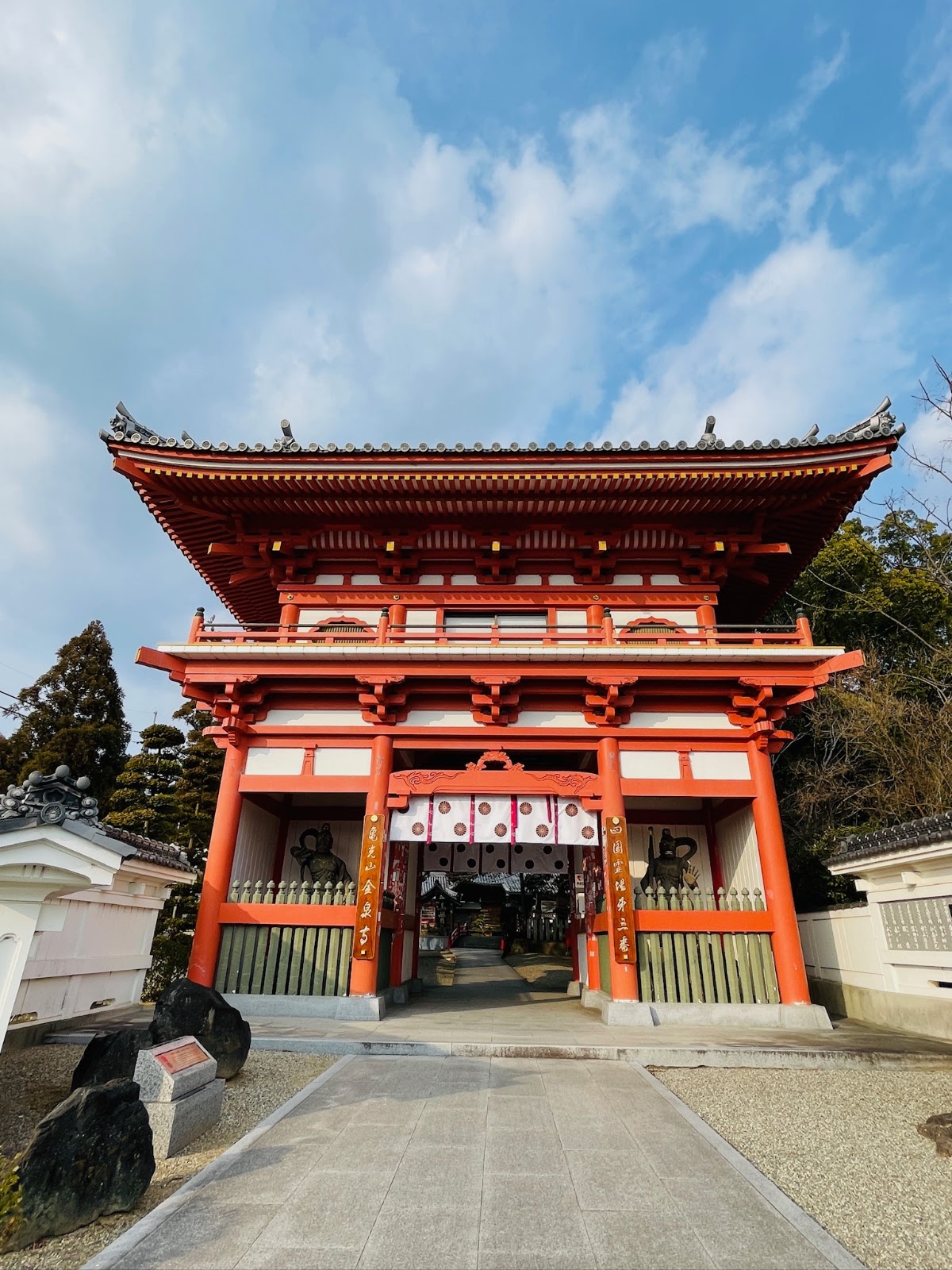
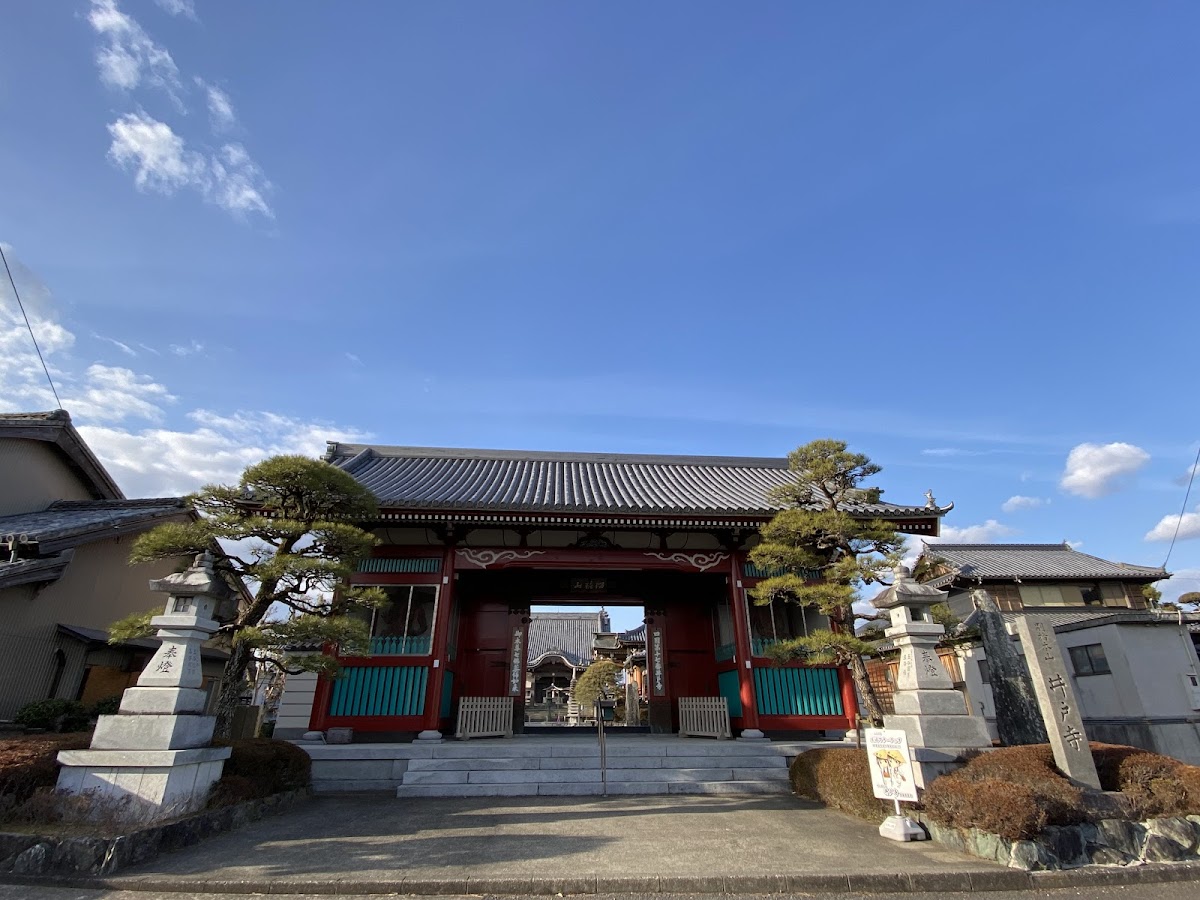
The vermilion-lacquered Niomon Gate, standing at the entrance to Idoji Temple, is the first structure that welcomes visitors. On either side are statues of Kongo Rikishi (guardian deities), warding off evil spirits and guarding the entrance to the sacred area. After passing through the Niomon Gate, the main hall can be seen straight ahead.
The Well of Reflections
The greatest attraction at Idoji Temple is the “Well of Reflections,” said to have been dug by Kobo Daishi in a single night. This well has the following legend:
It is said that if you look into the well and see your reflection, you will be blessed with good health and protection from illness; if you do not see your reflection, misfortune will befall you within three years. Furthermore, carefully examining your reflection in the well is believed to be a way to reflect on yourself and purify your heart.
A pilgrimage song also mentions this, stating, “Looking into the Well of Reflections, though I try to form an image, it is still the mirror of my heart,” making it a central event for visitors to Idoji Temple. Even today, many worshippers can be seen looking into this well to check their reflection.
Main Hall
The main hall houses the principal image, the Seven Buddhas of Medicine. The hall is enveloped in a solemn atmosphere, and worshippers quietly clasp their hands together, praying for recovery from illness and good health.
In front of the main hall, pilgrims can be seen offering sutras and chanting scriptures. Following the traditional worship practices of the Shikoku pilgrimage, they offer lamps and incense and chant the Heart Sutra, among other things.
Daishi Hall
Located to the right of the main hall, the Daishi Hall houses a statue of Kobo Daishi. For pilgrims, visiting the Daishi Hall is just as important as visiting the main hall. It is a place where pilgrims renew their spirit, walking alongside Kobo Daishi in the spirit of “two traveling together.”
Eleven-Faced Kannon Hall
Within the temple grounds is the Kannon Hall, which houses an eleven-faced Kannon statue said to have been carved by Kobo Daishi in one stroke and three strokes. This Kannon statue is designated as an Important Cultural Property, being one of the oldest wooden Buddhist statues in Tokushima Prefecture.
Other Temple Facilities
The temple grounds include facilities such as a bell tower, a sutra copying office, and a water basin for purification. Although the grounds are flat and located in the middle of the town, the varied arrangement of buildings provides visitors with a charming space.
Cultural Properties of Idoji Temple
Important Cultural Properties
Idoji Temple houses the following important cultural properties:
Wooden Eleven-Headed Kannon Standing Statue (Tokushima Prefecture Designated Tangible Cultural Property)
- Said to be the work of Kobo Daishi
- Made using the single-block carving technique
- A large Buddha statue, over 8 feet tall (approximately 2.4 meters or more)
- One of the oldest wooden Buddha statues in Tokushima Prefecture
This Kannon statue is a valuable cultural property that retains the style of the early Heian period, and holds high value from an art historical perspective.
Other Temple Treasures
Idoji Temple houses many temple treasures accumulated over its long history. Ancient documents, Buddhist implements, paintings, and other items that tell the story of history from the Hakuhō period to the present day enhance the cultural value of the temple. ## Visiting Information
Visiting Hours and Sutra Copying Hours
- Visiting Hours: Free access to the temple grounds (within reasonable hours)
- Sutra Copying Hours: 7:00 AM – 5:00 PM (may vary depending on the season)
- Sutra Copying Fee: 300 yen (for the temple stamp)
Visiting Etiquette
The traditional visiting etiquette for the Shikoku Pilgrimage is as follows:
- Bow at the main gate (Nio-mon)
- Cleanse your hands and mouth at the water basin
- Ring the bell at the bell tower (only before visiting, do not ring on the way back)
- Offer votive slips, coins, lamps, and incense at the main hall, and chant sutras
- Visit the Daishi Hall in the same manner
- Look into the Omokage-no-Ido (well of remembrance)
- Receive your sutra copy at the sutra copying office
- Bow at the main gate and exit
Waka Poem
The waka poem of Idoji Temple is as follows:
“Though I draw water from the well where my image is reflected, the reflection still hangs in the mirror of my heart.”
This waka poem recounts the legend of the well of reflections, emphasizing the importance of looking into the mirror of one’s heart through one’s own reflection in the well.
Transportation Information and Access
Access by Train
Using the JR Tokushima Line
- Get off at JR Tokushima Line “Fuchu Station,” approximately 15 minutes on foot
- Get off at JR Tokushima Line “Kofu Station,” approximately 20 minutes on foot
The journey from Tokushima Station to Fuchu Station takes about 10 minutes, and the fare is approximately 200 yen. The route from the station to Idoji Temple is flat, and there are well-maintained signs.
Access by Bus
You can use Tokushima City Buses and Tokushima Bus routes. Get off at the “Idoji” bus stop; the temple is right there. The bus journey from Tokushima Station takes approximately 20 minutes.
Access by Car
- Approximately 15 minutes from the Tokushima Interchange on the Tokushima Expressway
- Accessible via National Route 11 and Prefectural Route 1
- Navigation System Address: 80-1 Kitayashiki, Ido, Kofu-cho, Tokushima City, Tokushima Prefecture
Parking
Regular Cars: Approximately 20 spaces available (free)
Large Buses: Parking available (advance notice recommended)
Idoji Temple is located in the city center, so the parking lot is relatively spacious. However, it can get crowded during peak seasons (especially the spring and autumn pilgrimage seasons).
Distance to Previous and Next Temples
- From Temple No. 16, Kannonji: Approximately 2.5 km (approximately 40 minutes on foot, approximately 10 minutes by car)
- To Temple No. 18, Onzanji: Approximately 4 km (approximately 1 hour on foot, approximately 15 minutes by car)
For those walking the pilgrimage, the distance between temples 16 and 17, and between temples 17 and 18, is relatively short and can be covered in half a day.
Nearby Attractions and Extra Sacred Sites
Awa Provincial Government Site
The area around Idoji Temple was once the site of the provincial government of Awa Province. The place name, Kokufu-cho, also derives from this history. Ancient ruins and historical sites are scattered throughout the area, making it a great place for historical walks.
Awa Saigoku Thirty-Three Kannon Pilgrimage
Idoji Temple is also the 33rd temple of the Awa Saigoku Thirty-Three Kannon Pilgrimage (Eastern Region). Some pilgrims visit this Kannon pilgrimage site in conjunction with the Shikoku Pilgrimage.
The Townscape of Kofu-cho
Kofu-cho is a town with a long history, and its traditional townscape and local culture remain. It is recommended to take a stroll around the area before or after visiting Idoji Temple to enjoy the local atmosphere.
Accommodation and Rest Facilities at Idoji Temple
Idoji Temple does not have lodging facilities, but there are many pilgrim lodgings, guesthouses, and business hotels in the surrounding area. Because it is close to the center of Tokushima City, there are plenty of accommodation options.
There is a rest area on the temple grounds, which visitors can use free of charge. Pilgrim supplies are also sold at the temple office.
Guidelines for Visiting Idoji Temple
The Spirit of “Dōgyō Ninin”
In the Shikoku Pilgrimage, the phrase “Dōgyō Ninin” (two traveling together) is highly valued. This means that pilgrims are always walking together with Kobo Daishi. It is important to remember this spirit when visiting Idoji Temple. ### Mindset at the Well of Reflections
When looking into the Well of Reflections, it is important to view it not merely as a fortune-telling tool, but as an opportunity for self-reflection. The true meaning of this act lies in confirming one’s state of mind through one’s reflection and using it as a catalyst for personal growth.
Prayer to Yakushi Nyorai
The Seven Yakushi Nyorai are Buddhas who heal not only physical health but also mental illness. When visiting, it is important to acknowledge one’s own three poisons—greed, anger, and delusion—and pray for their healing.
Annual Events at Idoji Temple
Idoji Temple holds various Buddhist events throughout the year:
- New Year: First Shrine Visit of the Year, Shusho-e Ceremony
- Spring Equinox: Higan Memorial Service
- April: Hana Matsuri (Buddha’s Birthday)
- August: Obon Memorial Service, Segaki Memorial Service
- Autumn Equinox: Higan Memorial Service
- December: New Year’s Eve Bell Ringing
During these events, many parishioners and worshippers visit the temple, making it busier than usual.
Pilgrimage Experience: Voices of Visitors to Idoji Temple
The following are some of the comments received from pilgrims who visited Idoji Temple:
“When I looked into the well of reflection, I could clearly see my own image, and I felt relieved. At the same time, it was a good opportunity to reflect on my daily life.”
“I was deeply moved to encounter the rare principal image, the Seven Buddhas of Medicine. I felt a sense of gratitude for my health.”
“Despite being located in the city, it was a quiet and peaceful temple. I could feel the compassion of Kobo Daishi.”
Idoji Temple and the Local Community
Idoji Temple, an ancient temple with a history of over 1300 years, is deeply connected to the local community. It serves as a center of faith for the local people and also functions as a cultural hub.
In recent years, it has also undertaken initiatives to meet modern needs, such as opening the “Suzume no Sato” perpetual cemetery on its grounds. Its ability to maintain tradition while adapting to the times is also noteworthy.
Summary: The Significance of Visiting Idoji Temple
Idoji Temple, the 17th temple on the Shikoku 88 Temple Pilgrimage, is an important sacred site with the following characteristics:
- The Only Temple with Seven Yakushi Nyorai (Medicine Buddhas): The only temple on the Shikoku pilgrimage to have Seven Yakushi Nyorai as its principal deity.
- The Well of Reflections: A legendary well dug overnight by Kobo Daishi remains.
- Ancient History: A temple with a history of over 1300 years as a temple commissioned by Emperor Tenmu.
- Important Cultural Property: Houses cultural properties such as a standing statue of Eleven-Headed Kannon, said to have been created by Kobo Daishi.
- Easy Access: Located near Tokushima city center, with convenient transportation.
Visiting Idoji Temple is not merely a pilgrimage; it is a valuable opportunity to connect with the compassionate heart of Kobo Daishi and reflect on oneself. Through your reflection in the Well of Reflections, you can polish the mirror of your heart and gain insights to live a better life.
If you are planning a pilgrimage around Shikoku, or if you are interested in the history and culture of Tokushima, please visit Idoji Temple and experience its profound history and spirituality.