Hie Shrine (Chiyoda Ward, Tokyo) Complete Guide | History, Blessings, Access, and Sanno Festival Explained in Detail
Hie Shrine, located in Nagatacho, Chiyoda Ward, Tokyo, is affectionately known as “Sanno-san” and is a prestigious shrine with a history dating back to the Edo period. Despite its prime location in the heart of Tokyo, close to the National Diet Building and the Prime Minister’s Official Residence, its lush grounds are enveloped in tranquility, making it an urban oasis visited by many worshippers.
This article comprehensively covers everything you need to know before visiting Hie Shrine, from its history and blessings to the allure of the Sanno Festival and access methods.
Basic Information about Hie Shrine
Official Name: Hie Shrine
Location: 2-10-5 Nagatacho, Chiyoda-ku, Tokyo 100-0014
Main Deity: Ohoyamakuhi-no-kami
Associated Deities: Kunitokotachi-no-kami, Izanami-no-kami, Ashinakahiko-no-mikoto
Former Shrine Rank: Kanpei Taisha (Grand Imperial Shrine), Jun-Chokusaisha (One of the Ten Shrines of Tokyo)
Special Shrine: Designated
Annual Grand Festival: Sanno Festival (June 7th-17th, Shinkosai festival held every other year)
Telephone Number: 03-3581-2471
Hie Shrine is still positioned as a shrine protecting the Imperial Palace (former Edo Castle) as the “Guardian of the Imperial Palace.”
History of Hie Shrine
From the Kamakura Period to the Early Edo Period
The history of Hie Shrine dates back to the Kamakura period. It is believed to have begun when the Edo clan enshrined the Sanno Shrine as the ancestral deity of the Musashino region and the guardian deity of Edo.
During the Bunmei era (1469-1487), when Ota Dokan built Edo Castle, he invited the Sanno Shrine from Kawagoe to be enshrined within Edo Castle as a protective deity. This is the direct origin of the present-day Hie Shrine. When Ota Dokan chose the land of Edo to build the castle, he valued this shrine highly, hoping that its divine power would shine brightly and lay the foundation for the prosperity of Edo.
Tokugawa Ieyasu’s Entry into Edo Castle and the Shrine of the Tokugawa Shogunate
In 1590 (Tensho 18), when Tokugawa Ieyasu made Edo Castle his residence, Hie Shrine came to receive special reverence as the “guardian shrine of the castle,” the “guardian deity of the Tokugawa family,” and the “shrine of Edo’s birth.” Ieyasu positioned Hie Shrine as the shrine of the Tokugawa shoguns, making it one of the spiritual pillars of the Edo shogunate.
During the time of the second shogun, Tokugawa Hidetada, further improvements were made to the shrine buildings, and its ties with the shogunate became even stronger.
The Great Fire of Meireki and Relocation to the Current Location
In 1657 (Meireki 3), the shrine buildings located within Edo Castle were destroyed by the Great Fire of Meireki that struck Edo. Following this unprecedented disaster, during the reign of the fourth shogun, Tokugawa Ietsuna, Hie Shrine was relocated and rebuilt in its current location outside Edo Castle, in Nagatacho (then Kojimachi Hayabusa-cho).
This relocation shifted Hie Shrine to a position protecting the outer perimeter of Edo Castle. However, the shogun’s reverence for the shrine remained unchanged; in fact, it became even more widely worshipped by the townspeople of Edo, who found it easier to visit.
From the Meiji Restoration to the Present
After the Meiji Restoration, Hie Shrine took on a new role as a guardian deity of the Imperial Palace (Imperial City). It was designated a Kanpei Taisha (Grand Imperial Shrine) and a Jun-Chokusaisha (Quasi-Imperial Shrine), becoming a highly prestigious shrine receiving special reverence from the Imperial Family.
Many of the shrine buildings were destroyed by fire during World War II, but after post-war reconstruction, the current Gongen-zukuri style shrine buildings were rebuilt in 1958. Currently, it is counted as one of Tokyo’s Ten Shrines and attracts many visitors as a power spot in the heart of the city.
Deities and Benefits
Ohoyamakui-no-kami
Ohoyamakui-no-kami, the principal deity of Hie Shrine, is a central figure in Sanno faith. Known as the guardian deity of Mount Hiei (Mount Hie), it has been revered since ancient times as the “God of Mountains” and the “God of Water.”
Ohoyamakui-no-kami is considered a deity deeply involved in the prosperity of agriculture and industry, as a god who controls the mountains, protects the land, and brings abundant harvests. Furthermore, because it controls water, the source of life force, it is also worshipped as a god with the power to nurture life.
Diverse Benefits of Hie Shrine
Hie Shrine is said to offer a variety of benefits, including:
Protection from Evil and Disaster
Due to its history of protecting Edo Castle and the city of Edo, it is particularly famous for its benefits in warding off evil and disaster.
Family Safety
As the guardian deity of the Tokugawa shogunate, this shrine has been worshipped as a protector of family prosperity and safety.
Business Prosperity and Corporate Thriving
As a shrine that has grown alongside the development of Edo, many visitors come to pray for business prosperity and corporate growth.
Matchmaking
The monkey, the divine messenger of Oyamakui-no-kami, is believed to bring good fortune in relationships. The “sacred monkey” (Masaru) in particular also carries the meanings of “warding off evil” and “surpassing.”
Safe Childbirth and Fertility
Because the monkey (saru) sounds similar to the word for “to give birth” (umu), the shrine is also known for its blessings for safe childbirth and fertility. There is a pair of male and female sacred monkey statues on the grounds, attracting many visitors praying for children.
Career Advancement and Good Fortune
Located in Nagatacho, the political center of Japan, the shrine is known for attracting many business people and politicians seeking career advancement and good fortune.
Sanno Festival | One of Japan’s Three Great Festivals
History and Prestige of the Sanno Festival
The Sanno Festival, the annual festival of Hie Shrine, is counted as one of the “Three Great Festivals of Edo” along with the Kanda Festival and the Fukagawa Hachiman Festival. Furthermore, it is known as one of the “Three Great Festivals of Japan,” along with the Gion Festival in Kyoto and the Tenjin Festival in Osaka, making it a representative Japanese festival.
During the Edo period, it was one of the few festivals permitted to have its procession enter Edo Castle as a “Tenka Matsuri” (festival of the realm) viewed by the Shogun. This special status stems from the fact that Hie Shrine was the tutelary shrine of the Shogun’s family.
Highlights of the Sanno Festival
The Sanno Festival is held annually from June 7th to 17th, but the Shinko-sai (procession of the portable shrine) takes place every other year. The year in which the Shinko-sai is held is called the “Hon-matsuri” (main festival), and the year in which it is not held is called the “Kage-matsuri” (shadow festival).
Shinko-sai (Portable Shrine Procession)
In the year of the main festival, a magnificent procession stretching 300 meters and involving up to 500 participants parades through the heart of the city. The procession, adorned in imperial court attire, is a valuable cultural heritage that conveys the traditions of the Edo period.
Floats and Imperial Palanquin
The festival procession features dazzling floats and an imperial palanquin (portable shrine), and the sight of them moving through the city accompanied by gagaku (ancient Japanese court music) is breathtaking.
Traditional Edo Period Performing Arts
During the Sanno Festival, various traditional performing arts events are held on the shrine grounds, allowing visitors to experience Edo culture.
Highlights of the Shrine Grounds
Otoko-zaka (Men’s Slope), Onna-zaka (Women’s Slope), and Escalator
There are several routes to access the grounds of Hie Shrine.
Otoko-zaka (Men’s Slope)
A steep stone staircase leading from the main approach, consisting of 53 steps. The stairs have a powerful presence, and reaching the top gives a great sense of accomplishment.
Women’s Slope
This gentle slope is easy to climb even with a stroller or wheelchair.
Escalator
An escalator is installed on the back approach (towards Tameike-Sanno Station), making it easy for anyone to visit the shrine. This is a facility unique to shrines in the city center.
Senbon Torii (Inari Approach)
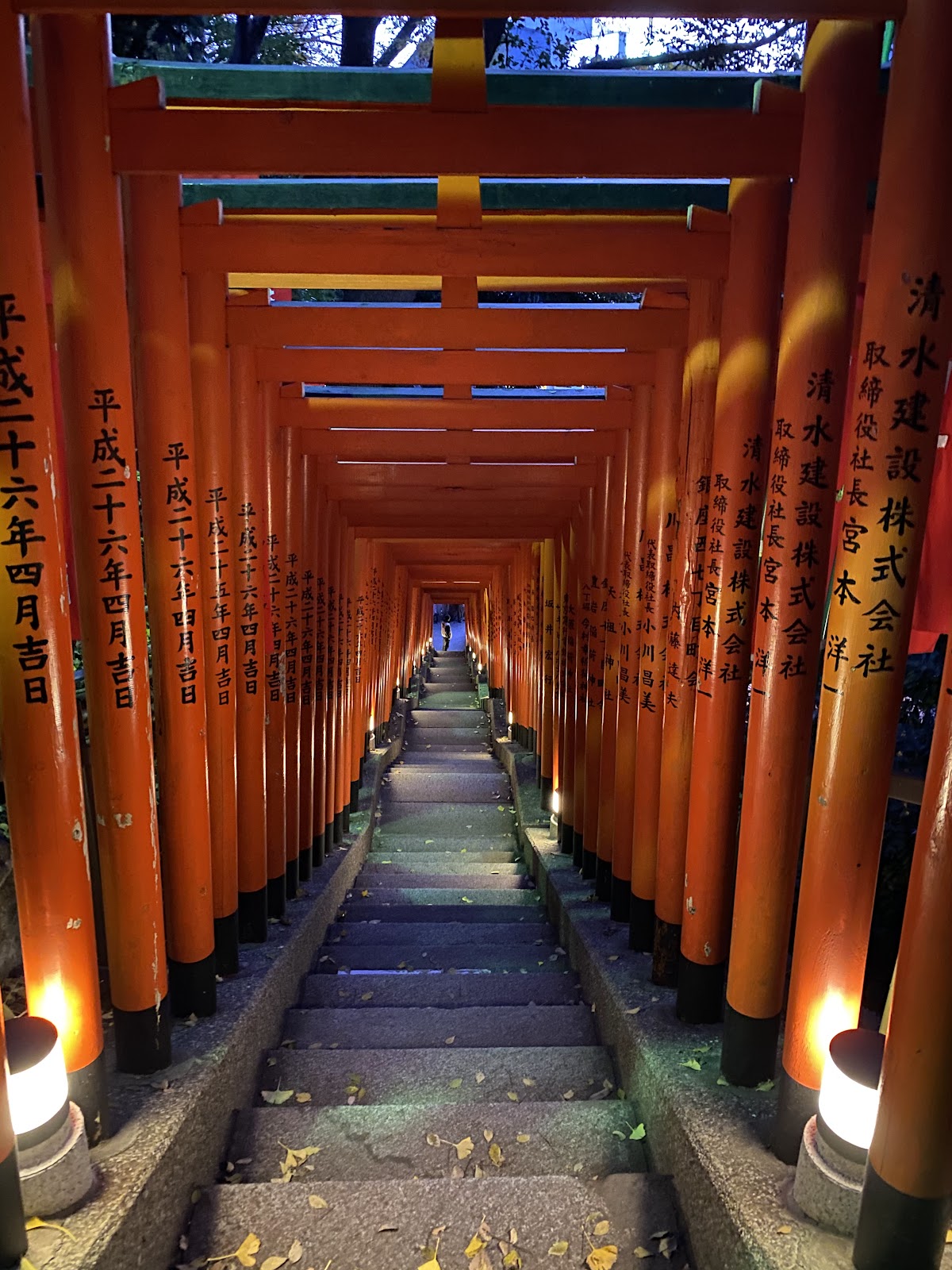
On the west side of the shrine grounds is the “Senbon Torii,” a row of vermilion torii gates. This is the approach to the subsidiary shrine, Sanno Inari Shrine, and offers a beautiful landscape reminiscent of Fushimi Inari Taisha in Kyoto. It is also a popular spot for Instagram photos.
Sacred Monkey Statues
There are several statues of monkeys, which are messengers of the gods, on the shrine grounds. The pair of male and female sacred monkey statues in front of the main hall are particularly popular with visitors praying for fertility and safe childbirth. Male monkeys are believed to bring good fortune in business, while female monkeys are believed to bring good fortune in conception and safe childbirth.
Shrine Building
The current shrine building was rebuilt in 1958 and is a magnificent example of Gongen-zukuri architecture. The beautiful vermilion-lacquered building exudes a sense of prestige and tradition despite its location in the heart of the city.
Goshuin (Shrine Seals) and Amulets
Goshuin (Shrine Seals)
At Hie Shrine, in addition to regular goshuin, seasonal goshuin and special goshuin during the Sanno Festival are available. Goshuin are available at the shrine office, and the offering fee is usually 500 yen.
Several types of original goshuin notebooks are also available, with popular designs including monkey designs and those featuring the Sanno Festival.
Popular Amulets
Masaru Amulet (Divine Monkey Amulet)
This amulet, featuring a monkey motif, symbolizes “warding off evil” and “overcoming adversity.” Popular with those seeking protection from misfortune and improved luck in competitions.
Matchmaking Charm
This charm is for those wishing for a successful relationship, featuring a cute design primarily in pink and red.
Career Charm
This charm is for those wishing for business prosperity and improved career luck, popular among business professionals.
Safe Childbirth Charm
This charm is for those praying for a safe childbirth, and is frequently received by pregnant women and their families.
Access Information
Hie Shrine is conveniently located in the city center and is accessible on foot from several train stations.
Access by Train
Tokyo Metro Chiyoda Line “Akasaka Station”
Approximately 3 minutes on foot from Exit 2 (nearest station)
Tokyo Metro Namboku Line/Ginza Line “Tameike-Sanno Station”
Approximately 3 minutes on foot from Exit 7 (escalator available)
Tokyo Metro Chiyoda Line “Kokkai-gijidomae Station”
Approximately 5 minutes on foot from Exit 5
Tokyo Metro Ginza Line/Marunouchi Line “Akasaka-Mitsuke Station”
Approximately 8 minutes on foot from Exit 11
All stations are easily accessible, with Akasaka Station and Tameike-Sanno Station being particularly convenient.
Access by Bus
Toei Buses and Chii-bus (community buses) are available. The nearest bus stops are “Akasaka-Mitsuke” and “Tameike.”
Access by Car
Hie Shrine has a parking lot for visitors, but spaces are limited. While there are many coin-operated parking lots in the area due to its central location, we recommend using public transportation.
Visiting Hours and Shrine Office Hours
Visiting Hours: 6:00 AM – 5:00 PM (6:00 AM – 6:00 PM from April to September)
Shrine Office Hours: 9:00 AM – 4:30 PM
Prayer Request Hours: 9:00 AM – 4:30 PM
Admission Fee: Free
Hours may be extended during the New Year holidays and the Sanno Festival.
About Prayers
Hie Shrine accepts various types of prayers.
Main Types of Prayers
- Protection from misfortune and evil influences
- Family safety
- Business prosperity and company success
- Safe childbirth prayer
- First shrine visit (Omiyamairi)
- Shichi-Go-San (7-5-3) festival
- Traffic safety prayer
- Success in examinations
- Good match prayer
Prayers do not require reservations and are conducted on a first-come, first-served basis on the day. The offering fee varies depending on the prayer, starting from 5,000 yen. Group and corporate prayers are also possible; advance reservations are recommended.
Annual Events
Hie Shrine holds various annual events in addition to the Sanno Festival.
January 1st: New Year’s Day Festival
February 3rd: Setsubun Festival
June 7th-17th: Sanno Festival (Annual Grand Festival)
June 30th: Great Purification Ceremony
Around November 15th: Shichi-Go-San Festival
December 31st: Great Purification Ceremony & New Year’s Eve Festival
Visiting the shrine during these events offers a special experience.
Nearby Tourist Attractions
There are many worthwhile tourist attractions around Hie Shrine.
National Diet Building
Approximately 10-minute walk. You can see the center of Japanese politics.
Prime Minister’s Official Residence
Approximately 5-minute walk. Only the exterior can be viewed.
Akasaka Sacas
Approximately 7-minute walk. A TBS complex where you can enjoy shopping and dining.
Tokyo Midtown
Approximately 15-minute walk. A luxury shopping mall and art museum.
Akasaka Palace State Guest House
Approximately 15 minutes on foot. Interior tours are available with prior reservation.
Points to Note When Visiting Hie Shrine
Best Season for Visiting
Hie Shrine can be visited year-round, but there are particularly recommended times.
June (Sanno Festival)
This is the busiest time, offering an opportunity to experience traditional festivals. The main festival year is especially spectacular.
Hatsumode (January 1st-3rd)
Many people visit for New Year’s prayers. It can be crowded, but you can experience a solemn atmosphere.
Spring/Autumn
The weather is pleasant, and the shrine grounds are beautifully green. Visiting is relatively peaceful.
Estimated Time Required
For simply visiting the shrine grounds, about 30 minutes is sufficient. Including a Goshuin (shrine stamp) and prayers, allow about an hour. During the Sanno Festival, a 2-3 hour stay including festival viewing is recommended.
Attire and Items to Bring
For regular visits, no special attire is required. However, if you are receiving a prayer, it is advisable to wear attire that is not too casual. If you plan to use the Otoko-zaka (men’s slope), comfortable walking shoes are recommended.
If you wish to receive a Goshuin (temple/shrine stamp), please bring your Goshuincho (stamp book).
Summary
Hie Shrine (Chiyoda-ku, Tokyo) is a prestigious shrine with a long history dating back to the Kamakura period. Founded by Ota Dokan, it played a vital role throughout history, from its origins as the guardian deity of the Tokugawa shogunate to its current position as a protector of the Imperial Palace.
It offers a variety of blessings, including protection from evil, family safety, business prosperity, matchmaking, and safe childbirth. The Sanno Festival, one of Japan’s three major festivals, is known as a valuable festival that preserves Edo culture. Despite being in the heart of the city, the tranquil grounds provide a special space that offers healing and strength to visitors.
Conveniently located within walking distance of several stations, it can be visited in conjunction with the National Diet Building and other tourist attractions in Akasaka. When you visit Tokyo, why not take a trip to Hie Shrine? You’re sure to feel the tradition and prestige that has continued since the Edo period, as well as the power of faith that thrives in the modern age.