Complete Guide to Kōsokuji Temple: History, Goshuin (Temple Seal), Access, and Highlights
Kōsokuji Temple is an ancient Jishū sect temple located in Jūnisō, Kamakura City, Kanagawa Prefecture. Nestled in a quiet valley somewhat removed from Kamakura Station, this temple maintains a tranquil atmosphere, in stark contrast to the bustling tourist center of Kamakura. This article provides a detailed explanation of Kōsokuji Temple’s history, highlights, access methods, and goshuin information—all essential information before your visit.
History and Origins of Kōsokuji Temple
Founding and Founder
Kōsokuji Temple, officially known as “Iwakura-san Kōsokuji,” was founded during the Kamakura period as a Jishū sect temple. Its founder is said to be Sakua Shōnin, a senior disciple of Ippen Shōnin. After Ippen Shōnin’s death, Sakua Shōnin traveled throughout Japan to spread the teachings of the Jishū sect, including missionary work in Kamakura.
There are various theories regarding the founding date of Kōshoku-ji Temple, but the most widely accepted theory places it around the Shōwa era (1312-1317) of the late Kamakura period. While many temples were built in Kamakura at that time, Kōshoku-ji Temple was built in a quiet area called Jūnisō, on the eastern edge of Kamakura.
The Jishū Sect and the Teachings of Ippen Shōnin
The Jishū sect is a branch of Pure Land Buddhism founded by Ippen Shōnin (1239-1289) in the mid-Kamakura period. It taught that everyone can attain rebirth in the Pure Land equally by chanting the Nembutsu, “Namu Amida Butsu.” Ippen Shōnin traveled throughout Japan, spreading the practice of Odori Nembutsu (dancing Nembutsu), and gained the support of many people.
Kōshoku-ji Temple also functioned as a place for missionary work based on the teachings of the Jishū sect. From the Kamakura period to the Muromachi period, it developed as a temple that attracted the faith of ordinary people.
Origin of the Name of Kōshoku-ji Temple
The temple name “Kōshoku-ji” originates from the Pure Land Buddhist belief that salvation is attained by touching the light of Amida Buddha. Amida Buddha’s light is said to illuminate all sentient beings and extend a helping hand. This meaning of “touching the light” is embodied in the temple’s name.
Highlights of Kōshoku-ji Temple
Shioname Jizo (Salt-Licking Jizo)
One of the greatest highlights of Kōshoku-ji Temple is the “Shioname Jizo” (Salt-Licking Jizo) enshrined in front of the main hall. An interesting legend surrounds this Jizo Bodhisattva statue.
The Legend of Shioname Jizo
Long ago, a merchant transporting salt from Mutsuura (present-day Kanazawa Ward, Yokohama City) to Kamakura passed through this area. Exhausted from carrying heavy sacks of salt, a traveling monk appeared and offered to carry the salt sacks for him. The merchant entrusted his salt sacks to a monk and arrived in Kamakura relieved.
However, he was puzzled when he couldn’t find the monk, so he returned to Kōshoku-ji Temple and found salt crystals on the shoulder of the Jizo Bodhisattva statue in front of the main hall. The merchant realized that the monk was an incarnation of Jizo Bodhisattva and was deeply grateful.
From this legend, this Jizo Bodhisattva came to be called “Shioname Jizo” (Salt-Licking Jizo). This legend, unique to Kamakura, which prospered as a salt trade route, speaks to the faith in Jizo Bodhisattva that relieved the hardships of ordinary people.
Characteristics of Shioname Jizo
The current Shioname Jizo is protected by a protective structure, shielding it from wind and rain. The statue is approximately 2 meters tall and greets visitors with its majestic presence. As a valuable cultural asset that retains the characteristics of stone Buddha statues from the Kamakura period, it is designated as a cultural property of Kamakura City.
The Cheek-Burning Amida
Another important object of worship at Kōshoku-ji Temple is the “Cheek-Burning Amida.” This is an Amida Buddha statue enshrined in the main hall, and it also has an interesting legend.
The Legend of the Cheek-Burning Amida
Once upon a time, there was a devout old woman who lived near Kōshoku-ji Temple. She offered sacrifices to Amida Buddha every day, but one day, she accidentally offered burnt rice cakes. Legend says that a burn mark appeared on the cheek of the Amida Buddha statue.
Another legend says that during a fire, Amida Buddha took the blame and suffered burns on his cheek. In any case, this legend expresses the profound compassion of Amida Buddha and the belief that he takes on people’s suffering in their place.
Atmosphere of the Main Hall and Temple Grounds
The main hall of Kōshoku-ji Temple is small but a charming building. Rebuilt during the Edo period, the temple boasts a simple and tranquil design characteristic of Jishu sect temples. Inside the main hall, in addition to the Hohoyaki Amida Buddha, a statue of Ippen Shonin is also enshrined.
The temple grounds are not particularly large, but the well-maintained garden and seasonal flowers soothe visitors. Especially during the cherry blossom season in spring, the hydrangea season in early summer, and the autumn foliage season, one can enjoy a quiet beauty.
Temple Gate and Approach
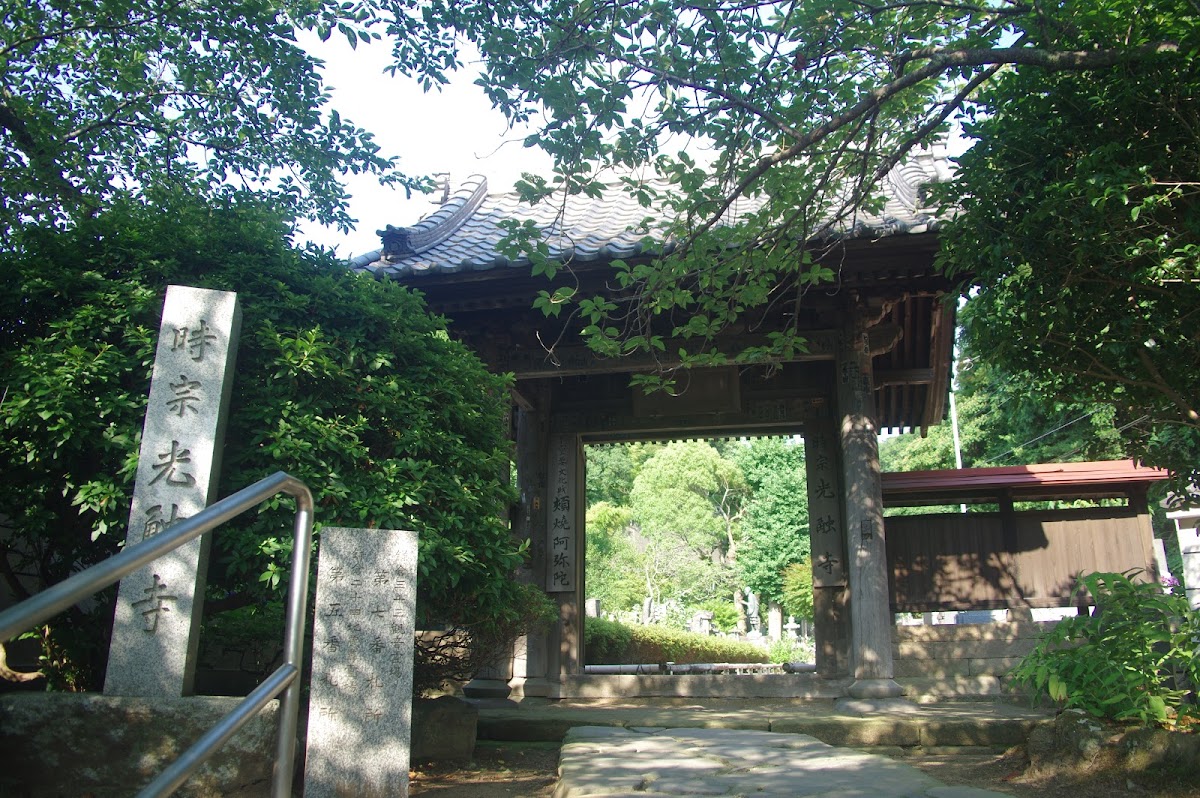
The approach to Kōshoku-ji Temple is located beyond the residential area of Jūnisō. The temple gate is simple yet dignified, and beyond it, a stone staircase leads to the main hall. Trees line both sides of the approach, creating a serene atmosphere unique to the valleys of Kamakura.
Annual Events and Special Viewings at Kōshoku-ji Temple
Main Annual Events
Kōshoku-ji Temple holds annual events in accordance with Jishu sect traditions. The main events include the following:
- Gantan-e (New Year’s Day Ceremony): A New Year’s memorial service held on January 1st.
- Shunki Higan-e (Spring Equinox Ceremony): A memorial service for ancestors held during the spring equinox.
- Segaki-e (Feeding of Hungry Ghosts Ceremony): A memorial service for hungry ghosts held in summer.
- Autumn Higan-e (Autumn Equinox Ceremony): A memorial service held during the autumn equinox.
- Kaisan-ki (Founder’s Memorial Service): A memorial service to commemorate the founder, Sakua Shonin.
These events are primarily for temple parishioners and local believers, but general visitors may also be able to participate.
Special Viewing Information
While the grounds of Kōshoku-ji Temple are usually open to the public, viewing the interior of the main hall may require prior notice. If you wish to view the Hohoyaki Amida (Cheek-Burning Amida Buddha) up close, it is recommended to contact the temple in advance.
Goshuin (Temple Seal) Information
Goshuin of Kōshoku-ji Temple
Goshuin (temple seals) are available at Kōshoku-ji Temple. The temple’s official seal (Goshuin) typically bears the temple’s name, “Kōshokuji,” and the inscription “Namu Amida Butsu,” indicating the principal image of Amida Buddha.
You can obtain the Goshuin at the temple office near the main hall, but since the head priest may be absent, it is recommended to call ahead to confirm availability if you wish to obtain one.
Regarding Goshuincho (Stamp Books)
Kōshokuji Temple generally does not carry its own original Goshuincho, but they will stamp your own. Those on pilgrimages to the 33 Kannon temples or 24 Jizo temples of Kamakura should bring their respective designated Goshuincho.
Admission Fee and Goshuin Stamp Offering Fee
- Admission Fee: Free to visit the temple grounds (please check for admission fees to the main hall).
- Goshuin Stamp Offering Fee: Approximately 300-500 yen (at your discretion).
Access Methods
Access by Train and Bus
To access Kōshokuji Temple using public transportation, please use the following methods:
By Bus from JR Kamakura Station
- Take a Keikyu Bus from the East Exit of Kamakura Station (JR Yokosuka Line/Enoshima Electric Railway)
- Take a bus bound for Kanazawa-Hakkei Station, Tachiarai, or Highland Loop
- Get off at the Junisho Shrine bus stop (approximately 15 minutes)
- Approximately 5 minutes on foot from the bus stop
By Bus from Keikyu Kanazawa-Hakkei Station
- Take a Keikyu Bus from Kanazawa-Hakkei Station (Keikyu Main Line)
- Take a bus bound for Kamakura Station
- Get off at the Junisho Shrine bus stop
- Approximately 5 minutes on foot from the bus stop
Walking from Kamakura Station
It is possible to walk from Kamakura Station, but the distance is approximately 3.5 kilometers, taking about 45-50 minutes. Exploring the eastern part of Kamakura on foot is a pleasant experience, but it’s a bit of a distance, so we recommend planning your trip with plenty of time to spare.
Access by Car and Parking
If you’re visiting by car, Kōshokuji Temple does not have its own parking lot. We recommend using a nearby coin-operated parking lot or parking near Kamakura Station and taking a bus or walking.
The Jūnisō area has many narrow roads, so driving requires caution. Also, Kamakura as a whole gets crowded on weekends and during peak tourist seasons, so using public transportation is advisable.
Nearby Tourist Attractions
When visiting Kōshokuji Temple, we recommend also visiting nearby temples, shrines, and tourist attractions.
Hōkokuji Temple (Bamboo Garden)
Hōkokuji Temple, located about a 15-minute walk from Kōshokuji Temple, is famous for its “Bamboo Garden.” The garden, with its approximately 2,000 moso bamboo trees, boasts some of the most beautiful scenery in Kamakura. Enjoying matcha tea while gazing at the bamboo grove offers a truly relaxing experience. ### Jōmyōji Temple
Jōmyōji Temple, the fifth-ranked of the Five Great Zen Temples of Kamakura, is located about a 20-minute walk from Kōshokuji Temple. Its vast grounds include a main hall, gardens, and a tea room, making it a pleasant place for a leisurely stroll. There’s also a restaurant called Ishigama Garden Terrace on the grounds, where you can enjoy a meal or afternoon tea.
Sugimoto-dera Temple
Sugimoto-dera Temple, considered the oldest temple in Kamakura, is also located about a 10-minute walk from Kōshokuji Temple. Its moss-covered stone steps are striking, and the main hall houses three eleven-faced Kannon statues. It’s also the first temple on the Kamakura Thirty-Three Kannon Pilgrimage, attracting many pilgrims.
Asahina Pass
Further east from Kōshokuji Temple lies Asahina Pass, one of the seven passes of Kamakura. This ancient road, excavated during the Kamakura period, remains a popular hiking course. Walking through nature while experiencing history is a unique charm of Kamakura.
Seasons and Best Viewing Times at Kōshokuji Temple
Spring (March-May)
In spring, cherry blossoms and wildflowers adorn the grounds of Kōshokuji Temple. Especially from late March to early April, the cherry blossoms are in full bloom, announcing the arrival of spring in the quiet temple grounds. A spring stroll through Kamakura, visiting Kōshokuji Temple along with Hōkokuji Temple and Jōmyōji Temple, is loved by many.
Summer (June-August)
In early summer, in June, hydrangeas adorn the temple grounds. Kamakura is known as a famous spot for hydrangeas, but the hydrangeas at Kōshokuji Temple are appealing because they can be enjoyed in a quieter atmosphere compared to the crowded Meigetsuin Temple and Hase-dera Temple.
During the hot summer months, the shade of the trees in the valley provides a cool respite.
Autumn (September-November)
Autumn is the season when Kōshokuji Temple is beautiful with its autumn foliage. From mid-November to early December, the maple and other trees on the temple grounds change color, allowing visitors to enjoy the autumn foliage in a tranquil atmosphere.
Winter (December-February)
Winter at Kōshokuji Temple is the quietest time of year. There are fewer visitors, allowing for a peaceful visit. On clear winter days, the time spent praying to the Shioname Jizo in the crisp winter air is truly refreshing.
Etiquette and Manners for Visiting Kōshokuji Temple
Etiquette for Visiting Temple
Kōshokuji Temple is a Jishū sect temple, so please follow the basic etiquette for visiting Buddhist temples.
- Bow at the Temple Gate: Before entering the temple grounds, bow at the temple gate.
- Purify at the Water Basin: If there is a water basin, purify your hands and mouth.
- Worship at the Main Hall: Quietly join your hands in prayer in front of the main hall and offer your prayers with sincerity.
- Worship at the Shioname Jizo: Offer your prayers to the Jizo Bodhisattva and express your gratitude.
- Bow Upon Departure: When leaving, bow at the temple gate before leaving the temple grounds.
Photography
Photography is generally permitted on the temple grounds, but photography inside the main hall or of Buddha statues may be prohibited. Please be mindful of other visitors and take photos quietly.
Clothing and Belongings
No special attire is required for visiting Kōshokuji Temple, but to show respect to the temple, it is best to avoid overly casual clothing. Also, since you will be walking on stone steps and paths, comfortable shoes are recommended.
During the summer months, the sun is strong, so it’s a good idea to bring a hat, parasol, and drinks. In winter, the eastern part of Kamakura is windy and cold, so be sure to dress warmly.
The Charm of Kōshokuji Temple and Why Visit It
Kōshokuji Temple is located away from the center of Kamakura, making it a hidden gem where you can pray in peace and quiet, without the crowds of tourists. The legends of the Shioname Jizo and the Hooyaki Amida are valuable cultural heritage that convey the history of folk belief in Kamakura.
While Kamakura sightseeing often focuses on famous spots like Tsurugaoka Hachimangu Shrine, Hase-dera Temple, and the Great Buddha, visiting a quiet temple like Kōshokuji Temple allows you to discover a different charm of Kamakura.
Taking your time to pray without being rushed and finding peace in the tranquility of the temple grounds will be a valuable experience in today’s busy life.
When you visit Kamakura, be sure to extend your trip and visit Kōshokuji Temple. The gentle appearance of the Shioname Jizo and the tranquil atmosphere of the temple grounds will surely become a cherished memory.
Summary
Kōshokuji Temple is an ancient temple of the Jishu sect, founded during the Kamakura period, and is home to two intriguing legends: the Shioname Jizo and the Hooyaki Amida. Located in the quiet valley of Jūnisō, about 15 minutes by bus from Kamakura Station, it offers a peaceful and uncrowded experience for visitors.
The eastern part of Kamakura is dotted with many temples worth seeing, including Hōkokuji, Jōmyōji, and Sugimotodera. A walking course starting from Kōshokuji Temple and exploring eastern Kamakura is highly recommended. You can experience the history and culture of Kamakura amidst the beauty of nature in every season and a serene atmosphere.
You can also receive a Goshuin (temple stamp), making it a temple worth visiting as part of a Kamakura pilgrimage. On your next visit to Kamakura, be sure to visit Kōshokuji Temple and experience its serene charm.