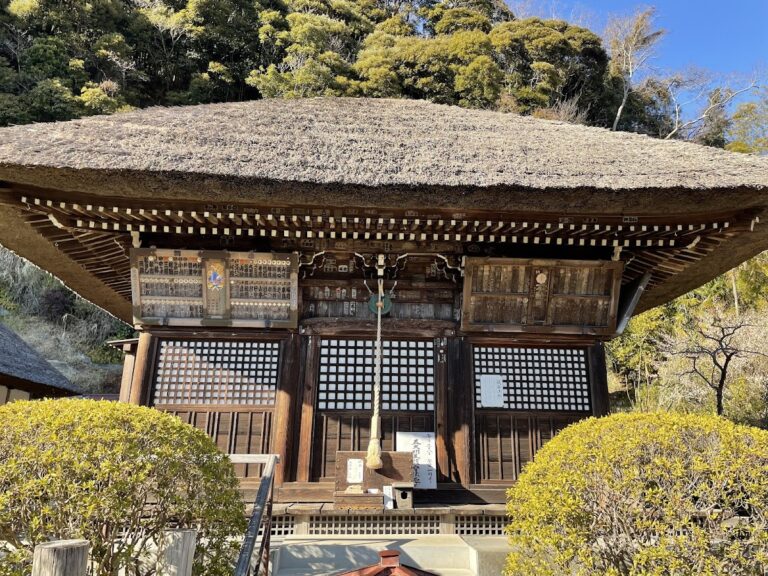
Myooin Temple (Kamakura City, Kanagawa Prefecture) Complete Guide | History, Cultural Properties, and Access Information
Located in Jūnisō, Kamakura City, Kanagawa Prefecture, Myooin Temple is an ancient temple of the Shingon sect, Sennyūji branch, founded at the behest of the fourth shogun of the Kamakura shogunate. Its mountain name is Iimoriyama, its temple name is Kankiji, and it is also known as “Godaidō” (Five Great Halls) because it enshrines the Five Great Wisdom Kings. It is also known as the eighth temple on the Kamakura Kannon Pilgrimage and is an important temple that preserves valuable cultural properties from the Kamakura period.
History of Myooin Temple
Founding Circumstances and Deep Connection with the Kamakura Shogunate
The founding of Myooin Temple dates back to Kanki 3 (1231). This temple, founded by Fujiwara (Kujō) Yoritsune, the fourth shogun of the Kamakura shogunate, was completed in Katei 1 (1235). The temple’s name, “Kanki-ji,” derives from the era name “Kanki,” the year it was founded.
The temple’s founding abbot was Jōgō, who served as the head priest of Tsurugaoka Hachimangū Shrine. Jōgō was a high-ranking priest who held an important position in the Kamakura Buddhist world at the time, and his invitation speaks to the high status of Myōō-in Temple. Initially, Myōō-in Temple played an important role in enshrining the Five Great Wisdom Kings as a protection against evil influences from the shogun’s residence.
It is a precious existence as the only temple in Kamakura City that was founded by imperial decree of the Kamakura shogun. This fact demonstrates Myōō-in Temple’s special place in Kamakura’s history.
Transition from the Medieval to the Early Modern Period
Approximately 400 years after its founding, during the Kan’ei era (1624-1644), Myōō-in Temple was struck by fire, and many of its buildings were destroyed. This fire dealt a major blow to the temple, but fortunately, the principal image, the Five Great Wisdom Kings statues, escaped destruction and have been preserved to this day.
During the reconstruction process after the fire, Myooin Temple, while reduced in size, continued to function as a training ground for Shingon Esoteric Buddhism. Throughout the Edo period, it attracted many pilgrims as a center of local faith and as a pilgrimage site for the Kamakura Kannon pilgrimage.
Myooin Temple in the Modern Era
Having weathered the wave of anti-Buddhist movement during the Meiji era, Myooin Temple successfully preserved its valuable cultural assets. In the Showa period, the thatched roof of the main hall was restored, and it came to be recognized as an important element of Kamakura’s historical landscape.
Currently, Myooin Temple belongs to the Sennyu-ji branch of the Shingon sect and continues its religious activities, centered on the Goma fire ritual held on the 28th of each month. It continues to mark nearly 800 years of history in the tranquil environment of Junisho, often called the inner sanctuary of Kamakura.
Cultural Properties of Myooin Temple
Nationally Designated Important Cultural Property: Wooden Statues of the Five Great Wisdom Kings
Myooin Temple’s greatest treasure is the wooden statues of the Five Great Wisdom Kings, designated as a National Important Cultural Property. The Five Great Wisdom Kings refer to the five deities: Fudo Myoo (Acala), Gosanze Myoo (Trailhead), Gundari Myoo (Arch-Wisdom King), Daiitoku Myoo (Great Wisdom King), and Kongoyasha Myoo (Vajrayaksha).
The seated statue of Fudo Myoo, placed at the center, is an excellent Buddhist statue believed to have been created during the Kamakura period. Approximately 90 centimeters tall, this statue is characterized by its powerful form and exquisite carving techniques, and is highly regarded as one of the masterpieces of Kamakura sculpture. At the “Kamakura x Esoteric Buddhism Exhibition” held at the Kamakura National Treasure Museum in the autumn of 2011, its overwhelming presence captivated many visitors.
The statues of the Five Great Wisdom Kings are usually housed in a shrine and are publicly displayed during the Goma ritual held on the 28th of each month. This monthly memorial service is the core of Myooin Temple’s faith and a valuable opportunity for many visitors to experience the awe-inspiring presence of the Five Great Wisdom Kings.
Kamakura City Designated Cultural Properties
Besides the statues of the Five Great Wisdom Kings, Myooin Temple possesses several other cultural properties designated by Kamakura City. These cultural properties are valuable resources that convey the history of Buddhist art and faith from the Kamakura period to the Edo period.
The architectural style of the main hall is also noteworthy. Its simple thatched roof harmonizes with the natural environment of Kamakura, giving visitors a sense of historical weight. Inside the main hall, in addition to the shrine housing the statues of the Five Great Wisdom Kings, various items related to successive chief priests are preserved.
Significance of the Five Great Wisdom Kings Faith
In Esoteric Buddhism, the Five Great Wisdom Kings have been revered as guardian deities who crush worldly desires and save sentient beings. The five deities, centered around Fudo Myoo, are believed to protect different directions and shield people from all kinds of calamities. The worship of the Five Great Wisdom Kings at Myooin Temple originated from the political and magical purpose of warding off evil spirits for the Kamakura Shogunate, but over time it spread to the common people. Even today, many believers gather for the Goma ritual, seeking the protection of Fudo Myoo.
Myooin Temple Grounds and Buildings
Main Hall (Godai-do Hall)
The main hall of Myooin Temple, also known as the “Godai-do Hall,” is the central building housing the Five Great Wisdom Kings. Its charming thatched roof reflects the tradition of Kamakura temple architecture.
A stone staircase leads to the main hall, and as you proceed along the path, its majestic form comes into view. The interior is filled with the solemn atmosphere characteristic of esoteric Buddhist temples, and a Goma altar is set up. During the Goma ritual held on the 28th of each month, a fire is lit on this altar, and prayers are offered to the Five Great Wisdom Kings.
The Approach and Grounds
From Kanazawa Road, cross the Sensui Bridge and proceed approximately 100 meters to reach the entrance to the approach to Myooin Temple. The approach passes through a quiet residential area, gradually becoming more temple-like.
The temple grounds are not particularly large, but the well-maintained gardens and ancient trees welcome visitors. Located in the naturally rich environment of Jūnisō, the inner sanctuary of Kamakura, Myooin Temple maintains a serene atmosphere.
The Kannon Hall and its Role as a Pilgrimage Site
Myooin Temple is also the eighth temple on the Kamakura Kannon Pilgrimage (the 33 Kannon of Kamakura). The Kannon Hall houses a statue of the Holy Kannon Bodhisattva, attracting many pilgrims.
As a pilgrimage site, Myooin Temple possesses a unique character, combining two forms of faith: the worship of the Five Great Myoo and the worship of Kannon. This can be said to reflect the comprehensive faith system of Shingon Esoteric Buddhism.
Annual Events and Goma Ritual
Goma Ritual on the 28th of Every Month
The most important event at Myooin Temple is the Goma Ritual held on the 28th of every month. During this ritual, the statues of the Five Great Wisdom Kings are unveiled, allowing worshippers to directly admire their majestic presence.
The Goma Ritual is a traditional Shingon Esoteric Buddhism practice, a ceremony in which sacred wood is burned to extinguish worldly desires and pray for the fulfillment of all wishes. Myooin Temple’s Goma Ritual, a valuable religious event that preserves a tradition dating back to the Kamakura period, attracts the attention of many believers and researchers.
The ritual is often held in the morning; it is recommended to confirm the time with the temple in advance. By participating in the Goma Ritual, you can directly feel the powerful energy of the Five Great Wisdom Kings.
End-of-Year Fudo Ritual
At the end of the year, a special ritual called “End-of-Year Fudo Ritual” is held. This is a ceremony to express gratitude to Fudo Myoo (Acala) as the year draws to a close, and to pray for safety in the new year.
Many worshippers, not only local followers but also those from far away, visit for the Osame-Fudo ceremony. This ceremony is a prime example of Myooin Temple’s continued function as a center of faith in the local community.
Other Annual Events
Traditional Buddhist ceremonies, such as the spring and autumn equinox services, are also held. Furthermore, the temple is bustling with worshippers during the New Year’s visit period, who come to offer prayers for the new year.
These events demonstrate that Myooin Temple is not merely a facility for storing cultural artifacts, but a living place of faith.
Goshuin (Temple Seal) and Visiting Information
About Goshuin (Temple Seals)
Myooin Temple offers goshuin to worshippers. The goshuin is inscribed with “Five Great Myoo” or “Holy Kannon” in ink, and stamped with the temple’s seal.
The reception time for obtaining a Goshuin (temple stamp) is until 4 PM, so we recommend visiting with ample time to spare. For those on the Kamakura Kannon pilgrimage, this will be an important stamp as it marks the eighth temple on the pilgrimage.
If you bring your Goshuincho (stamp book), they will write it directly for you. Pre-printed Goshuin may also be available, so please choose according to your needs.
Visiting Hours and Admission Fee
While admission to Myooin Temple is generally free, viewing the interior of the main hall and the Five Great Myoo statues is limited to the Goma ritual held on the 28th of each month. The temple grounds are open year-round, but the reception time for obtaining a Goshuin is until 4 PM.
If you wish to participate in the Goma ritual, we recommend contacting the temple in advance to confirm the start time and participation method.
Etiquette for Visiting the Temple
Myooin Temple is still a religiously active temple, so please observe the following etiquette when visiting:
- Behave quietly within the temple grounds and avoid disturbing other visitors.
- Take photographs only in designated areas (photography is often prohibited inside the main hall).
- Remove your shoes and neatly arrange them before entering the main hall.
- Turn off your mobile phone or set it to silent mode during the Goma ritual.
By observing these basic manners, you will have a more fulfilling visit.
Access Information
Access by Public Transportation
It is convenient to take a bus from Kamakura Station to Myooin Temple.
Access by Bus:
- Take the Keihin Kyuko Bus bound for “Kamakura Reien Shomen-mae Tachiarai” or “Kanazawa Hakkei Station” from JR Kamakura Station East Exit or Enoden Kamakura Station.
- Get off at the “Sensuibashi” bus stop and walk for approximately 3 minutes.
- Travel time: Approximately 13 minutes from Kamakura Station (bus ride time)
Access on Foot:
- Approximately 30-40 minutes on foot from Kamakura Station.
- Head east along Kanazawa Kaido, cross Sensuibashi Bridge, and the entrance to the temple grounds will be on your left.
- Enjoying the Kamakura streetscape while walking is also recommended.
Access by Car and Parking
Myooin Temple does not have its own parking lot. If you are visiting by car, we recommend using a nearby coin parking lot or parking in a parking lot near Kamakura Station and taking a bus or walking.
The roads in Kamakura are narrow, and traffic congestion is common during peak tourist season, so we recommend using public transportation whenever possible.
Nearby Tourist Attractions
The Twelve Shrines area, where Myooin Temple is located, also boasts other fascinating temples, shrines, and historical sites:
Kōshoku-ji Temple: Approximately 5 minutes’ walk from Myooin Temple. A Jishū sect temple founded during the Kamakura period.
Hōkoku-ji Temple (Bamboo Temple): Approximately 10 minutes’ walk. A Rinzai sect temple known for its beautiful bamboo grove.
Jōmyō-ji Temple: Approximately 15 minutes’ walk. A prestigious Zen temple, the fifth-ranked of the Five Great Zen Temples of Kamakura.
Kamakura-gū Shrine (Ōtō-gū): Approximately 20 minutes’ walk. A shrine dedicated to Prince Moriyoshi.
These spots can be combined to create a one-day itinerary exploring the eastern area of Kamakura.
The Charms and Highlights of Myooin Temple
Buddhist Art of the Kamakura Period
Myooin Temple’s greatest attraction is undoubtedly its Five Great Myōō statues, designated as a National Important Cultural Property. These Buddhist statues, estimated to have been created during the Kamakura period, are valuable works that demonstrate the high level of Buddhist art of that time.
The central seated statue of Fudo Myoo (Acala) is particularly impressive, with its wrathful expression and powerful physique, possessing an overwhelming presence that captivates the viewer. The meticulously carved details of the drapery and attributes speak to the high level of skill in Kamakura-period sculpture.
A Tranquil Atmosphere
Located in Junisho, often called the inner sanctuary of Kamakura, Myooin Temple maintains a tranquil atmosphere, distinct from the bustling tourist center of Kamakura.
The thatched-roof main hall, well-maintained gardens, and seasonal flowers offer peace of mind to visitors. Especially during early morning or weekday visits, one can enjoy a deeper sense of tranquility and contemplation with the Five Great Wisdom Kings.
Value as a Living Place of Faith
Myooin Temple is not merely a tourist attraction or cultural property preservation facility; it is a “living temple” where active religious activities continue. Local believers gather for the monthly Goma fire ritual, continuing a tradition that spans nearly 800 years.
One of the greatest attractions of Myooin Temple is the opportunity to experience this “living faith.” Participating in the Goma ritual offers a profound spiritual experience that cannot be obtained through mere observation.
The History of Myooin Temple and Kamakura
Relationship with the Kamakura Shogunate
Indispensable to understanding the history of Myooin Temple is its relationship with Fujiwara no Yoritsune, the fourth shogun of the Kamakura Shogunate. Yoritsune was a shogun from the Sekkan family, invited from Kyoto, and is known for bringing Kyoto’s culture and Buddhism to Kamakura.
Myooin Temple was founded while Yoritsune, as shogun, was promoting urban development and religious policies in Kamakura. The idea of enshrining the Five Great Wisdom Kings as a protection against evil spirits at the shogun’s residence strongly reflects the influence of Onmyodo and Esoteric Buddhism in Kyoto’s aristocratic culture.
As a Center of Shingon Esoteric Buddhism
During the Kamakura period, while Zen Buddhism flourished under the protection of the shogunate, Shingon Buddhism also held an important position. Myooin Temple functioned as one of the important centers of Shingon Esoteric Buddhism in Kamakura.
Its founder, Teigo, held the important position of head priest of Tsurugaoka Hachimangu Shrine, and his invitation indicates that Myooin was not merely a temple, but played a significant role in the shogunate’s religious policies.
Religious Landscape of Medieval Kamakura
Kamakura was a unique religious city with numerous temples and shrines built within a limited valley terrain. Jūnisho, where Myooin Temple is located, is situated on the eastern edge of Kamakura, forming an important religious space along the Kanazawa Road.
The group of temples in Jūnisho, including Myooin Temple, is thought to have also functioned as a religious defensive line for Kamakura. The belief in the Five Great Myoo as a protector against evil spirits needs to be understood within this overall religious arrangement of the city.
Seasonal Ways to Enjoy Myooin Temple
Myooin Temple in Spring
In spring, cherry blossoms and plum blossoms blooming on the temple grounds welcome visitors to Myooin Temple. From March to April, the entire Kamakura area enters its flowering season, and the area around Myooin Temple is also blessed with beautiful scenery.
The spring Goma ritual (March 28th and April 28th) is held amidst the fresh greenery, allowing visitors to receive the blessings of the Five Great Wisdom Kings in a refreshing atmosphere.
Summer at Myooin Temple
In summer, Myooin Temple becomes a tranquil space enveloped in deep greenery. Located in the secluded area of Kamakura, the Twelve Shrines is cooler than the city center, making it ideal for summer visits.
The Goma rituals in July and August, held in the heat, have a more ascetic aspect, offering a deeper spiritual experience.
Autumn at Myooin Temple
Autumn is the perfect season to visit Myooin Temple. The temple grounds, adorned with autumn leaves, harmonize beautifully with the thatched-roof main hall, creating a stunning landscape.
The Goma rituals held in October and November are conducted under the clear autumn sky, making the awe-inspiring presence of the Five Great Wisdom Kings seem even more radiant.
Myooin Temple in Winter
Winter at Myooin Temple is the quietest time of year. With fewer visitors, you can leisurely explore the temple grounds.
The final Fudo ritual on December 28th holds special significance as it marks the end of the year. It’s a good opportunity to express gratitude to the Five Great Wisdom Kings for the past year and pray for safety in the coming year.
Basic Information
Temple Name: Myōōin
Mountain Name: Iimorisan
Temple Name: Kankiji
Sect: Shingon-shu Sennyūji-ha
Principal Image: Five Great Myōō (centered around Fudō Myōō)
Alternate Name: Godaidō
Founded: Conceived in Kanki 3 (1231), completed in Katei 1 (1235)
Founder: Fujiwara (Kujō) Yoritsune (Fourth Shogun of the Kamakura Shogunate)
Founding Priest: Jōgō (Chief Priest of Tsurugaoka Hachimangū Shrine)
Pilgrimage Site: Kamakura Kannon Pilgrimage Site (Kamakura Thirty-Three Kannon), No. 8
Cultural Properties: Wooden statues of the Five Great Myōō (National Important Cultural Property), etc.
Location: 32, Jūnisho, Kamakura City, Kanagawa Prefecture 248-0001
Phone: 0467-25-0416
FAX: 0467-24-4401
Visiting Hours: Grounds are freely accessible (Goshuin stamps available until 4 PM)
Admission Fee: Free (Check for Goma rituals)
Parking: None
Access: 13-minute bus ride from JR Kamakura Station, 3-minute walk from Sensuibashi bus stop
Summary
Myōōin Temple is a historic Shingon Buddhist temple founded at the behest of the fourth shogun of the Kamakura shogunate. Its official name is Iimoriyama Kankiji, and it is also known as “Godaidō” because it enshrines the Five Great Wisdom Kings as its principal deities.
The wooden statues of the Five Great Wisdom Kings, designated as a National Important Cultural Property, are highly regarded as masterpieces of Buddhist art from the Kamakura period and can be viewed during the Goma ritual held on the 28th of each month. Known as the eighth temple on the Kamakura Kannon Pilgrimage, it attracts many pilgrims.
Located in the tranquil setting of Jūnisō, the inner sanctuary of Kamakura, Myōōin Temple offers a peaceful atmosphere distinct from the touristy center of Kamakura. It is a precious temple that preserves nearly 800 years of history. When visiting Kamakura, be sure to extend your trip and experience the majesty of the Five Great Wisdom Kings and the serene atmosphere of the temple grounds.