Shinnyo-ji Temple (Abeno Ward, Osaka Prefecture) Complete Guide | History, Access, and Goshuin Information
Shinnyo-ji Temple, located on Abeno-suji in the heart of Abeno Ward, Osaka City, is a historic temple belonging to the Koyasan Shingon sect. Despite its convenient location just a few minutes’ walk from Abeno Station on the Osaka Metro Tanimachi Line and Hankai Tramway Uemachi Line, it offers a tranquil space away from the hustle and bustle of the city. This article comprehensively introduces detailed, locally-rooted information about Shinnyo-ji Temple, including its history, features of the temple grounds, access methods, goshuin information, and nearby tourist attractions.
Basic Information about Shinnyo-ji Temple
Shinnyo-ji Temple is a Koyasan Shingon sect temple located at 4-18-11 Abeno-suji, Abeno Ward, Osaka City, Osaka Prefecture. Abeno Ward is located in the southern part of Osaka City and is known as an area where commercial facilities such as Abeno Harukas coexist with historical temples and shrines.
Location and Contact Information
- Address: 4-18-11 Abenosuji, Abeno-ku, Osaka City, Osaka Prefecture
- Phone Number: 06-6653-4996
- Sect: Koyasan Shingon Buddhism
- Nearest Station: Abeno Station (Osaka Metro Tanimachi Line), Abeno Station and Matsumushi Station (Hankai Tramway Uemachi Line)
The temple name, Shinnyo-ji, originates from the Buddhist concept of “Shinnyo.” Shinnyo is a Buddhist term meaning the essential truth of all existence, and it occupies an important position in the doctrines of the Shingon sect. This temple name also suggests that the temple cherishes the teachings of Shingon Esoteric Buddhism.
About Koyasan Shingon Buddhism
The Koyasan Shingon sect, to which Shinnyo-ji belongs, is a branch of Shingon Buddhism founded by Kobo Daishi Kukai. The head temple is Kongobu-ji Temple on Mount Koya in Wakayama Prefecture, and it is one of the major Buddhist sects in Japan, with approximately 3,600 branch temples throughout the country.
Characteristics of Shingon Buddhism
Shingon Buddhism is a sect based on esoteric Buddhism and teaches the doctrine of “sokushin jōbutsu” (becoming a Buddha in this very body). “Shingon” means “words of truth,” and the aim is to become one with the Buddha by chanting mantras (shingon), which are the words of the Buddha.
In Shingon practice, emphasis is placed on aligning the three mysteries (body actions, words, and mind) with the Buddha. Specifically:
- Body Mystery: Forming mudras (making specific shapes with the hands)
- Speech Mystery: Chanting mantras
- Mind Mystery: Contemplating the Buddha in one’s mind
Through these practices, practitioners are believed to approach the state of Buddhahood. At Shinnyo-ji Temple, these traditional teachings of the Shingon sect are preserved, making it a place of faith for local believers.
History and Origins of Shinnyo-ji Temple
While the exact founding date of Shinnyo-ji Temple is unclear due to limited existing historical records, it is certain that the temple is deeply intertwined with the history of Abeno Ward.
Historical Background of Abeno
The name Abeno is widely believed to originate from the Abe clan, as it is considered the birthplace of Abe no Seimei, a famous Onmyoji (diviner) of the Heian period. This area flourished as a key point on the Kumano Kaido road from ancient times, and many temples and shrines were built there.
The area around Abeno-suji, where Shinnyo-ji Temple is located, was a bustling pilgrimage route to Sumiyoshi Taisha Shrine during the Edo period, and since the Meiji era, it has developed as the southern gateway to Osaka City. Within this historical context, Shinnyo-ji Temple has attracted the faith of local residents and served as a spiritual support.
Role as a Shingon Buddhist Temple
As a temple of the Koyasan Shingon sect, Shinnyo-ji Temple has played a vital role in the transmission of Buddhist culture in the region. It has functioned not only as a venue for funerals and memorial services, but also as a spiritual center for local residents and a place to learn Buddhist teachings.
Even today, Shinnyo-ji Temple continues to contribute to the community as one of the important religious facilities in Abeno Ward.
Features and Highlights of the Temple Grounds
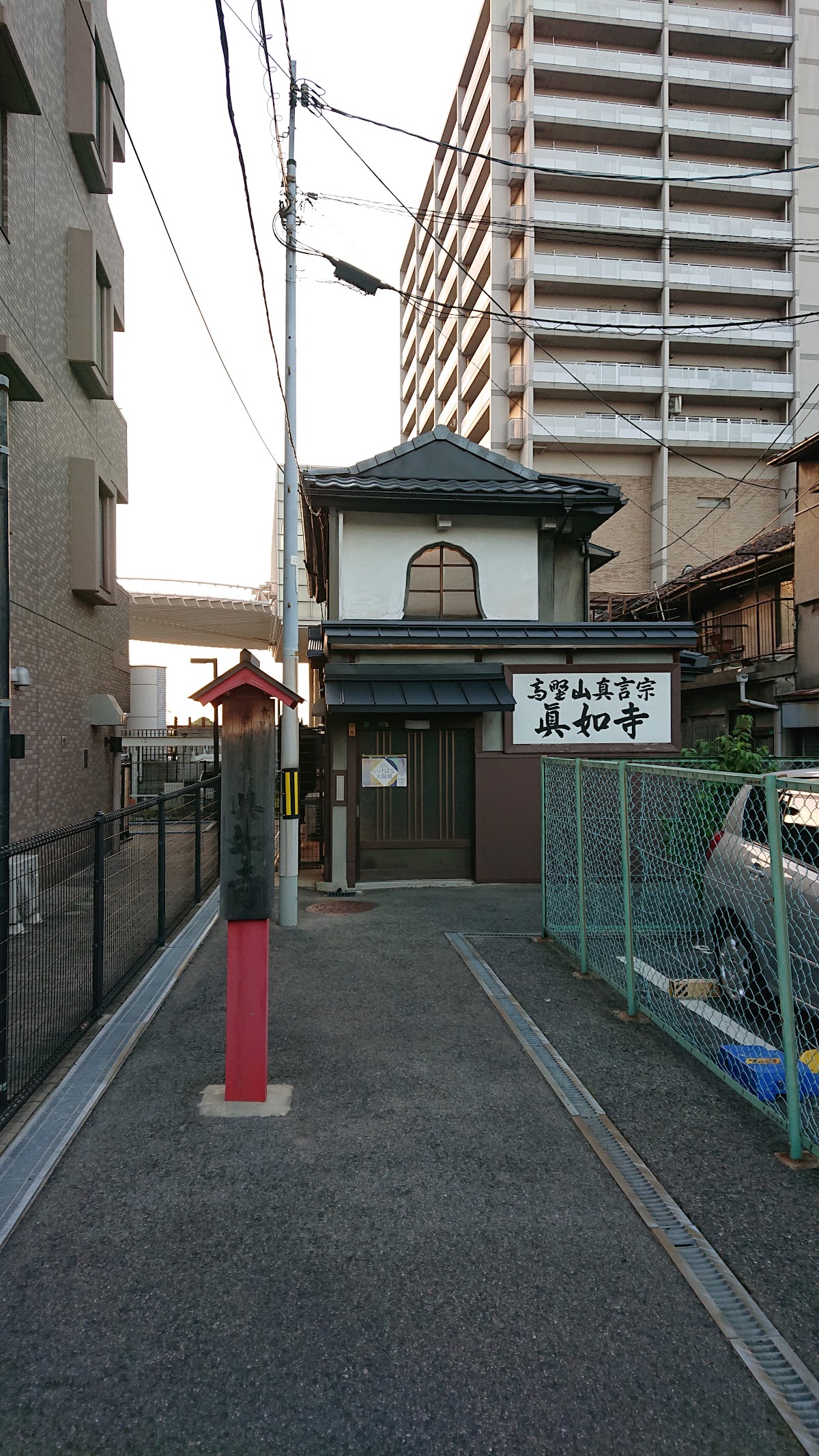
Despite being located in an urban area, Shinnyo-ji Temple exudes a tranquil atmosphere. Situated slightly off the main Abeno-suji street, visitors can experience a peaceful space away from the hustle and bustle of everyday life.
Main Hall
In the main hall of Shinnyo-ji Temple, various Buddhist statues are enshrined, centered around Dainichi Nyorai, the principal deity of the Koyasan Shingon sect. In Shingon Buddhism, Dainichi Nyorai is revered as the fundamental Buddha of the universe, and all Buddhas are considered to be manifestations of Dainichi Nyorai.
Regular Buddhist services are held in the main hall, attracting parishioners and local residents. The solemn chanting and Goma fire rituals, characteristic of Shingon Buddhism, evoke a profound spiritual experience in visitors.
Atmosphere of the Temple Grounds
Due to its location in an urban area, the temple grounds are compact, but the well-maintained landscaping and clean paths warmly welcome visitors. The changing appearance of the plants throughout the seasons is also a pleasure of visiting.
Access and Surrounding Information
Shinnyo-ji Temple is located in a particularly accessible area within Osaka City, making it easily reachable by public transportation.
Access by Train
From Abeno Station on the Osaka Metro Tanimachi Line
- Approximately 1 minute walk from Exit 6
- After exiting, walk approximately 80 meters south, and Shinnyo-ji Temple will be on your right.
- It is very close to the station, so even first-time visitors can arrive without getting lost.
From Abeno Station on the Hankai Tramway Uemachi Line
- Approximately 2 minutes walk
- The Hankai Tramway, affectionately known as the “Chinchin Train,” is a mode of transportation that allows you to experience the charm of Osaka.
- Walk a short distance south along Abeno-suji from the station to reach Shinnyo-ji Temple.
From Matsumushi Station on the Hankai Tramway Uemachi Line
- Approximately 5 minutes walk
- Access is also possible from Matsumushi Station, by walking north along Abeno-suji.
Access by Car
Shinnyo-ji Temple may not have its own parking lot, so if you are visiting by car, we recommend using a nearby coin parking lot. Abeno Ward is close to the center of Osaka City, and there are several paid parking lots in the surrounding area. ### Major Nearby Facilities
The area around Shinnyoji Temple is home to many of Osaka’s leading tourist attractions and commercial facilities:
- Abeno Harukas: Known as Japan’s tallest building, its observation deck offers panoramic views of Osaka city (approx. 10-minute walk)
- Tennoji Zoo: A zoo with over 100 years of history (approx. 15-minute walk)
- Shitennoji Temple: One of the oldest Buddhist temples in Japan, said to have been founded by Prince Shotoku (approx. 20-minute walk)
Other Temples and Shrines in Abeno Ward
Abeno Ward, where Shinnyoji Temple is located, also boasts numerous other historical temples and shrines. Visiting these in conjunction with Shinnyoji Temple will enhance your temple and shrine pilgrimage.
Abe no Seimei Shrine
This shrine stands on the site believed to be the birthplace of Abe no Seimei, a Heian period onmyoji (diviner). As a historical site associated with Seimei, it attracts visitors from all over Japan.
Abeno Shrine
This shrine is dedicated to Kitabatake Akiie, a military commander from the Nanboku-cho period, and is worshipped as the local guardian deity.
Abe Oji Shrine
Located along the Kumano Kodo pilgrimage route, this ancient shrine was once one of the “Oji Shrines” visited by pilgrims on their way to Kumano.
Kaishozan Shoenji Temple
One of the representative temples of Abeno Ward, known for its magnificent main hall and beautiful garden.
Saikoji Temple
As a temple deeply rooted in the community, it has attracted the faith of parishioners for many years.
By visiting these temples and shrines, you can experience the rich religious culture and history of Abeno Ward.
About Goshuin (Temple/Shrine Seals)
In recent years, collecting Goshuin has become a popular pastime during temple and shrine visits. While it may be possible to obtain a Goshuin at Shinnyo-ji Temple, it is recommended to check with the temple in advance for details.
What is a Goshuin?
A Goshuin is a seal and calligraphy given as proof of visiting a temple or shrine. Originally, it was a receipt stamp for offering handwritten sutras, but today it is widely cherished as a memento of a visit.
Etiquette When Receiving a Goshuin
When receiving a Goshuin, please observe the following etiquette:
- Pray First: Since a Goshuin is proof of worship, always pray at the main hall before receiving it.
- Prepare a Goshuincho (Goshuin notebook): It is standard practice to use a dedicated Goshuincho.
- Check Reception Hours: Reception hours vary depending on the temple.
- Prepare a Donation: Usually, around 300 to 500 yen is appropriate.
- Be Polite: Don’t forget to express your gratitude to the monks and temple staff.
If you wish to receive a Goshuin at Shinnyo-ji Temple, it is recommended to call ahead to ensure a smooth process.
Manners and Etiquette for Visiting a Temple
When visiting Shinnyo-ji Temple, observing basic temple etiquette will make your visit more meaningful.
Basic Etiquette for Visiting a Temple
- Bow at the Temple Gate: Before passing through the temple gate, which is the entrance to the temple, bow slightly.
- Purify at the Water Basin: If there is a water basin, purify your hands and mouth.
- Pray at the Main Hall: Pray quietly in front of the main hall.
- Offering a Coin: If there is an offering box, quietly place your offering in it.
- Bow Upon Exit: When leaving, bow at the temple gate before exiting.
Visiting a Shingon Buddhist Temple
At Shingon Buddhist temples, you may also chant the phrase “Namu Daishi Henjo Kongo.” This phrase expresses devotion to Kobo Daishi Kukai.
Furthermore, in Shingon Buddhism, it is common to chant the mantra of light, “Om Abiraunken Bazara Dato Ban.” This mantra is considered to be the mantra of Dainichi Nyorai (Vairocana Buddha), and it is believed that chanting it purifies worldly desires and brings merit.
Main Events Held at Shinnyo-ji Temple
Shinnyo-ji Temple holds annual Shingon Buddhist events and local traditional events. For specific dates and details, please contact the temple directly.
Main Annual Events of the Shingon Sect
- Shushōe: A Buddhist service to welcome the New Year (January)
- Setsubun-e: Events such as bean-throwing (February)
- Haru Higan-e: A memorial service for ancestors (March)
- Hana Matsuri: A memorial service celebrating the birth of Buddha (April 8th)
- Obon: An event to welcome the spirits of ancestors (August)
- Aki Higan-e: A memorial service for ancestors (September)
- Kōbō Daishi Mikage-ku: A memorial service for Kōbō Daishi (21st of every month)
These events are sometimes open not only to temple members but also to general visitors. Setsubun-e and Hana Matsuri, in particular, are popular events open to the community.
Shinnyo-ji Temple and the Local Community
Shinnyo-ji Temple plays a vital role in the local community of Abeno Ward, not merely as a religious institution.
Community Hub
Even in today’s increasingly urbanized world, temples function as gathering places for local residents. Through religious services and events, intergenerational interaction is fostered, strengthening community bonds.
Cultural Transmission
Shinnyo-ji Temple is also a place for passing on Buddhist culture and traditional events to future generations. Children can gain opportunities to experience traditional Japanese culture by participating in temple events.
A Place of Spiritual Respite
For people facing the stress and anxiety of modern society, temples offer a place of peace. By praying in the quiet temple grounds, one can escape the hustle and bustle of everyday life and have time to reflect on oneself.
The Charms and Tourist Information of Abeno Ward
Abeno Ward, where Shinnyo-ji Temple is located, is a fascinating area where history and modernity blend seamlessly.
Historical Background
Abeno Ward was historically a thriving area along the Kumano Kaido road. It’s also a place steeped in historical romance, with legends of Abe no Seimei still lingering there. Furthermore, it was the site of the “Battle of Abeno” during the Nanboku-cho period, making it a historically significant area.
Modern Abeno
Currently, Abeno Ward has developed as a commercial area centered around Abeno Harukas, while also remaining a popular residential area. Its convenient transportation links and easy access to various parts of Osaka make it a popular choice for residence.
Tourist Attractions
Nearby tourist attractions to visit when you come to Shinnyoji Temple:
- Abeno Harukas: The view from the “Harukas 300” observation deck, 300 meters above ground, is breathtaking.
- Tennoji Zoo: A historic zoo housing approximately 1,000 animals of about 180 species.
- Tennoji Park: A vast urban park, popular for its lawn area called “Tenshiba.”
- Tsutenkaku Tower: Osaka’s symbolic tower (located in the adjacent Shinsekai area).
- Shitennoji Temple: A renowned temple boasting one of the oldest temple architectures in Japan.
Gourmet Information
The Abeno Ward area is rich in Osaka’s unique gourmet spots. Many restaurants offer Osaka’s famous dishes such as takoyaki, okonomiyaki, and kushikatsu.
Planning Your Visit to Shinnyoji Temple
Here’s some practical advice for visiting Shinnyoji Temple.
Best Time to Visit
Shinnyo-ji Temple is open for worship throughout the year, but the best times to visit are:
- Spring (March-May): The weather is mild and suitable for worship. There are also events such as the Spring Equinox and the Flower Festival.
- Autumn (September-November): The weather is pleasant, and many worshippers visit during the Autumn Equinox.
- New Year’s Visit (January): You can pray for a safe year ahead by visiting in the new year.
Points to Note When Visiting
- Visiting Hours: Generally, temples are open for worship during the daytime. They may be closed after evening.
- Dress Code: There are no particularly strict dress code regulations, but please avoid revealing clothing and dress modestly.
- Photography: Photography is generally permitted on the temple grounds, but photography inside the main hall and of Buddha statues may be restricted. Always check before taking photos.
- Quietness: Please be quiet on the temple grounds and be considerate of other visitors.
Estimated Time Required
A visit to Shinnyo-ji Temple itself takes about 15-30 minutes. If you plan to receive a Goshuin (temple stamp) or stroll around the grounds at a leisurely pace, it’s best to allow about an hour.
If you plan to explore the Abeno area, including surrounding temples, shrines, and tourist spots, we recommend scheduling a half-day to full-day trip.
Inquiries Regarding Shinnyo-ji Temple
Specific inquiries to Shinnyo-ji Temple can be made using the following methods.
Telephone Inquiries
- Telephone Number: 06-6653-4996
- If you have any questions before visiting, such as visiting hours, event schedules, or the availability of Goshuin (temple stamps), we recommend calling in advance.
- When calling, the best time is from morning to evening.
Inquiries During Visits
You can also ask questions at the temple office or reception when you visit in person. Monks or temple staff may be able to assist you.
The Teachings of Koyasan Shingon Buddhism and Modern Society
The teachings of Koyasan Shingon Buddhism, to which Shinnyo-ji Temple belongs, offer many insights even in modern society.
The Philosophy of Instantaneous Buddhahood
“Instantaneous Buddhahood,” a core teaching of Shingon Buddhism, is the idea that one can become a Buddha in this very body. This is not a distant future ideal, but an extremely realistic and positive teaching that enlightenment can be attained in this very moment.
In today’s stressful society, focusing on the “here and now” and accepting oneself positively is a wisdom that resonates with modern psychotherapies such as mindfulness.
The Practice of the Three Secrets
The practice of harmonizing the three secrets of body, speech, and mind can be interpreted in a modern context as emphasizing the importance of aligning actions, words, and thoughts, and living honestly.
In today’s world, where words are often disregarded on social media, the teachings of Shingon Buddhism remind us of the power of words and the importance of using considerate language.
The Wisdom of Dainichi Nyorai
Dainichi Nyorai, the principal deity of Shingon Buddhism, is considered the Buddha who embodies the universe itself. The idea that all existence is a manifestation of Dainichi Nyorai offers a perspective that emphasizes harmony with nature and others.
In today’s world, where environmental problems and social divisions are becoming increasingly serious, the Shingon Esoteric Buddhist worldview that all things are fundamentally interconnected carries an important message.
Osaka’s Temple Culture and Shinnyo-ji Temple
Osaka Prefecture is home to numerous temples, each with its own unique history and culture. Shinnyo-ji Temple is one such temple, playing a vital role in Osaka’s Buddhist culture.
Shingon Buddhist Temples in Osaka
Osaka Prefecture has many temples of various Shingon Buddhist sects, including the Koyasan Shingon sect. This is related to the fact that Koyasan, founded by Kobo Daishi Kukai, is located in Wakayama Prefecture, and Osaka played an important role as a pilgrimage route to Koyasan.
The Role of Urban Temples
Temples in large cities like Osaka play a different role than those in rural areas. In cities where diverse people come and go, temples function as places where people from different backgrounds can gather.
Shinnyo-ji Temple, located in the urban area of Abeno, continues to play an important role as a spiritual center for local residents and as a successor to traditional culture.
Summary
Shinnyo-ji Temple is a Shingon Buddhist temple of the Koyasan sect located in the heart of Abeno Ward, Osaka City. Despite its location amidst the hustle and bustle of the city, it offers a tranquil space for prayer and is a beloved center of local devotion.
Its excellent accessibility, just a few minutes’ walk from Abeno Station on the Osaka Metro Tanimachi Line and Hankai Tramway Uemachi Line, makes it easily accessible. Combining a visit with nearby attractions such as Abeno Harukas and Tennoji Zoo enhances the overall Osaka sightseeing experience.
Through Shingon Buddhist ceremonies, rituals, and daily worship, Shinnnyo-ji Temple plays a vital role as a place of peace in modern society and as a center for passing on traditional Japanese culture to future generations.
When visiting Osaka, we highly recommend visiting Shinnnyo-ji Temple and spending some time in its serene urban setting. It will be a valuable experience to connect with Japanese Buddhist culture in Abeno, a region where history and modernity intersect.
We pray that your visit to Shinnyo-ji Temple will be a time of enrichment and fulfillment for everyone.