Eishoji Temple (Osaka Prefecture, Kita Ward) Complete Guide | History, Access, and Relationship with Kindergarten: A Thorough Explanation
Located in Nakatsu, Kita Ward, Osaka City, Eishoji Temple is a temple belonging to the Jodo Shinshu Honganji sect and has a history of growing alongside the local community in the post-war era. Despite its urban location, just a two-minute walk from Hankyu Nakatsu Station, its integrated operation with a kindergarten has given it a unique presence as a center of education and faith in the region.
This article comprehensively explains everything you want to know about Eishoji Temple, from its founding history to its current activities, access information, and how it differs from other Eishoji temples.
Basic Information about Eishoji Temple
Temple Overview
Official Name: Eishoji Temple
Mountain Name: Soaizan
Sect: Jodo Shinshu Honganji School
Principal Image: Amida Buddha
Address: 3-6-15 Nakatsu, Kita-ku, Osaka City, Osaka Prefecture 531-0071
Phone Number: 06-6371-3846
District Name: Osaka Kita-gumi
Temple Number: 162917
Eishoji Temple is a temple of the Jodo Shinshu Honganji School, belonging to the Shinshu religious organization with Nishi Honganji Temple in Kyoto as its head temple. It belongs to the Osaka Kita-gumi of the Osaka Diocese and functions as a center of Jodo Shinshu faith in the Nakatsu area of Kita-ku.
About the Jodo Shinshu Honganji School
The Jodo Shinshu Honganji School is one of the largest Buddhist sects of Jodo Shinshu Buddhism, founded by Shinran Shonin. It preaches the doctrine of salvation through the power of Amida Buddha’s vow, stating that everyone is equally saved by chanting “Namu Amida Butsu.”
Centered around its head temple, Nishi Honganji (Shimogyo-ku, Kyoto), it boasts over 10,000 temples nationwide and several million followers, making it one of the largest Buddhist sects in Japan. Eishoji Temple is also a member of this prestigious sect, actively engaged in missionary work in the local community.
History and Founding Background of Eishoji Temple
Post-War Founding
Eishoji Temple was founded in 1948 (Showa 23). This was just three years after the end of World War II, a time when Japan was still in the process of post-war reconstruction. During this period, while many temples were working to rebuild after war damage, Eishoji Temple was established in the Nakatsu area as a new temple.
Role as a Meeting Place During Wartime
Interestingly, although Eishoji Temple was officially founded in 1948, it is believed to have served as a meeting place for the Jodo Shinshu Honganji sect during World War II. Along with Kotokuji Temple, also located in the Nakatsu area, it provided a place of worship for local followers even during the difficult times of war.
In wartime Japan, religious activities were restricted, and such meeting places played a crucial role as spiritual pillars for local communities. The history of Eishoji Temple can truly be described as a history walked hand in hand with the local residents.
Connection to the Nakatsu Area
Nakatsu, Kita-ku, Osaka City, is located north of Umeda and has long been an area where residential and commercial areas coexist. From before the war to the postwar period, many Jodo Shinshu followers resided in this area, and Eishoji Temple was founded to meet the needs of this religious community.
Even today, Nakatsu is undergoing redevelopment while retaining its old-town atmosphere, and Eishoji Temple has consistently served as a spiritual center for the community amidst these changes.
Deep Relationship with Eishoji Kindergarten
Establishment of Eishoji Gakuen School Corporation
One of the major characteristics of Eishoji Temple is its integrated operation with a kindergarten. On April 1, 1941 (Showa 16), Eishoji Gakuen School Corporation was established, and Eishoji Kindergarten opened on the temple grounds.
This was also the year the Pacific War began, and the kindergarten opened amidst the strengthening of the wartime system. From before the war, through the war, and after the war, Eishoji Kindergarten has a history of continuously playing a vital role in early childhood education in the community.
The Unique Form of “A Temple Within a Kindergarten”
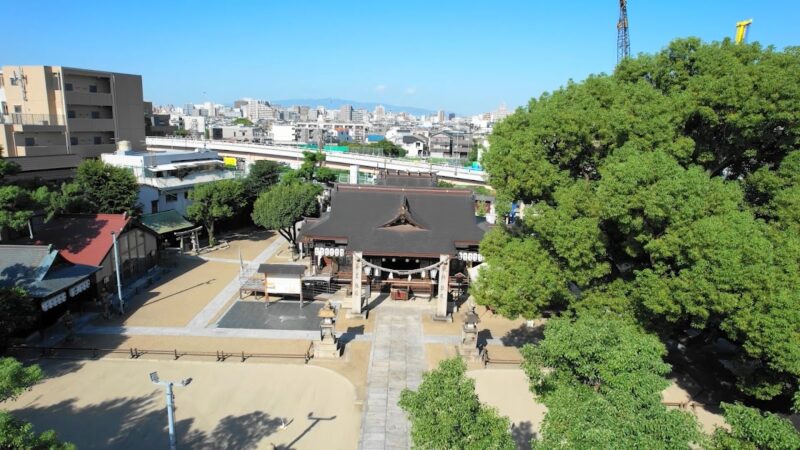
Visitors to Eishoji Temple are often surprised by its unique facility configuration. While it’s common for many temples to have a kindergarten attached to their grounds, in the case of Eishoji Temple, the kindergarten facilities occupy such a large proportion that it gives the impression of “a temple within a kindergarten.”
The temple gate is shared with the kindergarten, meaning visitors first pass through the kindergarten facilities to access the temple. This demonstrates that Eishoji Temple is not merely a religious institution, but a complex facility with a strong educational aspect.
Buddhist Education Practices
Eishoji Kindergarten practices Buddhist education based on the teachings of Jodo Shinshu Buddhism. Through daily life, children are nurtured to feel gratitude towards “Nono-sama (Amida Buddha),” and are taught the preciousness of life and compassion.
By integrating the kindergarten and temple, children can naturally encounter Buddhism and cultivate religious sentiment. Furthermore, for parents, dropping off and picking up their children creates opportunities to connect with the temple and deepen their understanding of Buddhism.
Access and Location
Access by Train
Nearest Station: Nakatsu Station (Hankyu Takarazuka Line/Kobe Line)
Travel Time: Approximately 2 minutes on foot
The greatest advantage of Eishoji Temple is its excellent accessibility. Located just a 2-minute walk from Hankyu Nakatsu Station, its convenient location is extremely appealing to visitors.
Nakatsu Station is the next station to Umeda Station, providing easy access from central Osaka. Both the Takarazuka Line and Kobe Line stop there, making it easily accessible from various locations along the Hankyu line.
Surrounding Environment
Nakatsu 3-chome, where Eishoji Temple is located, is a residential area slightly removed from the bustling Umeda district. The surrounding area retains a lively, old-town atmosphere with many shops and restaurants.
In recent years, the construction of high-rise condominiums has progressed, creating a mix of old and new residents, but Eishoji Temple continues to stand as a local landmark.
Parking
Eishoji Temple does not have its own parking lot. This is common for temples in urban areas, and due to its integrated operation with a kindergarten facility, securing parking space on the premises is difficult.
If you are visiting by car, you will need to use a nearby coin-operated parking lot. There are several coin-operated parking lots around Nakatsu Station, but they may be crowded during kindergarten drop-off and pick-up times, so using public transportation is recommended.
Activities and Dharma Gatherings at Eishoji Temple
Monthly Dharma Gatherings
Eishoji Temple holds a Buddhist gathering called a “Hōza” every month. A Hōza is a traditional Jodo Shinshu Buddhist gathering where participants listen to a sermon by a monk and discuss Buddhist teachings with each other.
At the Hōza, you can learn how to apply the teachings of Shinran Shonin and Buddhist wisdom to modern life. It provides an opportunity to consider everyday worries and life problems from a Buddhist perspective, and many parishioners and local residents participate.
For specific dates and times, please contact the temple directly (Tel: 06-6371-3846). First-time participants are welcome, and in many cases, no prior reservation is required, but it is recommended to check the details in advance.
Annual Events
As a temple of the Jodo Shinshu Honganji sect, Eishoji Temple holds various Buddhist events throughout the year.
- Spring and Autumn Equinox Services: Memorial services for ancestors
- Birth Day Celebration: A memorial service celebrating the birth of Shinran Shonin (around May 21st)
- Memorial Service: The most important memorial service commemorating the anniversary of Shinran Shonin’s death (late November)
- New Year’s Eve Service/New Year’s Day Service: Memorial services for the end of the year and the beginning of the new year
These events are often open to the general public as well as temple members, so those interested should inquire at the temple.
Community Interaction
Because Eishoji Temple has an attached kindergarten, it naturally has many points of contact with the local community. Through kindergarten events, families unfamiliar with Buddhism have the opportunity to become involved with the temple, and it plays a role as a core of the local community.
Differences from Other Eishoji Temples
There are several temples named “Eishoji” throughout Japan. Even within Osaka Prefecture alone, in addition to the Eishoji in Kita Ward, there are the following temples:
Eishoji (Ikuno Ward, Osaka City)
Eishoji in Ikuno Ward, Osaka City, is a temple of the Shinshu Otani sect (Higashi Honganji sect). While both are Jodo Shinshu temples, they belong to different sects, with their head temple being Higashi Honganji in Kyoto. This is in contrast to the Eishoji in Kita Ward, which belongs to the Honganji sect (Nishi Honganji sect).
Eishoji (Toyonaka City)
Eishoji, located at 2-10-10 Rikura, Toyonaka City, Osaka Prefecture, is also a temple of the Jodo Shinshu Honganji sect. Its mountain name is Kojozan, and the nearest station is Sone Station on the Hankyu Takarazuka Line.
Although they belong to the same sect and are geographically relatively close, each operates as an independent temple, and their founding histories and roles in the local community differ. ### Eishoji Temple (Higashi-Osaka City)
Eishoji Temple, located at 2-24-33 Eiwa, Higashi-Osaka City, is also a temple of the Jodo Shinshu Honganji sect. The head priest is Reverend Jinbe Teikazu.
Eishoji Temples Nationwide
Nationwide, there are said to be 26 temples with the name “Eishoji.” This is a relatively large number for a temple name, indicating that this name, meaning “eternal illumination,” is favored by many sects.
When visiting Eishoji Temple in Kita-ku, Osaka City, it is important to check the location and nearest station (Nakatsu Station) to avoid confusing it with other Eishoji Temples.
Points to Note and Manners When Visiting
Visiting Hours
Since Eishoji Temple is operated in conjunction with a kindergarten, consideration should be given to visiting hours. The temple is especially crowded during kindergarten drop-off and pick-up times (around 8:00 AM to 9:30 AM and 2:00 PM to 3:30 PM), so it’s best to avoid these times if you wish to pray in peace.
For general prayers and inquiries, weekdays during the daytime (around 9:00 AM to 4:30 PM) are appropriate. If you wish to participate in a Dharma service or event, it is recommended to check by phone in advance.
Jodo Shinshu Worship Etiquette
Jodo Shinshu has unique etiquette that differs from other Buddhist sects.
- Gassho: Bring both hands together in front of your chest.
- Nembutsu: Chant “Namu Amida Butsu.”
- Shoko: Do not press the incense to your forehead; place it directly into the incense burner (once or twice).
- Hairei: Bow deeply.
In Jodo Shinshu, clapping or banging your hands is not practiced. Also, please refrain from throwing offerings and instead quietly place them in the offering box.
Considerations in Shared Spaces with the Kindergarten
Since the gate and some spaces of Eishoji Temple are shared with the kindergarten, please be mindful of the following points:
- Avoid loud conversations and noise
- Be especially quiet during kindergarten activity hours
- Keep photography to a minimum and take care not to include children in the photos
- Use only designated areas for bicycle and car parking
The Appeal and Future Prospects of Eishoji Temple
A New Form of Temple in Urban Areas
Eishoji Temple presents a unique model of integrating religious and educational facilities within the limited space of an urban area. This can be considered a successful example of a modern urban temple.
In today’s society, where the birthrate is declining, the population is aging, and religious affiliation is decreasing, having contact with younger generations and families with children through the kindergarten is an important factor in enhancing the sustainability of the temple.
As a Core of the Local Community
Since its founding after the war, Eishoji Temple has walked hand in hand with the changes in the Nakatsu area. Throughout the rapid economic growth, the bubble economy and its collapse, and modern urban redevelopment, Eishoji Temple has consistently remained a spiritual pillar for the community.
Through monthly Dharma services, it continues to offer Buddhist wisdom and support to address the emotional concerns of modern people, a crucial role especially in today’s materially affluent society.
Passing on the Legacy to the Next Generation
The integrated operation with the kindergarten creates an ideal environment for naturally transmitting Buddhist teachings to the next generation. The experience of children regularly praying to “Nono-sama” (Buddhist deity) and cultivating a sense of gratitude will have a significant impact on their future character development.
Furthermore, for parents, it provides an opportunity to encounter Buddhism through their children, fostering a shared religious value system within the family.
Summary
Eishoji Temple, located in Nakatsu, Kita-ku, Osaka City, is a Jodo Shinshu Honganji-ha temple that has walked hand in hand with the community since its founding in 1948. With its mountain name, Soai-zan, and Amida Buddha as its principal deity, it continues to transmit the teachings of Jodo Shinshu Buddhism to the present day.
Its most distinctive feature is its integrated operation with Eishoji Kindergarten, established in 1941. This unique structure, sometimes described as “a temple within a kindergarten,” represents a new model for temples in urban areas.
Access is extremely convenient, just a two-minute walk from Hankyu Nakatsu Station, and various Buddhist events, including monthly Dharma services, are held there.
While there are 26 temples named “Eishoji” nationwide, including several in Osaka Prefecture, the Eishoji in Nakatsu, Kita Ward, has a unique history, having developed alongside the local community after the war.
In today’s increasingly urbanized world, Eishoji successfully balances its roles as both a religious institution and an educational institution, continuing to function as a spiritual anchor for the local community. It is a temple worth visiting for those interested in the teachings of Jodo Shinshu Buddhism, those who want to learn about local history, and those seeking peace of mind.
Those wishing to visit or participate in Dharma services should contact the temple (06-6371-3846) in advance for a more fulfilling experience. Taking advantage of its location just two minutes from Hankyu Nakatsu Station, it’s easy to stop by while running errands in Umeda.
Eishoji Temple continues to operate today as a living place of faith, practicing traditional Buddhist teachings within modern urban life and passing them on to future generations.