Complete Guide to Tomyoji Temple (Kamigyo Ward, Kyoto Prefecture) | The Charm and Visiting Information of a Historic Nichiren Buddhist Temple
Located on Rokkenmachi Street, north of Imadegawa, in Kamigyo Ward, Kyoto City, Tomyoji Temple is a historic temple belonging to the Nichiren sect. It holds a significant position in Kyoto’s Buddhist history due to its deep connection with Emperor Go-Yōzei and as the temple that enshrines the “Shichikuchi no Tō,” an important Nichiren Buddhist relic. This article provides a detailed explanation of Tomyoji Temple’s history, highlights, visiting information, and access methods—all the information you need to know before visiting.
Basic Information about Tomyoji Temple
Tomyoji Temple is a Nichiren Buddhist temple located at 119-1 Satake-cho, Kamigyo Ward, Kyoto City, Kyoto Prefecture. Its official mountain name is Myōhōzan, and its principal image is the Jikkai Daimandala.
Location and Contact Information
- Address: 119-1 Satake-cho, Rokken-cho-dori, Imadegawa-agaru, Kamigyo-ku, Kyoto City, Kyoto Prefecture 602-8314
- Phone Number: 075-463-2083
- Sect: Nichiren Buddhism
- Mountain Name: Myohozan
- Principal Image: Ten Realms Great Mandala
Temple Rank and Current Chief Priest
Tomyoji Temple is known as a former branch temple of Ritsuhonji Temple, and currently the chief priest is the 51st Chief Priest, Nagaoka Jundo. On May 21, 2023, a ceremony was held to pass on the Dharma lineage from the 50th Chief Priest, Nagaoka Jun’ei, to the 51st Chief Priest, Nagaoka Jundo, ushering in a new era. This Dharma lineage succession ceremony is recorded in the records of the Kyoto Prefecture First District Buddhist Affairs Office, and the temple continues to play an important role as a local Nichiren Buddhist temple.
History and Origins of Tomyoji Temple
Founding History
Tomyoji Temple was founded in 1558 (Eiroku 1). Its founder was Nichikei Shonin, and it has a significant historical background: it was built to enshrine the “Seven Entrances Pagoda,” erected by Nichizo Shonin, a senior disciple of Nichiren Shonin, the founder of the Nichiren sect.
Nichizo Shonin was a high-ranking priest of the Nichiren sect who was active from the Kamakura period to the Nanboku-cho period, and is known as a pioneer in the propagation of Nichiren Buddhism in Kyoto. He is said to have erected pagodas at the seven entrances (seven gates) of Kyoto to spread the teachings of the Lotus Sutra, and the fact that Tomyoji Temple was founded to protect and preserve these pagodas indicates that this temple is not merely a local temple, but has played an important role in the history of the Nichiren sect.
Emperor Go-Yozei and the Origin of the Temple Name
The temple name Tomyoji originated from its deep connection with Emperor Go-Yozei. Emperor Go-Yōzei was the 107th Emperor of Japan, reigning from the Azuchi-Momoyama period to the early Edo period. He is known as a monarch who was also enthusiastic about cultural activities.
According to tradition, Emperor Go-Yōzei ordered the offering of 100 lamps at this temple each day, which led to the temple’s current name, “Tōmyōji” (燈明寺). “Tōmyō” refers to lamps offered before Buddha, and the act of offering 100 lamps symbolizes light in Buddhism and represents the Emperor’s deep faith, making it a fitting name for the temple.
The origin of this temple name indicates that Tōmyōji was not merely a place of worship for the common people, but a prestigious temple with ties to the Imperial family.
Relationship with Ryūhonji Temple
Tōmyōji Temple, as a former branch temple of Ryūhonji Temple, has held an important position within the Kyoto Nichiren Buddhist temple network. Ryūhonji Temple is a head temple (historical temple) of the Nichiren sect located in Kamigyo-ku, Kyoto City, and is a powerful temple with many branch temples.
The branch temple system was established within the temple-parishioner system of the Edo period. The relationship between the head temple and branch temples was not merely a hierarchical one, but encompassed a wide range of religious and social functions, including the transmission of doctrine, the education of monks, and the performance of religious ceremonies. The fact that Tomyoji Temple was a branch temple of Ritsuhonji Temple indicates that this temple held a firm position within the Nichiren Buddhist community in Kyoto.
Highlights and Cultural Assets of Tomyoji Temple
Historical Significance of the Seven Entrances Pagoda
The “Seven Entrances Pagoda” enshrined at Tomyoji Temple is an extremely important historical site in the history of Nichiren Buddhism’s missionary work in Kyoto. These pagodas, said to have been erected by Nichizo Shonin at the seven entrances to Kyoto, were symbolic representations of spreading the teachings of the Lotus Sutra throughout Kyoto.
The seven entrances refer to the main roads leading into and out of Kyoto, including Toba-guchi, Fushimi-guchi, Toji-guchi, Awata-guchi, Ohara-guchi, Nagasaka-guchi, and Tanba-guchi. The construction of pagodas at these key locations reveals the missionary strategy of Nichizo Shonin, who sought to spread the teachings of the Lotus Sutra to all visitors of Kyoto.
Although many of these pagodas have now been lost, the one enshrined at Tomyo-ji Temple is a valuable cultural heritage that conveys this history, attracting attention not only from Nichiren Buddhist followers but also from Kyoto history researchers.
Principal Image: The Ten Realms Mandala
The principal image of Tomyo-ji Temple is the Ten Realms Mandala. A mandala is a visual representation of the Buddhist worldview and the state of enlightenment, and the “Ten Realms Mandala” is particularly important in the Nichiren sect.
The Ten Realms refer to the ten stages of existence in Buddhism: Hell, Hungry Ghosts, Animals, Asuras, Humans, Heavenly Beings, Shravakas, Pratyekabuddhas, Bodhisattvas, and Buddhas. The Nichiren sect’s mandala has a unique form, with the title “Namu Myoho Renge Kyo” at the center, surrounded by characters representing various Buddhas, Bodhisattvas, and deities.
The Ten Realms Great Mandala at Tomyoji Temple is the central object of faith for believers, serving as the focus of daily services and ceremonies. Chanting sutras and recitations in front of the mandala is the core of Nichiren sect faith practice, and visitors can feel the solemn atmosphere in the main hall.
Atmosphere and Architecture of the Temple Grounds
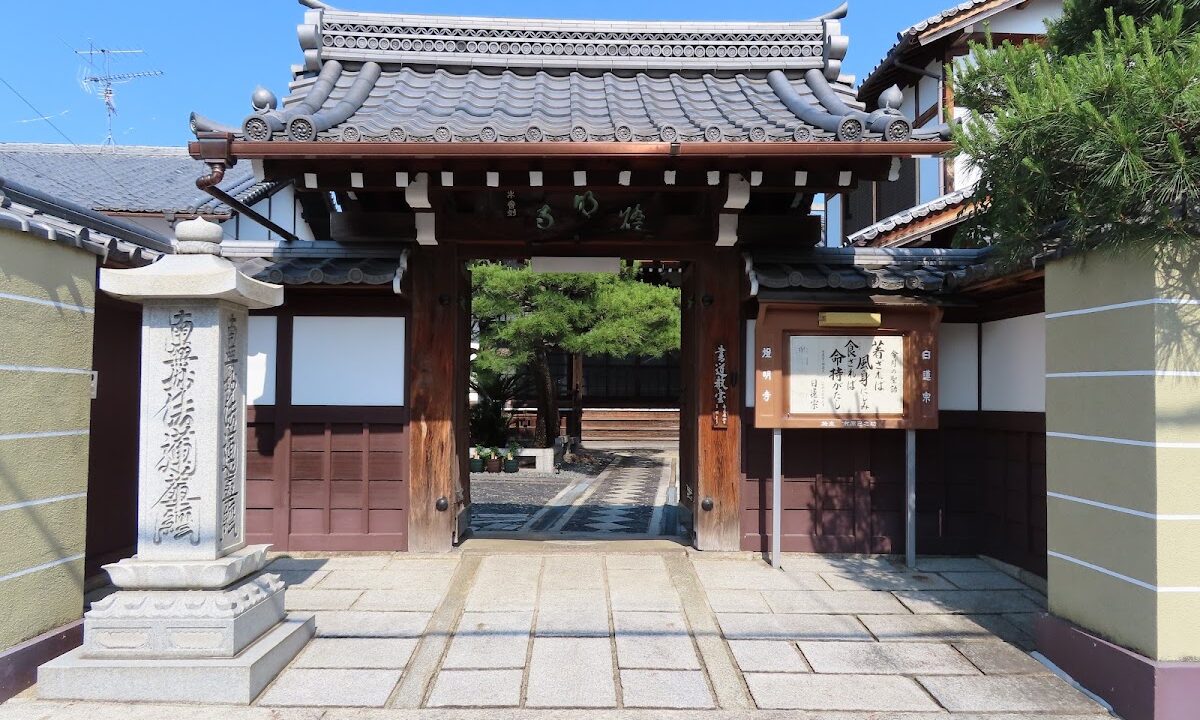
Tomyoji Temple is located in a residential area of Kamigyo Ward, Kyoto City, and is a quiet and peaceful temple. While the grounds are not vast, the well-maintained garden and main hall convey a sense of a temple deeply rooted in the community.
The main hall is built in the traditional Japanese architectural style, and the principal image, the Ten Realms Great Mandala, is enshrined inside. Furthermore, you can see Buddhist implements unique to Nichiren Buddhist temples, such as drums and wooden fish drums, and during memorial services, the powerful chanting and drumming resonate throughout the temple grounds.
The temple grounds also include a cemetery, which is still carefully preserved as the resting place for generations of local parishioners.
Access and Surrounding Information
Access by Public Transportation
The following methods are convenient for accessing Tomyoji Temple using public transportation.
If using the Keifuku Electric Railway (Randen) Kitano Line
- Nearest station: Kitano-Hakubaicho Station
- Approximately 13 minutes on foot from the station
- Kitano-Hakubaicho Station is the terminal station of the Randen line and is accessible from Shijo-Omiya Station and the Arashiyama area.
If using city buses
- City bus routes running along Imadegawa-dori and Senbon-dori are available.
- Within walking distance from bus stops such as “Imadegawa-Omiya” and “Senbon-Imadegawa”.
- From Kyoto Station, city bus routes 50 and 101 are convenient.
Access by Car
If visiting by car, the route from Imadegawa-dori or Senbon-dori to Rokkenmachi-dori is the easiest to follow. However, the roads in Kamigyo-ku, Kyoto City are narrow and there are many one-way streets, so it is recommended to check the route in advance using a map app.
Regarding parking, it is recommended to inquire directly with the temple. There are several coin-operated parking lots in the vicinity, but they can be full during tourist season, so using public transportation is the safest option.
Nearby Tourist Attractions
Numerous of Kyoto’s most famous tourist spots are located around Tomyoji Temple.
Kitano Tenmangu Shrine (approx. 15-minute walk)
The head shrine of all Tenmangu shrines nationwide, dedicated to Sugawara no Michizane, the god of learning. It is also famous for its plum blossoms, and is bustling with many visitors on the 25th of each month.
Kinkaku-ji Temple (Rokuon-ji Temple) (approx. 10-minute bus ride)
A representative Kyoto temple registered as a World Heritage Site. The reliquary hall, covered in gold leaf, attracts many tourists from both Japan and abroad.
Ryuhon-ji Temple (within walking distance)
Ryuhon-ji Temple, the head temple of Tomyoji Temple, is also located in Kamigyo Ward. The temple grounds contain a Buddha hall designated as an Important Cultural Property, allowing visitors to experience the history of the Nichiren sect.
Seimei Shrine (approx. 20-minute walk)
A shrine dedicated to Abe no Seimei, the Onmyoji (diviner). It has recently gained popularity as a power spot.
Visiting Information and Etiquette
Visiting Hours and Viewing Times
Tōmyōji Temple is primarily a temple for temple parishioners and is not a tourist temple that is always open to the public. If you wish to visit, it is recommended that you contact the temple by phone in advance to confirm visiting hours.
Generally, temple visiting hours are from 9:00 AM to around 5:00 PM, but visits may be closed during religious services or events. Especially during religious service periods, priority is given to parishioners, so consideration is necessary.
Admission Fee/Donation
Tōmyōji Temple is not a tourist temple, so there is generally no admission fee. However, it is customary to offer a donation or offering when visiting. There is no set amount, but many people offer around 100 to 500 yen as a token of their appreciation.
Visiting Etiquette
This section introduces basic etiquette for visiting Nichiren Buddhist temples.
Etiquette at the Temple Gate
- Bow before passing through the temple gate.
- Remove your hat and adjust your attire.
- Be careful not to step on the threshold of the temple gate.
Worship at the Main Hall
- Join your hands in prayer and bow before the main hall.
- In Nichiren Buddhism, chant “Namu Myoho Renge Kyo.”
- Quietly join your hands and pray with all your heart.
Notes on the Temple Grounds
- Do not speak loudly or run around.
- Take photographs only in designated areas.
- Do not enter the cemetery unless you are a temple parishioner.
- Take your trash with you.
Participation in Memorial Services and Events
Tōmyōji Temple holds various memorial services and events throughout the year. Some events are open to the general public (non-parishioners), so if you are interested, it is a good idea to inquire in advance.
The main annual events of Nichiren Buddhism include the following:
- Rikkyo Kaishū-e (April 28th): A memorial service commemorating the day Nichiren Shonin founded the Nichiren sect.
- Oeshiki (around October 13th): An important memorial service commemorating the anniversary of Nichiren Shonin’s death.
- Obon Hōyō (mid-August): A memorial service for ancestors.
These events are important memorial services for Nichiren sect temples, and many parishioners gather. While general participation may be possible in some cases, please be sure to check in advance.
About Nichiren Buddhism
Teachings and Characteristics of Nichiren Buddhism
The Nichiren sect, to which Tōmyōji Temple belongs, is a Buddhist sect founded by Nichiren (1222-1282), a monk of the Kamakura period. It considers the Lotus Sutra as its fundamental scripture and the chanting of “Namu Myōhō Renge Kyō” as its most important practice.
The core of Nichiren Buddhism is that the Lotus Sutra is the true teaching of Shakyamuni Buddha, and that by believing in this scripture and chanting its title, anyone can attain Buddhahood in this world. This clear and powerful teaching was widely accepted by samurai and commoners during the Kamakura period, and continues to have many followers to this day.
History of Nichiren Buddhism in Kyoto
Nichiren Buddhism truly spread in Kyoto thanks to the activities of Nichizo Shonin, a leading disciple of Nichiren. Nichizo Shonin began preaching in Kyoto in 1294, initially facing severe persecution. However, through persistent missionary work, he gradually increased his followers.
In particular, the faith of Nichiren Buddhism spread among townspeople (merchants and artisans), and many Nichiren temples were built in Kyoto. Even today, numerous Nichiren temples exist in Kyoto City, especially in Kamigyo and Nakagyo wards, and are deeply connected to the local community.
Tomyoji Temple has played an important role in the history of Kyoto’s Nichiren sect, as a temple that protects the relics of Nichizo Shonin.
Tomyoji Temple and Cemetery/Burial Site Information
About Tomyoji Temple’s Cemetery
Tomyoji Temple has a cemetery on its grounds, where the graves of its parishioners have been maintained for generations. Generally, using a temple cemetery requires becoming a parishioner of that temple.
If you wish to use a cemetery at Tomyoji Temple, you must first consult with the temple about becoming a parishioner. Becoming a parishioner entails obligations such as paying annual maintenance fees (offerings) and participating in temple events, but in return, you will receive attentive memorial services.
Flow of Cemetery Use
- Inquiry to the Temple: First, call to check the availability and conditions of the cemetery plot.
- Consultation on Becoming a Temple Member: Meet with the head priest to discuss becoming a temple member.
- Cemetery Use Contract: Once you agree to the conditions, sign a contract for the use of the cemetery plot.
- Tombstone Construction: Consult with a stonemason and construct the tombstone.
- Eye-Opening Ceremony: After the tombstone is completed, an eye-opening ceremony (soul-transferring ceremony) is held.
Costs
The following costs are required to use a temple cemetery.
- Perpetual Use Fee: Fee for the right to use the cemetery plot
- Gravestone Cost: Cost of the gravestone itself and construction
- Temple Membership Fee: Fee paid when becoming a temple member
- Annual Maintenance Fee: Fee paid annually for the maintenance and management of the temple
- Offering for Memorial Services: Fee paid at funerals and memorial services
Specific amounts vary greatly depending on the temple and region, so please be sure to check in advance. Even in the case of Tomyoji Temple, we recommend contacting them directly to confirm the details.
Information on Nearby Cemeteries and Burial Grounds
There are various other cemeteries and burial grounds around Tomyoji Temple. If you would like to consider options other than temple cemeteries, the following facilities are also possible choices.
Public Cemeteries
- Kyoto City-run cemeteries are relatively inexpensive and open to people of all religions and denominations.
- However, there are conditions such as being a Kyoto City resident.
- They are very popular and often require a lottery.
Private Cemeteries
- Open to anyone, regardless of religion or denomination.
- Often have excellent facilities and services.
- Tend to be more expensive than public cemeteries.
Columbariums
- Facilities for storing cremated remains indoors.
- Eliminates the need for a tombstone, thus reducing costs.
- Easy to manage and unaffected by weather.
When choosing a cemetery or burial ground, it is important to consider various factors comprehensively, including location, cost, facilities, and religious requirements.
Frequently Asked Questions
Can I visit Tomyoji Temple?
Tomyoji Temple is a temple for parishioners and is not a tourist temple that is always open to the public. If you wish to visit, it is recommended that you contact the temple by phone (075-463-2083) in advance to confirm whether visits are possible. On days when there are memorial services or events, it may not be possible to visit the temple.
Is there parking available?
Please contact the temple directly regarding parking availability and usage conditions. There are coin-operated parking lots nearby, but due to the narrow roads and many one-way streets, we recommend using public transportation.
Can I get a Goshuin (temple stamp)?
Please check directly with the temple regarding the issuance of Goshuin. Nichiren Buddhist temples generally issue Goshudai (stamps inscribed with “Namu Myoho Renge Kyo”). Bring your Goshuincho (stamp book) when you visit and ask the head priest or the temple office.
Can I request a memorial service even if I’m not a parishioner?
Memorial services such as funerals and Buddhist ceremonies are generally services intended for parishioners. If you are not a parishioner and wish to request a memorial service, please consult with the temple first. Depending on the circumstances, they may be able to accommodate you.
Can I see any relics related to Emperor Go-Yōzei?
While there is a legend that Emperor Go-Yōzei ordered a hundred-lantern offering, please contact the temple directly regarding the public display of specific artifacts and cultural properties. Some treasures may not be open to the public.
Summary
Tōmyōji Temple is a historic Nichiren Buddhist temple located in Kamigyo-ku, Kyoto City. Since its founding in 1558, it has enshrined the Seven-Stone Pagoda of Nichizō Shōnin and bears a temple name associated with Emperor Go-Yōzei, playing an important role in the history of Buddhism in Kyoto.
As a former branch temple of Ryūhonji Temple, Tōmyōji Temple has been a center of local faith and continues to support the faith of its parishioners under the 51st head priest, Nagaoka Jundō. The temple grounds house the principal image, the Ten Realms Great Mandala, allowing visitors to worship in a quiet and solemn atmosphere.
Access is approximately a 13-minute walk from Kitano-Hakubaichō Station on the Keifuku Electric Railway Kitano Line, or within walking distance from bus stops around Imadegawa-dori using the city bus. The surrounding area boasts many of Kyoto’s most famous tourist attractions, such as Kitano Tenmangu Shrine and Kinkaku-ji Temple, making it a convenient stop during your Kyoto sightseeing.
If you wish to visit, it is recommended to contact the temple by phone in advance to confirm the visiting hours. Also, if you are considering using the cemetery plots, you will need to consult with the temple regarding becoming a parishioner.
Tomyoji Temple, where the teachings of Nichiren Buddhism and the history of Kyoto breathe life into, offers a precious moment of quiet prayer in its tranquil grounds, allowing you to forget the hustle and bustle of modern life. When you visit Kyoto, be sure to pay your respects.