Oishi Shrine (Hirosaki City, Aomori Prefecture) Complete Guide: A Mysterious World Woven from a Sacred Site of Iwaki Mountain Worship and Jomon Period Ruins
About Oishi Shrine
Oishi Shrine is a shrine located in Omori Katsuyama, Hirosaki City, Aomori Prefecture, situated in a special location at the northeastern foot of the sacred Mount Iwaki. As a central shrine in the Iwaki Mountain worship tradition, it has long been revered by the local people.
Although surrounded by national forest, it possesses a unique geographical characteristic, being an exclave of Hirosaki City, serving as the tutelary shrine for both Omori and Kaizawa villages. While it appears to be in the former Iwaki Town on a map, it actually lies on an interesting border within Hirosaki City.
The shrine grounds spread across a tongue-shaped plateau between the Oishi River and the Omori River, and downstream lies the Omori Katsuyama Ruins, a nationally designated historical site. Its proximity to this site, which boasts a circular stone arrangement from the late Jomon period, indicates that this area has been a sacred place since ancient times.
History and Origins of Oishi Shrine
Founding History
Oishi Shrine was founded in 1612 (Keicho 17), when Tsugaru Nobumaki, the second lord of the Hirosaki Domain, invited the deity Oishi Myojin. The shrine enshrines an eleven-faced Kannon as its principal deity, preserving the syncretic Shinto-Buddhist belief system of the time.
Relationship with Iwaki-san Faith
Oishi Shrine is a shrine established through the Iwaki-san faith. It has played an important role as the lower shrine (satomiya) to the inner shrine at the summit of Mt. Iwaki. According to tradition, in ancient times, during the reign of Emperor Kanmu, the lower shrine was founded in the Tokoshinai area at the northern foot of the mountain by Sakanoue no Tamuramaro during the Enryaku era.
A large rock located in Akakurasawa, the entrance to the Iwaki-san climbing trail, also became an object of worship, and this Oishi faith forms the foundation of Oishi Shrine. Its location near the Iwaki-san climbing entrance indicates its importance as a base for ascetic monks and pilgrims.
Historical Changes
Throughout the Edo period, Oishi Shrine functioned as an important center of Iwaki-san worship in the Tsugaru region. Although the Eleven-Faced Kannon was separated due to the Meiji-era separation of Shinto and Buddhism, the worship of the shrine continued, and it became deeply rooted in the community as a village shrine.
Deities and Sacred Object
Deities
The deities enshrined at Oishi Shrine are Takamimusubi-no-kami and Kamimusubi-no-kami. These two deities are part of the three creation gods involved in the creation of heaven and earth, and are revered as gods who govern the power of creation and connection.
The Large Stone as the Sacred Object
The most distinctive feature of Oishi Shrine is, as its name suggests, the fact that it enshrines a massive stone as its sacred object. This large stone is believed to embody the spiritual power of Iwaki-san and has been an object of worship since ancient times. Megalithic worship is one of the primitive beliefs of the Japanese archipelago that has continued since the Jomon period, and it shows a continuity with the circular stone arrangement at the Omori Katsuyama ruins.
The sacred object enshrined behind the main hall truly symbolizes the boundary between this world and another, representing the entrance to the divine world of Tsugaru.
Highlights of the Shrine Grounds
Approach and Torii Gate
From Prefectural Road 30 (Yayoi Line), head towards Oishi Farm. As you ascend the paved, almost straight road towards Mt. Iwaki, you will see the first torii gate. Surrounded by a deep forest, you will truly feel that this is the entrance to a sacred area.
The second torii gate is adorned with a dragon carving, and its powerful form overwhelms visitors. The dragon is deeply connected to the worship of Mt. Iwaki as a god of water and mountains, and this decoration speaks to the depth of the faith.
Worship Hall and Main Hall
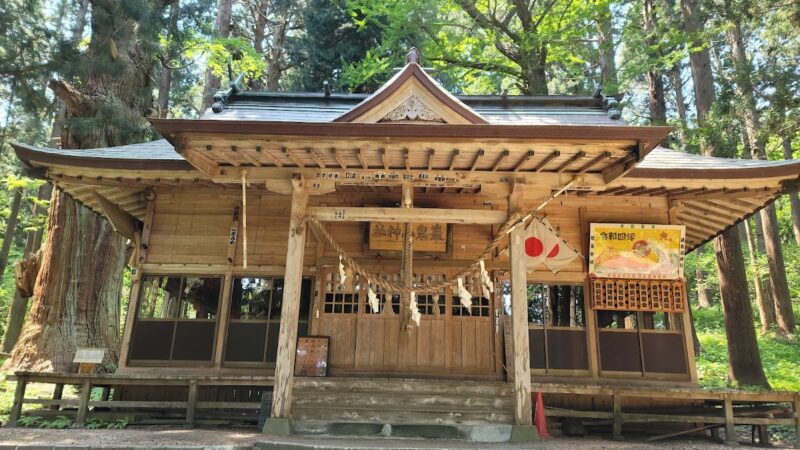
Upon entering the shrine grounds, the worship hall is built on the right. Despite its simple wooden construction, it possesses characteristics of traditional shrine architecture in the Tsugaru region. Behind the worship hall sits the main sanctuary, with the sacred stone, the object of worship, behind it.
Although the main sanctuary is relatively small, it is meticulously maintained, reflecting the deep faith of the local people.
Spring Water
Oishi Shrine has a pure spring water sourced from Mount Iwaki. Located near the Oishi River, it boasts an abundant supply of water, which has been revered as sacred water since ancient times. This spring water is a precious place where worshippers can directly feel the blessings of Mount Iwaki.
Faith and Benefits
Faith for Conception and Safe Childbirth
Oishi Shrine is particularly known as a shrine with miraculous powers for conception and safe childbirth. It is believed that the belief in life force and generative power, linked to the worship of megaliths, became associated with prayers for fertility and safe childbirth.
It is said that many women visited the shrine at that time to pray for conception and safe childbirth. Even today, this belief is passed down in the region.
Center of Iwaki-san Faith
Oishi Shrine is an important base for climbing Mount Iwaki. Further uphill is Akakura Shrine, which marks the main trailhead for Mount Iwaki. It is believed that ascetics and pilgrims prayed for safety at Oishi Shrine before entering the mountain.
Nearby Attractions
Omori Katsuyama Site
Located downstream from Oishi Shrine, the Omori Katsuyama Site is a nationally designated historic site featuring a large-scale circular stone arrangement from the late Jomon period (approximately 3000 years ago). In 2021, it was registered as a World Cultural Heritage site as part of the “Jomon Archaeological Sites of Hokkaido and Northern Tohoku.”
The circular stone arrangement (stone circle) is an important structure that conveys the spiritual world and rituals of the Jomon people, and is extremely interesting in considering its continuity with the megalithic worship of Oishi Shrine. It can be said to be valuable evidence that this area was a sacred place from ancient times.
Akakura Shrine
Continuing uphill from Oishi Shrine towards Mount Iwaki, you will reach Akakura Shrine. Located at the entrance to the Mount Iwaki climbing trail, Akakura Shrine is more directly connected to the Mount Iwaki faith. Visiting both Oishi Shrine and Akakura Shrine allows you to understand the overall picture of the Mount Iwaki faith.
Iwakiyama Shrine (Hyakusawa)
Located in the Hyakusawa area at the southern foot of Mount Iwaki, Iwakiyama Shrine is known as the head shrine of the Mount Iwaki faith. While Oishi Shrine is the base at the northeastern foot, Iwakiyama Shrine is the central presence at the southern foot. Visiting both shrines allows you to experience the vastness of the faith surrounding Mount Iwaki.
Access Information
Location
289 Omori Katsuyama, Hirosaki City, Aomori Prefecture 036-1203
Access by Car
- Approximately 20km northwest from central Hirosaki City on Prefectural Road 30 (Iwaki-san Ring Road)
- Continue past Oishi Farm and ascend towards Mt. Iwaki
- Parking available (near the temple grounds)
Public Transportation
Bus services are limited, so access by car is recommended. By taxi, it takes approximately 40 minutes from Hirosaki Station.
Points to Note When Visiting
- The surrounding area is a national forest, and heavy snowfall occurs in winter, so visiting from spring to autumn is recommended.
- As it is in a mountainous area, be aware of changes in weather.
- There are areas where cell phone signals are weak.
The Charm of Oishi Shrine
Mysterious Atmosphere
Located at the northeastern foot of Mt. Iwaki, surrounded by a deep forest, and with its unique form of worship that uses megaliths as sacred objects, Oishi Shrine is filled with a mystical atmosphere unlike any other shrine. Sometimes described as a “boundary to another world,” it offers visitors a special experience.
Sacred Site Continuing from the Jomon Period
The continuity between the circular stone arrangement at the Omori Katsuyama ruins and the megalithic worship at Oishi Shrine suggests that this area has been a sacred site since the Jomon period. The historical layering of a place where people have offered prayers for over 3000 years is a major attraction of Oishi Shrine.
Experiencing Tsugaru’s Faith and Culture
Oishi Shrine, where Tsugaru’s unique Kami-sama faith, Iwaki-san faith, and megalithic worship are fused, is an indispensable presence for understanding Tsugaru’s spiritual culture. You can still feel the form of faith that the local people have carefully preserved.
Points for Visiting
Visiting in Silence
Oishi Shrine is a quiet shrine, not commercialized for tourism. We recommend visiting slowly in the deep forest, where only the sounds of birdsong and wind can be heard.
Respect for the Sacred Object
At Oishi Shrine, where a megalith is the sacred object, it is important to show respect to the large stone behind the main hall. Avoid touching it directly and offer your prayers from an appropriate distance.
Seasonal Expressions
Oishi Shrine displays different expressions in each of the four seasons: the fresh green of spring, the deep green of summer, the autumn leaves, and the snow-covered winter (winter visits are difficult). Especially during the autumn foliage season, the scenery is beautiful, especially when combined with the vibrant colors of Mount Iwaki.
Summary
Oishi Shrine, located at the northeastern foot of Mount Iwaki in Hirosaki City, Aomori Prefecture, is a shrine steeped in history and mystery. With a history of over 400 years since its enshrinement in 1612, it possesses many attractions, including its unique form of worship with a massive rock as its sacred object, its role as a center of Mount Iwaki worship, and its proximity to Jomon period ruins.
Its miraculous powers for fertility and safe childbirth, its mystical nature as a gateway to the divine world of Tsugaru, and its tranquil atmosphere surrounded by deep forests offer visitors a special experience. When visiting Mount Iwaki, be sure to also visit Oishi Shrine and feel the power of this ancient sacred site.
Visiting nearby historical sites and shrines such as the Omori Katsuyama Ruins, Akakura Shrine, and Iwakiyama Shrine in conjunction with Oishi Shrine will deepen your understanding of Mount Iwaki worship and the spiritual culture of Tsugaru.