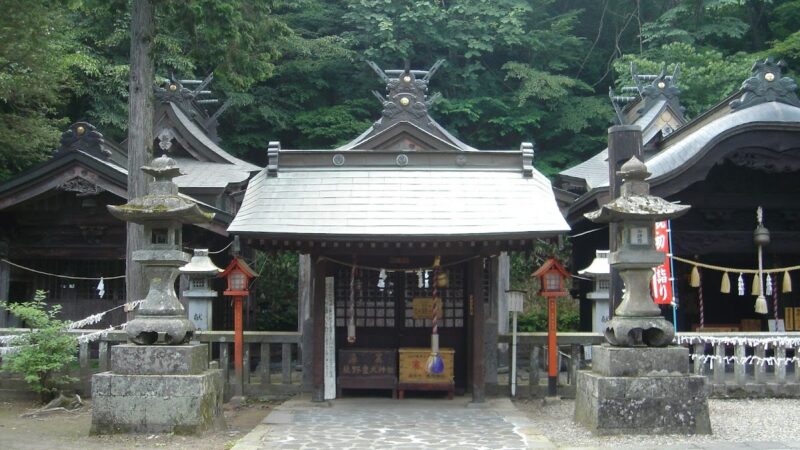
Nakanotake Shrine (Gunma Prefecture) Complete Guide | Japan’s Largest Daikokuten and a Sacred Site of Giant Rock Worship
Nakanotake Shrine, located in Kamikosaka, Shimonita-machi, Kanra-gun, Gunma Prefecture, is an ancient shrine situated at the southern foot of Mt. Myogi. Known as a shrine of giant rock worship, it enshrines a massive rock formation called Todoroki-iwa as its sacred object. Within the shrine grounds stands a 20-meter-tall, golden statue of Daikokuten, the largest in Japan. It is one of Gunma Prefecture’s leading power spots, attracting worshippers seeking business prosperity, family safety, matchmaking, and even baseball prowess.
Overview of Nakanotake Shrine
Nakanotake Shrine enshrines Todoroki-iwa, a particularly sacred rock formation among the rugged peaks of Mt. Myogi, as its sacred object. This shrine is essentially composed of two separate shrines: Nakano-dake Shrine, which enshrines Yamato Takeru no Mikoto as its main deity, and Kōshi Ōkuni Shrine (Nakano-dake Ōkuni Shrine), which enshrines Ōkuninushi no Mikoto. These two shrines are located adjacent to each other.
Basic Information
Location: 1248 Kami-Osaka, Shimonita-machi, Kanra-gun, Gunma Prefecture
Deities Enshrined: Yamato Takeru no Mikoto and 16 other deities, Ōkuninushi no Mikoto
Founding: Unknown (derived from ancient rock worship)
Shrine Rank: Former Village Shrine
Annual Festivals: Spring Grand Festival, Autumn Grand Festival
Parking: Available (Free)
Visiting Hours: Grounds are freely accessible (Shrine office is generally open from 9:00 to 16:00)
The shrine grounds are located on the slopes of Mt. Myōgi, surrounded by strangely shaped rocks and boulders, creating a mystical atmosphere. Upon passing through the first torii gate, the first thing that catches your eye is the gigantic, golden statue of Daikokuten.
History of Nakanodake Shrine
The history of Nakanodake Shrine is ancient, and although its origins are not clearly recorded, it has been revered since ancient times as a center of Myogi Mountain worship. Myogi Mountain is counted as one of the three famous mountains of Joshu (present-day Gunma Prefecture), and its rugged rocky peaks have long been a place of ascetic training for Shugendo practitioners and an object of worship for nature.
Origin of Iwakura Worship
Iwakura worship, with Todoroki-iwa (a large rock formation) as its sacred object, is rooted in ancient Japanese nature worship. The belief that a god resides in the giant rock itself strongly retains the form of primitive Shinto that existed before the arrival of Buddhism, and Nakanodake Shrine is a valuable example of this. The strangely shaped rock formations of Myogi Mountain are a natural beauty created by volcanic activity and years of weathering, and it was natural for ancient people to feel a sense of sacredness in these rocks.
Origin of Iwakura Worship ### Legend of Yamato Takeru
There is a legend that Yamato Takeru, the principal deity of Nakanodake Shrine, visited this area during his eastern expedition. It is said that he rested at this Todoroki Rock while crossing the treacherous Myogi Mountains and prayed for victory. This legend is the reason why Yamato Takeru is enshrined here.
Development in Modern Times
After the Meiji-era separation of Shinto and Buddhism, Nakanodake Shrine was designated a village shrine. From the Showa to the Heisei era, improvements were made to the shrine grounds, and especially in the Heisei era, its aspect as a tourist destination was strengthened. The largest Daikokuten statue in Japan was erected during this period, which increased its national recognition.
The Largest Daikokuten Statue in Japan
The greatest attraction of Nakanodake Shrine is undoubtedly the largest Daikokuten statue in Japan, enshrined within the shrine grounds.
Details of the Daikokuten Statue
Height: Approximately 20 meters
Weight: Approximately 8.5 tons
Material: Concrete (gold leaf finish)
Construction: Heisei era
Features: A standing statue shining with gold, holding a magic mallet in its right hand and a large bag in its left.
This Daikokuten statue stands out even from afar with its golden gleam, welcoming visitors. On a sunny day, its golden form shines even more majestically against the blue sky. Daikokuten is one of the Seven Lucky Gods and is believed to bring good fortune in business, abundant harvests, and wealth.
About Daikokuten
Daikokuten originally originated from Mahakala (Daikokuten), a Hindu god from India. In Japan, it merged with Okuninushi-no-Mikoto and became widely worshipped as a god of fortune. At Nakanodake Shrine, the Kōshi Daikoku Shrine, which enshrines Ōkuninushi-no-Mikoto, is located next door, making this giant statue of Daikokuten a symbol of both faiths.
Based on the belief that wishes will come true when one shakes the magic mallet, worshippers clasp their hands together before Daikokuten and pray for business prosperity and increased wealth. It is particularly popular among business owners and entrepreneurs, with many traveling long distances to visit.
Faith as the God of Baseball
Nakanodake Shrine is also known as the only shrine in Gunma Prefecture that enshrines the “God of Baseball.”
Why the God of Baseball?
The shrine grounds are filled with offerings modeled after baseball bats and balls, and it is constantly visited by people involved in baseball and young baseball players. There are various theories about the origin of this belief, but it is believed that the “magic mallet” held by Daikokuten (the god of wealth) is similar to a baseball “bat,” and the act of “hitting” is linked to the essence of baseball, leading to an increase in worshippers praying for improvement in baseball skills and victory in games.
Visits by Baseball-Related Individuals
High school baseball powerhouses, amateur baseball teams, and professional baseball players also visit the shrine, and especially during the season leading up to tournaments, many baseball-related individuals visit to pray for victory. Baseball and bat-shaped ema (votive tablets) are offered on the shrine grounds, bearing wishes such as “participation in the Koshien tournament,” “victory in games,” and “skill improvement.”
The Sacred Object, Todoroki-iwa Rock, and Highlights of the Shrine Grounds
Todoroki-iwa Rock (Sacred Object)
Todoroki-iwa Rock, the original sacred object of Nakanodake Shrine, is a gigantic rock towering behind the main hall. Formed by the volcanic activity of Mount Myogi, this rock has been revered since ancient times as a sacred rock inhabited by gods due to its imposing appearance. The name Todoroki-iwa (Roaring Rock) is said to originate from the roaring sound the rock makes during wind and rain.
Looking up at Todoroki-iwa from the worship hall, one feels a sense of sacredness amidst the natural beauty and overwhelming presence of the rock. This rock worship is the essence of Nakanodake Shrine, and one can feel a quiet and profound form of faith distinct from that of the Daikokuten statue.
Worship Hall and Main Shrine
The worship hall is built with Todoroki-iwa as its backdrop, and its structure is simple yet majestic. The main shrine is located inside a cave, truly preserving the form of rock worship. There is an offering box in front of the worship hall, where worshippers pray.
Stone Monuments and Offerings on the Shrine Grounds
Numerous stone monuments and offerings from past worshippers remain on the shrine grounds. In particular, the stone lanterns and guardian lion-dogs from the Edo and Meiji periods speak to the depth of faith at that time. Furthermore, baseball-related offerings are gathered in one corner of the grounds, showcasing a unique form of faith.
The Scenery of Mount Myogi
From the shrine grounds, you can enjoy a close-up view of the unique rock formations of Mount Myogi. Especially during the autumn foliage season, the contrast between the rocky peaks and the vibrant autumn colors is stunning, attracting many tourists. The shrine’s charm lies in its ability to offer beautiful scenery throughout the seasons: the fresh green of spring, the deep green of summer, and the snowy landscape of winter.
Benefits and Faith
Nakanodake Shrine is believed to offer a variety of blessings.
Main Benefits
Business Prosperity: A central benefit of Daikokuten worship
Increased Financial Fortune: Bringing good fortune and wealth through the magic mallet
Family Safety: Health and happiness for the family
Matchmaking and Good Relationships: The power of matchmaking by Okuninushi-no-Mikoto
Breaking Ties: The power to sever bad relationships
Exorcism: Warding off misfortune
Healing from Illness: Recovery of health
Traffic Safety: Safe travels
Good Fortune and Prosperity: Increased luck
Prayer for Success in Exams: Academic achievement
Improvement in Baseball and Victory: Faith as the god of baseball
Fulfillment of Wishes: Fulfillment of all wishes
Both Matchmaking and Breaking Ties
Interestingly, Nakanodake Shrine is said to offer benefits for both matchmaking and breaking ties. Okuninushi-no-Mikoto is known as the god of matchmaking, but there is also a belief that he can sever bad relationships and attract good ones. This is based on the idea that by severing unnecessary ties, truly necessary and beneficial relationships can be formed.
Etiquette and Amulets for Worship
Order of Worship
- Bow at the first torii gate
- Purify yourself at the water basin (right hand → left hand → mouth → left hand → handle)
- Worship in front of the Daikokuten statue
- Bow twice, clap twice, and bow once at the main hall
- Also worship at the Kōshi Daikoku Shrine
- Receive a goshuin (shrine stamp) and amulets at the shrine office
Amulets and Souvenirs
Nakanodake Shrine offers a variety of amulets and souvenirs.
- Business Prosperity Charm: A charm featuring a golden Daikokuten (god of wealth)
- Financial Luck Charm: A charm for wishing for increased wealth
- Baseball Charm: A special charm for wishing for improvement and victory in baseball
- Matchmaking Charm: A charm to attract good relationships
- Exorcism Charm: A charm to ward off misfortune
- Goshuin (Shrine Seal): Given as proof of worship
The baseball charm, in particular, is a rare item not found at other shrines and is popular among people involved in baseball.
Access
Nakanodake Shrine is located on the slopes of Mt. Myogi, so it is easily accessible by car.
Access by Car
From the Joshinetsu Expressway:
- Approximately 15 minutes from Shimonita IC
- Approximately 20 minutes from Matsuida-Myogi IC
Via National Route 254:
- Approximately 10 minutes from Shimonita town center on Prefectural Road 196 towards Mt. Myogi
Setting your car navigation system: Search for “Nakanodake Shrine” or the address “1248 Kamikosaka, Shimonita-machi, Kanra-gun, Gunma Prefecture”
There is a free parking lot in front of the shrine grounds, with space for approximately 30 regular cars. However, it can get crowded during the autumn foliage season and New Year’s visit period, so it is recommended to go earlier in the day.
Access by Public Transportation
Train and Bus:
- Get off at Shimonita Station on the Joshin Electric Railway
- Approximately 15 minutes by city bus or taxi from the station
Note: Bus service is limited, so it is recommended to check the timetable in advance. If using a taxi, the estimated fare is approximately 2,000 yen one way.
Walking: Walking from Shimonita Station involves a mountain path of about 1 hour and 30 minutes, so it is recommended for those with good physical fitness.
Nearby Tourist Attractions
When visiting Nakanodake Shrine, it is recommended to also visit nearby tourist attractions.
Myogi Shrine: Approximately 10 minutes by car from Nakanodake Shrine. The central shrine of Myogi Mountain worship.
Myogi Mountain Panorama Park: An observation facility where you can enjoy the spectacular view of Myogi Mountain.
Michi-no-Eki Shimonita: You can purchase Shimonita’s famous konjac and green onions.
Arafune Wind Cave: A component of the World Heritage Site “Tomioka Silk Mill and Related Industrial Heritage Sites.”
Tomioka Silk Mill: A historical building that is a World Heritage Site (approximately 30 minutes by car).
Annual Events and Festivals
Nakanodake Shrine holds various festivals throughout the year.
Main Annual Events
January 1st-3rd: Hatsumode (New Year’s visit) (Bustling with worshippers)
February 3rd: Setsubun Festival (Bean-throwing ritual)
Spring Grand Festival: Spring Grand Festival (Dates vary each year)
Autumn Grand Festival: Autumn Grand Festival (Thanksgiving for a bountiful harvest)
November: Shichi-Go-San (7-5-3) Festival
December 31st: Oharai-shiki (New Year’s purification ceremony)
Especially during the Hatsumode period, many worshippers visit, and many business owners can be seen praying for business prosperity and increased wealth.
Points to Note and Manners When Visiting the Shrine
Clothing and Items to Bring
- As the shrine grounds are located on a mountain slope, comfortable walking shoes are recommended.
- In winter, temperatures are low and there is snow, so warm clothing is necessary.
- In summer, insect repellent spray is useful.
- Photography is permitted, but please be considerate of other visitors.
Manners for Visiting the Shrine
- Bow when passing through the torii gate.
- Walk on the sides of the path, as the center is the path for the gods.
- Refrain from loud conversations.
- Always take your trash with you.
- Do not take photos in areas where photography is prohibited.
- Do not climb on or touch the sacred rock, Todoroki-iwa.
The Charm and Points to Note When Visiting Nakano-dake Shrine
The greatest charm of Nakano-dake Shrine lies in the coexistence of a modern object of worship—Japan’s largest statue of Daikokuten—and ancient rock worship. The gigantic, golden statue of Daikokuten is visually striking and has a strong tourist appeal, but the original form of worship, with the Todoroki Rock as the sacred object, is filled with a tranquil and sacred atmosphere.
Recommended Visiting Times
Early Morning (7:00-9:00): Fewer visitors, allowing for a peaceful visit. The Daikokuten statue illuminated by the morning sun is beautiful.
Late Morning (9:00-12:00): Stable weather, ideal for photography.
Evening (15:00-17:00): The rocky peaks of Mt. Myogi illuminated by the setting sun are mystical.
Enjoying the Shrine Through the Seasons
Spring (March-May): Beautiful fresh greenery and mountain cherry blossoms.
Summer (June-August): The shrine grounds, enveloped in deep green, offer a refreshing atmosphere.
Autumn (September-November): The autumn leaves are magnificent, and the entire Mt. Myogi is ablaze with color.
Winter (December-February): The contrast between the snow-covered rocky peaks and the statue of Daikokuten is fantastical.
Connection to the Community and Cultural Value
Nakanodake Shrine is an important cultural property of Shimonita Town and is part of the region’s identity. It is cherished by local residents as a valuable presence that conveys the history of Mt. Myogi worship.
History and Culture of Shimonita Town
Shimonita Town flourished as a back road of the Nakasendo during the Edo period and is known as a production area for konjac and green onions. Mt. Myogi has been an object of worship since ancient times and has also been used as a training ground for Shugendo practitioners. Nakanodake Shrine, as one of the centers of faith, is an indispensable presence when discussing the history and culture of the region.
Value as a Tourist Resource
In recent years, Nakanodake Shrine has attracted attention as an important tourist resource in Gunma Prefecture. Its impactful presence as Japan’s largest Daikokuten statue has become a topic of conversation on social media, and the number of young visitors has increased. Furthermore, amidst the power spot boom, visitors from all over Japan have come to pray for increased wealth and business prosperity.
Summary
Nakanodake Shrine is a unique shrine located on Mt. Myogi in Shimonita Town, Gunma Prefecture, with Japan’s largest Daikokuten statue and the Todoroki Rock as its sacred objects. It offers a variety of blessings, including business prosperity, increased wealth, matchmaking, and improvement in baseball skills, beautifully harmonizing ancient rock worship with modern forms of faith.
The shrine grounds, embraced by the magnificent nature of Mt. Myogi, showcase the beauty of each season, deeply moving visitors. The 20-meter-tall golden statue of Daikoku-sama (god of wealth) is so imposing that it catches the eye even from afar, and visitors can feel its powerful energy.
The shrine is easily accessible by car, and there are plenty of other tourist attractions nearby, such as Myogi Shrine and a roadside station. When you visit Gunma Prefecture, be sure to stop by Nakanodake Shrine and experience the blessings of Japan’s largest Daikoku-sama and the mystical atmosphere of Mount Myogi. This shrine is incredibly welcoming, accepting all kinds of wishes, from business owners seeking prosperity and those seeking good relationships to baseball players hoping to improve their skills.