Amano Hachimangu Shrine (Okayama Prefecture) Complete Guide | History, Deities, Access, and Goshuin Information
Amano Hachimangu Shrine, located in Aoe, Kita-ku, Okayama City, is a historical shrine said to have been founded in 1159. It is located approximately 3km south of Okayama Station, quietly situated east of Okayama Red Cross Hospital. This article provides detailed information useful for visitors, including the history of Amano Hachimangu Shrine, its enshrined deities, highlights of the grounds, access methods, and information on Goshuin (shrine stamps).
Overview and Basic Information of Amano Hachimangu Shrine
Amano Hachimangu Shrine is located in Aoe, Kita-ku, Okayama City, Okayama Prefecture, and has long been revered as the guardian shrine of the region. Its grounds are located behind Okayama Red Cross Hospital along National Route 2, maintaining a tranquil atmosphere despite its urban location.
Basic Information
Location
3-2-1 Aoe, Kita-ku, Okayama City, Okayama Prefecture 700-0941 (Some sources list Aoe 170)
Telephone Number
086-222-5010
Shrine Rank
Former Village Shrine
Deities Enshrined
- Emperor Chuai
- Emperor Ojin
- Empress Jingu
- Takamimusubi-no-kami
- Wakahirume-no-kami
- Kamimusubi-no-kami
Main Festival Dates
Autumn Grand Festival, etc. (Please contact the shrine for details)
History and Origins of Amano Hachimangu Shrine
History of the Shrine’s Founding and as a Hachiman Shrine
The founding of Amano Hachiman Shrine is said to date back to 1159 (Heiji 1). It is believed that the shrine began in that year with the enshrinement of a divided spirit from Otokoyama Hachiman Shrine (Iwashimizu Hachiman Shrine) in Yamashiro Province (present-day Kyoto Prefecture). Iwashimizu Hachiman Shrine is one of the head shrines of all Hachiman shrines nationwide, and by enshrining its divided spirit, the shrine developed into a center of local faith.
Initially, it was simply called “Hachiman Shrine,” and records show that it received seven koku and three sho of land. This indicates that it was a shrine of considerable size for its time. Because Hachiman worship was particularly valued as the guardian deity of the samurai class, it is thought that it attracted widespread devotion from the samurai class to commoners in Okayama.
Merger with Amano Shrine and Changes in Shrine Name
A significant turning point in the history of Amano Hachiman Shrine occurred in March 1921 (Taisho 10). At this time, the village shrine Amano Shrine, located in Okuda-aza-Tenjin, was merged with this shrine. Following this merger, the shrine’s name was changed to “Amano Hachimangu,” and it was relocated to its current location in Aoe.
There is a theory that Amano Shrine was a Shikinaisha (a shrine listed in the Engishiki Jinmyocho, a list of shrines compiled in 905 AD), indicating its very long history. With the addition of Takamimusubi-no-kami, Wakahi-no-megami, and Kamimusubi-no-kami, the deities of Amano Shrine, the shrine now enshrines six deities.
This merger and relocation can be said to have further strengthened the shrine’s role as the guardian shrine of the region, as it fused the traditions of Hachiman worship with those of Amano Shrine.
Positioning as a Shikinaisha
Some sources state that Amano Hachimangu is a Shikinaisha (a shrine listed in the Engishiki Jinmyocho, a list of shrines compiled in 905 AD). A Shikinaisha is a historically significant shrine listed in the Engishiki, a compilation of laws and regulations from the mid-Heian period. It signifies a high-ranking shrine officially recognized by the imperial court at the time.
However, this only indicates the possibility that the Amano Shrine, which was later merged with the Hachiman Shrine, was a Shikinaisha. It’s necessary to understand the history of the Hachiman Shrine and the Amano Shrine separately. In any case, it is undoubtedly a shrine with a long history of worship dating back to ancient times.
Details of the Enshrined Deities
Six deities are enshrined at Amano Hachiman Shrine. Let’s look at each deity in detail.
Hachiman God (Emperor Chuai, Emperor Ojin, Empress Jingu)
Emperor Chuai was the 14th Emperor and the husband of Empress Jingu. He is known as an emperor of great military prowess and is an important deity in Hachiman worship.
Emperor Ojin was the 15th Emperor and the son of Emperor Chuai and Empress Jingu. As the central figure of Hachiman, he is enshrined in Hachiman shrines throughout Japan and is worshipped as the god of military fortune, national protection, and industrial development.
Empress Jingu was the empress of Emperor Chuai and the mother of Emperor Ojin. Known as a legendary woman who successfully led an expedition to Silla, she is revered as the goddess of safe childbirth, child-rearing, and victory.
These three deities are often enshrined together as the “Three Hachiman Gods,” and gained nationwide devotion, especially from the Kamakura period onward, as guardian deities of the samurai government.
Deities enshrined in the Amano Shrine lineage
Takamimusubi-no-kami is one of the three creation gods involved in the creation of heaven and earth, and is considered the principal deity of Takamagahara, second only to Amaterasu-Omikami. As the god who governs the spiritual power of production and creation, he is the object of prayer for abundant harvests and the development of various industries.
Wakahirume-no-kami is a goddess considered to be the younger sister or younger form of Amaterasu-Omikami, and is known as the goddess of weaving. She is also worshipped as a guardian deity of women and a goddess of improvement in arts and skills.
Kamimusubi-no-kami is also one of the three creation gods, and together with Takamimusubi-no-kami, is considered a god possessing the fundamental power of creation of all things.
These three deities are enshrined together at Amano Shrine, preserving ancient beliefs to this day.
Highlights of the Shrine Grounds
Torii Gate and Approach
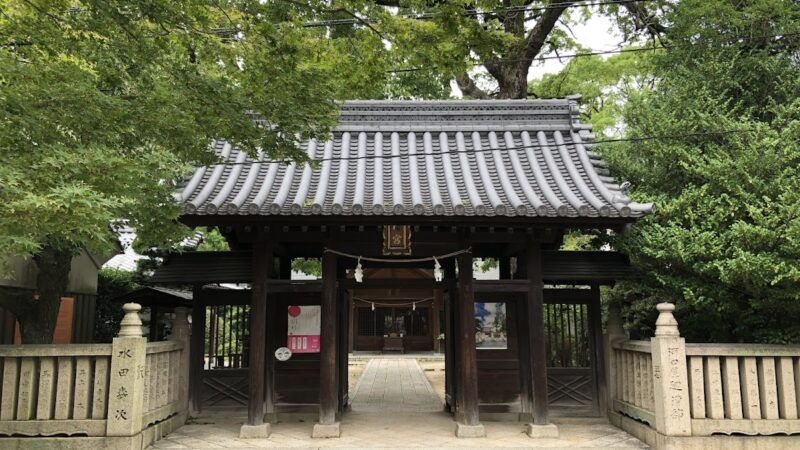
Upon entering the grounds of Amano Hachimangu Shrine, the first thing that catches the eye is the torii gate. The plaque on the torii gate bears the inscription “Amano Hachimangu,” but the character “野” (no) is written in a variant form, “𡌛,” which is unusual. This variant form preserves an ancient form, conveying the deep history of the shrine. Many visitors notice the unusual characters and become interested.
After passing through the torii gate, a quiet path leads to the shrine. Despite its urban location, the grounds are surrounded by trees, maintaining a tranquil atmosphere.
Shrine Buildings and Main Hall
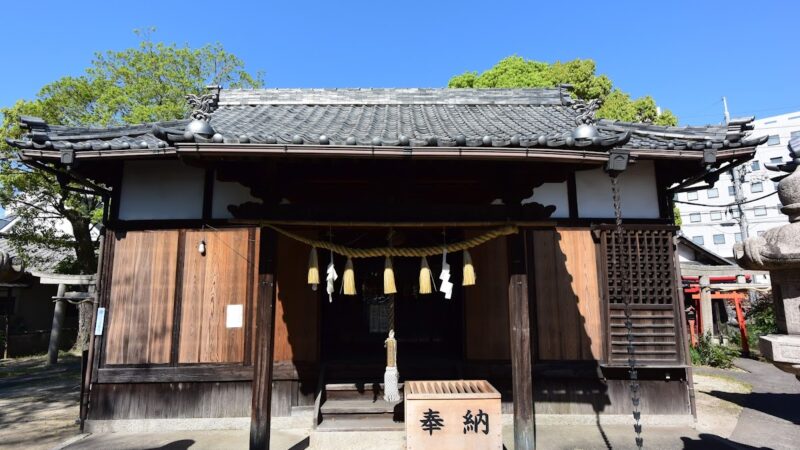
As you proceed along the path, you will see the worship hall. The shrine building maintains the traditional style of Shinto shrine architecture and is properly maintained. Behind the worship hall sits the main hall, where six deities are enshrined.
While the main hall is not generally open to the public, its architectural style and decorations reflect the history of local faith. It is believed to have been renovated during the relocation in the Taisho era, making it a structure with approximately 100 years of history.
Subsidiary Shrines and Stone Monuments
In addition to the main hall, several subsidiary shrines and stone monuments are located within the grounds. These demonstrate the diversity of local faith, showing traces of beliefs added over time.
Visiting these subsidiary shrines during your visit will allow you to delve deeper into the history of the shrine.
Atmosphere of the Shrine Grounds
Amano Hachimangu Shrine, while located in the heart of Okayama City, maintains a tranquil atmosphere. Despite its location east of Okayama Red Cross Hospital, stepping onto the shrine grounds transports you away from the hustle and bustle of the city.
It continues to attract devotion as a place of daily worship for local residents and a place of prayer at important life events.
Access Information
Access from the Nearest Station
From JR Okayama Station
Approximately 3km south of Okayama Station. Walking takes about 40 minutes; using a bus or taxi is recommended.
From Seikibashi Station
Approximately 24 minutes on foot from the Seikibashi Station exit. Relatively accessible.
From Bizen-Nishiichi Station
Accessible from Bizen-Nishiichi Station. Walking time is approximately 20-25 minutes.
Access by Bus
If you are taking a bus from Okayama Station, the bus bound for Okayama Red Cross Hospital is convenient. The shrine grounds are a few minutes’ walk from the nearest bus stop. For specific bus routes and timetables, please check the Okayama City public transportation information.
Access by Car
It’s easy to find the shrine by using Okayama Red Cross Hospital, located along National Route 2, as a landmark. If using a car navigation system, search for “Amano Hachimangu Shrine” or the address “3-2-1 Aoe, Kita-ku, Okayama City.”
We recommend contacting the shrine directly before your visit regarding parking availability.
Landmarks in the Surrounding Area
- Okayama Red Cross Hospital (immediately to the east)
- National Route 2 (close by)
- Located within the residential area of Aoe
Goshuin (Shrine Seal) Information
Regarding the Issuance of Goshuin
Amano Hachimangu Shrine offers Goshuin (shrine seals). In recent years, the number of visitors collecting Goshuin (temple/shrine stamps) as part of their shrine visits has increased, and many people receive Goshuin at Amano Hachimangu Shrine.
Goshuin are given out at the shrine office, but staff may be absent, so if you want to be sure to receive a Goshuin, it is recommended to call ahead to confirm.
About Electronic Goshuin
Some Goshuin services allow you to obtain an electronic Goshuin for Amano Hachimangu Shrine. This is a modern initiative that caters to those who enjoy collecting Goshuin online.
Manners When Receiving a Goshuin
Goshuin are not merely stamps, but proof of your visit. Always complete your prayers beforehand, bring your Goshuin book, and politely request a Goshuin. The Goshuin fee (offering) is generally around 300 to 500 yen, but it’s best to prepare the exact amount to avoid needing change.
Annual Events and Festivals
Amano Hachimangu Shrine holds various Shinto rituals and festivals throughout the year. As the guardian shrine of the region, seasonal festivals are important events for the local residents.
Main Annual Events
New Year’s Day Festival (January 1st)
This is the most important Shinto ritual to welcome the new year. Many visitors come for their first shrine visit of the year, praying for safety and prosperity throughout the year.
Spring Grand Festival
This festival celebrates the arrival of spring and prays for a bountiful harvest and the safety of the region.
Autumn Grand Festival
This is an important festival expressing gratitude for the harvest and gratitude to the gods. Many local residents participate, and traditional Shinto rituals are performed.
Monthly Festival
This is a Shinto ritual held regularly every month, where daily gratitude and prayers are offered.
Specific dates and times may change from year to year, so we recommend contacting the shrine directly or checking the Okayama Prefectural Shrine Association website.
Benefits and Faith of Worship
Benefits of Hachiman Faith
Hachiman has been worshipped since ancient times as the god of military success, victory, and national protection. In modern times, he is the object of prayer for various “competitive endeavors,” such as success in work, passing exams, and winning in sports.
Furthermore, because Empress Jingu is enshrined here, blessings for safe childbirth and protection of children are also expected.
Faith of Amano Shrine
Takamimusubi-no-kami and Kamimusubi-no-kami are gods of creation and development, and are believed to bring benefits such as business prosperity, family safety, and abundant harvests. Wakahi-no-megami is worshipped as the goddess of protection for women and improvement in arts and skills.
As the Guardian Shrine of the Region
Amano Hachiman Shrine serves as the guardian shrine of the Aoe district, playing a role in protecting the safety and prosperity of the entire region. It is an object of daily faith for local residents and a place of prayer at important life events.
Cultural Value of Amano Hachimangu Shrine
Importance in Local History
Amano Hachimangu Shrine is an indispensable part of the history of the southern region of Okayama City. From its founding at the end of the Heian period to the present day, it has remained the center of local faith for over 860 years.
Despite being affected by the modern Japanese religious policy of shrine consolidation during the Taisho era, its history of integrating the traditions of two shrines and passing on faith in a new form is an important case study for considering the cultural history of the region.
Shrine Architecture and Cultural Properties
The current layout of the shrine buildings and grounds is based on those established during the relocation in the Taisho era. These structures, with a history of approximately 100 years, are valuable examples that convey the characteristics of Taisho-era shrine architecture.
The variant character “𡌛” carved on the torii gate is also an interesting element that shows the history of written culture.
Transmission of Faith
Even today, daily worship by local residents continues, and it functions as a living place of faith. Shrines are places of worship at important life events such as New Year’s visits, Shichi-Go-San (a traditional rite of passage for children), and exorcisms, and faith has been passed down through generations.
Points to Note and Manners When Visiting a Shrine
Basic Manners for Visiting a Shrine
There are basic manners to observe when visiting a shrine. Bow when passing through the torii gate, and avoid walking in the center of the path (the center is considered the path of the gods).
If there is a purification fountain (temizuya), cleanse your hands and mouth before proceeding to the main hall (haiden). The basic way to pray at the main hall is “two bows, two claps, one bow.”
Photography
Photography is generally permitted on the shrine grounds, but there are areas where photography is prohibited, such as inside the main hall. Also, be considerate of other worshippers.
Maintaining a Quiet Environment
Shrines are places of prayer. Refrain from speaking loudly or making noise, and pray quietly. Especially during festivals and religious ceremonies, be careful not to disrupt the solemn atmosphere.
Nearby Tourist Attractions
When visiting Amano Hachimangu Shrine, you can also explore nearby tourist attractions.
Landmarks in Okayama City
Located approximately 3km south of Okayama Station, it offers excellent access to tourist spots in central Okayama City. Major attractions such as Okayama Castle and Korakuen Garden are relatively close.
Around the Asahi River
A promenade is maintained along the Asahi River, which flows through Okayama City, allowing visitors to enjoy a stroll. Depending on the season, cherry blossom trees create a beautiful landscape.
Frequently Asked Questions
Q: Can I get a Goshuin (shrine stamp) at Amano Hachimangu Shrine anytime?
A: Goshuin are available at the shrine office, but staff may be absent. If you want to be sure to get one, we recommend calling in advance (086-222-5010).
Q: Is there parking available?
A: Please contact the shrine directly regarding parking availability and capacity. There are also coin-operated parking lots in the surrounding area, which you can consider using.
Q: Is there parking available? Q: Can I receive prayers or purification rituals?**
A: We accept various prayers, but advance reservations may be required. Please contact the shrine directly for details.
Q: Can I receive prayers for Shichi-Go-San (7-5-3) or safe childbirth?
A: Yes, we accept prayers for various milestones in life. Please consult with the shrine in advance regarding dates and times.
Q: How long does it take to get there from the nearest station?
A: It’s about a 24-minute walk from Seikibashi Station and about a 20-25 minute walk from Bizen-Nishiichi Station. From Okayama Station, it’s convenient to use a bus or taxi.
Summary
Amano Hachimangu Shrine is a venerable shrine with a history of over 860 years since its founding in 1159. The Hachiman faith, which was invited from Iwashimizu Hachimangu Shrine, and the traditions of Amano Shrine, a Shikinaisha (a shrine listed in the Engishiki), have merged, and it continues to attract worshippers as the guardian shrine of the region.
Located in the urban area of Aoe, Kita-ku, Okayama City, the shrine grounds maintain a tranquil atmosphere, making it an ideal place to escape the hustle and bustle of everyday life and find peace of mind. In addition to the three Hachiman deities—Emperor Chuai, Emperor Ojin, and Empress Jingu—the shrine enshrines six other deities: Takamimusubi-no-kami, Wakahi-no-megami, and Kamimusubi-no-kami, offering a variety of blessings including military success, safe childbirth, and abundant harvests.
With its many historical elements, such as the variant character “𡌛” on the torii gate and the shrine building dating back to the Taisho era, it’s a shrine with plenty to see for those interested in shrine architecture and culture. Goshuin (shrine stamps) are also available, making it a popular spot for those who enjoy visiting shrines.
When you visit Okayama, be sure to stop by Amano Hachimangu Shrine and experience the space of faith nurtured by its long history. The warm atmosphere unique to a shrine deeply rooted in the community will surely make for a memorable pilgrimage.