Complete Guide to Gakuenji Temple (Shimane Prefecture) | An Ancient Tendai Sect Temple with Autumn Leaves and the Legend of Benkei
Located in Bessho-cho, Izumo City, Shimane Prefecture, Gakuenji Temple is an ancient Tendai sect temple said to have been founded in 594 AD (the second year of Empress Suiko’s reign). Nestled deep in the mountains of the Kitayama mountain range on the Shimane Peninsula, this temple is known as one of the prefecture’s best spots for viewing autumn leaves, and it also preserves the legend of Musashibo Benkei’s training there and its history as a sacred site for Shugendo (mountain asceticism).
This article comprehensively introduces information you should know before visiting Gakuenji Temple, including its history, highlights within the temple grounds, cultural assets, transportation access, and annual events.
History and Origin of Gakuenji Temple
Founding Legend and Origin of the Temple Name
Gakuenji Temple is said to have been founded in 594 AD (the second year of Empress Suiko’s reign). Founded by the monk Chishun Shonin, this is a historic temple said to have been established by the imperial decree of Empress Suiko.
An intriguing legend surrounds the origin of the temple’s name. While Chishun Shonin was practicing asceticism at Furō-no-taki waterfall, he accidentally dropped a vessel into the waterfall’s basin. According to legend, a crocodile (wani) retrieved the vessel and returned it, giving rise to the name “Wanibuchi-ji” (Crocodile Abyss Temple). This legend illustrates the temple’s deep connection to nature and its role as a place of Shugendo (mountain asceticism).
Development as a Sacred Site of Shugendo
In ancient times, Wanibuchi-ji was originally called “Wanibuchi-yama” and was a Shugendo training ground centered around Furō-no-taki waterfall. It developed into a nationally renowned place of worship, a center of mountain worship with Zaō Gongen as its principal deity. The rugged mountain location provided an ideal environment for ascetic monks to dedicate themselves to rigorous training, attracting many practitioners of Shugendo (mountain asceticism).
Prosperity in the Middle Ages
In the Middle Ages, Wanibuchi-ji Temple became a branch temple of Enryaku-ji Temple (Mount Hiei) and flourished as a Tendai sect temple. Particularly noteworthy is its strong connection to Izumo Taisha Shrine. During the era of syncretism of Shinto and Buddhism, Wanibuchi-ji Temple played a role similar to a temple associated with Izumo Taisha, prospering with numerous monks’ quarters.
During the Muromachi period, it reached its peak, with many halls and monks’ quarters built throughout the mountains, and records indicate that many Shugendo practitioners and monks resided there. Traces of the layout and architectural style from this period can still be seen throughout the temple grounds today.
Changes from the Early Modern Period Onward
During the Edo period, while receiving protection from the Matsue Domain, it was significantly affected by the Meiji-era separation of Shinto and Buddhism. However, it continued to uphold its Tendai sect traditions to this day. In 2007, the grounds of Wanibuchi-ji Temple were designated a National Historic Site. Recognized for its historical value, it retains much of its medieval character and is an important temple for understanding the medieval development of Buddhism in the Chugoku region.
Highlights of the Temple Grounds
From the Approach to the Niomon Gate
Visiting Wanibuchi-ji Temple begins at the parking lot. A 15-minute walk along the slightly dimly lit, tree-lined approach leads to the Niomon Gate. This approach is a space for preparing oneself mentally as one moves from the secular world to the sacred realm, allowing one to experience the changing seasons as one walks.
The Niomon Gate is an important building welcoming visitors to the temple grounds. Nio statues are enshrined on either side of the gate, watching over visitors as guardian deities who ward off evil spirits.
Main Hall
After passing through the Niomon Gate, you will find the main hall. The main building houses the temple office and the living quarters of the head priest, and is also where visitors are registered. During the autumn foliage season, the area around the main building is beautifully colored, attracting many visitors.
Stone Steps to the Nemoto-do Hall
A long flight of stone steps leads from the main building to the Nemoto-do Hall. These steps are the legendary setting where Musashibo Benkei is said to have carried the temple bell up them.
The steps are steep, offering a glimpse into the rigor of the Shugendo practices of yesteryear. Climbing each step allows one to contemplate the profound faith of the ascetic monks.
Nemoto-do Hall
Upon reaching the top of the steps, you arrive at the Nemoto-do Hall, the central building of Wanibuchi-ji Temple. The Nemoto-do Hall houses two statues: the principal deities, the Thousand-Armed Kannon Bodhisattva and the Medicine Buddha.
The hall is enveloped in a solemn atmosphere, conveying the sense of a space that has received the prayers of many people throughout its long history.
Furōtaki Waterfall
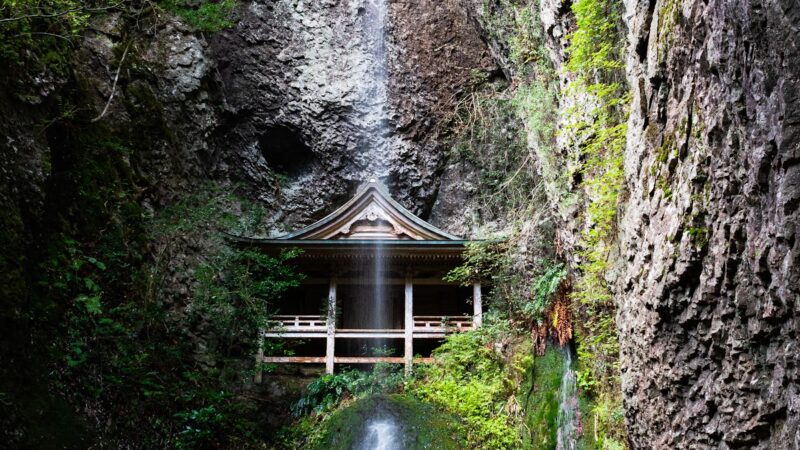
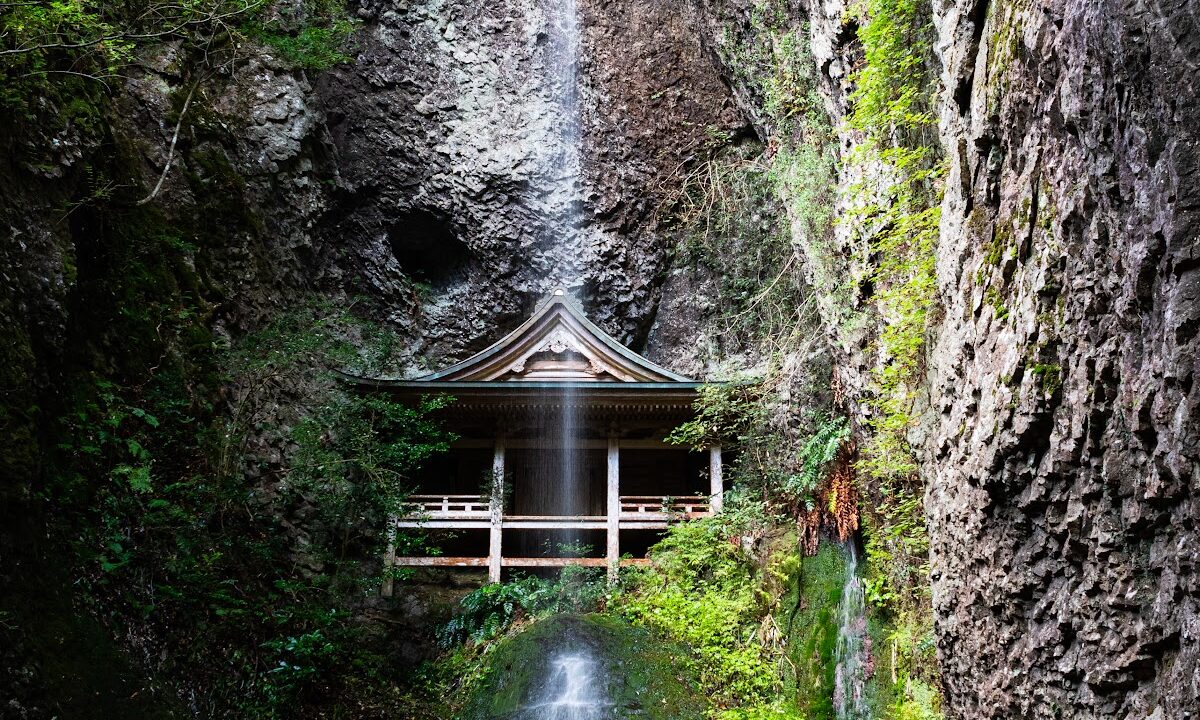
At the back of the temple grounds lies Furōtaki Waterfall, the setting for the legend of the founding of Wanibuchi-ji Temple. It was once a sacred place where Shugendō monks performed waterfall asceticism, and it still retains a strong atmosphere as a sacred site of Shugendō.
Furōtaki Waterfall, with its sound of water echoing in the silence of the mountains, has the power to purify the hearts of visitors. During the autumn foliage season, the area around the waterfall is beautifully colored, allowing visitors to enjoy a landscape where nature and faith are intertwined.
Musashibō Benkei and Wanibuchi-ji Temple
The Legend of Benkei’s Training
A legend remains at Wanibuchi-ji Temple that Musashibō Benkei trained here in his youth. Benkei is a historical figure known as a loyal retainer of Minamoto no Yoshitsune, and it is said that he spent his youth in these mountains.
According to the legend, Benkei diligently trained at Wanibuchi-ji Temple, honing his martial arts skills and spirit. The story that his training in this area formed the foundation for his later achievements has captivated the imaginations of many.
Cultural Assets Associated with Benkei
Several artifacts related to Benkei remain at Wanibuchi-ji Temple.
Bell: The most famous is the bell, which Benkei is said to have carried over overnight from Daisen-ji Temple in Hoki Province (present-day Tottori Prefecture). This bell bears the inscription “Bell of the Upper Precinct of Dainichi-ji Temple, Hoki Province, May 19th, Juei 2nd year,” and is designated a National Important Cultural Property. The bell is quite heavy, making it a symbolic relic demonstrating Benkei’s incredible strength.
Carrying Chest: A carrying chest believed to have been used by Benkei is also preserved.
Saw: A saw believed to have been used during his training is also preserved.
Self-Portrait: A self-portrait believed to have been painted by Benkei himself is also preserved, making it a valuable document for understanding his character.
These artifacts enhance the charm of Wanibuchi-ji Temple, where legend and history intertwine.
The prefecture’s premier autumn foliage spot
Best time to see the autumn leaves and its characteristics
Wanibuchi-ji Temple is widely known as the prefecture’s premier autumn foliage spot. In late autumn, the temple grounds are dyed crimson, creating a magnificent landscape.
The best time to see the autumn leaves is usually from mid- to late November. Deciduous trees such as maple and Japanese maple color the entire temple grounds, from the approach to the temple. The autumn leaves along the stone steps and around the main hall are particularly breathtaking, attracting many photography enthusiasts.
Due to its mountainous location, the cool mornings and evenings make the autumn leaves even more vibrant. Furthermore, the tree-lined approach to the temple becomes a tunnel of red and yellow during the autumn foliage season, creating a magical atmosphere.
Autumn Leaves Festival
Every year, the “Autumn Leaves Festival” is held to coincide with the peak of the autumn foliage season. During this event, many visitors from within and outside the prefecture come to the temple, making the grounds lively.
The Autumn Leaves Festival sometimes includes special public viewings of cultural properties that are normally closed to the public, providing an opportunity to learn more about the history and culture of Wanibuchi-ji Temple. There are also sales of local specialty products and performances of traditional arts, allowing visitors to experience Shimane’s culture.
Charms of Seasons Other Than Autumn Leaves
Outside of the autumn foliage season, Wanibuchi-ji Temple offers a quiet and peaceful atmosphere. Visitors can enjoy the beauty of nature in each season: the fresh greenery of spring, the deep green of summer, and the snowy landscapes of winter.
Especially outside of the autumn foliage season, there are fewer visitors, allowing visitors to more strongly feel that this was once a sacred site for Shugendo (mountain asceticism). This is an ideal environment for spending time contemplating nature in tranquility and calming the mind.
Cultural Properties
Nationally Designated Important Cultural Properties
Wanibuchi-ji Temple houses several nationally designated important cultural properties.
Bronze Bell (Hanging Bell): The bell, said to have been carried by Benkei (mentioned earlier), bears an inscription from the second year of Juei (1183) and is designated as a nationally important cultural property as a valuable early Kamakura period temple bell.
Wooden Standing Statue of Kannon Bodhisattva: This elegant and beautiful Buddha statue is known for its style influenced by Silla (an ancient kingdom on the Korean Peninsula). It is a valuable artifact that shows cultural exchange between Japan and the Korean Peninsula in ancient times.
Shimane Prefecture Designated Cultural Properties
Wanibuchi-ji Temple also preserves many cultural properties designated by Shimane Prefecture. These are important materials that tell the story of the temple’s long history and the development of Buddhist culture in the Izumo region.
Designated as a National Historic Site
In 2007, the grounds of Wanibuchi-ji Temple were designated as a National Historic Site. This was because the entire temple grounds retain much of their medieval character and were deemed to be of significant value in understanding the medieval development of Buddhism in the Chugoku region.
The layout of the grounds, including the stone steps and the arrangement of the temple buildings, exhibits a typical form of a medieval mountain temple, making it a valuable historical site for the study of Buddhist history.
Wanibuchi-ji Temple as a Pilgrimage Site
Wanibuchi-ji Temple is designated as a pilgrimage site for several sacred sites.
- Chugoku Kannon Pilgrimage Site, No. 25
- Izumo Kannon Pilgrimage Site, No. 3
- Izumo Province Shinto-Buddhist Pilgrimage Site, No. 2
These pilgrimages continue to this day, carried out by people seeking to deepen their faith and find peace of mind. Wanibuchi-ji Temple is an important place of worship for such pilgrims.
Annual Events and Festivals
Main Annual Events
Wanibuchi-ji Temple holds various Buddhist events throughout the year.
New Year’s Visit: Many worshippers visit in the new year to pray for peace throughout the year.
Spring Buddhist Services: Important Buddhist services are held in the spring.
Autumn Leaves Festival: This is the largest event, held from mid- to late November.
New Year’s Eve Bell Ringing: On New Year’s Eve, the bell associated with Benkei is rung to welcome the new year.
Special Viewings
Cultural assets and hall interiors that are normally closed to the public are sometimes specially opened during certain periods. Especially during the Autumn Leaves Festival, it is an opportunity to view valuable cultural assets that are not usually on display.
Access
Access by Public Transportation
JR San’in Main Line: Izumo-shi Station or Naoe Station are the nearest stations.
From the station, you can take a taxi or bus. However, since bus services are limited, it is recommended to check the timetable in advance.
Access by Car
San’in Expressway: Approximately 30 minutes from Izumo IC
Parking: Parking is available near the entrance to the temple grounds. During the autumn foliage season, congestion is expected, so early arrival is recommended.
From the parking lot to the Niomon Gate, it is about a 15-minute walk along the approach path. Since it is a mountain path, comfortable walking shoes are recommended.
Location
Address: 148 Bessho-cho, Izumo City, Shimane Prefecture
Phone: 0853-66-0250 (Wanibuchi-ji Temple)
Visiting Information
Visiting Hours and Fees
Visiting Hours: 8:00 AM – 5:00 PM (may vary depending on the season)
Admission Fee:
- Adults: 500 yen
- Junior and Senior High School Students: 300 yen
- Elementary School Students: 200 yen
*Fees may change during the autumn foliage season or special viewing periods.
Precautions for Visiting
- The temple grounds are located in the mountains and have many stone steps and slopes, so please wear comfortable clothing and shoes.
- The temple gets very crowded during the autumn foliage season. We recommend planning your visit with plenty of time to spare.
- There is a possibility of snow and icy roads in winter. Please check weather information in advance.
- The temple grounds are a sacred place. Please be mindful of proper etiquette during your visit.
Nearby Tourist Attractions
Izumo Taisha Shrine
Located about 30 minutes by car from Wanibuchi-ji Temple, Izumo Taisha Shrine is a representative tourist spot in Shimane Prefecture. Wanibuchi-ji Temple and Izumo Taisha Shrine have deep historical ties, and visiting both will allow you to gain a deeper understanding of the history of Shinto-Buddhist syncretism in Izumo.
Lake Shinji
Lake Shinji is the seventh largest lake in Japan and is known for its beautiful sunsets. Located about 40 minutes by car from Wanibuchi-ji Temple, it offers a chance to enjoy natural beauty.
Ichibata Yakushi Temple
Ichibata Yakushi Temple, known as the Buddha of the eyes, is also located in the Kitayama mountain range of the Shimane Peninsula, just like Wanibuchi-ji Temple. A pilgrimage visiting both temples is also popular.
Summary
Wanibuchi-ji Temple is an ancient Tendai sect temple nestled in the mountains of Izumo City, Shimane Prefecture, and is a historical temple said to have been founded in 594 AD (the second year of Empress Suiko’s reign). Developed as a sacred site for Shugendo (mountain asceticism), Wanibuchi-ji Temple flourished in the Middle Ages, strongly connected to Izumo Taisha Shrine.
This temple possesses a variety of attractions, including legends of Musashibo Benkei’s training there, important cultural properties associated with Benkei, and its beauty as one of the prefecture’s premier autumn foliage spots. The temple grounds, designated a national historical site, retain a strong medieval atmosphere and are highly valued for their historical significance.
With its seasonal natural beauty, solemn atmosphere, and abundant cultural assets, Wanibuchi-ji Temple offers new discoveries with every visit. Especially during the autumn foliage season, it becomes a popular tourist destination, attracting many visitors as one of Shimane Prefecture’s most spectacular spots.
Visiting it in conjunction with Izumo Taisha Shrine will allow you to more deeply experience the history and culture of Shinto-Buddhist syncretism in the Izumo region. When visiting Shimane Prefecture, be sure to include a visit to Wanibuchi-ji Temple in your itinerary.
Spending time in a tranquil, ancient temple nestled in the mountains, calming your mind and reflecting on history, will be a precious experience that allows you to forget the hustle and bustle of modern life.