Complete Guide to Kofuku-ji Temple | A Thorough Explanation of World Heritage Sites, National Treasures, History, and Access
What is Kofuku-ji Temple? – A World Heritage Temple Representing Nara
Kofuku-ji Temple is a head temple of the Hossō sect located in Noborioji-cho, Nara City, Nara Prefecture. It does not have a mountain name, and its principal image is a statue of Shakyamuni Buddha enshrined in the Chūkondō (Central Golden Hall). It is counted as one of the Seven Great Temples of Nara and is registered as a World Cultural Heritage site as part of the “Historic Monuments of Ancient Nara.”
Despite its convenient location just a 5-minute walk from Kintetsu Nara Station, it boasts a vast grounds of approximately 82,500 square meters (approximately 25,000 tsubo), and is known as a temple that has developed in close connection with the city of Nara.
It is a temple associated with Fujiwara no Kamatari, the ancestor of the Fujiwara clan, and his son, Fujiwara no Fuhito, and as the Fujiwara clan’s family temple, it wielded immense power from the Nara period to the Muromachi period. Even today, Kofuku-ji Temple possesses numerous national treasures and important cultural properties, including its five-story pagoda, and occupies an extremely important position in the history of Japanese Buddhism.
History of Kofuku-ji Temple – 1300 Years with the Fujiwara Clan
Origins and Founding – From Umayasaka-dera Temple to Kofuku-ji Temple
The history of Kofuku-ji Temple dates back to 669 (the 8th year of Emperor Tenji’s reign). Its predecessor is said to be Yamashina-dera Temple, founded in Yamashina (present-day Yamashina Ward, Kyoto City, Kyoto Prefecture) by Fujiwara no Kamatari’s wife, Kagami no Ōkimi, to pray for her husband’s recovery from illness. After Kamatari’s death, his son, Fujiwara no Fuhito, moved it to Asuka and renamed it Umayasaka-dera Temple.
In 710 (the 3rd year of the Wadō era), with the relocation of the capital to Heijō-kyō, Fujiwara no Fuhito moved Umayasaka-dera Temple to the left bank of Heijō-kyō, which became the present-day Kofuku-ji Temple. This relocation was linked to the policies of the imperial court, and the construction work was carried out directly by the government, making it a national project that went beyond that of a mere private temple.
Prosperity as the Fujiwara Clan Temple
Kofuku-ji Temple, as the clan temple of the Fujiwara clan, expanded its influence along with the rise of the Fujiwara family. From the Nara period to the Heian period, major temple buildings such as the Central Golden Hall, East Golden Hall, West Golden Hall, Five-Storied Pagoda, and Three-Storied Pagoda were successively constructed.
Interestingly, despite being the Fujiwara clan’s clan temple, many of the commissions for the construction of the major halls and pagodas came from emperors and empresses, indicating a deep connection with the imperial court. This is not unrelated to the Fujiwara clan’s central role in the imperial court through regency politics.
In the late Heian period, Kofuku-ji Temple also held the position of governor of Yamato Province (present-day Nara Prefecture), becoming a major religious force with a powerful group of warrior monks. It also had a deep relationship with Kasuga Taisha Shrine, functioning as a central figure in the syncretism of Shinto and Buddhism.
History of Fires and Reconstruction
The history of Kofuku-ji Temple is also a history of battling fires. Since the Heian period, it has been repeatedly struck by fires, but with the support of the Fujiwara clan, it was rebuilt each time. In particular, during the burning of Nara by Taira no Shigehira in 1180 (Jisho 4), many halls and pagodas were destroyed along with those of Todai-ji Temple, but they were rebuilt during the Kamakura period.
In the Edo period, the Central Golden Hall was destroyed in the Great Fire of 1717 (Kyoho 2), and for approximately 300 years thereafter, it remained in a temporary structure. The reconstruction of this Central Golden Hall in 2018 (Heisei 30) was a groundbreaking event in the history of Kofuku-ji Temple.
Meiji Restoration and Modernity
The Meiji Restoration’s separation of Shinto and Buddhism and the wave of anti-Buddhist sentiment had a significant impact on Kofuku-ji Temple. Separation from Kasuga Taisha Shrine progressed, and at one point, the temple was on the verge of being abolished. Many parts of the temple grounds were confiscated, and there are even anecdotes that the five-story pagoda was nearly sold.
However, with the growing momentum for cultural property preservation, Kofuku-ji Temple was restored, and in 1998, it was registered as a World Cultural Heritage site as part of the “Historic Monuments of Ancient Nara.” Currently, as the head temple of the Hossō sect and a representative tourist attraction of Nara, it welcomes many worshippers and tourists.
Kofuku-ji Temple’s Complex – Major Buildings within the Temple Grounds
Within the grounds of Kofuku-ji Temple, historically valuable halls and pagodas are scattered throughout an open space without walls or partitions. Here, we will explain the major buildings in detail.
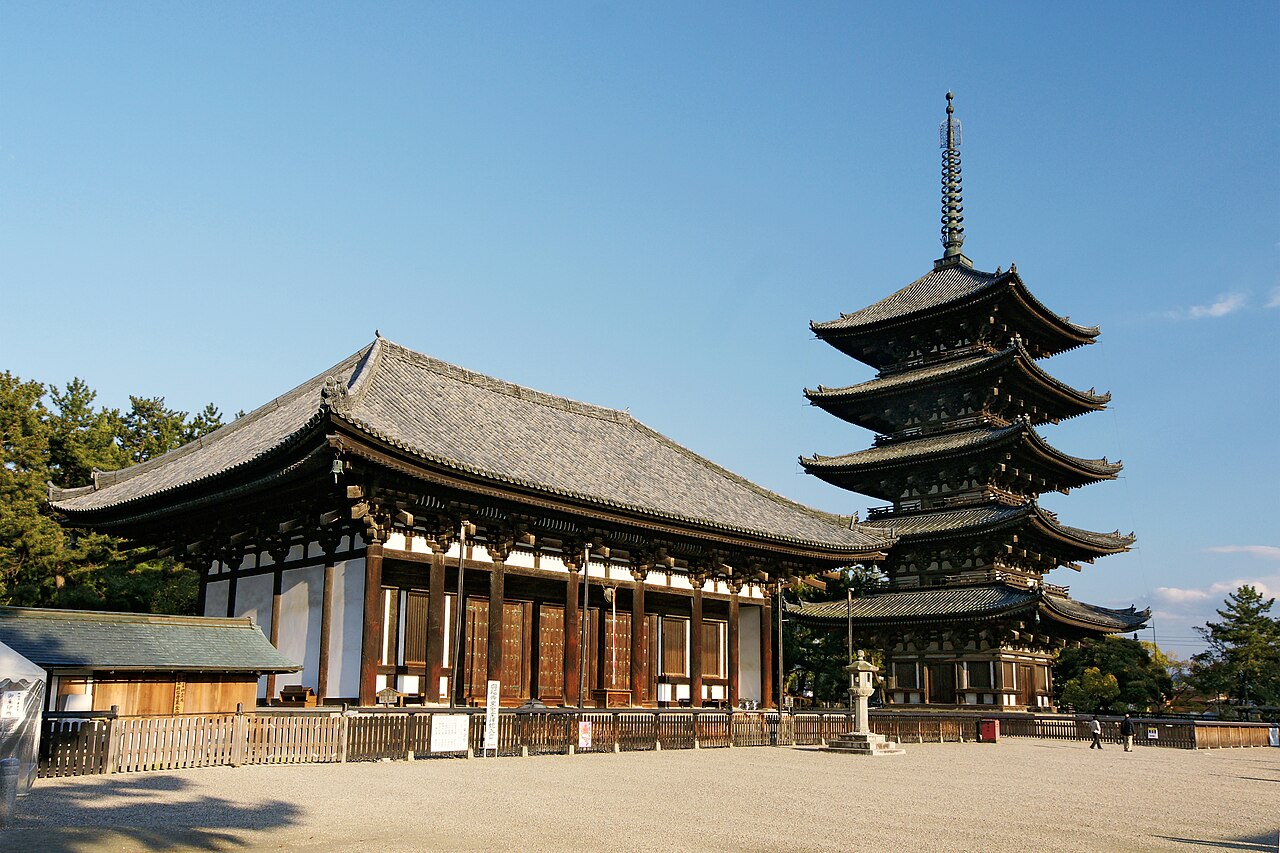
Chū-Kondō (Central Golden Hall) – The Central Hall Restored After 300 Years
The Chū-Kondō is the central hall of Kofuku-ji Temple’s complex and houses the principal image, a statue of Shakyamuni Buddha. Its founding is believed to be shortly after the relocation of the capital to Heijō-kyō in 710, and it has walked hand in hand with the history of Kofuku-ji Temple.
However, after suffering seven fires, and being destroyed in the fire of 1717 (Kyoho 2), only temporary reconstructions remained for approximately 300 years. Finally, in October 2018 (Heisei 30), the temple was rebuilt, and a dedication ceremony was held.
The rebuilt Central Golden Hall is an eclectic style, based on the original Tenpyo style while also incorporating elements from the Kamakura period reconstruction. Inside, a newly gilded statue of Shakyamuni Buddha is enshrined, along with statues of Yakushi and Yakujo Bodhisattvas (Important Cultural Properties), and the Four Heavenly Kings (National Treasures).
The reconstruction of the Central Golden Hall was not merely a building reconstruction, but a crucial project in restoring Kofuku-ji Temple’s religious and cultural center.
East Golden Hall – A National Treasure Building Housed with National Treasure Buddhist Statues
The East Golden Hall is said to have been originally built in 726 (Shinki 3) by Emperor Shomu to pray for the recovery of his aunt, Empress Gensho, from illness. The current building was rebuilt in 1415 (Oei 22) and is a prime example of Muromachi period Japanese-style architecture, designated a National Treasure.
Inside the hall, numerous National Treasures and Important Cultural Properties of Buddhist statues are enshrined, centering on the principal image, a seated statue of Yakushi Nyorai (Important Cultural Property), along with standing statues of Nikko and Gekko Bodhisattvas, a seated statue of Vimalakirti, and a seated statue of Monju Bodhisattva (all National Treasures). In particular, the standing statues of the Four Heavenly Kings (National Treasures) are known as masterpieces showcasing the powerful style of the Kamakura period.
The East Golden Hall, along with the Central Golden Hall, is one of Kofuku-ji Temple’s representative sightseeing spots.
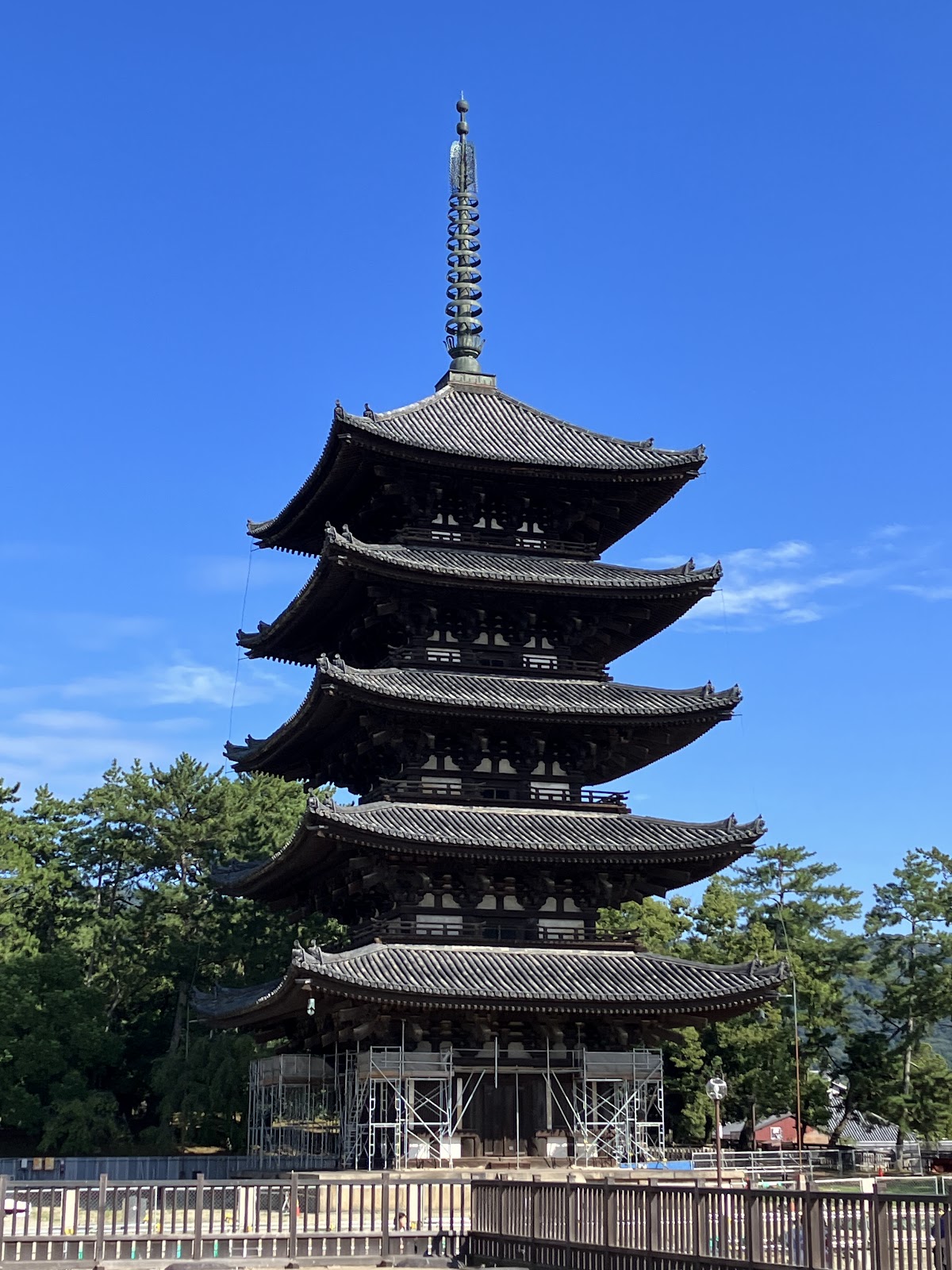
Five-Storied Pagoda – A Symbol of Nara
The five-storied pagoda of Kofuku-ji Temple stands approximately 50.1 meters tall, making it the second tallest wooden pagoda in Japan, after the five-storied pagoda of To-ji Temple. It is believed to have originated in 730 (Tenpyo 2) when Empress Komyo, daughter of Fujiwara no Fuhito, founded it, and the current pagoda was rebuilt in 1426 (Oei 33). It is designated a National Treasure.
The five-storied pagoda has long been a beloved symbol of Nara. Inside the first floor, statues of the Yakushi Triad, Shakyamuni Triad, Amida Triad, and Miroku Triad are enshrined in the four cardinal directions (east, west, north, and south), and the pillars are adorned with vividly colored paintings of flying celestial beings and scenes from the life of Buddha.
There is an anecdote that during the anti-Buddhist movement in the early Meiji era, it was almost sold for a mere 25 yen, but today it is carefully preserved as a representative building of Kofuku-ji Temple and as an integral part of Nara’s iconic landscape. ### North Octagonal Hall – Kofuku-ji Temple’s Oldest Building
The North Octagonal Hall is an octagonal hall rebuilt between 1210 (Jogen 4) and 1218 (Kenpo 6), and is the oldest existing building at Kofuku-ji Temple. It is designated a National Treasure.
It is said to have been founded in 721 (Yoro 5) by Empress Genmei and Empress Gensho on the first anniversary of the death of Fujiwara no Fuhito. There is also a theory that it was built at the request of the consort of Emperor Sutoku, and it is known as a beautiful small pagoda exuding a delicate and feminine gentleness.
Inside the hall, the seated statue of Miroku Nyorai (National Treasure), the principal image, is enshrined, along with standing statues of Asanga and Vasubandhu Bodhisattvas, and standing statues of the Four Heavenly Kings (all National Treasures). These are attributed to the Unkei school and are highly regarded as masterpieces of Kamakura period sculpture.
The North Octagonal Hall is usually closed to the public, but its interior can be viewed during special opening periods in spring and autumn.
South Octagonal Hall – Ninth Temple of the Saigoku Thirty-Three Kannon Pilgrimage
The South Octagonal Hall is an octagonal hall built in 813 (Kōnin 4) by Fujiwara Fuyutsugu for the repose of his father, Uchimaro. The current building was rebuilt in 1789 (Kansei 1) and is designated as an Important Cultural Property.
It is the largest octagonal hall in Japan, and its elegant architecture boasts beautiful ridges. As the ninth temple of the Saigoku Thirty-Three Kannon Pilgrimage, it is bustling with many visitors daily, not only pilgrims on the Saigoku pilgrimage.
The main image is a statue of Fuku Kensaku Kannon Bodhisattva (National Treasure), and the four sides are guarded by statues of the Four Heavenly Kings (National Treasures). The South Octagonal Hall is usually closed to the public, but it is specially opened on October 17th each year, the day of the Great Prajnaparamita Sutra recitation ceremony. Archaeological excavations have revealed that during the construction of the foundation, Wado Kaichin and Ryuhei Eiho coins were scattered to appease the earth gods, making it a valuable structure for understanding the architectural techniques and religious beliefs of the time.
Three-Storied Pagoda – A National Treasure Boasting Beautiful Proportion
The three-storied pagoda was built in 1143 (Koji 2) by Empress Kokamon-in, the consort of Emperor Sutoku, and is the second oldest existing building at Kofuku-ji Temple after the Hokuen-do Hall. It is designated as a National Treasure.
Although a relatively small pagoda at approximately 19 meters tall, it is known for its beautifully proportioned and well-proportioned designation. A statue of Benzaiten is enshrined inside the first floor, and it was formerly known as the Benzaiten Hall.
National Treasure Museum – A Treasure House of Valuable Cultural Assets
The National Treasure Museum is the treasure hall of Kofuku-ji Temple, which opened in 1959 (Showa 34). Built on the site of the former dining hall, the National Treasure Hall displays numerous National Treasures and Important Cultural Properties owned by Kofuku-ji Temple.
The most famous are the Eight Legions statues (National Treasure), including the Ashura statue. The Ashura statue is known as a masterpiece of Tenpyo-era sculpture, and its melancholic, boyish expression has captivated many.
In addition, many other National Treasure-class Buddhist statues are on display, including the Thousand-Armed Kannon Bodhisattva statue (National Treasure), the Ten Great Disciples statues (National Treasure), the Kongo Rikishi statues (National Treasure), and the Tenki and Ryuki statues (National Treasure). Furthermore, the bronze Buddha head from the Hakuho period, known as the Buddha Head (National Treasure), is one of Kofuku-ji Temple’s representative cultural properties.
The National Treasure Hall underwent renovation work from 2017 to 2018, making it a more comfortable facility for viewing cultural properties.
Cultural Properties of Kofuku-ji Temple – Numerous National Treasures and Important Cultural Properties
Kofuku-ji Temple is known for possessing a particularly large number of National Treasures and Important Cultural Properties among Japanese temples. Three buildings—the Five-Storied Pagoda, the East Golden Hall, and the North Octagonal Hall—are designated as National Treasures, while five buildings, including the Three-Storied Pagoda, are designated as Important Cultural Properties.
In terms of sculpture, the temple possesses numerous National Treasure Buddhist statues, including the Eight Legions (including the Ashura statue), the Ten Great Disciples, the Thousand-Armed Kannon Bodhisattva, and the Kongo Rikishi. These are extremely important from an academic perspective, representing the history of Japanese sculpture from the Nara to the Kamakura periods.
In terms of crafts, the temple preserves a wide range of cultural properties, such as the Kahara Kei (National Treasure) and the temple bell, and in terms of paintings, the silk painting of the Buddha’s Nirvana.
These cultural properties serve as evidence that Kofuku-ji Temple has remained one of Japan’s religious and cultural centers for over 1300 years.
Annual Events at Kofuku-ji Temple
Kofuku-ji Temple holds various religious events throughout the year.
Main Annual Events
- Shōshō-e (January 1st-3rd): A Buddhist service to welcome the New Year
- Setsubun-e (February 3rd): A demon-exorcising ceremony is held
- Nirvana-e (March 15th): A Buddhist service commemorating the passing of Shakyamuni Buddha
- Butsu-shō-e (April 8th): A Buddhist service celebrating the birth of Shakyamuni Buddha
- Takigi-noh (Third Friday and Saturday of May): A Noh performance by the Konparu school
- Kaikai-e (July 7th): A Buddhist service for the purification of summer
- Urabon-e (August 13th-15th): A Buddhist service for the repose of ancestors
- Dai Hannya-kyō Tendoku-e (October 17th): Special opening of the Nan’en-dō Hall
- Jion-e (November 13th): A memorial service commemorating the founder of the Hossō sect.
The Noh performance, in particular, is widely known as a traditional event of Kōfuku-ji Temple and attracts many spectators. Furthermore, the Hokuen-dō Hall is specially opened in spring and autumn, allowing visitors to view national treasure Buddhist statues that are not normally on public display.
Visiting Information – Fees, Hours, and Highlights
Visiting Hours and Fees
Visiting Hours
- National Treasure Hall, East Golden Hall, Central Golden Hall: 9:00 AM – 5:00 PM (Last entry at 4:45 PM)
- Temple Grounds: Free (Free)
Admission Fees
- National Treasure Hall: Adults 700 yen, Junior/Senior High School Students 600 yen, Elementary School Students 300 yen
- East Golden Hall: Adults 300 yen, Junior/Senior High School Students 200 yen, Elementary School Students 100 yen
- Central Golden Hall: Adults 500 yen, Junior/Senior High School Students 300 yen, Elementary School Students 100 yen
- Combined Ticket (National Treasure Hall + East Golden Hall + Central Golden Hall): Adults 1,500 yen, Junior/Senior High School Students 1,200 yen, Elementary School Students 600 yen
*Fees are subject to change. Please check the official website for the latest information.
Recommended Visiting Route
We introduce a recommended route for efficiently visiting Kofuku-ji Temple.
- Enter through the South Octagonal Hall and soak up the atmosphere of the temple grounds.
- Admire the Five-Storied Pagoda from the outside (normally closed to the public).
- View the National Treasure Buddha statues in the East Golden Hall.
- Admire masterpieces, including the Ashura statue, in the National Treasure Museum.
- View the reconstructed central hall in the Central Golden Hall.
- Admire the North Octagonal Hall from the outside (interior viewing available during special opening periods).
- Visit the Three-Storied Pagoda.
The estimated time required is 2-3 hours if you take your time to explore thoroughly. The National Treasure Museum is particularly impressive, so we recommend visiting with plenty of time to spare.
Access Information – How to Get to Kofuku-ji Temple
Access by Train
Kintetsu Nara Line
- Approximately 5 minutes on foot from Kintetsu Nara Station (east)
- From the station, head south through the Higashimukai Shopping Arcade, then west along Sanjo Street and you will see the Five-Storied Pagoda.
JR Line
- Approximately 15 minutes on foot from JR Nara Station
- Approximately 5 minutes by bus from JR Nara Station, get off at the “Prefectural Office” bus stop.
- The city loop bus is convenient.
Access by Car
From Expressways
- Approximately 15 minutes from the Daini-Hanna Expressway, Horai IC
- Approximately 20 minutes from the Nishi-Meihan Expressway, Tenri IC
- Approximately 20 minutes from the Keina-Wa Expressway, Kizu IC
Parking
Kofuku-ji Temple does not have its own parking lot, so you will need to use nearby paid parking lots. There are several options, including the Nara Prefectural Noborioji Parking Lot (approximately 5 minutes on foot) and private parking lots. Due to crowds on holidays, we recommend using public transportation.
Nearby Tourist Attractions
Kofuku-ji Temple is surrounded by many of Nara’s most famous tourist spots.
- Nara Park: A vast park where you can interact with deer, just a short walk away.
- Todai-ji Temple: Approximately 15 minutes on foot, a World Heritage temple famous for its Great Buddha.
- Kasuga Taisha Shrine: Approximately 15 minutes on foot, a beautiful vermilion-painted World Heritage shrine.
- Nara National Museum: Approximately 5 minutes on foot, houses masterpieces of Buddhist art.
- Gangoji Temple: Approximately 10 minutes on foot, an ancient World Heritage temple.
- Sarusawa Pond: Approximately 3 minutes on foot, a beautiful pond reflecting the five-story pagoda.
Starting from Kofuku-ji Temple, you can easily visit Nara’s main tourist attractions on foot.
Kofuku-ji Temple and the Hosso School – Doctrine and History
Kofuku-ji Temple is the head temple of the Hosso school of Buddhism. The Hossō school of Buddhism is a Buddhist sect based on the Chinese Yogacara philosophy, and was introduced to Japan during the Nara period.
The doctrines of the Hossō school center on the Yogacara philosophy, which states that “all existence is a creation of the mind.” It deeply analyzes the nature of human perception and explains the path from delusion to enlightenment.
The central temples of the Hossō school in Japan are Kōfuku-ji and Yakushi-ji, with Kōfuku-ji in particular functioning as a center of Hossō school scholarship since the Heian period. Traditional Hossō teachings continue to be studied and practiced at Kōfuku-ji today.
The Charm of Kōfuku-ji – Why Does It Attract So Many People?
The reasons why Kōfuku-ji attracts so many people are its historical importance, its abundance of cultural assets, and its integration with the city of Nara.
With a history of over 1300 years, and its background as the family temple of the Fujiwara clan, which remained the center of Japanese politics and culture, it evokes a historical drama that transcends mere religious institutions.
The numerous national treasures and important cultural properties, including the Ashura statue, are masterpieces that inevitably appear in Japanese art history textbooks. Being able to see these up close is a unique experience only available at Kofuku-ji Temple.
Furthermore, the open space within the temple grounds, without walls or partitions and integrated with Nara Park, gives visitors a special sense of freedom. The five-story pagoda, a beloved symbol of the city, blends seamlessly into the everyday landscape, demonstrating Kofuku-ji’s deep connection to the city of Nara.
The 2018 reconstruction of the Central Golden Hall further enhances Kofuku-ji’s appeal, marking a new chapter in its history, connecting the past and present.
Summary – Experiencing Japanese History and Culture at Kofuku-ji Temple
Kofuku-ji Temple, as the head temple of the Hossō sect with a history of over 1300 years, occupies an extremely important position in the history of Japanese religion and culture. It flourished as the family temple of the Fujiwara clan and developed alongside the city of Nara as one of the seven great temples of Nara.
Kofuku-ji Temple boasts countless attractions, including national treasure buildings such as the five-story pagoda, the East Golden Hall, and the North Octagonal Hall, numerous national treasure sculptures including the Ashura statue, and the Central Golden Hall, which was restored in 2018. At the National Treasure Museum, you can admire many masterpieces representing the history of Japanese sculpture up close.
With its convenient location just a 5-minute walk from Kintetsu Nara Station, it’s ideally situated for a visit in conjunction with nearby tourist spots such as Nara Park, Todai-ji Temple, and Kasuga Taisha Shrine.
When visiting Nara, be sure to stop by Kofuku-ji Temple and experience the depth of Japanese history and culture. You’ll be able to fully appreciate the charm of Nara, the ancient capital registered as a World Heritage Site.