About Senso-ji Temple
Senso-ji Temple, located in Asakusa, Taito-ku, Tokyo, is the oldest temple in Tokyo. It is said to have been founded in 628 AD (the 36th year of Emperor Suiko’s reign) and boasts a history of approximately 1400 years as the head temple of the Shokannon sect. It is one of Japan’s leading tourist attractions, visited by approximately 30 million people annually, and is affectionately known as “Asakusa Kannon” or “Asakusa’s Kannon-sama.”
The principal image is the Holy Kannon Bodhisattva. While it is an absolutely secret Buddha and never publicly displayed, many worshippers from both Japan and abroad visit seeking its compassionate blessings.
History and Origins
Legend of Founding
The founding of Senso-ji Temple begins with a miraculous event on the Sumida River. On March 18, 628 (the 36th year of Emperor Suiko’s reign), the brothers Hinokuma no Hamanari and Takenari were fishing in the Miyato River (present-day Sumida River) when a Buddhist statue got caught in their net.
The brothers’ master, Haji no Nakatomo, worshipped the statue and recognized it as a statue of the Holy Kannon Bodhisattva. He became deeply devoted to it and converted his home into a temple to enshrine it, which is considered the beginning of Senso-ji Temple.
History of Development
In 942 (the 5th year of the Tenkei era), during the early Heian period, Taira no Kinmasa renovated the temple buildings, establishing its foundation. During the Kamakura period, Minamoto no Yoritomo became a devout follower, and in the Edo period, Tokugawa Ieyasu designated it as a prayer temple of the shogunate, leading to its development into a large temple that attracted widespread devotion from commoners to samurai.
Following the Meiji Restoration’s separation of Shinto and Buddhism, the Toshogu Shrine and other temples that had previously been managed as the head temple were separated. During World War II, many buildings, including the main hall, were destroyed in the Tokyo air raids. However, the main hall was rebuilt in 1958, resulting in its current form.
Benefits
The principal image of Senso-ji Temple, the Holy Kannon Bodhisattva, is known as the Buddha who grants all wishes.
Main Benefits
- Fulfillment of all wishes
- Family safety
- Business prosperity
- Protection from evil
- Academic success
- Matchmaking
- Recovery from illness
It has long been said that “the benefits of Asakusa Kannon are immediate,” attracting people from all over Japan with heartfelt wishes.
Main Highlights
Kaminarimon (Wind and Thunder Gate)
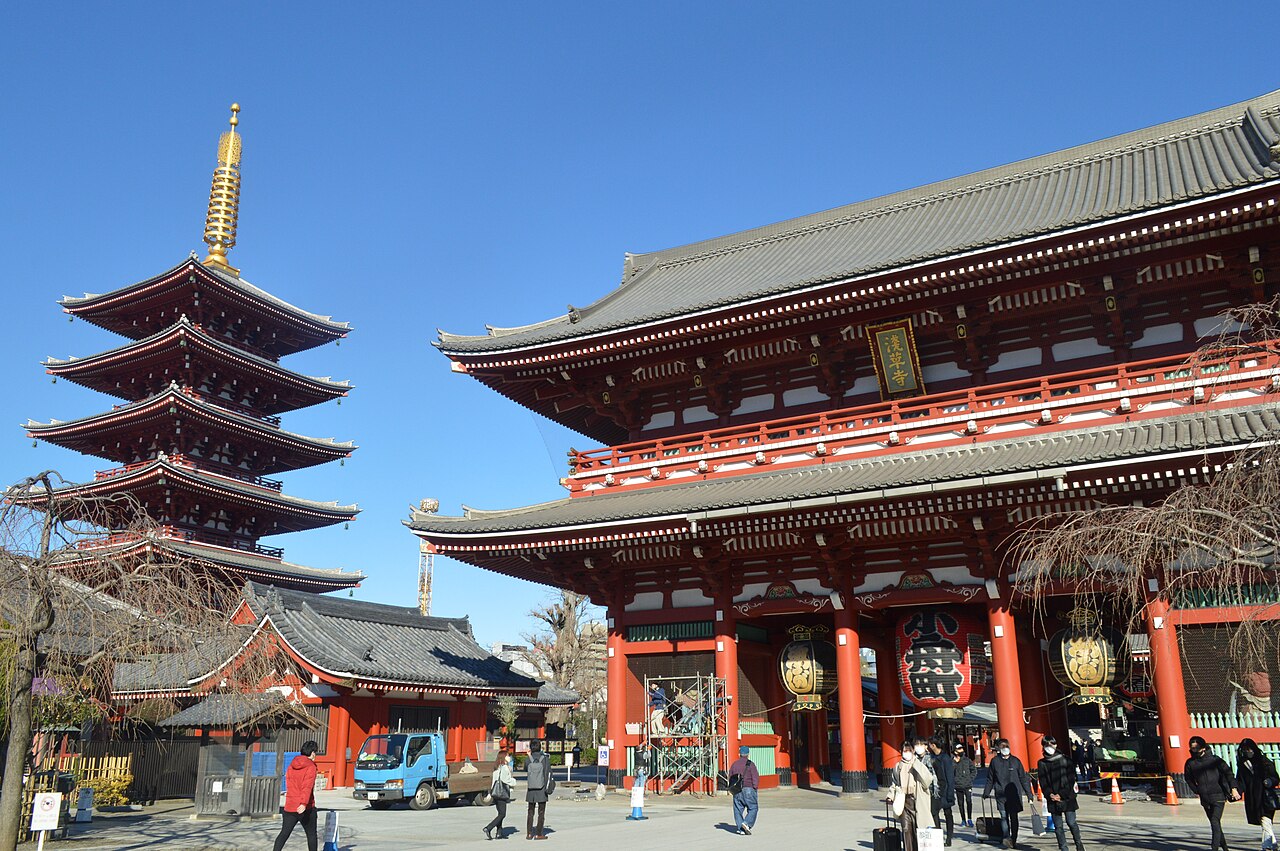
The main gate, a symbol of Senso-ji Temple, is world-famous. Its official name is “Fūraijinmon” (Wind and Thunder God Gate), and it was founded in 942 AD by Taira no Kimimasa. The current gate was rebuilt in 1960 through a donation from Matsushita Konosuke, the founder of Matsushita Electric Industrial Co., Ltd. (now Panasonic).
It is characterized by a giant red lantern, 3.9m high, 3.3m in diameter, and weighing approximately 700kg. A magnificent dragon carving adorns the base of the lantern, making it well worth looking up at. Statues of Fujin (Wind God) and Raijin (Thunder God) are enshrined on either side of the gate, welcoming visitors.
Nakamise Street
One of Japan’s oldest shopping streets, stretching approximately 250m from Kaminarimon (Thunder Gate) to Hōzōmon (Treasure Gate). With a tradition dating back to the Edo period, it boasts approximately 90 shops.
From famous local delicacies such as ningyo-yaki (doll-shaped cakes), kaminari-okoshi (rice crackers), and fried manju (sweet buns), to fans, tenugui (hand towels), and other Japanese goods, you can find a wide variety of Asakusa’s unique products. The cobblestone streets have had their power lines buried underground, preserving the Edo-period atmosphere.
Hozomon Gate (Niomon Gate)
A two-story gate towering at the end of Nakamise Street. Originally built in 942 AD, the current gate was rebuilt in 1964.
Flanking the gate are 4.5-meter-tall Nio statues (Kongo Rikishi statues), protecting the temple from evil. A giant straw sandal (4.5m long, 1.5m wide, weighing 500kg), known as a charm against evil, hangs on the back of the gate; this was donated by Murayama City, Yamagata Prefecture.
Main Hall (Kannon Hall)
A reinforced concrete building rebuilt in 1958. The outer hall is freely accessible to everyone, while the inner hall houses the hidden principal image of Buddha.
The ceiling is adorned with paintings by renowned artists, including “Dragon” by Kawabata Ryushi and “Celestial Beings” by Domoto Insho. There is a legend that if you let the smoke rising from the incense burner in front of the main hall hang over your body, illnesses and injuries will be cured.
Five-Storied Pagoda
Founded in 942 (Tenkei 5). The current pagoda, rebuilt in 1973 (Showa 48), stands 53.32 meters tall, and the top floor houses Buddhist relics (the remains of Shakyamuni Buddha) brought from Sri Lanka.
Fortune Slips
Asakusa Temple’s fortune slips are famous for having a high proportion of “bad luck” slips. This is because they adhere to the ancient distribution ratio established by Ganzan Daishi, with a probability of drawing a bad luck slip being approximately 30%. Even if you draw a bad fortune slip, it is believed that if you tie it to the “fortune slip tying place” on the temple grounds before leaving, the blessings of Kannon (Goddess of Mercy) will turn the misfortune into good fortune.
Correct Way to Worship
Asakusa Temple is a Buddhist temple, so worship customs differ from those of Shinto shrines.
Flow of Worship
- Passing through the Kaminarimon Gate: Bow before passing through the gate.
- Proceeding along Nakamise Street: Please keep to the left.
- Purifying at the Water Basin: Purify in the following order: left hand → right hand → mouth → handle of left hand.
- Bathing in the Incense Smoke: Let the smoke waft over the parts of your body you wish to purify.
- Worshiping at the Main Hall:
- Quietly place your offering in the offering box.
- Clasp your hands together in front of your chest (do not clap).
- Silently state your wish.
- Bow and leave.
Points to Note When Worshiping
- Do not clap your hands: Unlike Shinto shrines, Buddhist temples do not make noise.
- Photography is prohibited inside the Main Hall: Exterior photography is permitted.
- Use only one incense stick: There is no need to light multiple sticks.
- Please be considerate during crowded times: It gets especially crowded during the first three days of the New Year.
Annual Events
Main Events
- Hatsumode (January 1st-7th): Approximately 2.8 million people visit during the first three days of the year.
- Setsubun-e (February 3rd): Bean-throwing ceremony and Fukuju-no-mai dance.
- Jigen-e (March 18th): A memorial service commemorating the manifestation of the principal image.
- Shimanrokusen-nichi Hozuki-ichi (July 9th-10th): Visiting on this day grants the blessings of 46,000 days.
- Hagoita-ichi (December 17th-19th): A year-end market overflowing with Edo-period charm.
- Joya-no-Kane (December 31st): The temple bell is rung 108 times.
Basic Information and Access
Basic Information
- Official Name: Kinryuzan Sensoji Temple
- Sect: Shokannon-shu (Head Temple)
- Principal Image: Shokanzeon Bodhisattva (Secret Buddha)
- Founded: 36th year of Emperor Suiko’s reign (628 AD)
- Founder: Haji no Nakatomo
- Address: 2-3-1 Asakusa, Taito-ku, Tokyo 111-0032
- Phone: 03-3842-0181
- Visiting Hours:
- April to September: 6:00 AM to 5:00 PM
- October to March: 6:30 AM to 5:00 PM
- Admission Fee: Free (Outer Hall of the Main Building)
- Estimated Time Required: 1-2 hours
Access
Train
- 5-minute walk from Exit 1 of Asakusa Station on the Tokyo Metro Ginza Line
- 5-minute walk from Exit A4 of Asakusa Station on the Toei Subway Asakusa Line
- 5-minute walk from Asakusa Station on the Tobu Skytree Line
- 8-minute walk from Asakusa Station on the Tsukuba Express
Bus
- Get off at the Toei Bus “Asakusa Kaminarimon” stop and it’s right there.
- Accessible via Taito Ward Community Bus “Megurin” at all stops.
Parking
- No dedicated parking.
- Several paid parking lots are available nearby (e.g., Kaminarimon Underground Parking).
Nearby Attractions
- Asakusa Shrine: Adjacent to Senso-ji Temple, known as “Sanja-sama”
- Tokyo Skytree: Within walking distance, popular for its view across the Sumida River
- Sumida Park: Famous for its cherry blossoms, and the venue for the Sumida River Fireworks Festival
- Kappabashi Kitchenware Street: Specialty street for cooking utensils and food samples
- Asakusa Engei Hall: Popular entertainment such as rakugo and manzai
Summary
Senso-ji Temple, with its nearly 1400-year history, is Tokyo’s oldest temple and has attracted the faith of people across generations. From the large lantern at Kaminarimon Gate to the bustling Nakamise shopping street and the magnificent main hall, there are countless sights to see.
Asakusa Temple, located in the heart of Tokyo, retains a strong Edo-period atmosphere, making it a precious place to experience Japanese culture. By following the proper etiquette for worship, you can receive the benevolent blessings of Kannon (Goddess of Mercy). Visiting during events such as Hatsumode (first shrine visit of the year) or Shimanrokusen-nichi (46,000-day festival) will allow you to appreciate the charm of Asakusa Temple even more deeply.