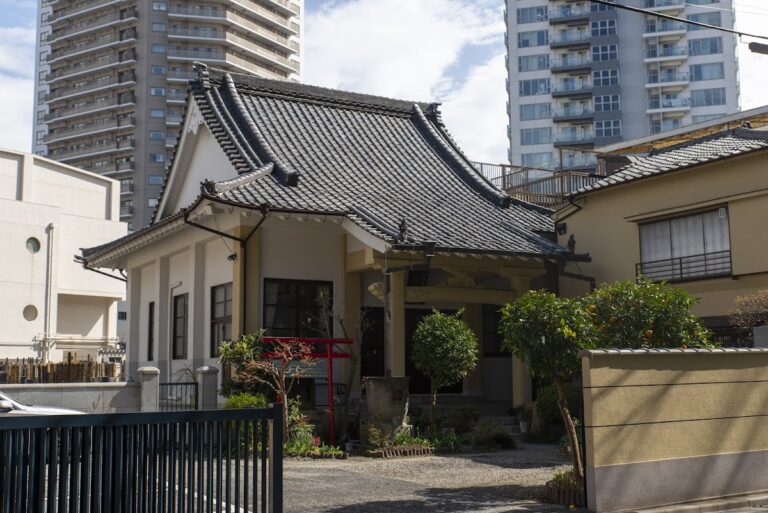
Sokenji Temple (Taito Ward, Tokyo) Complete Guide | History, Cultural Properties, and Access Information
About Sokenji Temple
Sokenji Temple is a Nichiren Buddhist temple located in Ikenohata 2-chome, Taito Ward, Tokyo. Its mountain name is Myokozan, and it was formerly a Bishamondo (a hall dedicated to Bishamonten) located on the shores of Shinobazu Pond, attracting the faith of ordinary people. Even today, it stands quietly in the residential area of Ikenohata, west of Ueno Park, and is cherished by the local community.
Its former head temple was Kuonji Temple on Mount Minobu in Kai Province, and it belongs to the Shioshi lineage. It houses a wooden seated statue of Nichiren Shonin, a registered cultural property of Taito Ward, and has a unique history of attracting faith as a “temple for curing hemorrhoids,” making it a distinctive temple.
Basic Information about Sokenji Temple
- Official Name: Myokozan Sokenji Temple
- Sect: Nichiren Buddhism
- Address: 2-1-15 Ikenohata, Taito-ku, Tokyo
- Postal Code: 〒110-0008
- Corporate Number: 2010505000368
- Former Head Temple: Kai Minobu-san Kuonji Temple
- Dharma Lineage: Shioshi Dharma Lineage
- Cemetery Type: Parishioner Cemetery
History of Sokenji Temple
From Founding to the Edo Period
The history of Sokenji Temple dates back to the early Edo period. It was founded in 1619 (Genna 5) with Nichiju Shonin of Eishoin (died 1627, Kan’ei 4) as its founding priest. Initially, it opened as “Bishamondo” and was a place of worship for ordinary people on the shores of Shinobazu Pond.
During the Kan’ei era (1624-1644), the temple’s name was changed to its current name, “Sōkenji.” This name change indicates that the temple’s structure was established and its position as a Nichiren Buddhist temple became clear.
At the time of its founding, Sōkenji is said to have been established by inviting Nichijū Shōnin from Sanpatamoto in the area. Sanpatamoto is a concept indicating the lineage of temples in the Nichiren sect, signifying that Sōkenji inherited the orthodox lineage of the Nichiren sect.
Development during the Edo Period
Throughout the Edo period, Sōkenji steadily developed, thanks to its favorable location in Ikenohata. The area around Shinobazu Pond was a popular recreational spot for the people of Edo, attracting many pilgrims.
On March 13, 1689 (Genroku 2), a wooden seated statue of Nichiren Shōnin was created during the time of the 5th head priest. This statue is still housed at Sokenji Temple and is carefully preserved as a registered cultural property of Taito Ward. An inscription written in ink is found on the base of the statue, clearly recording its date of creation and background.
Developments in the Modern Era
After the Meiji Restoration and the advent of the modern era, Sokenji Temple underwent new developments. In the early Taisho period, during the time of the 30th head priest, Nichiho Shonin of Jushin-in, prayers for curing hemorrhoids became popular.
Of particular note is the “prayer for hemorrhoids.” Nichiho Shonin’s prayers for curing hemorrhoids gained popularity, and Sokenji Temple became widely known as the “temple of hemorrhoid charms.” This unique belief reflects the historical context of a time before the development of modern medicine, when many people suffered from hemorrhoids. Sokenji Temple’s hemorrhoid charms developed in response to the earnest wishes of ordinary people, attracting many worshippers.
Even as times have changed from Showa to Heisei and then to Reiwa, Sokenji Temple has continued to uphold its Buddhist traditions in Ikenohata. It still maintains a family cemetery and engages in community-based temple activities.
Taito Ward Cultural Property: Wooden Seated Statue of Nichiren Shonin
Overview of the Cultural Property
The wooden seated statue of Nichiren Shonin, owned by Sokenji Temple, is a valuable Buddhist statue designated as a registered cultural property of Taito Ward. Created on March 13, 1689 (Genroku 2), this statue possesses high artistic and historical value as a Nichiren statue from the mid-Edo period.
Characteristics of the Sculpture
The wooden seated statue of Nichiren Shonin exhibits the typical appearance of a Nichiren statue. Its refined features simultaneously express the dignity and compassion of Saint Nichiren, leaving a deep impression on the viewer.
Authentic techniques were employed in its creation, and every detail is meticulously finished. It is considered a particularly outstanding work among Nichiren statues produced during the Edo period. The statue demonstrates the high level of skill of the Buddhist sculptors of the time in every aspect, from the exquisite wood carving technique and the beauty of the coloring to the overall balance.
Value of the Inscription
One of the important features of this statue is the inscription written in ink on its base. The inscription clearly states the date of creation: March 13, 1689 (Genroku 2), and also includes information about the 5th head priest of Sokenji Temple.
Surprisingly, there are few examples of Buddhist statues with clearly identifiable creation dates, making this inscription a valuable document from both an art history and historical perspective. It provides important clues to understanding the reality of Buddhist statue production and the nature of faith in temples during the Edo period.
Preservation and Public Access
The wooden seated statue of Nichiren Shonin, designated as a registered cultural property of Taito Ward, is preserved in an appropriate environment. It is usually housed within the temple, and there are opportunities for visitors to view it. However, from the perspective of cultural property protection, it is recommended to check with the temple in advance regarding viewing.
Faith as a “Temple for Hemorrhoid Relief”
The Beginning of Sealing Prayers
In the early Taisho period, during the time of the 30th head priest, Nichiho Shonin of Jushin-in Temple, sealing prayers became popular at Sokenji Temple. Sealing prayers are prayers to seal away specific illnesses or calamities, and are a form of faith widely practiced in various Buddhist sects, including the Nichiren sect.
Sokenji Temple became particularly famous for its sealing prayers for hemorrhoids, and was affectionately known as the “temple for hemorrhoid relief.”
Background of Popular Belief
The widespread acceptance of hemorrhoid relief prayers stems from the medical conditions of the time. In an era before modern treatments for hemorrhoids were established, many people suffered from the pain and discomfort of hemorrhoids.
Especially in urban life, from Edo to Tokyo, many people suffered from hemorrhoids due to sedentary work and changes in diet. In an era when medical treatments were limited, people sought hope in religious relief.
The Practice of Faith
The hemorrhoid treatment at Sokenji Temple was based on the prayer rituals of the Nichiren sect. Worshippers received prayers and amulets and talismans, praying for the healing of their hemorrhoids.
This faith was not mere superstition, but an important religious activity that provided spiritual support to the people of that time. The sense of spiritual reassurance sometimes led to the alleviation of physical symptoms, and it is believed that the fact that many people actually felt relieved contributed to the temple’s reputation as a “hemorrhoid treatment temple.”
The Legacy in Modern Times
While medical advancements have greatly improved the treatment of hemorrhoids, Sokenji Temple’s history as a “hemorrhoid treatment temple” continues to be passed down as a unique characteristic of the temple. This is evidence of the temple’s close connection to the lives of local people and holds cultural and historical value as a valuable example of popular faith.
Highlights of the Temple Grounds
Main Hall
The main hall of Sokenji Temple is a magnificent building with an atmosphere befitting a Nichiren Buddhist temple. The principal image is enshrined inside, and daily services are performed. Not only temple parishioners, but also general visitors can pay their respects.
Cemetery
Sokenji Temple has a parishioner cemetery, which is well-maintained and enjoys plenty of sunlight. Despite its location in Ikenohata, close to the city center, it maintains a quiet and peaceful environment for ancestral worship.
Surrounding Environment
Sokenji Temple is located in the residential area of Ikenohata, but is also close to Shinobazu Pond and Ueno Park, blessed with a lush green environment. The area around the temple is a unique blend of the atmosphere of old Edo-era downtown and the cultural atmosphere of Ueno, where many cultural facilities are located.
Transportation Access
Access by Train
Sokenji Temple is easily accessible by public transportation.
Nearest Stations:
- Nezu Station (Tokyo Metro Chiyoda Line): Approximately 6 minutes on foot (closest station)
- Yushima Station (Tokyo Metro Chiyoda Line): Approximately 8 minutes on foot
- Ueno Station (JR Yamanote Line/Keihin-Tohoku Line): Approximately 15 minutes on foot
- Keisei Ueno Station (Keisei Main Line): Approximately 12 minutes on foot
Access from Nezu Station is the most convenient, taking about 6 minutes on foot towards Shinobazu-dori. From Ueno Station, you can also access the shrine on foot by walking along the west side of Shinobazu Pond, allowing you to enjoy a stroll while visiting.
Access by Bus
You can also use Toei Buses or Taito Ward’s community bus “Megurin”. There is a bus stop near Ikenohata 2-chome, and it is a few minutes’ walk from there.
Access by Car
If you are visiting by car, the nearest exit is the Ueno exit of the Metropolitan Expressway. However, the surrounding area is a residential area, so the roads are narrow and parking is limited. When visiting, it is recommended to check with the temple in advance regarding parking availability.
Using public transportation is recommended.
Address and Map
Address: 2-1-15 Ikenohata, Taito-ku, Tokyo 110-0008
Ikenohata is a cultural area located west of Ueno Park, close to Shinobazu Pond. There are many other temples in the surrounding area, making it a great place to enjoy temple and shrine hopping.
Nearby Temples and Tourist Spots
Nearby Temples
Many temples are scattered around Ikenohata, where Sokenji Temple is located. There are not only Nichiren Buddhist temples, but also temples of various other sects, allowing visitors to enjoy collecting temple stamps and visiting temples and shrines.
The area from Ikenohata to Nezu and Yanaka is known as “Yanesen” and is a popular tourist area with temples that retain the atmosphere of the Edo period. When visiting Sokenji Temple, visiting the surrounding temples as well will provide a deeper historical experience.
Ueno Park
Ueno Park is within walking distance of Sokenji Temple. Many cultural facilities, including the Tokyo National Museum, the National Museum of Western Art, and Ueno Zoo, are concentrated here, allowing you to enjoy a culturally enriching day in conjunction with your temple visit.
Shinobazu Pond
Shinobazu Pond, which is said to have been located on the banks of Sokenji Temple when it was founded, is also within walking distance. It is a popular urban oasis where you can enjoy nature in all four seasons. It is especially beautiful in the summer when the lotus flowers bloom, making it ideal for a stroll.
Yanaka-Sendagi Area
The Yanaka-Sendagi area, encompassing Nezu, Yanaka, and Sendagi, is a popular tourist destination that retains the atmosphere of old Tokyo’s downtown. Old shopping streets, cafes, and galleries are scattered throughout, allowing you to enjoy a leisurely stroll.
Temple Visit Etiquette and Manners
Temple Visit Etiquette at Nichiren Buddhist Temples
Sokenji Temple is a Nichiren Buddhist temple, so please follow Nichiren Buddhist etiquette when visiting.
- Bow at the temple gate: Bow at the temple gate before entering the temple grounds.
- Purify yourself at the water basin: If there is a water basin, purify your hands and mouth.
- Worship at the main hall: Join your hands in prayer in front of the main hall and chant “Namu Myoho Renge Kyo”.
- Offering a donation: If making a donation, do so quietly.
- Bow upon leaving: When leaving the temple grounds, bow towards the main hall.
Precautions when visiting the temple
- Behave quietly on the temple grounds and avoid disturbing other visitors.
- Photography is only permitted in designated areas. Photography of cultural properties and other items may be prohibited.
- The cemetery area is a private space for temple parishioners; please refrain from entering unnecessarily.
- Please dress appropriately and respectfully, avoiding revealing clothing.
Annual Events at Sokenji Temple
Main Buddhist Services of the Nichiren Sect
Sokenji Temple, a Nichiren sect temple, holds various Buddhist services throughout the year.
- Oeshiki: The most important service held around the anniversary of Nichiren Shonin’s death (October 13th).
- Rikkyo Kaishūe: A service commemorating the day Nichiren Shonin founded the sect (April 28th).
- Kotan-e: A service celebrating Nichiren Shonin’s birthday (February 16th).
These services are primarily for parishioners, but general visitors may be able to participate. Please contact the temple directly for details.
Other Events
During Obon and Higan, memorial services are held to honor ancestors. Family memorial services are also held as needed.
Sokenji Temple and the Nichiren Sect
What is the Nichiren Sect?
The Nichiren Sect is a Buddhist sect founded by Nichiren Shonin (1222-1282), a monk of the Kamakura period. It considers the Lotus Sutra as its fundamental scripture and centers its practice on chanting the mantra “Namu Myoho Renge Kyo.”
Nichiren Shonin taught that the Lotus Sutra is the highest teaching that conveys the true meaning of Shakyamuni Buddha, and asserted that by spreading this teaching, he could save people and bring peace and security to the nation.
The Position of Sokenji Temple
Sokenji Temple belongs to the Nichiren Sect, with its former head temple being Kuonji Temple on Mount Minobu in Kai Province, and is affiliated with the Shio-shi lineage. Minobu-san Kuon-ji Temple is the head temple of the Nichiren sect, built on the site where Nichiren Shonin spent his later years. Soken-ji Temple is one of the temples that inherits its lineage.
The Shioshi Dharma lineage is a group of temples in the Nichiren sect based on the master-disciple relationship, and temples belonging to the same lineage maintain strong ties.
Teachings of the Nichiren Sect
The basic teachings of the Nichiren sect are as follows:
- Supremacy of the Lotus Sutra: The Lotus Sutra is considered the highest scripture.
- Practice of the Title: One can attain Buddhahood by chanting “Nam Myoho Renge Kyo.”
- Worldly Benefits: Realizing happiness and peace in this world.
- Shakubuku (Propagation): Actively spreading the teachings.
Soken-ji Temple also conducts its daily religious activities based on these teachings.
About the Danka System and Cemetery
Soken-ji Temple as a Danka Cemetery
Soken-ji Temple is a temple with a danka cemetery. A “danka” refers to a family that supports a specific temple as their family temple and requests funeral and memorial services from that temple.
The cemetery at Sokenji Temple enjoys ample sunlight and maintains a quiet environment despite its proximity to the city center. Its convenient location, just a 6-minute walk from Nezu Station on the Tokyo Metro Chiyoda Line, is a significant advantage for those visiting the graves.
Cemetery Features
- Location: Excellent location in Ikenohata, Taito-ku, close to the city center
- Transportation: Convenient access, just a 6-minute walk from Nezu Station
- Environment: Sunny and quiet environment
- Management: Appropriate management by a Nichiren Buddhist temple
About Cemetery Use
The cemetery at Sokenji Temple is primarily a danka cemetery. Becoming a danka is a prerequisite for using the cemetery. For details regarding available plots, usage fees, and management fees, please contact the temple directly.
In recent years, the demand for cemeteries in urban areas has been high, and temple cemeteries with convenient transportation access are particularly popular. Cemeteries at historic temples like Sokenji Temple are highly valuable as places for ancestral memorial services.
History and Culture of Ikenohata, Taito Ward
The Place Name Ikenohata
The place name “Ikenohata” originates from its location on the edge of Shinobazu Pond. It’s a historical place name dating back to the Edo period, and the area still retains a strong sense of Tokyo’s old downtown culture.
Ikenohata in the Edo Period
During the Edo period, Ikenohata was a mixed area of samurai residences and merchant districts. The area around Shinobazu Pond was a bustling recreational spot for Edo commoners, with many tea houses and restaurants lining the streets.
Sokenji Temple was founded in 1619 (Genna 5), shortly after the establishment of the Edo Shogunate. Around this time, temples began to appear in Ikenohata, giving it the character of a temple town.
Development Since the Modern Era
After the Meiji Restoration, cultural facilities such as museums and art galleries were built in Ueno, and the area around Ikenohata also developed as a cultural district. Despite experiencing the Great Kanto Earthquake and wartime damage, this area has survived as one of Tokyo’s cultural centers.
Today, Ikenohata is a tranquil residential area where historical temples and shrines harmoniously blend with modern housing.
Points to Note When Visiting Sokenji Temple
Best Time to Visit
Sokenji Temple is open year-round, but there are particularly recommended times:
- Spring (March-May): Visiting during cherry blossom season, especially in conjunction with a visit to Ueno Park, is highly recommended.
- Autumn (October-November): Experience the atmosphere of a Nichiren Buddhist temple during the Oeshiki festival.
- Hatsumode (January): Visit for the New Year.
Time Required
While a visit to Sokenji Temple itself only takes about 30 minutes, combining it with a visit to other temples and shrines in the area or a stroll through Ueno Park makes for a half-day to full-day sightseeing course.
Attire and Belongings
- Attire: Casual attire is acceptable, but please avoid revealing clothing.
- Shoes: Comfortable walking shoes are recommended (consider exploring the surrounding area).
- Belongings: Camera (only in areas where photography is permitted), Goshuincho (if receiving a Goshudai).
About Goshuin and Goshudai
At Sokenji Temple, a Nichiren Buddhist temple, you can receive a “Goshudai” instead of a “Goshuin” (temple stamp). A Goshudai is a document inscribed with “Namu Myoho Renge Kyo” and is a unique item given out by the Nichiren sect.
While it is customary to prepare a dedicated Goshudaicho when receiving one, it is recommended to confirm details with the temple.
Summary
Sokenji Temple is a historic Nichiren Buddhist temple located in Ikenohata, Taito-ku, Tokyo. Since its founding in 1619 (Genna 5), it has attracted the faith of the local community for over 400 years.
The temple houses a wooden seated statue of Nichiren Shonin, a cultural property of Taito Ward, and its history of fostering a unique folk faith as a “temple for curing hemorrhoids” speaks volumes about its individuality. Its location on the banks of Shinobazu Pond, its cultural environment in Ueno, and its religious role as a Nichiren Buddhist temple—all these elements harmoniously combine to make Sokenji Temple a valuable resource for understanding Tokyo’s temple culture.
Its convenient location, just a 6-minute walk from Nezu Station, is another attractive feature, making it easy to combine a visit with sightseeing in Ueno or exploring the Yanaka, Nezu, and Sendagi areas. For those interested in history, those wanting to experience Nichiren Buddhism, or those wanting to experience Tokyo’s downtown culture, Sokenji Temple is well worth a visit.
Sokenji Temple in Ikenohata offers a place to spend time in quiet contemplation, reflecting on 400 years of history.