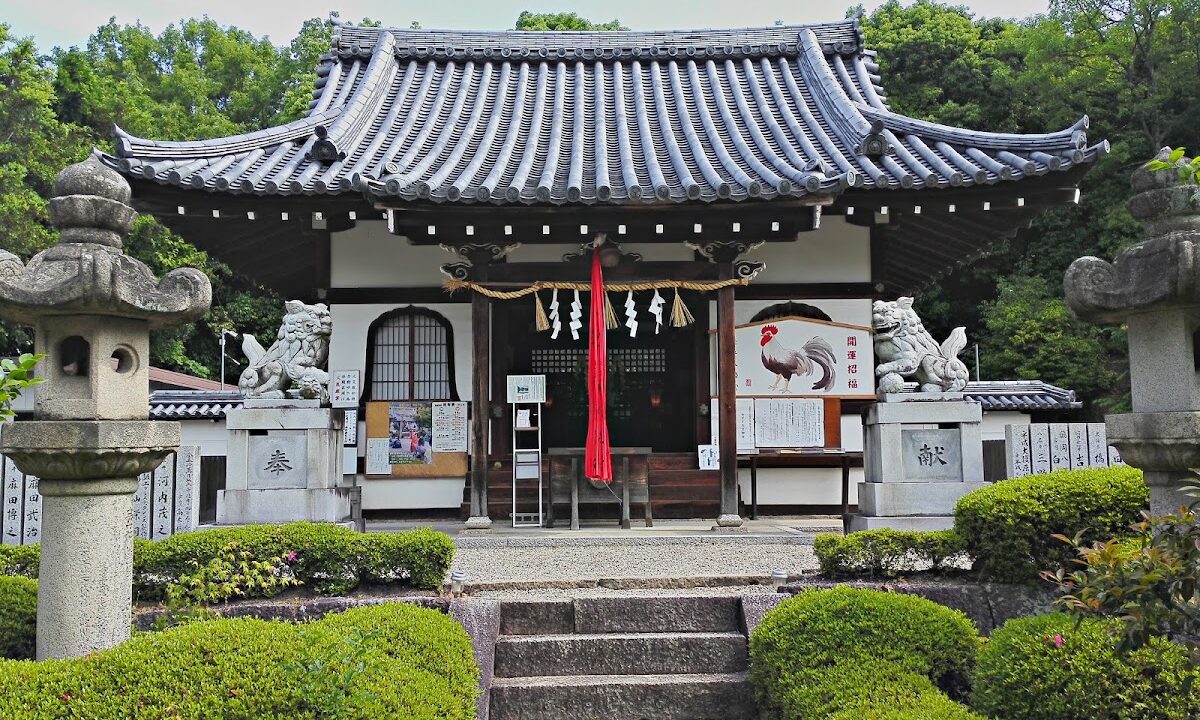
Tsuboi Hachimangu Shrine (Habikino City, Osaka Prefecture) Complete Guide: The Birthplace of the Kawachi Minamoto Clan and the Charm of Important Cultural Properties
Tsuboi Hachimangu Shrine, located in Habikino City, Osaka Prefecture, is a shrine boasting nearly a thousand years of history as the tutelary shrine of the Kawachi Minamoto clan, renowned as the leaders of the samurai class. Founded by Minamoto no Yoriyoshi and his son Yoshiie to commemorate their victory in the Former Nine Years’ War, the shrine retains numerous attractions that are unmissable for history buffs and shrine enthusiasts alike, including nationally designated important cultural properties such as armor and divine statues, and a giant camphor tree designated as an Osaka Prefecture natural monument.
This article provides a detailed explanation of everything you need to know before visiting Tsuboi Hachimangu Shrine, from its historical background and highlights within the grounds to access information, goshuin (shrine stamps), and surrounding spots.
History of Tsuboi Hachimangu Shrine: The Birthplace of the Kawachi Minamoto Clan
The Kawachi Minamoto Clan and the Private Residence of Minamoto no Yorinobu
The history of Tsuboi Hachimangu Shrine dates back to 1020 (Kanjin 4) in the mid-Heian period. Minamoto no Yorinobu, a descendant of the Seiwa Minamoto clan, was appointed Governor of Kawachi Province and established his private residence in Tsuboi, Habikino City. Yorinobu expanded his power from his base in Kawachi, and his descendants came to be known as the “Kawachi Minamoto clan.”
The Kawachi Minamoto clan later became a prestigious family, producing many leaders of samurai families, including Minamoto no Yoritomo, who founded the Kamakura Shogunate, and played an extremely important role in the history of the samurai. Tsuboi Hachimangu Shrine, as the tutelary shrine built on the very birthplace of the Kawachi Minamoto clan, has been revered by samurai families.
Founded by Minamoto no Yoriyoshi and Yoshiie
Tsuboi Hachimangu Shrine was officially founded on May 15, 1064 (Kohei 7). Minamoto no Yoriyoshi, son of Minamoto no Yorinobu, and his eldest son, Minamoto no Yoshiie (known as Hachiman Taro Yoshiie), celebrated their victory in the Former Nine Years’ War (1051-1062) by inviting a sacred object from Iwashimizu Hachimangu Shrine in Kyoto and constructing a shrine building on the east side of their private residence.
The Former Nine Years’ War was a conflict to suppress the Abe clan’s rebellion in Oshu (present-day Tohoku region). Minamoto no Yoriyoshi and his son Yoshiie prayed for victory at Iwashimizu Hachimangu Shrine and achieved a resounding victory. In gratitude and as a token of appreciation, they founded the Hachimangu Shrine in Kawachi after their triumphant return.
Hachiman was worshipped as a god of war by samurai families, and was especially important to the Minamoto clan as their tutelary deity. Having received a branch shrine from Iwashimizu Hachimangu Shrine, Tsuboi Hachimangu Shrine became a spiritual pillar for the Kawachi Minamoto clan and a shrine that watched over the prosperity of the Minamoto family.
History of War and Reconstruction
After its founding, Tsuboi Hachimangu Shrine flourished as the tutelary shrine of the Kawachi Minamoto clan, but it was devastated by the fires of war during the Sengoku period (Warring States period). Many shrines and temples suffered damage from fires and destruction during the turbulent times, and Tsuboi Hachimangu Shrine was no exception.
Later, in 1701 (Genroku 14) of the Edo period, the current shrine building was rebuilt by order of Tokugawa Tsunayoshi, the 5th shogun of the Tokugawa shogunate. Tsunayoshi is known as the shogun who issued the “Edict on Compassion for Living Things,” but he also had a strong sense of being a descendant of the Minamoto clan, and he devoted himself to the restoration of Tsuboi Hachimangu Shrine, which was associated with the Kawachi Minamoto clan. Through this reconstruction, Tsuboi Hachimangu Shrine revived as a shrine that attracted the faith of the local community throughout the Edo period.
During the Meiji era, it was ranked as a village shrine under the modern shrine ranking system and has been carefully preserved as the local tutelary deity to this day.
Highlights of Tsuboi Hachimangu Shrine
Nationally Designated Important Cultural Property: Kurokawa Odoshi Domaru (Black Leather-Laced Domaru Armor)
The most valuable cultural property owned by Tsuboi Hachimangu Shrine is the “Kurokawa Odoshi Domaru,” a nationally designated Important Cultural Property. This armor is a Kamakura period weapon said to have been favored by Minamoto no Yoshiie, and is a Domaru-style armor made of black leather (laminated with thread or leather plates).
Domaru armor developed from the late Heian period to the Kamakura period. Compared to O-yoroi (great armor), it was lighter, easier to move in, and more suitable for actual combat. The Kurokawa Odoshi Domaru is in excellent condition and is an extremely valuable historical document for understanding the weapon-making techniques and equipment of samurai at that time.
Currently, this black leather-laced cuirass is on deposit at the Tokyo National Museum and is not normally on display at Tsuboi Hachimangu Shrine, but it is sometimes exhibited during special exhibitions.
Important Art Object: Tenkomaru Sword
Tsuboi Hachimangu Shrine also possesses another important art object: the “Tenkomaru Sword.” This sword is also said to be associated with Minamoto no Yoshiie and is a valuable cultural asset that conveys the glory of the Kawachi Minamoto clan, a prestigious samurai family.
Swords were the primary weapon of samurai from the Heian period to the Kamakura period, and particularly famous swords were symbols of the authority of military commanders. The Tenkomaru Sword, as its name suggests, is said to possess a mystical radiance and is carefully preserved as a treasure symbolizing the bravery and spirituality of the Minamoto clan.
Nationally Designated Important Cultural Property: Wooden Statues of Hachiman and Other Deities
Tsuboi Hachimangu Shrine also has a group of wooden statues of deities designated as important cultural properties. The “Wooden Monk-Shaped Hachiman and Other Deities” is a rare example of a deity, depicting Hachiman in the form of a Buddhist monk, and is a valuable example of the syncretic belief system of the Shinto-Buddhist era.
Hachiman became syncretized with Buddhism during the Nara period and was often depicted in the form of a monk. This group of statues is estimated to have been created between the Heian and Kamakura periods, and is an important cultural asset for understanding the sculptural techniques and beliefs of that time.
Osaka Prefecture Designated Natural Monument: Tsuboi Hachiman Shrine’s Camphor Tree
The most impressive feature on the shrine grounds is the “Tsuboi Hachiman Shrine’s Camphor Tree,” a designated natural monument of Osaka Prefecture. This gigantic camphor tree is estimated to be approximately 1000 years old and can be considered a living witness that has watched over the shrine grounds since its founding.
With a trunk circumference exceeding 10 meters and a height of over 30 meters, this massive tree overwhelms visitors with its majestic presence. The tree is vigorous, and from spring to summer, its lush green leaves bring a refreshing atmosphere to the shrine grounds.
The camphor tree has long been revered as a sacred tree of Shinto shrines, and the camphor tree at Tsuboi Hachimangu Shrine is cherished by the local people as a sacred tree that has grown alongside the history of the Minamoto clan. When you visit the shrine grounds, be sure to stand before this giant tree and reflect on its thousand-year history.
Tsuboi Gongen Shrine
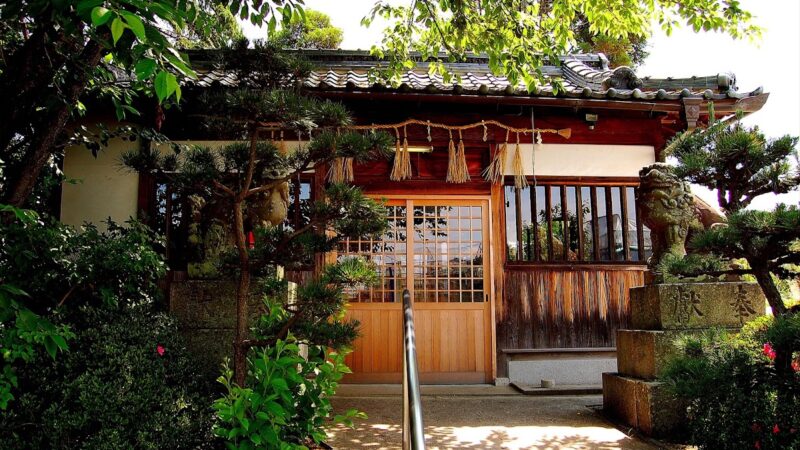
Within the shrine grounds stands the Tsuboi Gongen Shrine, said to have been founded by Minamoto no Yoshitoki, the son of Minamoto no Yoshiie. Gongen shrines are based on the syncretic belief of Shinto and Buddhism, representing the belief that Buddha appeared (manifested) in the form of a god.
The Tsuboi Gongen Shrine is built separately from the main shrine and is a historically valuable structure that speaks to the deep faith of the Kawachi Minamoto clan. It is thought to have been renovated during the Edo period and retains the architectural style of that time.
Atmosphere of the Shrine and Grounds
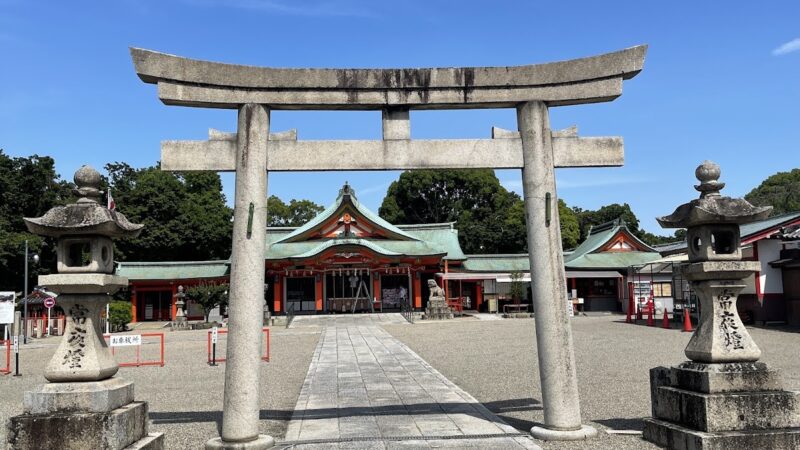
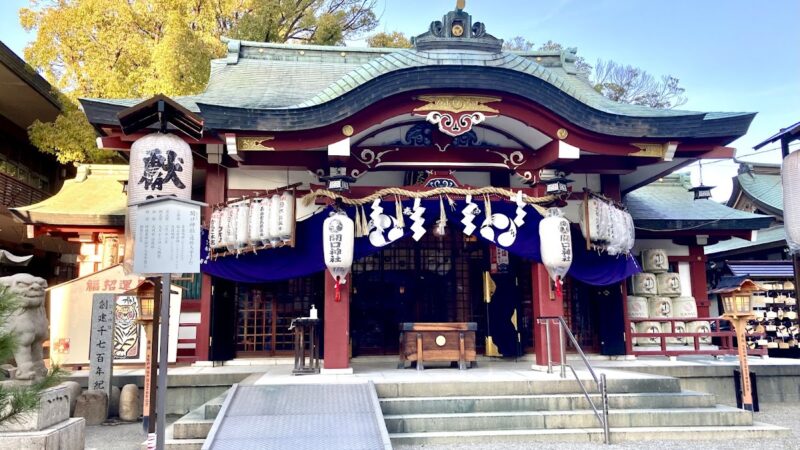
The current shrine building was rebuilt in 1701 (Genroku 14) by order of Tokugawa Tsunayoshi and exhibits characteristics of mid-Edo period shrine architecture. The main hall is a one-bay nagare-zukuri style building, and while it lacks extravagant decoration, it has the simple yet robust appearance befitting a samurai shrine.
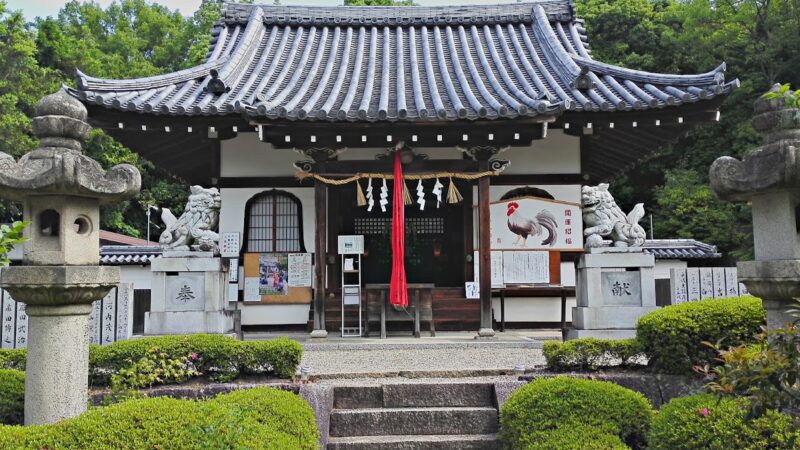
The worship hall is an irimoya-zukuri style building and is maintained as a place for worshippers to offer prayers. The grounds are relatively compact, but the placement of large camphor trees, stone lanterns, and guardian lion-dogs creates a solemn atmosphere that conveys a sense of historical weight.
Especially during the autumn foliage season and the New Year’s visit period, it is bustling with local worshippers, showing a different face in each season.
Historic Site Designation and Cultural Property Protection
The grounds of Tsuboi Hachimangu Shrine are recognized for their historical value as the birthplace of the Kawachi Minamoto clan and have been designated as a historical site. The shrine grounds and surrounding area contain the remains of the Minamoto clan’s private residence and related structures, making it an archaeologically important site.
Osaka Prefecture and Habikino City are working to protect and utilize the group of historical sites associated with the Kawachi Minamoto clan, including Tsuboi Hachimangu Shrine, and are using them as a regional historical resource to promote tourism. The shrine grounds are well-preserved, and regular maintenance efforts continue to ensure that these valuable cultural assets are passed on to future generations.
Goshuin (Shrine Seals) and Amulets
Goshuin Information
Tsuboi Hachimangu Shrine offers goshuin (shrine seals) to visitors. The goshuin features the calligraphy and red seal of “Tsuboi Hachimangu Shrine,” making it a special item as it is associated with the Kawachi Minamoto clan.
Goshuin are available at the shrine office, and the offering fee is approximately 300 to 500 yen, similar to other shrines. However, since the shrine office may be unattended, it is recommended that those who definitely wish to receive a goshuin (shrine stamp) call ahead to confirm.
While you can have your goshuin written directly in your goshuincho (stamp book), pre-printed goshuin may also be available. For those who enjoy visiting shrines, the goshuin from Tsuboi Hachimangu Shrine, associated with the Kawachi Minamoto clan, will be a particularly valuable addition to your collection.
Amulets and Souvenirs
Tsuboi Hachimangu Shrine also offers various amulets and ema (votive tablets). As a shrine dedicated to Hachiman, the god of war, it is believed to bring good fortune in competitions, good luck, and protection from evil, attracting students taking exams and those embarking on new challenges.
Furthermore, as a shrine associated with the Minamoto clan, amulets wishing for lasting military success and family prosperity are also popular. The shrine office staff will provide courteous service, so why not pick up a souvenir as a memento of your visit?
Access Information
Basic Information
Address: 605-2 Tsuboi, Habikino City, Osaka Prefecture
Phone Number: 072-956-2824
Official Website: http://tuboihatimanguu.jp/
Access by Train
The nearest station to Tsuboi Hachimangu Shrine is “Kaminotaishi Station” on the Kintetsu Minami-Osaka Line.
- Walking distance from Kaminotaishi Station: Approximately 20-25 minutes
- Exit the station and head east, passing through the residential area towards Tsuboi. There are signs along the way, but for first-time visitors, using a smartphone map app is recommended.
Since you will be walking, we recommend wearing comfortable shoes. The route is relatively flat, but it is a considerable distance, so please plan your visit with ample time.
Access by Car
If visiting by private car, the following route is convenient.
- Hanshin Expressway/Nishi-Meihan Expressway: Approximately 15 minutes from Fujiidera IC
- National Route 170 (Outer Ring Road): From Habikino city center towards Tsuboi
Please enter “Tsuboi Hachimangu Shrine” or the address “605-2 Tsuboi, Habikino City” into your car navigation system.
Parking
Tsuboi Hachimangu Shrine has a parking lot for visitors. However, the number of spaces is limited, and it may be full during busy periods such as New Year’s Day and festivals. During long holidays or special events, please consider using public transportation.
Parking is free, but since the shrine grounds are a historical site with many cultural properties, please be mindful of proper parking and worship etiquette.
Worship Manners and Precautions
Visiting Hours
Tsuboi Hachimangu Shrine is generally open for worship during the daytime. Please note that the reception hours at the shrine office may be limited. If you wish to receive a Goshuin (shrine stamp) or other items, we recommend visiting between 9:00 AM and 4:00 PM.
Attire and Items to Bring
Please dress appropriately for visiting a shrine. While there are no strict dress code regulations, it is considered polite to avoid revealing or overly flashy clothing.
The shrine grounds are a historical site with many cultural artifacts. Photography is permitted, but please refrain from taking pictures inside the shrine buildings or in sacred areas, or obtain permission beforehand. Also, please be careful not to damage natural monuments such as camphor trees.
Accessibility Information
The shrine grounds contain many historical buildings and have steps and stone paths. If you wish to visit using a wheelchair or stroller, we recommend contacting the shrine in advance to confirm accessible routes.
Nearby Tourist Attractions
Tsuhoji Temple Ruins
To the west of Tsuboi Hachimangu Shrine are the ruins of Tsuhoji Temple, said to have been founded by Minamoto no Yorinobu. Although only a stone monument remains today, this is a place where you can imagine what it was like when the private residence of the Kawachi Minamoto clan and a temple were adjacent to each other.
Kawachi Minamoto Residence Site
Near Tsuboi Hachimangu Shrine, the site of the Kawachi Minamoto residence, believed to be the location of Minamoto no Yorinobu’s private residence, also remains. Although it is now a residential area, information boards have been installed, allowing visitors to enjoy a tour of historical sites related to the Minamoto clan.
Eifuku-ji Temple (Kami-no-Taishi)
Near Kintetsu Kami-no-Taishi Station is Eifuku-ji Temple, believed to be the burial place of Prince Shotoku. Visiting it together with Tsuboi Hachimangu Shrine will give you a deeper understanding of Osaka’s history from ancient to medieval times.
Kofun Clusters in Habikino City
Habikino City is home to the Furuichi Kofun Cluster, part of the World Heritage Site “Mozu-Furuichi Kofun Group.” In addition to visiting massive burial mounds such as the Emperor Ōjin Mausoleum (Homuda Gobyōyama Kofun), you can learn about excavated artifacts and local history at the Habikino City Historical Museum.
Visiting Tsuboi Hachimangu Shrine in conjunction with this allows you to experience the rich history and culture of the Minami-Kawachi region of Osaka Prefecture, from ancient times through the medieval and early modern periods.
Annual Events and Festivals
Tsuboi Hachimangu Shrine holds various festivals and events throughout the year.
Grand Festival
The Grand Festival is held every October, bringing together local parishioners and worshippers. A procession of portable shrines and dedication ceremonies take place, and the shrine grounds are bustling with many visitors. As a shrine associated with the Kawachi Minamoto clan, it attracts many martial arts practitioners and history enthusiasts.
New Year’s Visit
At the start of the new year, visitors come for their first shrine visit of the year. The shrine is bustling with people, mainly locals, praying for safety and prosperity in the new year. The shrine office is open from New Year’s Day through the third day of the year, and you can receive Goshuin (shrine stamps) and other offerings.
Other Annual Events
Traditional annual events of the shrine, such as the Spring Kinensai (Harvest Festival), Summer Natsukoshi no Harae (Summer Purification Ceremony), and Autumn Niinamesai (Harvest Festival), are also held. Detailed schedules can be found on the official website or by phone.
The Significance of Visiting Tsuboi Hachimangu Shrine
Tsuboi Hachimangu Shrine is not merely a tourist spot; it is a historical sacred site essential for understanding the origins of Japan’s samurai society. The ancestors of many warriors who played active roles in later eras, such as Minamoto no Yoritomo, Ashikaga Takauji, and Nitta Yoshisada, departed from this place.
Standing within the shrine grounds, you can feel the spirit of the era when samurai of the Heian period offered prayers at Iwashimizu Hachimangu Shrine before heading to the battlefield. The armor and divine statues, designated as important national cultural properties, and the thousand-year-old camphor tree teach us the weight and reverence of history, transcending a thousand years of time.
For history buffs, shrine enthusiasts, and those seeking tranquil moments, Tsuboi Hachimangu Shrine will undoubtedly be a memorable and special place. When visiting Habikino City, Osaka Prefecture, be sure to stop by.
Summary
Tsuboi Hachimangu Shrine, as the birthplace of the Kawachi Minamoto clan, is a valuable shrine that preserves the culture and history of Japanese samurai. Founded by Minamoto no Yoriyoshi and his son Yoshiie to commemorate their victory in the Former Nine Years’ War, the shrine buildings were rebuilt by Tokugawa Tsunayoshi. Highlights include the nationally designated important cultural property, the Kuroi-odoshi Domaru (black leather-laced armor), wooden statues of deities, and the camphor tree, a designated natural monument of Osaka Prefecture.
It is accessible on foot from Kaminotaishi Station on the Kintetsu Minami-Osaka Line, and a parking lot is available for those arriving by car. With the availability of Goshuin (shrine stamps) and other offerings, it’s an ideal spot to include in a shrine pilgrimage.
Habikino City has many other ancient burial mounds and historical sites, and you can explore the history and culture of Minami-Kawachi in depth, starting from Tsuboi Hachimangu Shrine. I highly recommend visiting Tsuboi Hachimangu Shrine, a hidden historical gem in Osaka Prefecture.