Complete Guide to Dewa Shrine: History and Worship Methods of the Three Gods’ Combined Shrine at the Summit of Mt. Haguro
What is Dewa Shrine?
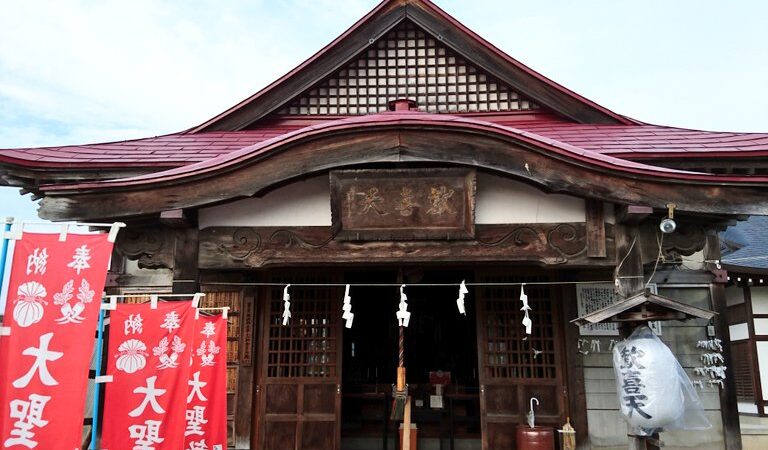
Dewa Shrine (Ideha Jinja) is a shrine located at the summit of Mt. Haguro in Tamuke, Haguro-cho, Tsuruoka City, Yamagata Prefecture. It is a central site of mountain worship, known as the collective name for the Dewa Sanzan (Mt. Gassan, Mt. Haguro, and Mt. Yudono), and its most distinctive feature is the “Three Gods’ Combined Shrine,” which enshrines the three gods of Mt. Haguro, Mt. Gassan, and Mt. Yudono together.
The enshrined deities are Ideha-no-kami and Ukanomitama-no-mikoto, and it is a prestigious shrine with a long history dating back to ancient times as a Shikinaisha (a shrine listed in the Engishiki, an ancient Japanese legal text). It was formerly ranked as a National Shrine of the lower rank, boasting a history of over 1400 years as one of the oldest shrines in the Tohoku region.
Located in the Shonai region of southern Dewa Province, the Dewa Sanzan have long been an object of mountain worship. Hagurosan symbolizes worldly benefits, Gassan symbolizes the afterlife, and Yudonosan symbolizes rebirth. Visiting these three mountains was widely practiced among common people during the Edo period as a “journey of rebirth.”
History of Dewa Sanzan Shrine and the Syncretism of Shinto and Buddhism
Founding and Ancient Beliefs
The history of Dewa Shrine begins in 593 AD, the first year of Emperor Suiko’s reign, when Prince Hachiko, son of Emperor Sushun, opened Hagurosan. It is said that Prince Hachiko fled the capital to the Tohoku region, landed at Yaotomeura (present-day Yura), and was guided to Hagurosan by a three-legged sacred crow.
At the summit, he perceived the three deities—Amida Buddha, Kannon Bodhisattva, and Dainichi Nyorai—and enshrined them as Haguro Gongen. From this legend, the mountain’s name, “Haguro,” is thought to originate from the sacred crow.
Syncretism of Shinto and Buddhism and the Development of Shugendo
From the Heian period to the Edo period, the Dewa Sanzan mountains flourished as a major center of Shugendo, adopting a form of syncretism of Shinto and Buddhism. Known as the Haguro-ha ancient Shugendo, it became a place where Shugendo practitioners (yamabushi) from all over Japan gathered to undergo rigorous training.
Hagurosan enshrined Haguro Gongen (Ideha-no-kami), Gassan Gongen (Tsukuyomi-no-Mikoto) on Gassan, and Yudonosan Gongen (Oyamatsumi-no-Mikoto, Onamuchi-no-Mikoto, Sukunahikona-no-Mikoto) on Yudonosan, establishing a unique form of faith that fused Buddhism and Shinto.
The Meiji Restoration and the Separation of Shinto and Buddhism
The Meiji Restoration’s decree separating Shinto and Buddhism brought about a major transformation for the Dewa Sanzan mountains. The Buddhist elements were removed, and the mountains were reorganized as purely Shinto shrines. Haguro Gongen became Dewa Shrine, Gassan Gongen became Gassan Shrine, and Yudonosan Gongen became Yudonosan Shrine, resulting in their current forms.
However, the tradition of Shugendo is still passed down today as the Haguro-ha Koshugendo, and rituals such as mountain ascetics entering the peaks are still performed.
Sanshin Gosaiden: Japan’s Foremost Grand Shrine
Architectural Features and History
The Sanshin Gosaiden, located on the summit of Mount Haguro, is Japan’s largest grand shrine, enshrining the three deities of Mount Haguro, Mount Gassan, and Mount Yudono. The current shrine was rebuilt in 1818 during the Edo period and is designated as a National Important Cultural Property.
The shrine is a wooden building with a thatched roof, measuring 28 meters wide, 17 meters deep, and 28 meters high. The thatched roof, reaching 2.1 meters in thickness, is one of the largest in the Tohoku region, and the re-thatching work, which occurs only once every 10 years, requires enormous labor and skill.
The architectural style is a unique structure called “Gassho-zukuri,” forming a landscape characteristic of mountain temples. The interior, adorned with vermilion-painted pillars and lavish decorations, is highly regarded as a masterpiece showcasing the pinnacle of Edo period architectural techniques.
Why are the three deities enshrined together?
The reason the Three Deities’ Shrine was built lies in the difficulty of visiting during winter. Mount Gassan (1984 meters above sea level) and Mount Yudono (1500 meters above sea level) are covered in deep snow during winter, making visits impossible. On the other hand, Mount Haguro (414 meters above sea level) is a relatively low mountain and can be visited throughout the year.
Therefore, a shrine enshrining the three deities together was built on the summit of Mount Haguro so that people could worship the gods of all three mountains even in winter. The belief that visiting this shrine is equivalent to paying respects to the gods of all three mountains at once has become established, and many worshippers still visit today.
Highlights and a Guide to the Shrine Grounds
The Path from the Zuishinmon Gate to the Summit
Visiting Dewa Shrine begins at the Zuishinmon Gate at the foot of Mount Haguro. From here to the summit, the traditional method of worship is the “stone staircase pilgrimage,” which involves climbing 2,446 stone steps.
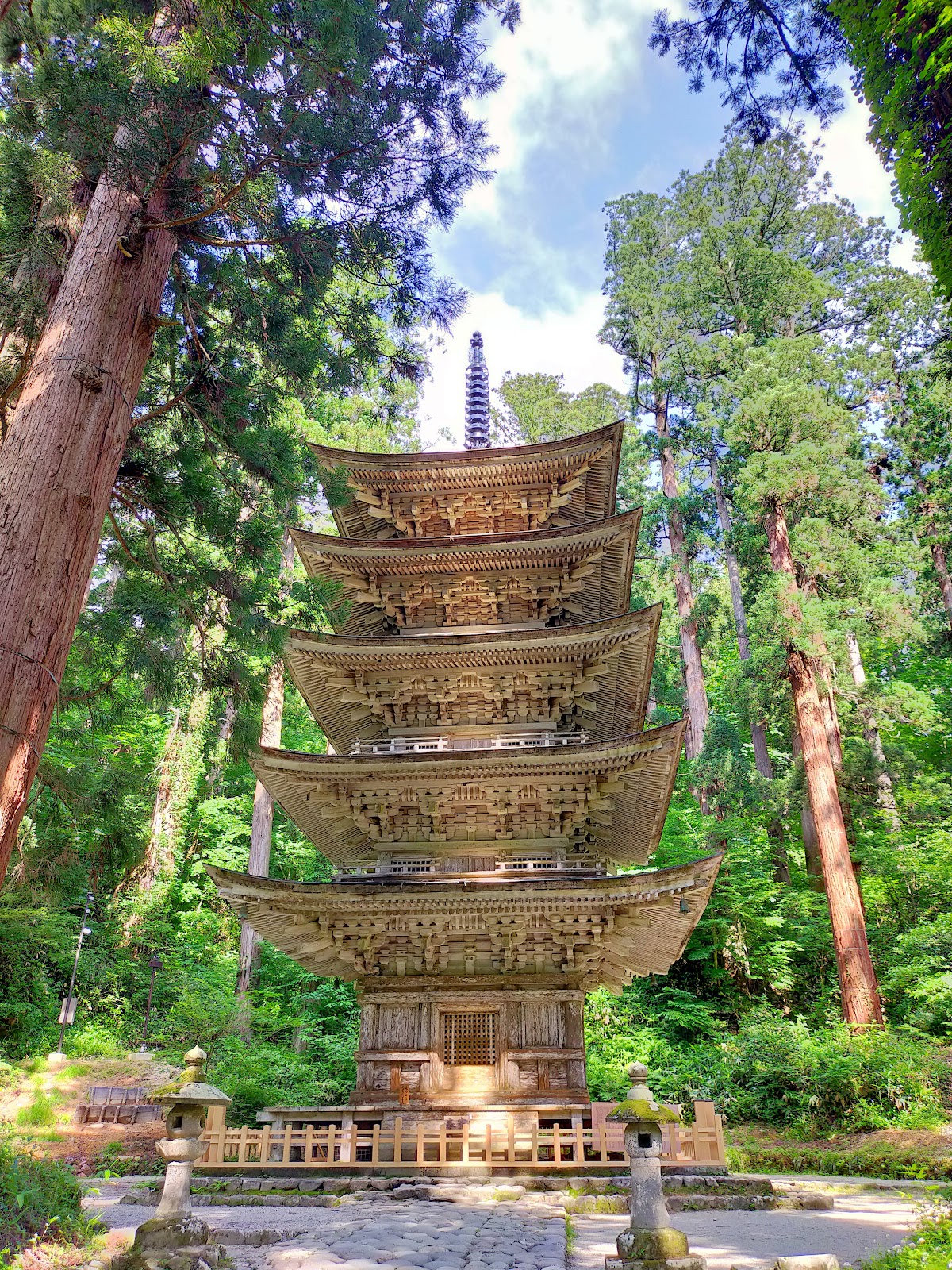
Along the steps is a five-story pagoda designated as a National Treasure. Believed to have been built during the Jōhei era of the Heian period (931-938), it is known as the oldest five-story pagoda in the Tohoku region. This 29.4-meter-tall pure wooden structure, harmonizing beautifully with the surrounding cedar trees, is a representative landscape of the Dewa Sanzan mountains.
Jiji-sugi and the Giant Trees Over a Thousand Years Old
Along the steps stands the “Jiji-sugi,” a gigantic cedar tree estimated to be over 1,000 years old. This giant tree, with a trunk circumference exceeding 10 meters, has watched over pilgrims to the Dewa Sanzan mountains throughout its long history.
Throughout Mount Haguro, a cedar avenue stretching for approximately 1 kilometer, with trees ranging from 300 to 500 years old, is designated as a Special Natural Monument. This cedar avenue is an important element that gives visitors a sacred atmosphere.
Facilities at the Summit
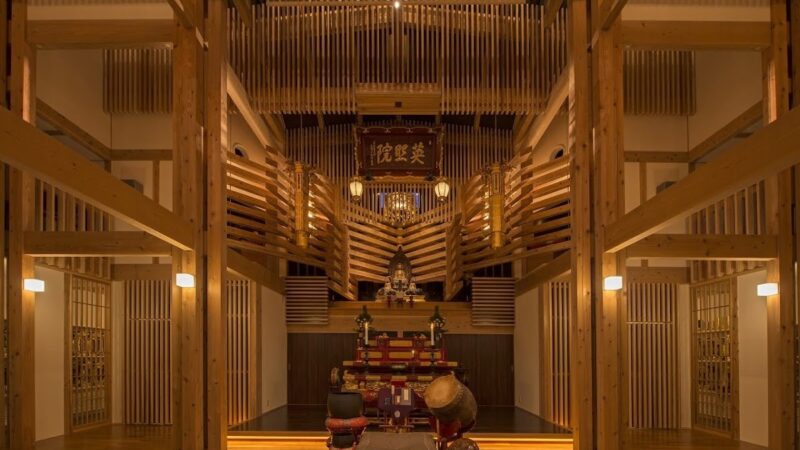
Upon reaching the summit, various facilities are arranged around the Sanjin Gosaiden (Three Gods’ Combined Shrine), including Kagamiike (Mirror Pond), a bell tower, and a saikan (ritual hall).
Kagamiike is a central sacred site of Haguro faith, where many bronze mirrors have been dedicated since ancient times. Hundreds of bronze mirrors dating from the Heian to Kamakura periods have been unearthed and are designated as important national cultural properties.
The Bell Tower houses a bronze bell designated as an important national cultural property, and is considered one of the oldest bells in the Tohoku region.
Saikan is accommodation for visitors, where they can enjoy vegetarian cuisine. The vegetarian cuisine of Dewa Sanzan is traditional, using local ingredients such as wild vegetables and mushrooms, allowing visitors to experience the food culture of Shugendo (mountain asceticism).
How to Visit and Manners
Basic Flow of Visiting
Visiting Dewa Shrine follows the following flow: 1. Bow at the Zuishinmon Gate: Bow at the Zuishinmon Gate, the entrance to the approach to the shrine, to compose yourself.
- Climbing the Stone Steps: Purify your mind and body as you climb the 2446 stone steps. Offer prayers at the Five-Storied Pagoda and the Jiji-sugi Cedar along the way.
- Purification at the Water Basin: Purify your hands and mouth at the water basin at the summit.
- Worship at the Sanshin Gosaiden (Three Gods’ Combined Shrine): Worship using the two bows, two claps, and one bow ritual.
- Receiving a Goshuin (Shrine Seal): You can receive a Goshuin at the shrine office.
Time Required and Precautions for Climbing the Stone Steps
Climbing the stone steps from the Zuishinmon Gate to the summit usually takes about 1 to 1.5 hours. Since some sections of the steps are steep, comfortable shoes and clothing are recommended.
During winter, the trails become slippery due to snow and ice, so extra caution is necessary. Walking sticks are available for rent, so please use them if needed.
For those who are not confident in their physical strength or have limited time, you can drive to the summit using the toll road. A parking lot is available at the summit.
Goshuin (Shrine Seals) and Souvenirs
At Dewa Shrine, in addition to the Goshuin of the Three Gods’ Combined Shrine, Goshuin of Gassan Shrine and Yudono-san Shrine are also available. Collecting all three Goshuin is a goal for many visitors.
Souvenirs include amulets featuring the guardian deities of Dewa Sanzan and items inspired by the attire of mountain ascetics.
The Faith of Dewa Sanzan: A Journey of Rebirth
The Meaning of Each of the Three Mountains
Visiting Dewa Sanzan is understood not merely as a shrine visit, but as a “journey of rebirth.”
- Mount Haguro: A mountain that presides over worldly benefits and where prayers are offered for present happiness.
- Mount Gassan: A mountain symbolizing the afterlife and dedicated to ancestral spirits.
- Mount Yudono: A mountain signifying rebirth and where prayers are offered for the birth of new life.
The belief that visiting these three mountains allows one to relive a human life and achieve spiritual rebirth has been passed down from the Edo period to the present day.
Shugendo and the Training of Yamabushi
The Dewa Sanzan (Three Mountains of Dewa) is the center of the ancient Haguro school of Shugendo, and training by Yamabushi (mountain ascetics) is still practiced there today. Every summer, a training called “Autumn Peak Entry” is held, and the general public can participate.
During the training, participants wear white robes and perform rituals such as waterfall meditation and Goma fire rituals while traversing the mountains. Through this rigorous training, they aim to purify their mind and body and achieve spiritual growth.
Access and Visiting Information
Access by Public Transportation
Train and Bus
- Approximately 50 minutes by Shonai Kotsu bus bound for Hagurosan Summit from JR Uetsu Main Line “Tsuruoka Station”
- Bus service is limited, so it is recommended to check the timetable in advance.
- Please note that the number of buses decreases during the winter season.
Nearest Station
- JR Uetsu Main Line “Fujishima Station” or “Tsuruoka Station”
Access by Car
From Yamagata Area
- Approximately 40 minutes from Yamagata Expressway “Shonai Asahi IC”
- Via National Route 112 to Hagurosan Toll Road
From Niigata Area
- Approximately 30 minutes from Nihonkai Tohoku Expressway “Tsuruoka Nishi IC”
Parking
- Free parking available at the summit (approximately 150 cars)
- Parking also available near the Zuishinmon Gate
Visiting Hours and Admission Fee
- Visiting Hours: Grounds are freely accessible (Shrine office: 8:30-17:00)
- Admission Fee: Free
- Viewing the Interior of the Three Gods’ Shrine: Only possible during special viewing periods (advance confirmation required)
Accommodation
At the Saikan (shrine hall) at the mountaintop, you can experience accommodation and vegetarian cuisine. Also, in the Tamuke area at the foot of Mt. Haguro, many temple lodgings are in operation, offering a traditional temple lodging experience.
Annual Events and Festivals
Main Annual Events
January 1st: Saitansai (New Year’s Festival)
A festival celebrating the New Year, attracting many first-time visitors.
February 17th: Kinensai (Harvest Festival)
An important festival praying for a bountiful harvest.
July 15th: Hana Matsuri (Flower Festival)
A grand summer festival held at the mountaintop, featuring a portable shrine procession and other events.
Late August to Early September: Autumn Pilgrimage
This is the most important training period for the Haguro-ha ancient Shugendo sect.
December 31st: Shōreisai Festival
Designated as a National Important Intangible Folk Cultural Property, this is the largest festival of the Dewa Sanzan mountains. A magnificent fire festival takes place from New Year’s Eve to New Year’s Day, with large torches being burned.
Nearby Tourist Spots
Around Mount Haguro
Ideha Cultural Memorial Hall
A museum where you can learn about the history and culture of the Dewa Sanzan mountains, exhibiting valuable cultural artifacts.
Tamagawa-ji Temple
One of the 33 Kannon pilgrimage sites in Shonai, famous for its beautiful garden.
Tsuruoka City
Chidō Museum
A comprehensive museum introducing the history and culture of the Shonai region.
Tsuruoka Park
Known as a famous cherry blossom viewing spot, it is bustling with many visitors in spring.
To Learn More About Dewa Shrine
Related Books
For those who wish to learn more about the history and faith of the Dewa Sanzan mountains, the following books are recommended:
- *Dewa Sanzan – History and Culture of Mountain Worship*
- *A Study of Haguro Shugendo*
- *The World of Dewa Sanzan Faith*
These books provide detailed explanations of the complex forms of faith and historical background of the Dewa Sanzan mountains.
How to Obtain Official Information
The official website of Dewa Sanzan Shrine contains the latest event information and visitor guides. The official Instagram and Twitter accounts also share beautiful scenery and event details throughout the seasons.
Before visiting, it is recommended to check official information, including event dates and any changes to visiting conditions due to weather.
Summary
Dewa Shrine is a sacred site of mountain worship representing Japan, with a history of over 1400 years. The Sanjin Gosaiden, a grand shrine dedicated to the three deities of Dewa Sanzan, stands atop Mount Haguro and continues to attract countless visitors as Japan’s finest shrine.
Dewa Sanzan, where Shugendo ascetic practices are still carried out today while inheriting the tradition of syncretism between Shinto and Buddhism, is a precious place to experience Japanese spiritual culture. The “Ishidan-mode,” a pilgrimage up 2,446 stone steps, is physically demanding, but the process purifies the mind and body, and the sense of accomplishment upon reaching the summit is exceptional.
A visit to Dewa Sanzan, cherished as a “journey of rebirth,” offers modern people a valuable opportunity to step away from daily life and reflect on themselves. We highly recommend visiting Dewa Shrine, surrounded by the beautiful nature of the four seasons.