Complete Guide to Oarai Isosaki Shrine | A Thorough Explanation of the Kamiiso Torii Gate, History, Prayers, and Access
Oarai Isosaki Shrine, located in Isohama-cho, Oarai-machi, Higashiibaraki-gun, Ibaraki Prefecture, is a shrine situated on a hill overlooking the Pacific Ocean’s rough waves. It is nationally known for its “Kamiiso Torii Gate” standing in the sea. With a history of over 1000 years since its founding in the Heian period, it is one of the leading power spots in the Kanto region, attracting many worshippers seeking blessings for medicine, protection from evil, and good fortune.
This article comprehensively explains everything you need to know before visiting Oarai Isosaki Shrine, including its enshrined deities, history, highlights, prayer information, and access methods.
Overview and Basic Information of Oarai Isosaki Shrine
Oarai Isosaki Shrine is a historically significant shrine listed in the Engishiki Jinmyocho (a list of shrines compiled in the Heian period) as a Shikinaisha (a major shrine listed in the Engishiki). Formerly a National Shrine of the second rank, it is currently designated as a Special Shrine by the Association of Shinto Shrines.
Basic Information
- Location: 6890 Isohama-cho, Oarai-machi, Higashiibaraki-gun, Ibaraki Prefecture
- Phone Number: 029-267-2637
- Opening Hours: May-August 5:30-18:00, September-April 6:00-17:00
- Prayer Reception: 9:00-15:30
- Shrine Office: 8:30-16:30
- Goshuin (Shrine Seal): 8:30-16:30
- Parking: 70 spaces (free)
- Admission Fee: Free
The shrine is situated on a hill overlooking the Pacific Ocean to the east on the Oarai coast, offering magnificent ocean views from its grounds. In particular, the “Kamiiso Torii” gate, standing on the rocky shore where it is said that a god descended, is a symbol of Oarai Isomae Shrine and Oarai Town, and is nationally famous as a spot to watch the first sunrise of the year.
Deities and History
Deities
Oarai Isomae Shrine enshrines two deities.
Ōnamuchi-no-Mikoto
Also known as Ōkuninushi-no-Mikoto, this deity is also the principal deity of Izumo Taisha Shrine. As the god of nation-building, he is worshipped in a wide range of fields, including agriculture, commerce, and medicine.
Sukunahikona-no-Mikoto
A deity who worked with Ōnamuchi-no-Mikoto in nation-building, he is especially known as the god of medicine, hot springs, and incantations. He is said to have possessed great wisdom despite his small stature and was skilled in the art of curing illnesses.
These two deities, working together to build the foundation of Japan, are worshipped as gods of medicine, protection from evil, and good fortune, particularly for their contributions to saving people in the field of medicine.
History and Origin
Origin of Founding
Oarai Isosaki Shrine is said to have been founded in the third year of the Saikō era (856 AD) during the Heian period. According to the *Montoku Jitsuroku* (Chronicle of Emperor Montoku), on December 29th of that year, the two deities Ōkuninushi-no-Mikoto and Sukunahikona-no-Mikoto descended upon the coast of Oarai Isosaki.
Tradition says that a shining object emerged from the sea, eventually taking the form of the two deities. Following this mystical event, local people built a shrine, marking the beginning of Oarai Isosaki Shrine. At the same time, Sakatsurai Isosaki Shrine, located on the opposite bank of the Nakagawa River, was also founded, and the two shrines have a deep connection.
Destruction and Reconstruction During the Sengoku Period
Oarai Isomae Shrine long attracted worshippers, but its buildings were destroyed by fire during the wars of the Sengoku period. Later, in the Edo period, Tokugawa Mitsukuni (known as Mito Kōmon), the second lord of the Mito domain, began the reconstruction of the shrine.
Tokugawa Mitsukuni valued the shrine’s history and ordered its restoration. Construction progressed during the reign of the third lord, Tokugawa Tsunajo, and the current shrine buildings were completed in 1730 (Kyōhō 15).
Current Architecture
The current shrine buildings are valuable cultural assets that convey the architectural style of the mid-Edo period. The worship hall features vibrant carvings, while the main hall has a simple thatched roof in a traditional style. These buildings are masterpieces of Edo period shrine architecture, completed under the generous protection of the Mito domain.
Kamiiso Torii Gate | The Biggest Highlight of Oarai Isomae Shrine
The “Kamiiso Torii Gate,” standing in the sea, is a must-see for anyone visiting Oarai Isomae Shrine.
What is the Kamiiso Torii Gate?
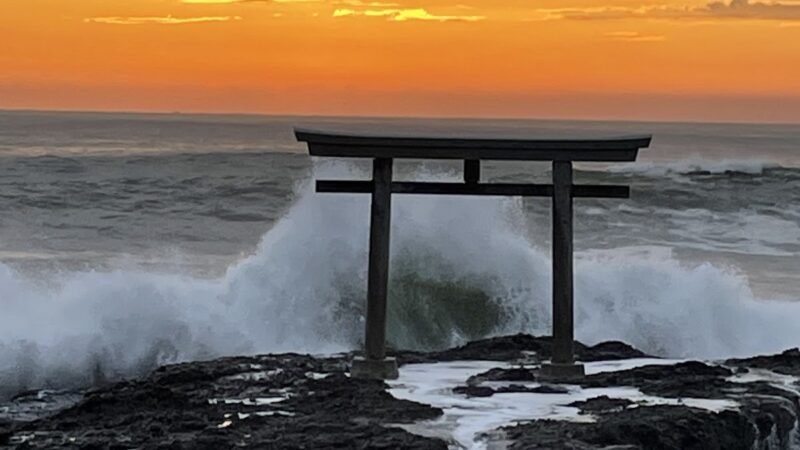
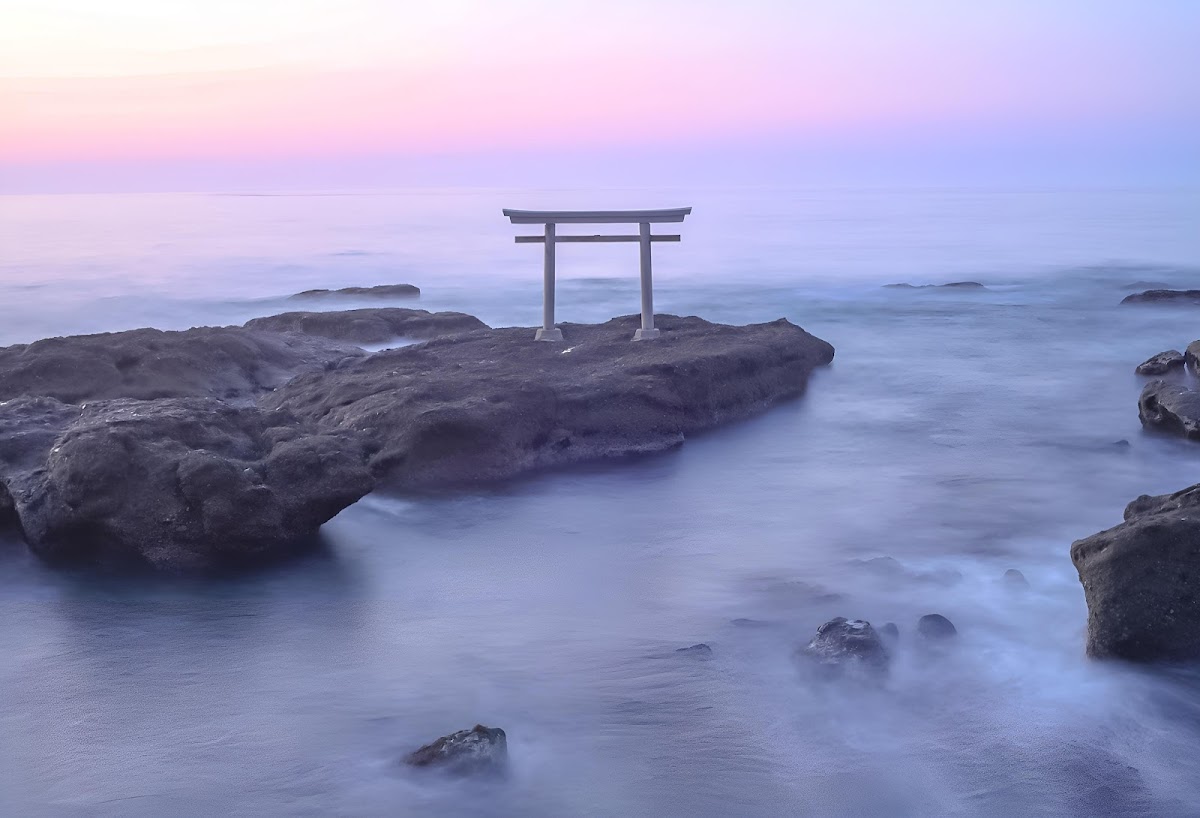
The Kamiiso Torii Gate stands on a rocky outcrop, battered by the rough waves of the Pacific Ocean, at the bottom of a staircase from the grounds of Oarai Isomae Shrine. This is Kamiiso, the sacred site where Ōkuninushi-no-Mikoto and Sukunahikona-no-Mikoto are said to have descended during the Heian period.
The torii gate, standing majestically amidst the white spray of waves, is truly divine and exudes an overwhelming presence that captivates visitors. Especially at sunrise, the silhouette of the torii gate against the rising sun creates a breathtaking spectacle, making it one of the top spots in Ibaraki Prefecture for viewing the first sunrise of the year.
First Sunrise and Sunrise Photography
Viewing the first sunrise from the Kamiiso Torii Gate is one of the most spectacular spots in the Kanto region. On New Year’s Day, many worshippers and photography enthusiasts visit, welcoming the start of the new year in a sacred atmosphere.
The sunrise over the torii gate, appearing from the horizon of the Pacific Ocean, and the sight of the orange light illuminating the sea surface, is breathtakingly beautiful. Not only during the first sunrise of the year, but early morning sunrises are a popular photography spot throughout the year.
Important Note: Do not bring stones from the sea into the shrine
There is an important point to remember when visiting the area around the torii gate at Kamiiso. That is, “Do not bring stones from the sea into the shrine.”
In recent years, there have been instances of people taking rocks and stones from Kamiiso as souvenirs or piling them up on the shrine grounds as a form of prayer, but this is explicitly prohibited by the shrine. Kamiiso is a sacred place, and it is important to maintain its natural state. Furthermore, moving stones on the beach is problematic from an environmental conservation perspective.
When visiting, please simply admire the beautiful scenery of Kamiiso with your eyes and take photographs, and refrain from touching the stones and rocks.
Highlights and Architecture of the Shrine Grounds
Worship Hall and Main Hall
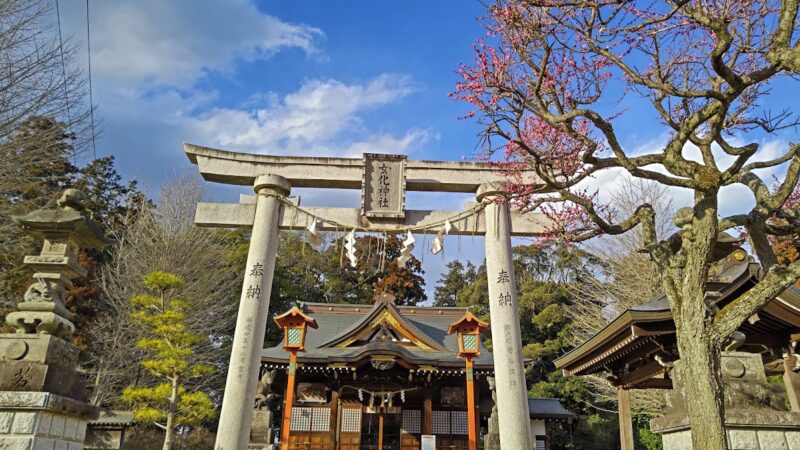
Completed in 1730 (Kyoho 15) during the restoration by Tokugawa Mitsukuni, the worship hall is a magnificent example of mid-Edo period architecture. The pillars and beams are adorned with intricate carvings, and the vibrant decorations welcome visitors.
The main hall, with its simple thatched roof, contrasts sharply with the worship hall, presenting a dignified yet understated appearance. This thatched-roof main hall is a valuable structure that preserves the ancient traditions of shrine architecture.
Zuishinmon Gate and Stone Steps
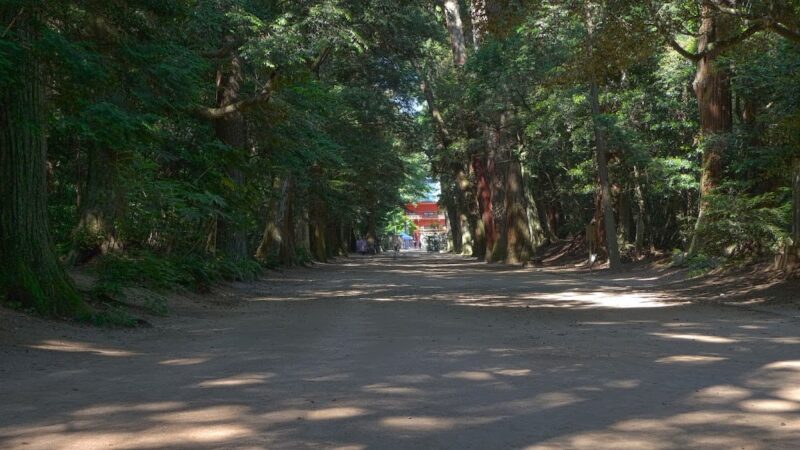
The Zuishinmon Gate, the entrance to the shrine grounds, is a vibrant vermilion gate that adds a sense of grandeur to the approach. Passing through the gate, stone steps descend towards the sea, leading to the Kamiiso Torii gate.
Views from the Shrine Grounds
Because the grounds of Oarai Isomae Shrine are located on a hill, a panoramic view of the Pacific Ocean can be enjoyed. On a clear day, you can see all the way to the horizon, and a magnificent view unfolds, a tapestry of blue sea and blue sky. This view is one of the reasons why Oarai Isomae Shrine is so popular.
Prayers and Blessings
Types of Prayers
At Oarai Isomae Shrine, you can receive various types of prayers. Prayer reception hours are from 9:00 to 15:30.
Main types of prayers:
- Prayer for Safe Childbirth: Prayers for the safety of the pregnant woman and a safe delivery.
- First Shrine Visit (Omiyamairi): Prayers for the healthy growth of the baby.
- Shichi-Go-San (7-5-3 Festival): Prayers for the growth of a child and for their health.
- Exorcism: Prayers for warding off misfortune during the unlucky year and for peace.
- Family Safety: Prayers for the health and happiness of all family members.
- Business Prosperity: Prayers for the development and prosperity of the business.
- Recovery from Illness: Prayers for recovery from illness.
- Traffic Safety: Prayers for the safety of vehicles and drivers.
Benefits
The deities enshrined at Oarai Isomae Shrine, Ōkuninushi-no-Mikoto and Sukunahikona-no-Mikoto, are known as gods of nation-building and medicine, and are therefore believed to offer the following benefits.
- Medicine and Healing: Deeply revered as the god of medicine
- Protection from Evil: Warding off misfortune and bad luck
- Matchmaking: Forging good relationships
- Business Prosperity: Success in business
- Family Safety: Peace and health for the family
- Maritime Safety: Deeply revered by those involved in fishing
In particular, the shrine has long been deeply revered as the god of medicine, and many worshippers visit to pray for healing from illness and good health.
Items Offered
The shrine office offers amulets, talismans, and votive tablets. The office is open from 8:30 to 16:30.
Popular items include health amulets, protection from evil amulets, and matchmaking amulets. Votive tablets featuring the torii gate of Kamiiso are also popular.
Goshuin (Shrine Seal)
Goshuin (shrine seals) at Oarai Isomae Shrine are available from 8:30 to 16:30. The goshuin (temple/shrine stamp) will have the shrine’s name and the date of visit written in ink, and then stamped with a red seal. You can bring your own goshuincho (stamp book) or purchase one on the spot.
Annual Events and Festivals
Oarai Isomae Shrine holds various festivals and events throughout the year.
Main Annual Events
January
- New Year’s Day Festival (January 1st): A festival celebrating the New Year
- First Sunrise Worship: The first sunrise of the year at the Kamiiso Torii gate is popular.
February
- Setsubun Festival: A ritual to ward off evil spirits by scattering beans.
April
- Spring Grand Festival: The grand spring festival.
July
- Summer Purification Ceremony: A Shinto ritual to purify oneself of the impurities accumulated over the past six months.
September
- Autumn Grand Festival: The grand autumn festival.
November
- Shichi-Go-San Festival: A celebration of children’s growth.
December
- Great Purification Ceremony: A ceremony to purify oneself of the impurities accumulated over the year.
- New Year’s Eve Festival: The year-end festival.
The Grand Festival includes a portable shrine procession and Kagura (sacred dance) performances, creating a lively atmosphere for the local community.
Access Methods
Oarai Isomae Shrine is easily accessible by train, bus, or car.
Access by Train and Bus
Using the Kashima Rinkai Railway Oarai-Kashima Line
- Get off at “Oarai Station”
- Take the Oarai Kaiyu-go bus for approximately 15 minutes and get off at the “Oarai Isomae Shrine-shita” bus stop.
- Alternatively, walk for approximately 40 minutes (approximately 3 km).
Using a Bus from Mito Station
- Approximately 30 minutes by Ibaraki Kotsu Bus (Route No. 50)
Access by Car
Using the Kita-Kanto Expressway
- Approximately 15 minutes (approximately 5.5 km) from the Mito-Oarai Interchange
Parking
There is a free parking lot on the shrine grounds with a capacity of 70 cars. During busy periods such as the first sunrise of the year or the annual festival, early arrival is recommended.
Bicycle Rental
Bicycle rental services are available around Oarai Station, allowing you to visit the shrine while cycling along the coast. Oarai Town has a relatively flat terrain, making it ideal for sightseeing by bicycle.
Tourist Attractions Around Oarai Isomae Shrine
When visiting Oarai Isomae Shrine, you can also enjoy the surrounding tourist attractions.
Sakatsura Isomae Shrine
This shrine is a counterpart to Oarai Isomae Shrine and enshrines Sukunahikona-no-Mikoto as its main deity. It is famous for its tunnel of camellia trees over 300 years old, and the scenery is especially beautiful during the blooming season from February to March.
Aqua World Ibaraki Oarai Aquarium
This is one of the largest aquariums in Japan, boasting the largest number of shark species in captivity. Dolphin and sea lion shows are also popular, making it a perfect spot for families.
Oarai Marine Tower
This 60-meter-high observation tower offers panoramic views of the Pacific Ocean and the townscape of Oarai. On clear days, you can sometimes see Mount Fuji.
Oarai Coast & Oarai Sun Beach
This beautiful coastline is perfect for swimming in the summer and for strolling and surfing during other seasons.
Oarai Town’s Food Culture
Oarai Town boasts abundant seafood, and its winter specialty, “Ankou Nabe” (anglerfish hot pot), is particularly exquisite. Many restaurants serve fresh seafood, making a meal after visiting the shrine another enjoyable experience.
As a Holy Site for Girls und Panzer
In recent years, Oarai Isomae Shrine has gained attention as a holy site for the popular anime “Girls und Panzer” (commonly known as “Garupan”). Because the story is set in Oarai Town, many anime fans visit, and the entire town is buzzing with collaborations with the anime.
Many anime-related ema (votive tablets) have been dedicated at the shrine, creating a new form of worship culture. Oarai Town’s efforts to foster coexistence between the community and anime fans are attracting attention as a successful example of regional revitalization.
Manners and Precautions for Visiting a Shrine
Basic Manners for Visiting a Shrine
- Bow before passing through the torii gate: A courtesy when entering the sacred area.
- Avoid walking in the center of the path: The center is the path of the gods.
- Purify your body and mind at the water basin: Purify your left hand, right hand, and mouth in that order.
- Two bows, two claps, one bow: Basic etiquette at the main hall.
Precautions around the Kamiiso Torii Gate
- Do not approach on days with high waves (safety first).
- Watch your step as the rocks are slippery.
- Do not take or pile stones from the sea.
- Always take your trash with you.
- When taking photos early in the morning, be considerate of other visitors.
Clothing
Since you will be descending stone steps to the Kamiiso Torii Gate, we recommend wearing comfortable shoes. Also, since it can be windy along the coast, it’s a good idea to bring a jacket.
Accommodation in Oarai
For those who want to enjoy the first sunrise of the year at Oarai Isomae Shrine or leisurely explore Oarai, staying in Oarai town is recommended.
Oarai town has several hot spring inns and hotels with ocean views overlooking the Pacific Ocean. Accommodations with open-air baths where you can watch the sunrise are particularly popular, and early reservations are necessary.
Enjoying cuisine made with fresh seafood is another highlight of your stay. Monkfish hot pot, a famous Oarai specialty in winter, is offered at many accommodations.
Summary: The Charm of Oarai Isomae Shrine
Oarai Isomae Shrine is a venerable shrine with a history of over 1000 years. It’s a power spot with many attractions, including its spectacular location facing the Pacific Ocean, its mystical Kamiiso Torii gate, and its blessings as a god of medicine, protection from evil, and good fortune.
From its mystical founding legend in the Heian period, its restoration in the Edo period by Tokugawa Mitsukuni, to its new aspect as a modern anime pilgrimage site, it continues to attract people across generations.
From the breathtaking view of the first sunrise of the year, to the tranquil atmosphere of worship away from the hustle and bustle of everyday life, to prayers of gratitude for the blessings of the sea—Oarai Isomae Shrine offers a special experience for each visitor.
When you visit Ibaraki Prefecture, be sure to stop by Oarai Isomae Shrine and experience the grandeur of the Pacific Ocean and the history of the shrine at this sacred site where the sacred torii gate of Kamiiso stands. It is sure to be a memorable pilgrimage experience.