What is Taiheiji Temple? A Complete Guide to the History, Characteristics, and Access of Taiheiji Temples Nationwide
The name Taiheiji (太平寺) exists in multiple regions throughout Japan. Each has its own unique history and beliefs, and has been cherished by the local people. This article focuses on Taiheiji temples of particular historical and cultural importance, providing detailed explanations of their origins, characteristics, cultural assets, and visiting information.
Origin and Meaning of the Name Taiheiji Temple
The name “Taiheiji” originates from the word “Taihei,” meaning “peace,” “tranquility,” and “a peaceful era.” Many Taiheiji temples were built during times of war or social unrest, and functioned as places to pray for peace. In Buddhism, “Taihei” is not merely the absence of war, but a deeper concept signifying peace of mind for people and harmony for society as a whole.
The existence of temples with the same name throughout Japan can be seen as a result of the wishes for peace embodied in each region. Below, we will introduce Taiheiji temples of particular historical importance in detail.
Taiheiji Temple in Kamakura City: The Foremost Temple of the Five Kamakura Nunneries
History and Origin
Taiheiji Temple, located in Nishimikado Village, Kamakura District, Sagami Province (present-day Nishimikado, Kamakura City, Kanagawa Prefecture), was a Rinzai Zen nunnery that boasted the highest rank as the foremost of the Five Kamakura Nunneries. From the Kamakura period to the Muromachi period, it played an important role as a training ground for women and as a place where daughters of samurai families became nuns.
The Five Kamakura Nunneries was a ranking system for Rinzai Zen nunneries established by the Kamakura and Muromachi Shogunates, and Taiheiji Temple held the highest position. This high rank speaks to the social influence and depth of faith the temple held.
Founding and Development
There are various theories regarding the founding of Taiheiji Temple, but the most likely theory is that it was established in the mid-Kamakura period by a woman from the Hojo clan. Under the patronage of the Hojo clan, a powerful vassal family of the Kamakura Shogunate, Taiheiji Temple flourished through numerous donations and land contributions.
During the Muromachi period, it also received protection from the Ashikaga Shogunate, solidifying its position with the establishment of the Five Nunneries system. At that time, Taiheiji Temple served as a gathering place for many learned monks, functioning as a center for studying Zen teachings.
Circumstances of its Abandonment
The history of Taiheiji Temple underwent a major turning point in 1556 (Koji 1). In that year, Satomi Yoshihiro, a Sengoku daimyo from Awa Province (present-day southern Chiba Prefecture), attacked Kamakura, causing damage to many temples and shrines. Taiheiji Temple was also affected by this conflict, falling into ruin and eventually becoming an abandoned temple.
While many temples in Kamakura declined during the turbulent Sengoku period, the abandonment of Taiheiji Temple, which held the high status of the head temple of the Five Nunneries of Kamakura, was a great loss to society at the time.
Current Remains and Historic Sites
Currently, the site of Taiheiji Temple remains in the Nishimikado district of Kamakura City. A few stone monuments and foundation stones hint at its former glory. Local historians and community researchers continue their investigations, and archaeological excavations are gradually revealing the layout of the buildings and the lifestyle of the time.
As part of Kamakura City’s efforts to protect cultural properties, the Taiheiji Temple site is recognized as an important historical site, and an information board has been installed. It is a place worth visiting for those who want to learn more about the history of Kamakura.
Taiheiji Temple in Tennoji Ward, Osaka City: A Temple Popular for the “Thirteen Pilgrimage”
Basic Information and Origin
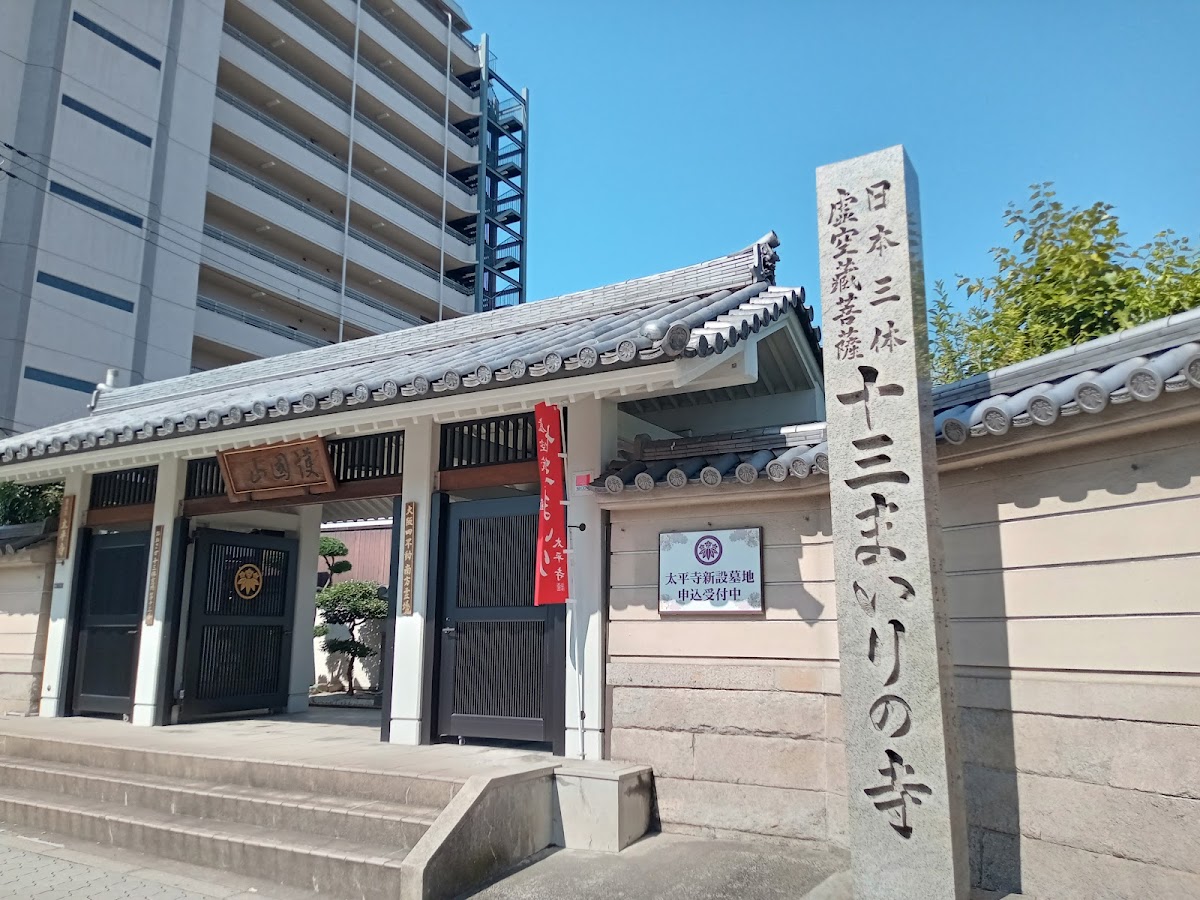
Taiheiji Temple, located in Tennoji Ward, Osaka City, is a Soto Zen Buddhist temple with the mountain name Gokokuzan. Its principal image is Kokuzo Bosatsu (Akasagarbha Bodhisattva), and it is particularly popular among locals as a temple for the “Thirteen Pilgrimage.”
Taiheiji Temple was originally a single building within the grounds of Shitennoji Temple, existing as Ryushoji Temple of the Shingon sect around 1555. Although it later fell into disrepair, it was restored as a Soto Zen temple during the Edo period.
The Tradition of the Thirteen-Year-Old Pilgrimage
The most distinctive feature of Taiheiji Temple is its reputation as a temple for the “Thirteen-Year-Old Pilgrimage,” a widely practiced ritual in the Kansai region. The Thirteen-Year-Old Pilgrimage is a traditional event where children who have turned 13 years old (by traditional Japanese age reckoning) visit Kokuzo Bosatsu (Akasagarbha Bodhisattva) to receive wisdom and good fortune.
Every year, many families visit Taiheiji Temple to celebrate their children’s growth and pray for their future happiness. Especially in spring, the temple grounds are bustling with children in their finest attire. Kokuzo Bosatsu is worshipped as the “Buddha of Wisdom,” and there is a constant stream of visitors praying for academic success and healthy growth.
Highlights of the Temple Grounds
Besides the main hall, Taiheiji Temple’s grounds include the Kokuzo Hall and a bell tower. The main hall houses the principal image, a statue of Kokuzo Bodhisattva, offering a serene atmosphere for worship.
Despite being located amidst the hustle and bustle of the city, the temple grounds maintain a peaceful space and serve as a place of relaxation for local residents. Regular memorial services and ceremonies are held, and the temple has strong ties with its parishioners and followers.
Taiheiji Temple, Shimanto City, Kochi Prefecture: A Zen Temple Possessing National Important Cultural Properties
Historical Background
Taiheiji Temple, located in Ueyama Satsuki-cho, Shimanto City, Kochi Prefecture, is a Zen temple founded during the Bunwa era (1352-1356) of the Nanboku-cho period. It was founded by Kaiho Shoko-ni, with the assistance of Sengan Kakuun, a monk on a pilgrimage to Shikoku.
Taiheiji Temple is known for its deep connection to the Tosa Ichijo clan. The Tosa Ichijo clan was a Sengoku period daimyo (feudal lord) descended from the Ichijo family, a powerful Kyoto-based regency family, and ruled western Tosa Province from their base in Nakamura (present-day Shimanto City).
The Tosa Ichijo Clan and Taiheiji Temple
During the Tenbun era (1532-1555), Ichijo Fusamoto, the third head of the Tosa Ichijo clan, considered Taiheiji Temple important as a refuge in times of emergency. Therefore, sturdy stone walls were built within the temple grounds, and triangular arrow slits were added to the earthen walls, incorporating military defensive features.
These stone walls still remain today, serving as a valuable historical site that conveys the tension of the Sengoku period. It showcases the unique characteristics of this era, combining a temple with castle-like elements.
National Important Cultural Property Buddhist Statues
The greatest cultural assets of Taiheiji Temple are the wooden seated statues of Seikōni and Kakuun, both designated as National Important Cultural Properties. These are portrait sculptures of the temple’s founders, Kaihō Seikōni and Izumigan Kakuun, and are valuable works showcasing the excellent sculptural techniques of the Nanboku-chō period.
The seated statue of Seikōni is a rare work that realistically depicts the figure of a nun, and is an important resource for understanding the appearance of female monks at that time. Together with the seated statue of Kakuun, these cultural assets speak to the deep respect and faith shown towards the temple’s founders.
Visiting Information and Access
Taiheiji Temple is located in a quiet area somewhat away from the city center of Shimanto. It is easily accessible by car, and there is parking available on the temple grounds. If using public transportation, take a bus or taxi from Nakamura Station on the Tosa Kuroshio Railway.
From the temple grounds, you can enjoy views of Shimanto’s nature, making it a temple where you can visit in a peaceful environment. If you contact them in advance, you can receive an explanation from the head priest about the temple’s history and cultural assets.
Taiheiji Temple, Nishi-ku, Sakai City, Osaka Prefecture: An ancient temple associated with Gyoki Bodhisattva
Legend of Founding by Gyoki Bodhisattva
Taiheiji Temple, located in Nishi-ku, Sakai City, Osaka Prefecture, is said to have been founded by Gyoki Bodhisattva, a high-ranking priest of the Nara period. Gyoki was a monk who built many temples and carried out social projects for the people, and there are temples throughout Japan that have legends of being founded by Gyoki.
The principal image of Taiheiji Temple is Yakushi Nyorai (Medicine Buddha), and it has long attracted worshippers seeking healing from illness and good health and longevity. Yakushi Nyorai is also called the “King of Medicine” and is deeply revered as a Buddha who heals people’s physical and mental illnesses.
Connection with Kobo Daishi Kukai
There is a legend at Taiheiji Temple that Kobo Daishi Kukai trained at this temple before secluding himself on Mount Koya. It is said that after training in this area, Kukai carved three statues of Fudo Myoo (Acala), one of which was enshrined at Takitani Fudo-son.
This legend indicates that Taiheiji Temple has long been considered an important place for ascetic training. Even today, the atmosphere of a training ground remains within the temple grounds, allowing for a peaceful environment for worship.
Current Activities
Currently, Taiheiji Temple operates as a community-based temple, regularly holding memorial services and ceremonies. While maintaining the danka (parishioner) system, it also welcomes general visitors and offers services such as issuing Goshuin (temple seals).
The temple grounds include the main hall, living quarters, and cemetery, serving as a center of faith for the local people. Annual events include the New Year’s visit, spring and autumn equinox services, and the Obon (Buddhist festival) memorial service.
Taiheiji Temple, Sumiyoshi Ward, Osaka Prefecture: A Temple Affectionately Known as the “Temple of Gratitude”
Modern Temple Activities
Taiheiji Temple, located in Sumiyoshi Ward, Osaka City, is a modern temple known for its catchphrase, “The Temple of Gratitude.” It conducts various Buddhist ceremonies and social activities, centering on memorial services and prayers.
While preserving the traditional role of a temple, Taiheiji Temple operates flexibly to meet the needs of modern society. It strives to create an environment that is easily accessible to people of all ages by disseminating information through its official website.
Memorial and Prayer Services
Taiheiji Temple caters to diverse memorial needs, including ancestral memorial services, memorial services for stillborn babies, and memorial services for pets. It also accepts prayers for family safety, business prosperity, and academic success, supporting people who visit at various milestones in their lives.
An eternal memorial tower is also installed, providing an option for those without successors or those who are concerned about the management of their graves. Its temple management is characterized by its adaptation to the changing family structures of modern times.
Taiheiji Temple, Showa-ku, Nagoya City, Aichi Prefecture
A Temple Rooted in the Community
Taiheiji Temple, located in Kawana Honmachi, Showa-ku, Nagoya City, is easily accessible, approximately a 5-minute walk from Kawana Station on the Tsurumai Subway Line. Despite being situated in a residential area, it maintains a quiet environment.
It belongs to the Myoshinji branch of the Rinzai school of Zen Buddhism and is known as Choshozan. Its principal image is the Toko Yakushi Nyorai (Bhaisajyaguru), and it is said to have been founded during the Kaō era (1169-1171). Initially a Shingon Buddhist temple, it declined before being restored during the En’en era (1336-1340) by the Zen Buddhist monk, Mineō Soichi.
Historical Changes
The history of Taiheiji Temple begins with its founding during the late Heian period to the early Kamakura period. It functioned as a center of local faith throughout the medieval period, but temporarily declined during the turbulent Sengoku period.
Since its restoration as a Zen Buddhist temple during the Nanboku-cho period, it has continued to uphold the traditions of the Rinzai sect to this day. During the Edo period, it operated stably as a local parishioner’s temple, and since the Meiji era, it has maintained its ties with the local community to this day.
Temple Grounds and Cultural Assets
The temple grounds include the main hall, priest’s quarters, and bell tower, and house the principal image, a statue of Toko Yakushi Nyorai. Yakushi Nyorai is worshipped as a Buddha who heals illnesses and is cherished as a protector of the health of the local people.
The temple possesses the “Choshozan Yurai-ki” (Record of the Origin of Choshozan), a valuable historical document for understanding the temple’s history. In addition to regular Buddhist services, opportunities to experience Buddhist culture, such as sutra copying sessions, are also offered.
Taiheiji District, Fukushima City, Fukushima Prefecture
Taiheiji as a Place Name
There is a place name called “Taiheiji” in Fukushima City, Fukushima Prefecture. Its postal code is 960-8151, and it is located in the Sugitsuma district, in the southern part of Fukushima city. The name of this area is believed to originate from the fact that a temple called Taiheiji once existed here.
Currently, it has developed as a residential area, bordering Gōnome to the north, Toriyano to the northeast, Kuroiwa to the east, Fushibai/Nagaigawa to the south, Ōmori to the west, and Hōkida to the northwest.
Regional History
The Taiheiji area was an agricultural area during the Edo period, but gradually became urbanized with modernization after the Meiji Restoration. During the post-war period of rapid economic growth, it was developed as a residential area, and is now an important residential area in Fukushima City.
The fact that the temple name remains in the place name suggests that Taiheiji once played an important role as the center of faith in this region.
Common Characteristics of Taiheiji Temples Nationwide
Prayer for Peace
What is common to Taiheiji temples throughout Japan is that, as the temple name “Taihei” suggests, it embodies a prayer for peace and tranquility. Many of these temples were built during times of war and have functioned as places to pray for social peace and peace of mind for people. ### Deep Ties with the Community
Many Taiheiji temples have developed in close connection with their local communities. Through the danka (parishioner) system, they have relationships with local residents, and through annual events, they have historically functioned as the core of their communities, passing on local culture.
Preservation of Cultural Properties
Taiheiji temples throughout Japan have preserved valuable cultural properties, including Buddhist statues, ancient documents, and buildings. In particular, the Taiheiji temple in Shimanto City, Kochi Prefecture, preserves cultural properties of high historical and artistic value, such as the Buddhist statue designated as a National Important Cultural Property.
Significance and Etiquette of Visiting Taiheiji Temples
Mindset for Visiting
When visiting a Taiheiji temple, it is important to understand the history and the weight of faith it holds and to visit with respect. Remember that the temple grounds are a place of training and prayer, and visit quietly.
Basic Etiquette for Visiting a Temple
The basic etiquette for visiting a temple is as follows:
- Bow at the temple gate before entering the grounds.
- Cleanse your hands and mouth at the water basin.
- Join your hands in prayer in front of the main hall and offer a sincere prayer.
- Quietly place your offering in the offering box.
- Bow at the temple gate again when leaving the grounds.
Please refrain from taking photographs in areas where photography is prohibited, such as inside the main hall, and be considerate of other visitors.
About Goshuin (Temple Seals)
Many Taiheiji temples offer Goshuin. Goshuin are proof of your visit, not merely souvenir stamps. It is important to bring your Goshuincho (stamp book) and request one respectfully. The Goshuin fee is generally around 300 to 500 yen.
The Future of Taiheiji Temples and Cultural Property Protection
Challenges in Cultural Property Protection
One of the challenges facing Taiheiji temples throughout Japan is the protection and transmission of cultural properties. Restoring wooden buildings and Buddhist statues is expensive and requires specialized skills. In some cases, the proper preservation of cultural properties is becoming difficult due to declining parishioners and the challenges of temple management.
Collaboration with the Local Community
In modern times, collaboration with the local community is essential for temples to survive. Beyond the traditional parishioner system, temples are required to develop events and activities that allow the general public to participate, acting as open temples.
The efforts of temples like Taiheiji Temple in Sumiyoshi Ward, Osaka City, which provide memorial services and information dissemination that meet modern needs, will serve as a model case for future temple management.
Digitalization and Information Dissemination
In recent years, many temples have begun using websites and social media for information dissemination. By utilizing digital technology, such as sharing temple history, event information, and broadcasting sermons, it is possible to convey Buddhist teachings and the appeal of temples to a wider audience.
It is expected that temples bearing the name Taiheiji will also adapt to these changes, preserving tradition while providing new forms of places of worship.
Summary: The History and Faith Conveyed by Taiheiji Temples
Taiheiji temples, located throughout Japan, each possess their own unique history and characteristics, yet they share the common theme of “peace.” From the Taiheiji in Kamakura, which flourished as the foremost of the Five Great Nunneries of Kamakura, to the Taiheiji in Tennoji Ward, Osaka, beloved for its 13-year-old pilgrimage, and the Taiheiji in Shimanto City, Kochi Prefecture, which houses a nationally important cultural property, each Taiheiji temple is a valuable presence that conveys Japanese Buddhist culture and local history to the present day.
While the role of temples is changing in modern society, the significance of Taiheiji temples as spiritual havens and places to protect cultural properties remains undiminished. Providing tranquility and peace to visitors, and continuing to convey the weight of history and faith, Taiheiji temples will undoubtedly continue to be an important part of Japanese spiritual culture.
When visiting Taiheiji temples, understanding their historical background and reflecting on the faith and culture that our ancestors have preserved and passed down will lead to a deeper pilgrimage experience.