Koshio Shrine (Kazuno City) | A Thorough Explanation of the History and Origins of Hachimantai, Akita Prefecture
Located in Hachimantai, Kazuno City, Akita Prefecture, Koshio Shrine is a historical shrine founded in 1570. While several Koshio Shrines exist within Akita Prefecture, the one in Kazuno City possesses its own unique history and cultural assets, and has long been revered as a center of local faith. This article provides a detailed explanation of Koshio Shrine in Kazuno City, including its history, enshrined deities, cultural assets, and access information.
Table of Contents
- Overview of Koshio Shrine (Kazuno City)
- History and Origin
- Deities and Origin of the Shrine
- Highlights and Cultural Assets on the Shrine Grounds
- Annual Events and Festivals
- Access and Visiting Information
- Relationship with Other Koshio Shrines in Akita Prefecture
- Places to Visit Along with Kazuno City Tourist Spots
Overview of Koshio Shrine (Kazuno City)
Koshio Shrine is a shrine located in Hachimantai, Kazuno City, Akita Prefecture, and is affectionately known as “Koshio-sama” by local residents. Kazuno City is located in the northeastern part of Akita Prefecture, near the border with Aomori Prefecture, and is a naturally rich area spreading at the foot of Mount Hachimantai.
The shrine is said to have been founded in 1570 (Genki 1), and was built as a guardian deity of the region at the end of the Sengoku period. Records show that it was built under the rule of the Tozawa clan, who ruled the region at the time, by order of the lord.
Location and Basic Information
- Location: Hachimantai, Kazuno City, Akita Prefecture
- Founded: Genki 1 (1570)
- Shrine Rank: Village Shrine
- Main Deity: Oohiko-no-mikoto
- Annual Festival Day: Multiple festivals are held throughout the year
History and Origin
Founded during the Sengoku Period
Detailed records of the construction of Koshio Shrine remain in the documents of the former head of the board, Mr. Togashi. According to these documents, “Koshio Daigongen was built on an auspicious day in the fourth month of Genki 1, by Tozawa Rokuro, also known as Hyobu, with Togashi Saemon Taro as the magistrate.” This indicates that Saemon Taro Katsuie, the seventh generation descendant of Togashi family’s ancestor, Seihaku, constructed the shrine as the magistrate under the orders of Lord Tozawa Hyobu.
The Tozawa clan was a powerful local family that ruled the northern part of Dewa Province from the Muromachi period to the Sengoku period, and they wielded considerable influence in the Kazuno region. The first year of the Genki era (1570) was a turbulent period during the Sengoku era, and it is believed that the shrine was built to pray for the peace of the region and the safety of its people.
Architecture by a Master Craftsman of Hida
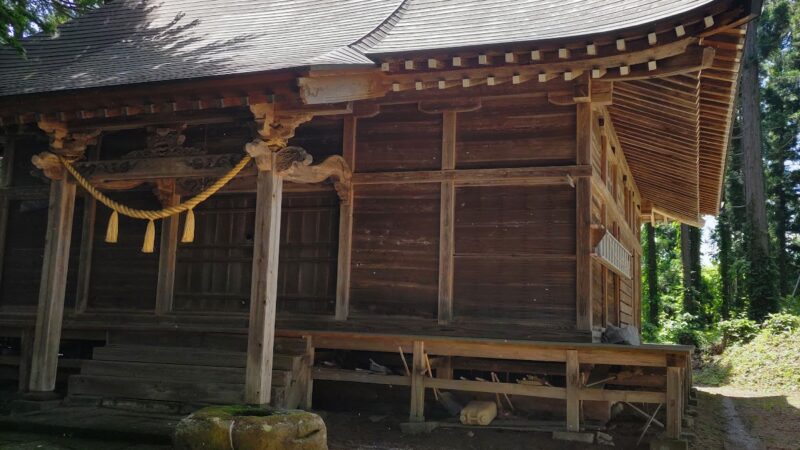
The architecture of Koshio Shrine in Kazuno City is attributed to Jinbei, a master craftsman from Hida. Hida craftsmen have long been known for their excellent architectural techniques and have been involved in the construction of temples and shrines throughout Japan. The architectural style of this shrine is characterized by a bold combination that is not bound by traditional styles, making it a valuable structure that fuses the strength and sophistication of the Sengoku period.
Changes After the Meiji Era
With the arrival of the Meiji era, shrines throughout Japan underwent significant changes due to the separation of Shinto and Buddhism. Koshio Shrine was no exception, and its name was changed from the syncretic Shinto-Buddhist name “Koshio Daigongen” to “Koshio Shrine.” During the Meiji era, it was designated a village shrine under the shrine ranking system, and positioned as a center of local faith. Even into the Showa era, it continued to attract the fervent devotion of local residents and has been carefully preserved to this day.
Deities and the Origin of the Shrine
Main Deity: Ōhiko-no-Mikoto
The main deity of Koshiō Shrine is Ōhiko-no-Mikoto. Ōhiko-no-Mikoto is an ancient warrior who appears in the *Nihon Shoki* and *Kojiki*, and is said to be the son of Emperor Kōgen, the 8th emperor. During the reign of Emperor Sujin, he was dispatched to the Hokuriku region as one of the Four Generals and is known for his achievements in pacifying the Emishi people.
Ōhiko-no-Mikoto is considered the ancestor of the Abe clan, and has been revered as the founder of the Abe clan, including later figures like Abe no Hirafu, who were involved in the development and governance of the Tohoku region.
Origin of the Name “Koshiō”
The name “Koshiō” is believed to be a variation of “Koshiō” (King of Echigo). This originates from the fact that Ōhiko-no-Mikoto was one of the four generals dispatched to the Hokuriku region (Echigo Province).
The four generals were generals dispatched by Emperor Sujin to the four directions to pacify the country, and Ōhiko-no-Mikoto was in charge of the Hokuriku region. “Echigo” is a place name referring to the ancient Hokuriku region, and it is believed that the name “Koshiō” and then “Koshiō” arose from Ōhiko-no-Mikoto being revered as the king of Echigo.
Relationship with Takemikazuchi-no-Kami
While Takemikazuchi-no-Kami is also enshrined at other Koshiō shrines, such as the Koshiō Shrine in Akita City, Ōhiko-no-Mikoto is the main deity enshrined at the Koshiō Shrine in Kazuno City. Takemikazuchi-no-Kami is the principal deity of Kashima Shrine and is known as a god of war and thunder.
In ancient times, gods with war-god characteristics played an important role in the expansion and governance of the Tohoku region, which is why it is believed that Ōhiko-no-Mikoto and Takemikazuchi-no-Kami became associated and worshipped.
Highlights and Cultural Properties within the Shrine Grounds
Architectural Style of the Main Hall
The main hall of Koshiō Shrine in Kazuno City is said to have been built by Jinbei, a master craftsman from Hida, and is characterized by its bold and original combination of elements. As a valuable cultural property that conveys the architectural techniques of the Sengoku period, it holds significant architectural historical value.
The advanced techniques of Hida craftsmen can be seen throughout the woodworking techniques and the details of the carvings, demonstrating the high level of architectural technology at the time. Although there is some weathering due to age, it has been preserved in its original form through regular restoration.
Important Cultural Property: Standing Statue of Tamonten
Koshiō Shrine enshrines a standing statue of Tamonten, which is designated as an Important Cultural Property. Tamonten is one of the Four Heavenly Kings in Buddhism, a warrior god also known as Bishamonten.
This standing statue is a remnant of the syncretism of Shinto and Buddhism, and a valuable legacy from the time when it was worshipped as Koshio Daigongen. Due to its sculptural skill and excellent state of preservation, it has been designated a National Important Cultural Property and occupies an important position in the history of Japanese religious art.
Atmosphere of the Shrine Grounds
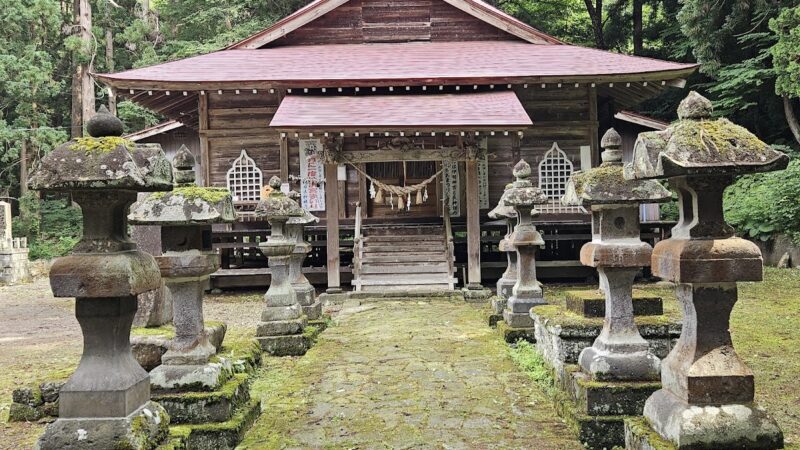
The shrine grounds are surrounded by the nature of Hachimantai, creating a tranquil atmosphere. Ancient trees line the approach to the shrine, allowing visitors to appreciate the beauty of nature throughout the seasons. Especially during the fresh greenery of spring and the vibrant autumn foliage, the grounds are vividly colored, delighting the eyes of worshippers.
Around the shrine building, stone monuments and lanterns donated by local people are placed, reflecting the long history of faith.
Annual Events and Festivals
Grand Festival
Various festivals are held throughout the year at Koshio Shrine. The annual festival, in particular, is an important local event, attracting many parishioners and worshippers. The festival includes the dedication of Kagura (sacred dance and music) and the procession of the portable shrine, serving as a venue for preserving the region’s traditional culture.
Seasonal Festivals
In spring, the Kinensai (harvest festival) is held to pray for a bountiful harvest, and in autumn, the Niinamesai (harvest festival) is held to give thanks for the harvest. These festivals are related to agriculture. Kazuno City is a region where agriculture thrives, and these festivals are closely intertwined with the lives of the local people.
Connections with the Community
Local residents actively participate in the preparation and operation of the festivals, creating a place for intergenerational exchange. Children also have the opportunity to learn about the region’s history and traditions by participating in the festivals.
Access and Visiting Information
Access by Public Transportation
By JR Train:
- Get off at Kazuno-Hanawa Station on the JR Hanawa Line
- Approximately 15 minutes by bus or taxi from the station
- Take a bus bound for Hachimantai
By Bus:
- Take the Akita Kita Bus Hachimantai Line from Kazuno-Hanawa Station
- Approximately 5 minutes on foot from the nearest bus stop
Access by Car
From the Tohoku Expressway:
- Approximately 10 minutes from Kazuno-Hachimantai IC
- Accessible via National Route 282
Parking:
- Parking spaces for visitors are available around the shrine
- Temporary parking may be available during festivals
Visiting Hours and Precautions
- Visiting Hours:: Visitors can visit anytime during the day
- Shrine Office:: The office may be unattended, so it is recommended to check in advance if you wish to receive a Goshuin (shrine stamp) or other items.
- Dress Code:: There are no specific regulations, but please wear appropriate attire for visiting a shrine.
- Photography: Photography is permitted within the shrine grounds, but confirmation is required regarding photography of cultural properties.
Relationship with other Koshio Shrines in Akita Prefecture
There are several Koshio Shrines in Akita Prefecture, each with its own unique history and characteristics. These shrines are deeply connected to the history of the Tohoku region from ancient to medieval times, demonstrating the spread of local faith.
Koshio Shrine in Terauchi, Akita City
The Koshio Shrine located in Terauchi, Akita City, is said to have the oldest history in Akita Prefecture. As the guardian deity of Akita Castle, it played an important role from the Nara period to the Heian period. It was formerly ranked as a National Shrine of the lower rank and is considered to have the highest status among the Koshio Shrines in the prefecture.
Its founding is said to date back to the reign of Emperor Sujin, and it is believed to have begun when Ohiko-no-Mikoto enshrined Takemikazuchi-no-Mikoto. Later, Abe no Hirafu enshrined Ōhiko no Mikoto alongside the main deity, and the shrine was revered as the “God of Agitaura.”
Koshiō Shrine in Daisen City
The Koshiō Shrine, located in Ōmagari, Daisen City, is also an important shrine with a history dating back to ancient times. This shrine also enshrines Ōhiko no Mikoto as its main deity and has been a center of local faith.
Koshiō Shrine in Kisakata, Nikaho City
There is also a Koshiō Shrine in Kisakata, Nikaho City. This region, facing the Sea of Japan, has been a key point for trade with the north since ancient times and played an important role as a place of worship where people prayed for the safety of maritime traffic.
Koshiō Shrines in Yurihonjō City, Yokote City, and Yuzawa City
Koshiō Shrines also exist in Ōuchi Nakadate, Yurihonjō City, Jūmonji, Yokote City, and Inagawa, Yuzawa City. In Yuzawa City, there was once a junior high school called Koshio Junior High School, indicating that the name “Koshio” was well-established as a place name.
Spread of Faith and Historical Background
The distribution of these Koshio Shrines reflects the history of development and governance in Dewa Province from ancient to medieval times. It is believed that the Koshio faith spread throughout the region during the process of Tohoku’s administration by ancient warlords such as Ohiko-no-Mikoto and Abe-no-Hirafu.
The Koshio Shrine in Kazuno City, while relatively newer than these, was founded in 1570 (Genki 1), but it is considered to have inherited ancient faith and was newly established during the regional governance of the Sengoku period.
Places to Visit Along with Kazuno City’s Tourist Spots
Nature of Hachimantai
The Hachimantai region, where the Koshio Shrine is located, is a tourist destination blessed with abundant nature. Hachimantai is a volcanic plateau area spanning Akita and Iwate prefectures, where you can enjoy beautiful scenery throughout the four seasons.
Spring to Summer:
- Strolling through the lush green beech forest
- Observing alpine plants
- Trekking and hiking
Autumn:
- Nationally famous for its autumn foliage
- Enjoying views from drives and ropeways
Winter:
- Skiing and snowboarding
- Viewing frost-covered trees
Yuse Onsenkyo
Kazuno City is home to Yuse Onsenkyo, a popular base for sightseeing in Hachimantai. Located along the Yoneshiro River, it is a hot spring resort surrounded by pure water and abundant nature. After visiting Koshio Shrine, you can relax and soothe your fatigue in the hot springs.
Oyu Stone Circle
In the Oyu district of Kazuno City, there is a large-scale stone circle from the late Jomon period. It is designated as a National Special Historic Site and was registered as a World Cultural Heritage site in 2021 as part of the “Jomon Prehistoric Sites in Hokkaido and Northern Tohoku.”
This is a historical site where you can feel the lives of people from ancient times, and you can also feel a historical connection to the ancient beliefs of Koshio Shrine.
Hanawa Bayashi
The Hanawa Bayashi festival, held every August in the Hanawa district of Kazuno City, is a traditional festival considered one of Japan’s three great festival music festivals. Magnificent floats parade through the town, and the sounds of flutes and drums resonate throughout. It is designated as a National Important Intangible Folk Cultural Property.
Michi-no-Eki Kazuno Antoraa
This roadside station offers Kazuno City’s specialty products and fresh local produce. Akita’s famous products, such as Kazuno beef and Hinai chicken, are also available. It’s a convenient facility for gathering tourist information and taking a break.
Narita Farm
This is a tourist farm in Kazuno City where you can enjoy fruit picking. You can experience picking various fruits depending on the season, such as cherries, blueberries, and apples. It’s a popular spot for families.
Faith and Local Culture of Koshio Shrine
Connections with Local Residents
Koshio Shrine in Kazuno City has been a center of faith for local residents for over 450 years. In a region centered on agriculture, it has been a place where people’s various wishes, such as prayers for a bountiful harvest, family safety, and business prosperity, have been received.
The parishioners’ organization remains active, responsible for the maintenance of the shrine and the operation of festivals. Even in a regional city with an aging population, it serves as a place for intergenerational exchange, with younger generations participating in festivals and cleaning activities.
Preservation and Transmission of Cultural Properties
The preservation of cultural properties, including the important cultural property, the standing statue of Tamonten, is a crucial issue for the region. Through appropriate environmental management and regular restoration, valuable cultural heritage is being passed on to future generations.
In local school education, Koshio Shrine is used as teaching material for learning about local history and culture, providing children with an opportunity to cultivate pride and affection for their community.
Potential as a Tourism Resource
Kazuno City boasts diverse tourism resources, including the natural beauty of Hachimantai, the Oyu Stone Circles, and hot springs. Koshio Shrine, as a historical and cultural resource, is attracting attention as part of a sightseeing route that combines these attractions.
Especially for tourists interested in history and architecture, the shrine, with its Sengoku period architecture and important cultural properties, is a fascinating destination.
Manners and Etiquette for Worship
Basic Worship Etiquette
By observing basic shrine worship etiquette, you can offer a more heartfelt prayer.
- How to Pass Through the Torii Gate: Bow before passing through the torii gate. Since the center of the path is considered the path of the gods, it is considered best to walk along the side.
- How to Wash Your Hands: Cleanse your body and mind at the water basin. Hold the ladle in your right hand, wash your left hand, then switch to your left hand and wash your right hand. Switch the ladle back to your right hand, receive water in your left hand, rinse your mouth, and finally cleanse the handle by holding the ladle upright.
- Worship at the Main Hall: Quietly place your offering in the offering box and ring the bell. Worship using the two bows, two claps, and one bow ritual.
Photography
Photography is generally permitted on the temple grounds, but please note the following:
- Photography of the interior of the main hall and cultural artifacts may be restricted.
- Be considerate of other worshippers.
- Refrain from photography during festivals or obtain permission before taking pictures.
Clothing and Belongings
There are no specific dress code requirements, but it is desirable to dress appropriately for a sacred place. Especially in summer, use insect repellent, and in winter, take proper precautions against the cold.
Summary: The Charm of Koshio Shrine (Kazuno City)
Located in Hachimantai, Kazuno City, Akita Prefecture, Koshio Shrine is a historic shrine that has attracted the faith of the local community for over 450 years since its founding in 1570. Built during the Sengoku period by order of the Tozawa clan, its magnificent architectural style, crafted by master Hida artisans, still conveys its original appearance.
The main deity enshrined here is Ohiko-no-Mikoto, a figure who distinguished himself in the development of the Tohoku region as one of the Four Great Generals of ancient times, and the name “Koshio (Echigo-o)” reflects this history. The standing statue of Tamonten, a designated Important Cultural Property, is a valuable legacy from the era of syncretism of Shinto and Buddhism, and holds significant value in the history of Japanese religious art.
Several Koshio Shrines exist within Akita Prefecture, each with its own unique history, yet connected by ancient faith. Among them, Koshio Shrine in Kazuno City is a particularly valuable example, with its specific historical context of the Sengoku period.
Nestled amidst the rich natural beauty of Hachimantai, the shrine grounds offer a tranquil escape, showcasing the beauty of each season. When visiting Kazuno City, be sure to also visit Koshio Shrine, along with other tourist attractions such as the Oyu Stone Circles and Yuse Onsenkyo hot spring resort. You’ll experience a unique blend of history, culture, and natural beauty that is characteristic of Kazuno City.
Koshio Shrine, protected by the local community and passed down to future generations, embodies over 450 years of history and the prayers of its people within its serene atmosphere.