Complete Guide to Sowa Inari Shrine (Onomichi City, Hiroshima Prefecture) | History and Visiting Information
Sowa Inari Shrine is located right in front of JR Onomichi Station, the gateway to Onomichi City, Hiroshima Prefecture. Despite its unusual location in a corner of the station’s rotary, this shrine boasts a long history and deep faith, making it a beloved place for many worshippers and tourists visiting Onomichi. This article provides a detailed overview of Sowa Inari Shrine, including its history, enshrined deities, visiting information, and access methods.
Basic Information on Sowa Inari Shrine
Location: 10-11 Higashi-Gosho-cho, Onomichi City, Hiroshima Prefecture 722-0036 (Some sources list 10-4)
Deity Enshrined: Ukanomitama-no-kami
Phone Number: 0848-23-6862
Shrine Rank: Unranked Shrine
Benefits: Business prosperity, abundant harvests, industrial development
Sowa Inari Shrine boasts excellent accessibility, located just a 1-minute walk (approximately 110m) from the south exit of Onomichi Station. Due to its location next to the station’s rotary, it’s a popular first stop for visitors to Onomichi, and a place to pray for safe travels.
History and Origins of Sowa Inari Shrine
From the Yamaguchi Family’s Guardian Shrine to a Public Shrine
The origin of Sowa Inari Shrine lies in the Inari deity worshipped as the guardian deity of the Yamaguchi Junteki family, a prominent family in Onomichi. The Yamaguchi family was a prominent family that had continued in Onomichi for generations, and the Inari shrine privately worshipped within their residence eventually came to be worshipped by the local people.
A History of Several Relocations
Before settling in its current location in Higashi-Gosho-cho, Sowa Inari Shrine moved locations several times. The history of its relocation is as follows:
- Near the main gate of Saikoku-ji Temple (The earliest location)
- Tsuchido-cho Ferry Crossing
- Tsuchido-cho, below Hōdoji Temple
- Coast below the Police Station
- Current Location (Higashi-Gosho-cho) (Showa 12/1937)
The shrine was relocated to its current location in Showa 12 (1937), and for over 80 years since then, it has been a place of worship for the people of Onomichi. The plaque on the torii gate reads “Sowa Shrine,” and it is affectionately known as “Sowa-san” by the locals.
Connection with Yamaguchi Gendō
An indispensable figure when discussing Sowa Inari Shrine is Yamaguchi Gendō (1863-1937). Yamaguchi Gendō was a businessman and politician who was active from the Meiji to the early Showa period, and his real name was Yamaguchi Junnosuke.
Yamaguchi Gendō is known for his significant contributions to the development of Onomichi, and is particularly famous for donating almost all of the construction costs for Onomichi City’s water supply system from his personal fortune. This enormous donation allowed the citizens of Onomichi to enjoy clean tap water. He also made substantial donations to educational and social welfare projects, and is still remembered today as a “benefactor of Onomichi.”
The Sowa Inari Shrine is deeply connected to the Yamaguchi family, as it was the guardian shrine of Yamaguchi Junteki, an ancestor of Yamaguchi Gendō. It is said that Yamaguchi Gendō himself cherished his faith in this Inari deity.
Deities and Benefits
Ukanomitama-no-kami
The deity enshrined at Sowa Inari Shrine is Ukanomitama-no-kami. This deity is widely worshipped at Inari shrines throughout Japan as the god of food and grains, and is a historically significant deity appearing in the Kojiki and Nihon Shoki.
Ukanomitama-no-kami is considered the child of Susanoo-no-Mikoto and Kamu-Oichihime, and “Uka” is an archaic word meaning grain or food. As a central deity in Inari worship, Ukanomitama-no-kami has been widely worshipped as the god of agriculture and commerce.
Main Benefits
The benefits you can expect at Sowa Inari Shrine are as follows:
- Business Prosperity: Onomichi has long flourished as a commercial city, and the shrine has attracted the faith of local merchants.
- Abundant Harvest: As a deity of agriculture, there is a belief in praying for a bountiful harvest.
- Industrial Development: In modern times, many visitors pray for the development of various industries.
- Family Safety: As it was the guardian shrine of the Yamaguchi family, there is also a belief in praying for the safety and prosperity of the family.
- Safe Travel: Due to its location in front of the station, it is also a popular place for travelers to pray for safe journeys.
Shrine Grounds and Highlights
Open and Inviting Grounds
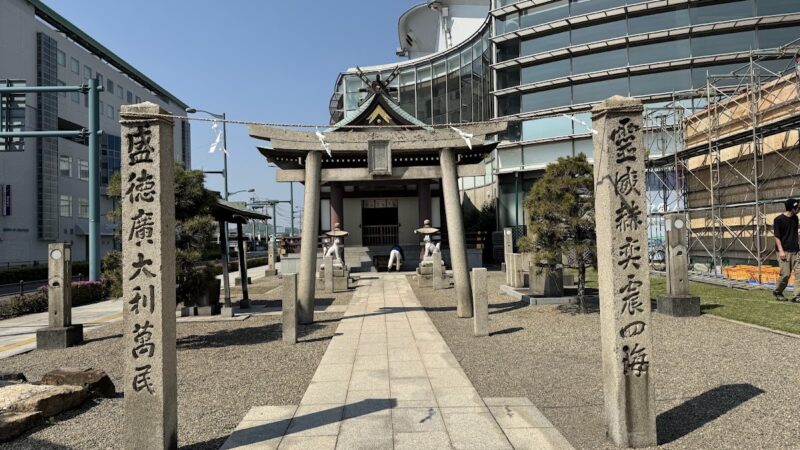
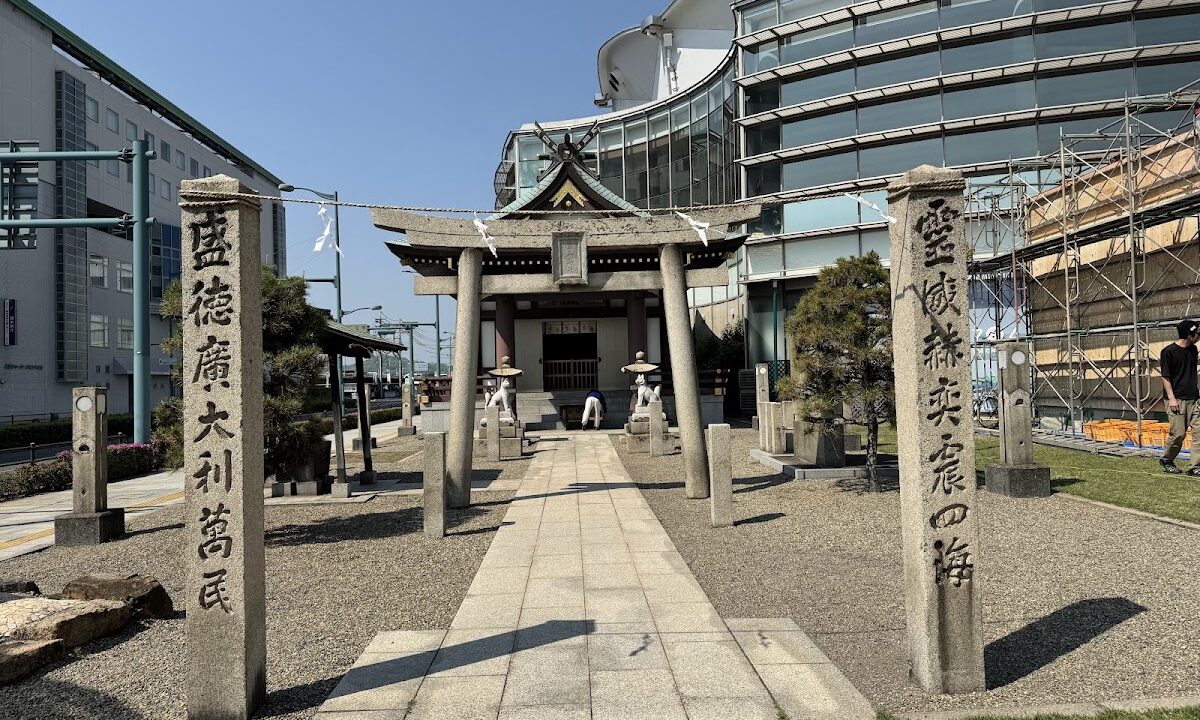
The most distinctive feature of Sowa Inari Shrine is its very open atmosphere, lacking a stone fence (tamagaki). Facing the station rotary, it is a friendly shrine that anyone can easily visit.
Torii Gate and Plaque
A vermilion torii gate stands at the entrance to the shrine grounds, and its plaque reads “Sokuwa Shrine.” This plaque is a valuable artifact that tells the history of the shrine. Passing through the torii gate, the main shrine building comes into view immediately.
Main Shrine Building and Inari Statues (instead of Komainu)
The main shrine building faces east and, though compact, is meticulously maintained. While typical shrines have guardian lion-dogs, this Inari shrine features a fox statue (Inari-sama) in front of the main shrine. This fox statue serves as a divine messenger of Ukanomitama-no-kami, protecting the shrine.
Clean Shrine Grounds
Despite its location near the train station, the shrine grounds are always kept clean, reflecting the careful maintenance by the local community. Although a small shrine, its refreshing atmosphere leaves a positive impression on many visitors.
How to Worship and Manners
Basic Worship Procedure
Worship at Sowa Inari Shrine follows the same procedures as at most shrines:
- Bow before the Torii Gate: Before entering the shrine grounds, bow slightly before the torii gate.
- Purify at the Water Basin: If there is a water basin, purify your hands and mouth (this may vary depending on the facilities).
- Proceed to the Main Hall: Proceed quietly to the main hall.
- Offer an Offering: Place your offering in the offering box.
- Two Bows, Two Claps, One Bow: Bow deeply twice, clap twice, and finally bow once.
- Bow After Leaving the Torii Gate: When leaving the shrine grounds, turn around and bow outside the torii gate.
Points to Note When Worshiping
- Due to its location in front of the station, there are many passersby other than worshippers. Remember to be considerate of those around you.
- Photography is permitted, but please be considerate of other worshippers.
- As the shrine grounds are small, please respect the order of worship when visiting in groups.
Goshuin (Shrine Seal) Information
Regarding the Issuance of Goshuin
Regarding the issuance of Goshuin at Sowa Inari Shrine, there may not be a permanent shrine office or priest present. Those wishing to receive a Goshuin are advised to confirm in advance by phone (0848-23-6862).
Onomichi City has many shrines and temples, and many visitors enjoy collecting Goshuin. Planning a tour of Onomichi’s temples and shrines starting from Sowa Inari Shrine is a good idea.
Nearby Goshuin (Shrine Stamp) Spots
The following temples and shrines near Onomichi Station offer Goshuin stamps:
- Senkoji Temple: A representative ancient temple of Onomichi, situated on the summit of Senkoji Mountain.
- Tenneiji Temple: A Rinzai Zen temple famous for its three-story pagoda.
- Saikokuji Temple: A large Shingon Buddhist temple possessing important cultural properties such as its main hall and three-story pagoda.
- Jodoji Temple: A renowned temple with a national treasure main hall and pagoda.
Access Methods
Access by Train
1 minute walk (approx. 110m) from JR Sanyo Main Line “Onomichi Station”
This is the easiest way to access Sowa Inari Shrine. Exit the south exit (seaside exit) of Onomichi Station, and you will see the shrine on the right side of the station square. It is very close to the station, so you are unlikely to get lost.
Travel Time from Major Stations:
- From Hiroshima Station: Approximately 1 hour 30 minutes on the JR Sanyo Main Line
- From Fukuyama Station: Approximately 20 minutes on the JR Sanyo Main Line
- From Mihara Station: Approximately 10 minutes on the JR Sanyo Main Line
By Shinkansen
The nearest Shinkansen station is “Shin-Onomichi Station,” but it is quite far from the actual Onomichi city center. If using the Shinkansen:
- Get off at “Fukuyama Station” and transfer to the JR Sanyo Main Line to Onomichi Station (approximately 20 minutes)
- Get off at “Shin-Onomichi Station” and take a bus or taxi to Onomichi Station (approximately 15 minutes)
Considering convenience, the route via Fukuyama Station is recommended.
Access by Car
Approximately 15 minutes from the Sanyo Expressway “Onomichi IC”
After exiting the Onomichi IC, head towards Onomichi city center via National Route 184. However, since the shrine itself does not have a dedicated parking lot, you will need to use nearby coin-operated parking lots or parking lots around the station.
Parking Information
Sowa Inari Shrine does not have a dedicated parking lot. If you are visiting by car, please use the following parking lots:
- Onomichi Station Front Parking: Multi-story parking garage in front of the station (paid)
- Nearby Coin-Operated Parking: Several available around the station
- Onomichi City Municipal Parking: Scattered throughout the city
If you are only visiting the shrine, it will only take a short time, so using a coin-operated parking lot is convenient.
Access by Bus
While there are buses that circulate within Onomichi city, they start from Onomichi Station, so accessing Sowa Inari Shrine by train is the most convenient.
Nearby Tourist Spots
Sowa Inari Shrine is ideally located as a starting point for sightseeing in Onomichi. Here are some nearby spots you might want to visit after your visit.
Onomichi Shopping Street
A traditional shopping street that stretches out within a 5-minute walk from the station. Enjoy local delicacies such as Onomichi ramen, Onomichi-yaki (a type of okonomiyaki), and seafood. Strolling through the retro-style shopping streets is a highlight of Onomichi sightseeing.
Senkojiyama Ropeway
The ropeway station, located about a 15-minute walk from the station, provides access to the summit of Senkojiyama Mountain. From the summit, you can enjoy panoramic views of the Onomichi Channel and the islands of the Seto Inland Sea, making it a spectacular spot selected as one of “Japan’s Top 100 Sunset Spots.”
Onomichi Hondori Shopping Street
This arcade shopping street, approximately 1.2 km long, offers a unique atmosphere where old townscapes blend with modern shops. There are also many Instagrammable spots, such as the “Cat Alley.”
Literary Path
This walking path, located on the slopes of Senkojiyama Mountain, is lined with stone monuments inscribed with works by literary figures associated with Onomichi. Experience the literary atmosphere of Onomichi, loved by many great writers such as Fumiko Hayashi and Naoya Shiga.
Onomichi City Museum of Art
Located near the summit of Senkoji Mountain, this museum boasts architecture designed by Tadao Ando. It primarily exhibits art from the Seto Inland Sea region.
The History of Onomichi and the Role of Sowa Inari Shrine
The Development of Onomichi as a Port Town
Onomichi has long flourished as a key point on the Seto Inland Sea. By the end of the Heian period, it was already functioning as a port, and in the Middle Ages, it became one of the centers of Seto Inland Sea trade as “Onomichi-tsu.”
From the Muromachi period to the Edo period, it greatly prospered as a port of call for Kitamae ships and as a transit point connecting Osaka with the San’in, Sanyo, and Kyushu regions. This development of the shipping industry gave rise to many wealthy merchants in Onomichi, and their wealth contributed to the construction of temples and shrines and the development of culture.
Commercial City and Inari Worship
In Onomichi, which developed as a commercial city, Inari worship, the god of business prosperity, naturally took root. Sowa Inari Shrine is one of the shrines that has attracted the faith of merchants within Onomichi’s commercial culture.
The history of prominent families like the Yamaguchi family enshrining Inari as their guardian deity, and how it eventually became a shrine open to the local community, illustrates the relationship between Onomichi’s commercial development and its religious culture.
Modernization and Shrine Relocation
The modernization of Onomichi since the Meiji era, particularly the opening of the railway (the Sanyo Railway extended to Onomichi in 1891), significantly changed the urban structure of the city. The relocation of Sowa Inari Shrine to its current location in 1937 is thought to be related to this urban modernization.
By being located in front of the station, the new gateway to Onomichi, the shrine has also taken on the role of welcoming and sending off visitors to Onomichi.
Annual Events and Festivals
Regarding the annual events of Sowa Inari Shrine, it appears that large-scale festivals are not held due to the shrine’s small size. However, the following events may be held at the Inari Shrine:
Hatsuumasai (First Horse Day Festival)
The first Horse Day of February is the most important festival day for Inari Shrines. Hatsuumasai festivals are held at Inari Shrines throughout Japan, where prayers are offered for business prosperity and a bountiful harvest. It is possible that a special festival is held at Sowa Inari Shrine on this day.
Annual Grand Festival
Many shrines hold an annual grand festival (the most important festival of the year) once a year. For information regarding the date of Sowa Inari Shrine’s annual grand festival, please contact the shrine directly.
Visitor Feedback and Reviews
Visitors who have actually visited Sowa Inari Shrine have shared the following comments:
- “The convenience of being able to visit right after getting off the train is great. It’s perfect for praying for safe travels.”
- “Although small, it’s kept clean, and you can tell it’s cherished by the locals.”
- “The open atmosphere makes it easy to visit casually.”
- “It’s become a routine to stop by at the beginning and end of my Onomichi sightseeing.”
- “It’s a tranquil space that you wouldn’t expect to find in front of a train station, and it calms the mind.”
Best Season to Visit Sowa Inari Shrine
Sowa Inari Shrine is open year-round, but each season has its own unique charm:
Spring (March-May)
Onomichi is also known as a famous cherry blossom viewing spot, and you can enjoy beautiful cherry blossoms on Senkoji Mountain and other locations. It’s a comfortable season to visit in the warm climate.
Summer (June-August)
A season where you can feel the refreshing sea breeze of the Seto Inland Sea. However, since there are many days with strong sunshine and high temperatures, precautions against heatstroke are necessary.
Autumn (September-November)
This is the best season for sightseeing in Onomichi. The autumn leaves are beautiful, the weather is mild, and it’s ideal for visiting the shrine. October and November, in particular, see many tourists.
Winter (December-February)
While the Seto Inland Sea climate is relatively mild, there are also cold days. Many worshippers visit during special events such as Hatsumode (first shrine visit of the year) and Hatsuumasai (first horse festival).
Summary: Guardian Deity of Onomichi Station
Sowa Inari Shrine, despite its modern location in front of JR Onomichi Station, boasts a history and tradition dating back to the Edo period. Beginning as the guardian shrine of the Yamaguchi family, this shrine has grown alongside the development of Onomichi and continues to be a spiritual haven for local residents and travelers visiting Onomichi.
Sowa Inari Shrine, dedicated to Ukanomitama-no-kami, the deity of business prosperity and abundant harvests, boasts an open and friendly atmosphere. When visiting Onomichi, be sure to stop by this small shrine near the station and pray for safe travels and good fortune.
Nearby at the gateway to the historic port town of Onomichi, Sowa Inari Shrine stands quietly. Its small grounds encapsulate the history of Onomichi and the faith of its people. Begin your Onomichi sightseeing adventure—a town known for its hills, literature, and cats—by visiting this shrine. A wonderful trip to Onomichi surely awaits you.