Complete Guide to Bikuni Shrine (Shakotan-cho, Shakotan-gun, Hokkaido) | History, Deities, Annual Festival, and Access Information
Bikuni Shrine, located in Shakotan-cho, Shakotan-gun, Hokkaido, is a historic shrine founded in 1725. Situated in Bikuni-cho, surrounded by the beautiful sea and mountains of the Shakotan Peninsula, it has been a center of local faith for approximately 300 years, cherished by the residents for prayers for safety at sea and abundant catches. This article provides a detailed explanation of Bikuni Shrine’s history, enshrined deities, highlights of its annual festival, information on its Goshuin (shrine stamp), and access methods.
Basic Information on Bikuni Shrine
Bikuni Shrine is located at 230 Osawa, Bikuni-cho, Shakotan-gun, Hokkaido. Its former shrine rank was Gosha (village shrine). It is situated on the western side of the Shakotan Peninsula, close to Bikuni Fishing Port, and boasts a scenic location overlooking the Sea of Japan.
Location: 230 Osawa, Bikuni-cho, Shakotan-gun, Hokkaido 046-0201, Japan
Phone Number: 0135-44-2101
Annual Festival Date: July 5th (The Grand Festival is held in early July)
Former Shrine Rank: Gosha (Village Shrine)
Affiliation: Hokkaido Shrine Association
Deities of Bikuni Shrine
Bikuni Shrine enshrines three deities. Each is a god who presides over food, the sea, and the mountains, protecting the lives of the local people engaged in fishing and agriculture.
Ukemochi-no-kami
Ukemochi-no-kami is the goddess of food, revered as a deity who brings abundant harvests and the blessings of food. In Japanese mythology, there is a legend that she entertained Tsukuyomi-no-Mikoto, who visited as a messenger of Amaterasu-Omikami, by producing various foods from her mouth. In the Shakotan region, where fishing and agriculture thrive, this deity is worshipped as an important god who presides over the bounty of food.
Ōwatatsumi-no-kami
Ōwatatsumi-no-kami is a sea god who rules the ocean and is worshipped as the guardian deity of maritime safety and abundant catches. The Shakotan Peninsula has long prospered from herring and sea urchin fishing, and the faith in Ōwatatsumi-no-kami, the god of the sea, is particularly strong among fishermen who make their living from the sea. The fact that the Bikuni Shrine is located close to the sea also indicates its deep connection with this deity.
Ōyamatsumi-no-kami
Ōyamatsumi-no-kami is a god who presides over mountains and protects the bounty and safety of the mountains. The clear streams flowing from the rich mountains of the Shakotan Peninsula are also connected to the abundance of the sea, and the presence of Ōyamatsumi-no-kami is indispensable in a region that receives the blessings of both mountains and sea. Furthermore, as a deity protecting the safety of the mountains, it has also been revered by people involved in forestry and mountain work.
History and Origins of Mikuni Shrine
Circumstances of its Founding
The history of Mikuni Shrine dates back to 1725 (Kyoho 10). In that year, a divided spirit was invited from Fushimi Inari Taisha in Kyoto, and the shrine was founded as an Inari shrine. During the mid-Edo period, in the Shakotan region, which was under the rule of the Matsumae Domain, herring fishing was beginning to flourish, and a shrine was needed as a place to pray for the prosperity of fishing and safety at sea.
Fushimi Inari Taisha is the head shrine of approximately 30,000 Inari shrines nationwide, and is widely worshipped as a deity of abundant harvests and business prosperity. It is believed that the Inari shrine was invited to Mikuni because the local residents at the time wished for the prosperity of both agriculture and fishing.
The Meiji Era Shrine Ranking System and Renaming
With the arrival of the Meiji era, the new government reorganized the shrine system. In 1875 (Meiji 8), Mikuni Shrine was ranked as a Gosha (village shrine), establishing its position as a central shrine in the region. A Gosha is a shrine with a rank second only to a prefectural shrine in the modern shrine ranking system, and is a rank given to shrines that serve as the center of faith in a certain region (go).
Subsequently, on October 31, 1892 (Meiji 25), a request to change the name from Inari Shrine to Mikuni Shrine was submitted, and it was officially approved on May 25, 1893 (Meiji 26). This renaming is thought to have been intended to establish a more locally rooted identity as a shrine by adding the regional name “Mikuni” to the shrine’s name.
Up to the Present Day
Through the Meiji, Taisho, Showa, Heisei, and Reiwa eras, Mikuni Shrine has consistently remained the center of faith in the region. In Bikuni Town, where fishing is particularly thriving, the shrine has long been revered by local residents as a place of prayer for maritime safety and abundant catches. Furthermore, the annual grand festival, held every July, is the largest festival event in Shakotan Town, attracting many worshippers and tourists.
Highlights of the Bikuni Shrine Grand Festival
The Bikuni Shrine Grand Festival is the largest festival event in Shakotan Town, held annually in early July (the festival day is July 5th). This festival, which prays for maritime safety, a bountiful harvest, and abundant catches, is known as a spectacular event combining traditional Shinto rituals with magnificent parades.
Maritime Procession
One of the biggest highlights of the grand festival is the maritime procession held at Bikuni Fishing Port. This ritual involves placing the portable shrine on a boat and traveling across the sea, praying to Owatatsumi-no-kami, the god of the sea, for maritime safety and abundant catches. The sight of multiple boats surrounding the boat carrying the portable shrine and parading through the fishing port truly speaks to the deep faith of the people of Shakotan, who live in harmony with the sea.
The spectacle of the fleet of boats, adorned with colorful fishing flags, sailing against the backdrop of the blue Sea of Japan is breathtaking, attracting many spectators to the port. The sea procession often takes place in the morning, and on clear days, the beautiful color of the sea, known as “Shakotan Blue,” combined with the vibrant festival atmosphere, makes for an excellent photo opportunity.
Portable Shrine Procession and Float Parade
After the sea procession, the portable shrine procession and float parade take place in the town of Bikuni. With energetic shouts, bearers carry the portable shrine through the town. Several floats also parade through the streets, and the sounds of festival music fill the air.
The participation of local children and the way the entire town is immersed in the festival atmosphere demonstrate the strong bonds of the local community. The portable shrines and floats parading through the shopping streets and residential areas are greeted with cheers and applause from people along the route, and the festival’s excitement continues until evening.
Tengu Fire Crossing
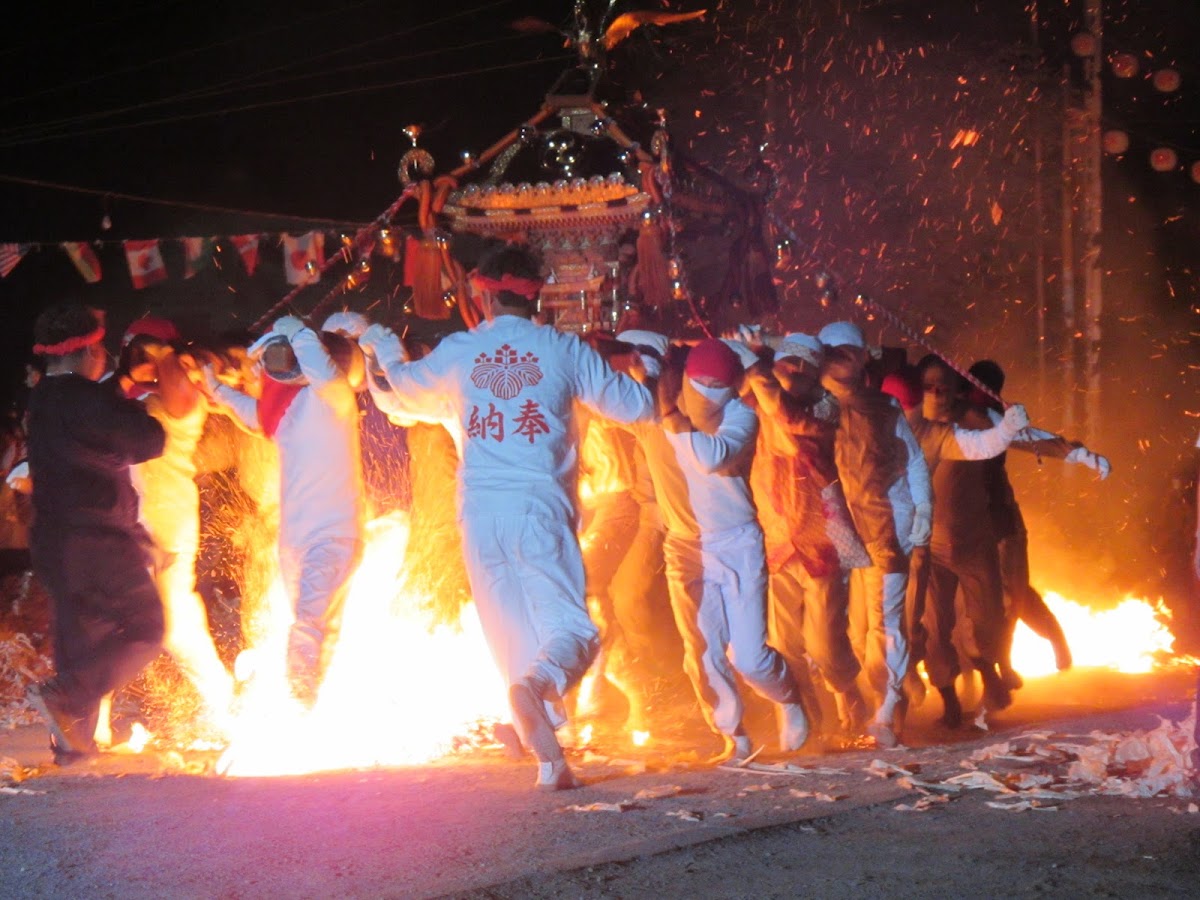
The most impressive event at the Mikuni Shrine Grand Festival is the “Tengu Fire Crossing.” This is a Shinto ritual held within the grounds of Mikuni Shrine, in which young men carrying the portable shrine and a leader wearing a Tengu mask cross through blazing flames—a magnificent ceremony.
This fire crossing symbolizes the removal of impurities and purification. Fire has been considered to possess purifying power since ancient times, and by passing through the flames, people pray for the safety of the fishermen as they head out to sea with renewed spirits, warding off the misfortunes of the past year.
As dusk falls on the shrine grounds, a large fire is lit, and to the sound of drums, a Tengu (a mythical creature) appears. Following this, young men carrying a portable shrine run through the flames, chanting “Soiya! Soiya!” The sight is breathtaking and deeply moving. This fire-jumping ceremony is the climax of the annual festival, and is held in front of a large crowd of spectators.
Annual Festival Schedule and Time
The annual festival is usually held on a weekend in early July. Specific dates may vary from year to year, so those planning a visit are advised to check with the Shakotan Town Tourism Association or the Bikuni Shrine beforehand.
General Schedule:
- Morning: Procession on the Sea (Bikuni Fishing Port)
- Afternoon: Mikoshi Procession and Float Parade (City Center)
- Evening: Tengu Fire Passing Ceremony (Bikuni Shrine Grounds)
Grounds and Facilities of Bikuni Shrine
Shrine Buildings
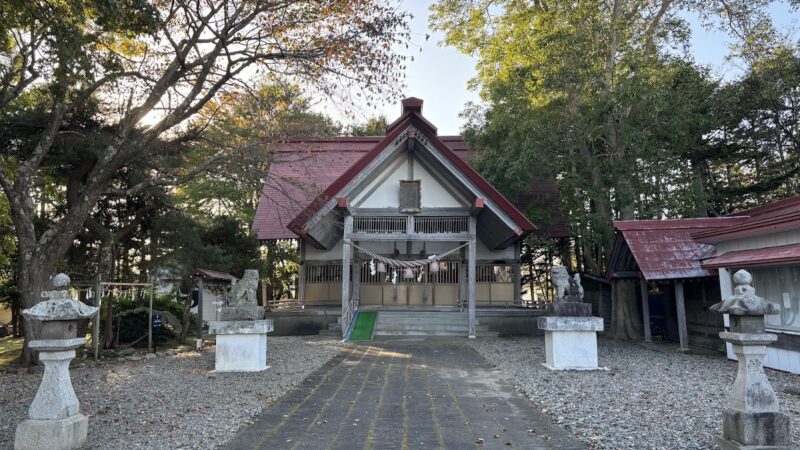
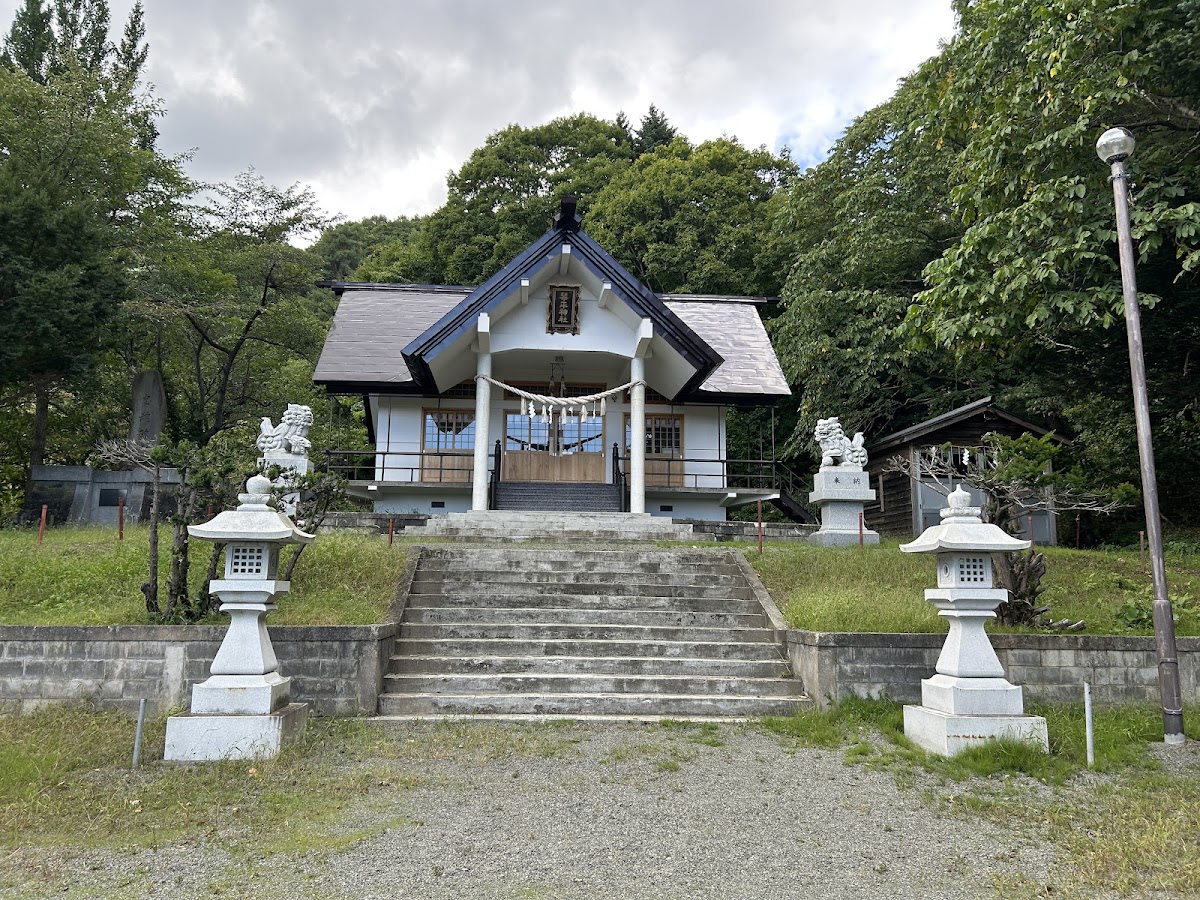
Bikuni Shrine’s buildings are wooden structures exhibiting the characteristics of Hokkaido shrine architecture. The main hall, worship hall, and shrine office are neatly arranged and kept clean. A shimenawa (sacred rope) is stretched in front of the worship hall, welcoming worshippers.
Trees are planted around the shrine buildings, and the greenery is particularly beautiful from spring to summer, creating a tranquil atmosphere. In winter, the entire grounds are covered in snow, which also adds to the unique charm of Hokkaido shrines.
Highlights of the Grounds
Stone lanterns and guardian lion-dogs are placed throughout the grounds, allowing visitors to feel the history of the shrine simply by walking along the approach. The area where people pass through the fire during the annual festival, usually a quiet space, becomes bustling with people during the festival.
From the shrine grounds, you can enjoy views of the town of Bikuni and the Sea of Japan, and on clear days, you can enjoy the beautiful scenery of the Shakotan Peninsula.
Goshuin Information
Goshuin (shrine stamps) are available at Bikuni Shrine. Goshuin are popular among many visitors as proof of their visit and as a way to forge a connection with the shrine.
Regarding the Issuance of Goshuin
Goshuin can be obtained at the shrine office, but staff may not always be present. Therefore, if you definitely want a goshuin, it is recommended to call ahead to confirm. It is especially easier to obtain them during the annual festival.
Even if you do not have a goshuin notebook, pre-printed goshuin may be available, so please inquire at the shrine office.
Etiquette for Visiting the Shrine
When receiving a goshuin, it is considered proper etiquette to first pay your respects at the main hall before proceeding to the shrine office. Goshuin (temple/shrine stamps) are not just stamp rallies; they are important for forging a connection with the gods, so please visit with a respectful heart.
Access Methods
There are two ways to access Biko Shrine: by public transport or by private car. Since public transport services are limited on the Shakotan Peninsula, access by private car is more convenient.
Access by Public Transport
From Sapporo:
- From JR Sapporo Station to Otaru Station: Approximately 30 minutes by Rapid Airport train
- From Otaru Station Bus Terminal: Approximately 90 minutes by Hokkaido Chuo Bus “Kōsoku Shakotan-go” or local bus to Biko Terminal
- Approximately 10 minutes on foot from Biko Terminal
From Otaru:
From Otaru Station Bus Terminal: Approximately 90 minutes by Hokkaido Chuo Bus to Biko Terminal, then approximately 10 minutes on foot
Since bus services are limited, it is recommended to check the Hokkaido Chuo Bus timetable in advance. Services may be reduced, especially during winter.
Access by Private Car
From Sapporo:
Approximately 2 hours 30 minutes to 3 hours from Sapporo city center via National Route 5 and National Route 229 (Shakotan National Highway). This is a scenic route along the coastline of the Shakotan Peninsula.
From Otaru:
Approximately 1 hour 30 minutes to 2 hours from Otaru city center via National Route 229.
Parking:
There are parking spaces for visitors around the Bikuni Shrine. However, congestion is expected during the annual festival period, so it is recommended to use public parking or arrive early. There are also parking spaces around the Bikuni Fishing Port.
Access in Winter
During winter in Hokkaido (November to March), there is snow and icy roads, so winter tires are essential if accessing by private car. Also, please drive with caution in blizzards and poor visibility. Public transportation may also be suspended or delayed due to weather, so please plan accordingly.
Tourist Attractions Around Bikuni Shrine
When visiting Bikuni Shrine, you can also enjoy the rich nature and tourist attractions of the Shakotan Peninsula.
Shakotan Blue Sea
The Shakotan Peninsula is known for its beautiful, crystal-clear sea, known as “Shakotan Blue.” Scenic spots such as Cape Kamui, Shimamui Coast, and Kogane Cape offer breathtaking views. The sea’s blueness is particularly striking during the summer, attracting many tourists.
Sea Urchin Rice Bowl
Shakotan Town is famous for its fresh sea urchins. During the sea urchin fishing season from June to August, you can enjoy freshly caught sea urchin rice bowls at restaurants in Bikuni Town. Enjoying Shakotan’s seafood in conjunction with a visit to Bikuni Shrine is highly recommended.
Bikuni Port
Bikuni Fishing Port, located very close to Bikuni Shrine, is one of the main fishing ports on the Shakotan Peninsula. In the early morning, you can see fishing boats coming and going, giving you a sense of the town’s vitality as a fishing community.
Sea Urchin Rice Bowl ### Other Tourist Facilities in Shakotan Town
- Shakotan Town General Culture Center: A facility where you can learn about the history and culture of Shakotan.
- Hiji Coast: A scenic spot with a series of strangely shaped rocks.
- Demisaki Lighthouse: A lighthouse standing at the tip of the Shakotan Peninsula.
Etiquette and Manners for Visiting the Shrine
We will introduce the basic etiquette for visiting the Bikuni Shrine.
How to Pass Through the Torii Gate
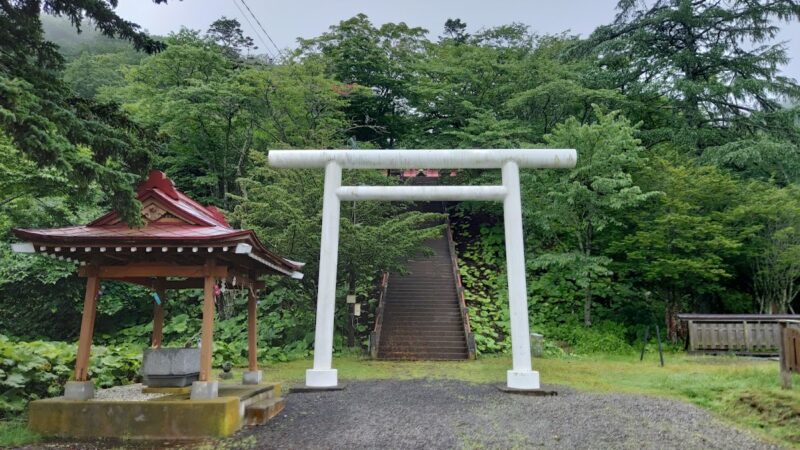
The torii gate is the entrance to the sacred area. Before passing through the torii gate, bow once, and since the center of the path is considered the path of the gods, it is polite to walk along the side.
Proper Ritual of Washing Hands
- Hold the ladle in your right hand and wash your left hand.
- Switch the ladle to your left hand and wash your right hand.
- Switch the ladle back to your right hand, receive water in your left hand, and rinse your mouth.
- Wash your left hand again.
- Hold the ladle upright, let the water flow down the handle, and return it to its original place.
Worship at the Main Hall
- Place your offering in the offering box.
- Ring the bell (if present).
- Two bows, two claps, one bow: Bow deeply twice → clap twice → bow deeply once.
- Make your wish quietly in your heart.
Annual Events at Mikuni Shrine
Besides the annual festival, various Shinto rituals are performed throughout the year at Mikuni Shrine.
- New Year’s Day Festival (January 1st): A festival celebrating the New Year
- Spring Festival: A festival celebrating the arrival of spring
- Grand Festival (Early July): The most important annual event
- Autumn Festival: A festival giving thanks for the harvest
- Great Purification Ceremony (June & December): A Shinto ritual to purify oneself of the impurities accumulated over the past six months
These rituals are primarily conducted by local residents, but some are open to worshippers.
Summary
Bikuni Shrine is a historical shrine founded in 1725 (Kyoho 10) in Shakotan-cho, Shakotan-gun, Hokkaido. It enshrines three deities: Uke-mochi-no-kami, Owatatsumi-no-kami, and Oyamatsumi-no-kami. For approximately 300 years, it has been a center of local faith, cherished by residents for prayers for maritime safety, abundant fishing, and bountiful harvests.
The annual festival, held every July, features a sea procession, a portable shrine procession, and a magnificent fire-jumping ritual by a Tengu (mythical creature), making it Shakotan Town’s largest festival and attracting many worshippers and tourists.
Nearby surrounded by the beautiful nature of the Shakotan Peninsula, Bikuni Shrine is an attractive tourist spot where visitors can enjoy not only the shrine’s beauty but also the Shakotan Blue sea, fresh seafood such as sea urchins, and scenic views. It’s easily accessible from Sapporo and Otaru, making it a worthwhile shrine to visit as part of a Hokkaido trip.
Experience the charm of Bikuni Shrine, a blend of history, tradition, and the rich natural beauty of Shakotan, by visiting in person.