Complete Guide to Hirakiki Shrine | History, Benefits, and Visiting Information for Satsuma Province’s Ichinomiya Shrine with Mount Kaimon as its Sacred Object
Hirakiki Shrine, located in Kaimon-jucho, Ibusuki City, Kagoshima Prefecture, is an ancient shrine situated at the southernmost tip of the Satsuma Peninsula, enshrining Mount Kaimon, a sacred mountain known as “Satsuma Fuji,” as its sacred object. It has long been revered as the Ichinomiya (first-ranked shrine) of Satsuma Province and is known as a guardian deity of traffic and maritime safety. This article comprehensively introduces information you should know before visiting Hirakiki Shrine, including its history, benefits, highlights within the grounds, visiting information, and access methods.
What is Hirakiki Shrine? | Overview of Satsuma Province’s Ichinomiya Shrine
Hirakiki Shrine is a Shikinaisha (Myojin Taisha) shrine located in Ibusuki City, Kagoshima Prefecture, and is a highly prestigious shrine as the Ichinomiya of Satsuma Province. It enshrines Mount Kaimon, which rises to an altitude of 924 meters, and its shrine buildings are constructed at its foot.
Basic Information
- Official Name: Hirakiki Shrine
- Former Shrine Rank: Shikinaisha (Myojin Taisha), Ichinomiya of Satsuma Province, Kanpei Taisha
- Deity Enshrined: Ohirume-no-Mikoto (another name for Amaterasu Omikami)
- Location: 1366, Kaimon Jucho, Ibusuki City, Kagoshima Prefecture
- Founding Date: Unknown (Shrine tradition states it was founded in the age of the gods)
- Annual Festival Date: August 16th
The Ichinomiya of Satsuma Province refers to the shrine that held the highest rank in the province (under the Ritsuryo system) from ancient to medieval times. Hirakiki Shrine, as the highest-ranking shrine in Satsuma Province, received deep reverence from the imperial court and samurai families.
History of Hirakiki Shrine | The Origins of an Ancient Shrine Dating Back to the Age of the Gods
Founding and Ancient Beliefs
The exact founding date of Hirakiki Shrine is unclear, but according to shrine tradition, it dates back to the age of the gods. The *Engishiki Jinmyocho* (compiled in 927) lists it as “Hirakiki Shrine, Ei District, Satsuma Province, Myojin Taisha,” indicating that it was already highly regarded by the imperial court as a Myojin Taisha during the Heian period.
Mount Kaimon has long been called “Hirakiki-dake” or “Kaimon-dake,” and was a key point for maritime traffic, serving as a landmark for navigation. Therefore, it is believed that the worship of the god of the sea and the guardian deity of navigation has been rooted there since ancient times.
Development in the Medieval and Early Modern Periods
During the medieval period, the shrine received the reverence of the Shimazu clan, who ruled Satsuma Province, and they donated land and constructed shrine buildings. Although it declined temporarily during the Sengoku period, it was revived under the patronage of the Shimazu clan during the Edo period and became an important shrine of the Satsuma domain.
Edo period documents record that many pilgrims visited the shrine as the Ichinomiya (first-ranked shrine) of Satsuma Province. In particular, people praying for safety at sea and Shugendo practitioners climbing Mount Kaimon visited the shrine.
Changes in the Modern Era
Under the modern shrine ranking system of the Meiji era, the shrine was ranked as a Kokuhei Chusha (national shrine of the second rank) in 1871 (Meiji 4) and elevated to Kanpei Taisha (government-supported shrine of the first rank) in 1915 (Taisho 4). This signifies that its status as the Ichinomiya of Satsuma Province was nationally recognized.
After World War II, the shrine ranking system was abolished, but it remains known as the Ichinomiya of Satsuma Province, attracting the faith of local people and visitors from all over Japan.
Deities and Benefits | Divine Virtues Received at Hirakiki Shrine
About the Deities
The deity enshrined at Hirakiki Shrine is Ohirume-no-Mikoto. This is another name for Amaterasu Omikami, the supreme deity in Japanese mythology, and is enshrined here.
According to one theory, Mount Kaimon was considered a sacred mountain, and mountain worship was practiced here. It is also believed to have held the characteristics of a guardian deity of maritime traffic. Furthermore, in some regions, a connection to Watatsumi-no-kami, the god of the sea, has been pointed out.
Main Benefits
Hiraki Shrine is known for the following benefits:
- Traffic Safety: Widely worshipped for prayers for safe travel on land and sea.
- Safe Navigation: Since ancient times, it has been revered as a god of the sea, attracting the faith of sailors and those involved in fishing.
- Good Fortune and Prosperity: Due to its status as a principal shrine, it is believed to bring good fortune in general.
- Family Safety: As it enshrines Amaterasu Omikami, one can pray for peace and prosperity in the home.
- Protection from Misfortune: Believed to ward off misfortune and provide divine protection.
- Business Prosperity: Many visitors come to pray for the development of local industries.
The benefit of traffic safety is particularly well-known, and many people visit to pray for safe travels when purchasing a new car or before traveling.
Highlights of the Shrine Grounds | Architecture and Nature of Hirakiki Shrine
Shrine Buildings and Architecture
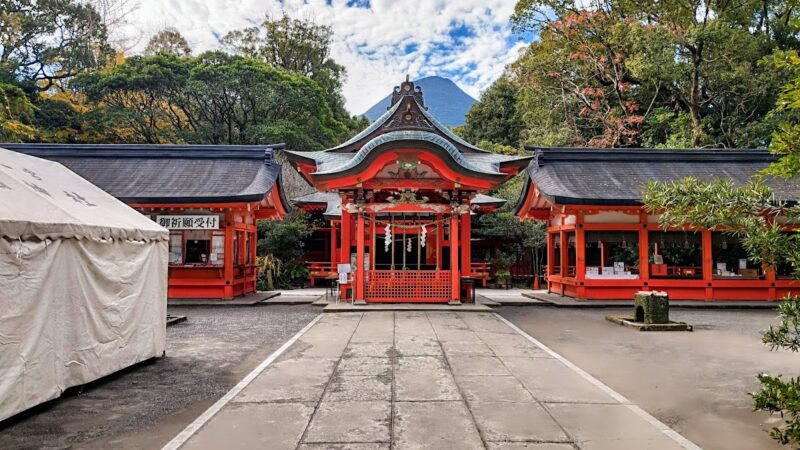
The shrine buildings of Hirakiki Shrine are built with Mount Kaimon as a backdrop, in a style that allows worshippers to pay homage to the sacred mountain.
Haiden: This is the building where worshippers offer their prayers, and it exhibits the traditional style of shrine architecture.
Honden: This is the most sacred place where the enshrined deity is worshipped, and general worshippers begin their prayers from the Haiden.
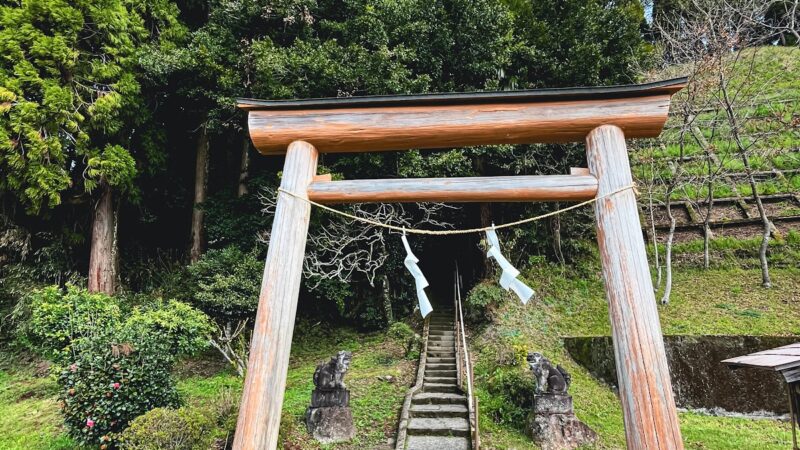
Torii: The torii gate, which marks the entrance to the sacred area, stands with Mount Kaimon as a backdrop and is a popular photo spot.
Sacred Trees and Natural Environment
The shrine grounds contain ancient camphor trees and cedar trees estimated to be several hundred years old, creating a sacred atmosphere. These sacred trees are living witnesses that have watched over Hirakiki Shrine throughout its long history.
Located at the foot of Mount Kaimon, the shrine grounds are surrounded by abundant nature, allowing visitors to enjoy the scenery of each season. The area is particularly beautiful during the spring when the new leaves appear and in the autumn when the leaves change color, and many people enjoy nature walks in conjunction with their visit to the shrine.
Relationship with Mount Kaimon
The most distinctive feature of Hirakiki Shrine is that it enshrines Mount Kaimon as its sacred object of worship. The view of Mount Kaimon from the shrine is majestic, and one can truly understand why ancient people worshipped this mountain as a god.
Mount Kaimon is a beautiful conical volcano, also known as “Satsuma Fuji,” with an elevation of 924 meters. Hiking trails are well-maintained, and from the summit, a spectacular view unfolds, stretching to the Satsuma Peninsula, Yakushima Island, and Tanegashima Island. Many people enjoy climbing Mount Kaimon in conjunction with their visit to Hirakiki Shrine.
Information on Goshuin (Shrine Seals) and Amulets
About Goshuin
Goshuin (shrine seals) are available at Hirakiki Shrine.
- Reception Location: Shrine Office
- Reception Hours: Usually 9:00 AM to 5:00 PM (Hours may vary, so prior confirmation is recommended)
- Offering Fee: Approximately 300-500 yen (May vary depending on the season)
- Features: The inscription “Ichinomiya of Satsuma Province” and the shrine’s vermilion seal are stamped.
Goshuin notebooks are also available, and the original notebook featuring a design of Mount Kaimon is particularly popular.
Amulets and Souvenirs
Hiragi Shrine offers a variety of amulets and souvenirs:
- Traffic Safety Amulet: The most popular amulet, also available as a sticker for cars.
- Maritime Safety Amulet: A popular amulet among sailors and those involved in fishing.
- Good Fortune Amulet: An amulet for wishing for good fortune and prosperity.
- Exorcism Amulet: An amulet for those in their unlucky year or those wishing for protection from evil.
- Academic Success Amulet: An amulet for students taking exams or other students.
Other items such as ema (votive tablets) and omikuji (fortune slips) are also available.
Annual Events and Festivals
Grand Festival (August 16th)
The most important festival at Hiragi Shrine is the Grand Festival, held annually on August 16th. A portable shrine procession and dedication ceremonies take place, attracting many local residents and worshippers. Traditional performing arts are also offered, making it the most lively day at the shrine.
Other Major Events
- New Year’s Day Festival (January 1st): A festival celebrating the New Year, bustling with visitors making their first shrine visit of the year.
- Setsubun Festival (around February 3rd): Events such as bean-throwing are held.
- Summer Purification Ceremony (June 30th): A Shinto ritual to purify oneself of sins and impurities accumulated over the past six months.
- Autumn Grand Festival (around November 23rd): A festival to give thanks for the harvest.
- Year-End Purification Ceremony (December 31st): A Shinto ritual to purify oneself of sins and impurities accumulated over the year and prepare for the New Year.
Please note that the dates of festivals may vary from year to year, so it is recommended to check with the shrine before visiting.
Visiting Information | Visiting Hours and Etiquette
Visiting Hours
While you can generally visit the grounds of Hiraki Shrine freely, the reception hours for the shrine office are generally as follows:
- Visiting Hours: From sunrise to sunset (grounds are freely accessible)
- Shrine Office Reception Hours: 9:00 AM to 5:00 PM (approximate)
- Prayer Request Reception: 9:00 AM to around 4:30 PM (advance confirmation required)
Hours may change during the New Year holidays and festival days.
Shrine Visiting Etiquette
Please observe basic shrine visiting etiquette:
- Bow before passing through the torii gate: Bow before entering the sacred area.
- Avoid the center of the path: The center of the path is considered the path of the gods, so walk along the sides.
- Purify at the water basin: Purify your hands and mouth before praying.
- Two bows, two claps, one bow: In front of the main hall, bow twice, clap twice, and finally bow once.
- Be quiet: Be mindful that this is a sacred place and refrain from speaking loudly.
About Prayers
Various prayers are available at Hiraki Shrine:
- Traffic safety prayer (car blessing)
- Family safety
- Business prosperity
- Protection from evil
- Safe childbirth prayer
- First shrine visit for a newborn
- Shichi-Go-San (7-5-3 Festival)
If you wish to have a prayer ceremony, we recommend making a reservation by phone in advance. The offering fee varies depending on the prayer content, but it is generally from 5,000 yen.
Access | How to get to Hirakiki Shrine
Location
Address: 1366, Kaimon Jucho, Ibusuki City, Kagoshima Prefecture 891-0603
Access by Car
From Kagoshima City:
- Approximately 1 hour 30 minutes via Ibusuki Skyline
- Head south on National Route 226 towards Kaimon
- There is free parking at the shrine (approximately 30 regular cars)
From Ibusuki City Center:
- Head south on National Route 226, approximately 30 minutes
- It’s easy to find if you use Mount Kaimon as a landmark
Searching for “Hirakiki Shrine” on your car navigation system or map app will show the exact location.
Access by Public Transportation
By JR:
- Get off at Kaimon Station on the JR Ibusuki-Makurazaki Line
- Approximately 15 minutes on foot from the station (approx. 1.2 km)
- Approximately 5 minutes by taxi
By Bus:
- Get off at the Hirakiki Shrine bus stop on the Kagoshima Kotsu bus.
- However, since the number of buses is limited, it is recommended to check the timetable in advance.
From Kagoshima Airport:
- Take the airport shuttle bus to Kagoshima-Chuo Station (approx. 40 minutes)
- Take the JR Ibusuki-Makurazaki Line to Kaimon Station (approx. 1 hour 30 minutes)
- Alternatively, renting a car is convenient (approx. 2 hours)
Parking Information
Hirakiki Shrine has a free parking lot for visitors:
- Capacity: Approximately 30 regular cars
- Fee: Free
- Operating Hours: Follow the visiting hours.
On days when crowds are expected, such as festival days or New Year’s visits, temporary parking may be provided.
Nearby Tourist Spots | Places to Visit Along with Hirakiki Shrine
Mount Kaimon
Mount Kaimon, the sacred object of worship at Hirakiki Shrine, is accessible for hiking. The hiking trail is well-maintained, and the round trip to the summit takes approximately 4-5 hours. The 360-degree panoramic view from the summit is spectacular.
Cape Nagasaki
A cape at the southernmost tip of the Satsuma Peninsula, offering a spectacular view of Mount Kaimon across the sea. It also features Ryugu Shrine, associated with the legend of Urashima Taro. Approximately 10 minutes by car from Hirakiki Shrine.
Lake Ikeda
The largest caldera lake in Kyushu, also known for the legend of Issie. From the lakeside, you can enjoy a beautiful view of Mount Kaimon. Approximately 15 minutes by car from Hirakiki Shrine.
Ibusuki Onsen
Ibusuki Onsenkyo, famous for its sand baths. Relaxing in a hot spring after your visit is also recommended. It’s about a 30-minute drive from Hirakiki Shrine.
Chirin-ga-shima Island
From March to October, during low tide of spring and neap tides, a sandy path called “Chiririn Road” appears, allowing you to walk to an uninhabited island. It’s also a popular power spot for matchmaking.
Hirakiki Shrine Visit Tips and Q&A
What to Wear for Visiting the Shrine?
While there are no strict dress code regulations for visiting the shrine, it’s best to dress appropriately, keeping in mind that it’s a sacred place. If you’re receiving prayers, overly casual attire (jackets for men, dresses or suits for women) is preferred.
Is Photography Allowed?
Photography is generally permitted within the shrine grounds, but it may be prohibited inside the main hall or during religious ceremonies. Check with the shrine office or review posted notices before taking photos.
Are Pets Allowed?
Pets are generally not recommended on shrine grounds. In particular, entry into buildings is prohibited. If you wish to visit with your pet, we recommend checking with the shrine in advance.
Is it wheelchair accessible?
While some parts of the shrine grounds are barrier-free, not all areas are wheelchair accessible. If you wish to visit, we recommend contacting the shrine in advance to check the situation.
Summary | The Charm of Visiting Hirakiki Shrine
Hirakiki Shrine is a shrine of great prestige as the Ichinomiya (first-ranked shrine) of Satsuma Province, and boasts a magnificent scale with Mount Kaimon as its sacred object of worship. With a history of over 1,000 years, it is known for its blessings of traffic safety and maritime safety, attracting many visitors.
The shrine grounds, with the beautiful Mount Kaimon as a backdrop, are filled with a sacred atmosphere, making it a fitting place to purify the soul. When visiting southern Kagoshima Prefecture, be sure to visit Hirakiki Shrine and experience the history and divine blessings of the Ichinomiya of Satsuma Province.
There are many attractive tourist spots in the surrounding area, such as Mount Kaimon, Nagasakibana, Lake Ikeda, and Ibusuki Onsen, which can be explored in a single day. Enjoy a fulfilling trip combining worship and sightseeing.
Pre-Visit Checklist:
- Check the shrine office’s opening hours
- Check the schedule of festivals and events
- Check the weather and visibility of Mt. Kaimon
- Check the opening hours of nearby tourist attractions
- Check the timetable if using public transportation
We hope your visit to Hirakiki Shrine will be a memorable experience.