Sugimoto-dera Temple Complete Guide | History, Highlights, and Visiting Information for Kamakura’s Oldest Temple
Nearby along the Kanazawa Road in the secluded heart of Kamakura, Sugimoto-dera Temple is Kamakura’s oldest temple, founded approximately 500 years before the establishment of the Kamakura Shogunate. Since its founding in 734 AD, it has continued to boast a history of nearly 1300 years, welcoming many visitors to this day. As the first temple of the Bando Thirty-Three Kannon Pilgrimage and the first temple of the Kamakura Thirty-Three Kannon Pilgrimage, Sugimoto-dera Temple has been revered as a sacred site of Kannon worship. This guide thoroughly introduces the charm of Sugimoto-dera Temple, from its history and highlights to visiting information.
What is Sugimoto-dera Temple? | Overview of Kamakura’s Oldest Temple
Sugimoto-dera Temple is a Tendai sect temple located in Nikaido, Kamakura City, Kanagawa Prefecture. Its mountain name is Okura-san, and its official name is “Okura-san Kannon-in Sugimoto-dera.” The main deity is three eleven-faced Kannon Bodhisattva statues, also known as “Sugimoto Kannon” and “Okura Kannon.”
Sugimoto-dera Temple, known as the oldest temple in Kamakura, was founded in 734 AD (Tenpyo 6) by Gyoki Bodhisattva during the Nara period. It is a historical temple that has functioned as a center of Kannon worship in this area for over 450 years, even before the establishment of the Kamakura Shogunate.
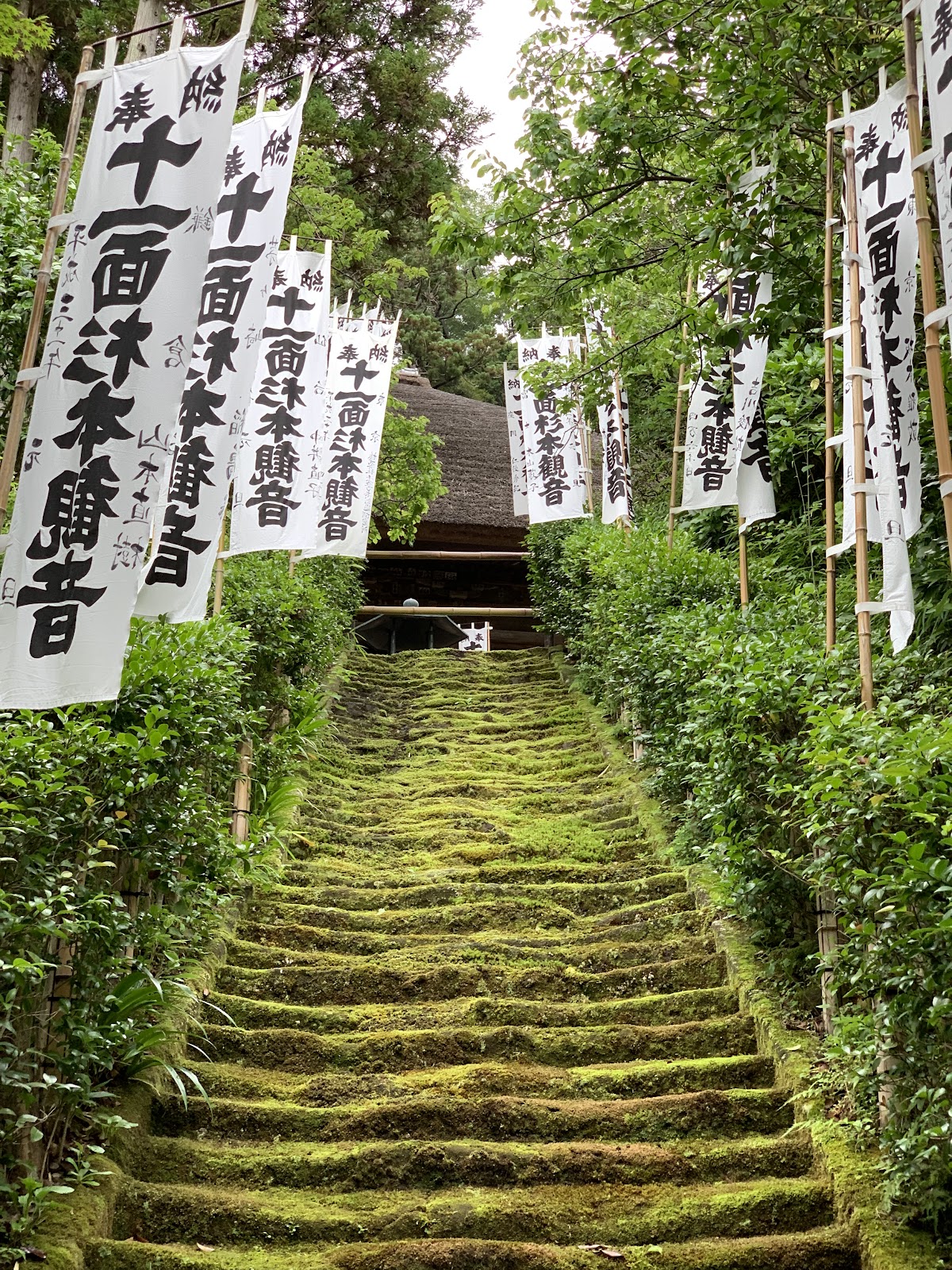
Within the temple grounds are beautiful moss-covered stone steps, a charming thatched-roof main hall, and a collection of precious Buddhist statues that can be viewed up close, making it a valuable place that conveys the original landscape of the ancient capital of Kamakura.
History and Origins of Sugimoto-dera Temple | A Sacred Site of Kannon Worship Continuing from the Tenpyo Period
Origin of Founding and Gyoki Bodhisattva
The founding of Sugimoto-dera Temple dates back to 734 AD (Tenpyo 6), during the Nara period. According to legend, when Gyōki Bodhisattva gazed upon the land of Kamakura from Mount Ōkura, he had a spiritual inspiration that “a statue of Kannon should be enshrined in this place.” He then carved an eleven-faced Kannon statue himself and enshrined it, marking the beginning of the temple.
Gyōki was a prominent Buddhist monk of the Nara period, dedicated to spreading Buddhism among the common people and undertaking social projects. He is known for constructing temples, bridges, and roads throughout Japan, and later came to be revered as “Gyōki Bodhisattva.” Sugimoto-dera Temple holds an important position as one of the temples founded by Gyōki.
Connection with Empress Kōmyō
A few years after its founding, in 739 AD (Tenpyō 11), the temple buildings were renovated at the behest of Empress Kōmyō, the consort of Emperor Shōmu. Empress Kōmyō was known for her deep faith in Buddhism and was deeply involved in the construction of the Great Buddha of Tōdai-ji Temple.
It is said that Empress Kōmyō herself dedicated an eleven-faced Kannon statue at this time, and this is considered one of the reasons why three principal images are enshrined at Sugimoto-dera Temple. This deep connection with the Imperial family indicates that Sugimoto-dera Temple was not merely a local temple, but a temple of national importance.
Jikaku Daishi Ennin and the Third Principal Image
During the Jōwa era of the Heian period (834-848), Jikaku Daishi Ennin, a high-ranking priest of the Tendai sect, visited Sugimoto-dera Temple and dedicated a third eleven-faced Kannon statue. Jikaku Daishi served as the third head priest of Enryaku-ji Temple on Mount Hiei and made significant contributions to the development of the Tendai sect.
Thus, three eleven-faced Kannon statues—one created by Gyōki, one commissioned by Empress Kōmyō, and one by Jikaku Daishi—came to be enshrined as principal images, and this remains the most distinctive feature of Sugimoto-dera Temple to this day.
History from the Kamakura Period Onward
Even after the establishment of the Kamakura Shogunate, Sugimoto-dera Temple attracted the faith of samurai families, including Minamoto no Yoritomo. In 1191, it suffered a fire, but a legend remains that the three Kannon statues, the temple’s principal images, miraculously took refuge under cedar trees within the temple grounds. It is said that the name “Sugimoto Kannon” originated from this miracle.
During the Edo period, it received the patronage of the Tokugawa family and was granted temple lands. Having weathered the storm of the anti-Buddhist movement of the Meiji era, it continues to uphold its tradition as the oldest temple in Kamakura to this day.
Highlights of Sugimoto-dera Temple | A Thorough Explanation of the Temple Grounds’ Charm
Moss-Covered Stone Steps | The Symbol of Sugimoto-dera Temple
The first thing visitors to Sugimoto-dera Temple see is the beautiful moss-covered stone steps leading to the temple. The moss, which has spread over many years to cover the entire steps, resembles a deep green carpet, becoming a symbolic landscape of Sugimoto-dera Temple.
These stone steps are believed to date back to the Kamakura period and are currently closed to traffic for preservation purposes, but their appearance when viewed from below is breathtaking. Numerous white banners bearing the inscription “Eleven-Faced Sugimoto Kannon” line both sides, adorning the approach to the temple.
The moss-covered steps are especially beautiful after rain or when wet with morning dew, their greenery becoming even more vibrant. The steps, which change their appearance with each season, are one of the charms of Sugimoto-dera Temple, offering new discoveries with every visit.
Niomon Gate | Entrance to the Temple Grounds
Beyond the moss-covered steps lies the Niomon Gate. This gate houses Kongo Rikishi statues (Nio statues) on either side, protecting the temple. Passing through the Niomon Gate leads to the temple grounds, which include the main hall.
The area around the Niomon Gate is also lush with greenery, and depending on the season, hydrangeas and autumn leaves are beautiful, delighting visitors.
Thatched-Roof Main Hall | Buddhist Statues You Can View Up Close
The main hall of Sugimoto-dera Temple is a distinctive building featuring a charming thatched roof. Thatched roofs are a traditional Japanese architectural style that requires periodic re-thatching, but their simple and warm appearance exudes the dignity of an ancient temple.
Inside the main hall, you can view the three principal images, the Eleven-Headed Kannon statues, up close. This is extremely rare even among temples in Kamakura. In many temples, Buddhist statues are enshrined in shrines and can only be worshipped from a distance, but at Sugimoto-dera Temple, you can approach the statues and directly experience their majestic presence.
In addition to the three Eleven-Headed Kannon statues, many other Buddhist statues are enshrined inside the main hall, including Bishamonten and Fudo Myoo. The statues standing in the dimly lit hall are enveloped in a mystical atmosphere, deeply moving visitors.
Three Eleven-Headed Kannon Statues | The Principal Images of Sugimoto-dera Temple
The greatest highlight of Sugimoto-dera Temple is undoubtedly its three principal images: the Eleven-Headed Kannon statues.
The Kannon statue created by Gyoki is a valuable Buddhist statue that retains the style of the Nara period, characterized by its simple yet powerful form. Placed at the time of the temple’s founding in 734 AD, this statue can be considered the origin of Sugimoto-dera Temple, which boasts a history of nearly 1300 years.
The Kannon statue commissioned by Empress Komyo was dedicated in 739 AD and is characterized by its elegant and refined form. It holds special significance as a Kannon statue imbued with Empress Komyo’s deep faith.
The Kannon statue created by Jikaku Daishi was dedicated during the Jowa era of the Heian period and is characterized by its majestic appearance influenced by Tendai Esoteric Buddhism.
These three Kannon statues, though from different eras and by different artists, are harmoniously enshrined within the main hall, making them a valuable representation of the flow of Japanese Buddhist history.
The Substitute Jizo and the Nun-General Jizo
Sugimoto-dera Temple is also the fourth and sixth temple on the Kamakura Twenty-Four Jizo Pilgrimage. Within the temple grounds are enshrined the Substitute Jizo and the Nun-General Jizo.
The Substitute Jizo is revered as a Jizo Bodhisattva who takes on people’s suffering in their place. The Nun-General Jizo is a Jizo statue associated with Hojo Masako, the wife of Minamoto no Yoritomo, and is cherished as a guardian deity for women.
The Four Seasons of the Temple Grounds | Seasonal Beauty
The grounds of Sugimoto-dera Temple display different expressions in each of the four seasons.
In spring, the fresh greenery is beautiful, and the moss-covered stone steps become even more vibrant. During cherry blossom season, cherry blossoms bloom on the temple grounds, enveloping them in an elegant atmosphere.
In summer, hydrangeas adorn the temple grounds, and during the rainy season, the moss, wet with rain, shines even more beautifully.
In autumn, the autumn leaves dye the grounds red, creating a magnificent harmony with the thatched-roof main hall.
In winter, silence envelops the temple, and sometimes the snow-covered grounds create a fantastical landscape.
First Temple of the Bando Thirty-Three Kannon Pilgrimage | The Starting Point of the Pilgrimage
Sugimoto-dera Temple is the first temple of the Bando Thirty-Three Kannon Pilgrimage, serving as the starting point for the Kannon pilgrimage. The Bando Thirty-Three Kannon Pilgrimage is a pilgrimage route that visits 33 Kannon temples spread across the Kanto region (Bando), and is believed to have been established from the late Heian period to the Kamakura period.
Alongside the Saigoku Thirty-Three Kannon Pilgrimage and the Chichibu Thirty-Four Kannon Pilgrimage, the Bando Thirty-Three Kannon Pilgrimage is counted as one of Japan’s three major Kannon pilgrimage routes. Sugimoto-dera Temple, the first temple on the pilgrimage route, holds special significance for many who begin their journey.
At the main hall, pilgrims can receive a Goshuin (temple stamp), and have their pilgrimage book inscribed. As the first temple, it is constantly filled with worshippers praying for a safe pilgrimage.
Kamakura Thirty-Three Kannon Pilgrimage, First Temple | Center of Local Faith
Sugimoto-dera Temple is not only the first temple on the Bando Thirty-Three Kannon Pilgrimage, but also the first temple on the Kamakura Thirty-Three Kannon Pilgrimage. The Kamakura Thirty-Three Kannon Pilgrimage is a pilgrimage route that visits 33 Kannon temples in and around Kamakura.
Because it is a pilgrimage route within the limited area of Kamakura, it is possible to complete it in a day or a few days, making it an easily accessible pilgrimage. As the first temple, Sugimoto-dera Temple serves as the starting point for the Kamakura Kannon Pilgrimage.
Annual Events at Sugimoto-ji Temple | Traditional Ceremonies and Events
Sugimoto-ji Temple holds various annual events throughout the year.
January 1st-3rd: Shushō-e (New Year’s Ceremony)
February 3rd: Setsubun-e (Bean-throwing Ceremony)
August 10th: Shimanrokusen-nichi (The Day of Great Merit of Kannon)
August 18th: Segaki-e (February 18th Ceremony)
Every 18th of the Month: Kannon Ennichi (Kannon Festival)
Many worshippers visit these events, preserving ancient traditions. In particular, Shimanrokusen-nichi is celebrated because visiting on this day is believed to bestow the merit of 46,000 days, attracting many believers.
Visiting Information | Visiting Hours, Fees, and Access
Visiting Hours and Fees
Visiting Hours: 8:00 AM – 4:30 PM (Open year-round)
Admission Fee:
- High school students and older: 300 yen
- Junior high school students: 200 yen
- Elementary school students: 100 yen
Considering that you can view the Buddha statues inside the main hall up close, the admission fee is very reasonable.
Access Information
Access by Train/Bus:
- From JR Kamakura Station East Exit, take the Keikyu Bus bound for “Kanazawa Hakkei Station,” “Tachiarai,” or “Highland Loop” (approximately 10 minutes), get off at the “Sugimoto Kannon” bus stop, and walk for 1 minute.
- Approximately 25 minutes on foot from JR Kamakura Station East Exit.
Access by Car:
- Approximately 5 minutes from the Asahina IC on the Yokohama-Yokosuka Expressway.
- Parking: Available (free, several spaces)
Sugimoto-dera Temple is located along the Kanazawa Kaido road and is a bit of a distance from Kamakura Station, but it is easily accessible by bus. If walking, the most common route is to walk along the Kanazawa Kaido from Tsurugaoka Hachimangu Shrine, and you can enjoy the scenery along the way.
Location and Contact Information
Address: 903 Nikaido, Kamakura City, Kanagawa Prefecture 248-0002
Phone: 0467-22-3463
Attractions Around Sugimoto-dera Temple | Places to Visit Together
When visiting Sugimoto-dera Temple, we recommend also visiting the surrounding temples and shrines.
Hokoku-ji Temple (Bamboo Temple)
Located about a 5-minute walk from Sugimoto-dera Temple, Hokoku-ji Temple is famous for its “bamboo garden.” The bamboo grove, with approximately 2000 moso bamboo trees, is breathtaking, and you can even enjoy matcha tea amidst the bamboo forest.
Jomyoji Temple
Jomyoji Temple, which holds the fifth rank among the Five Great Zen Temples of Kamakura, is also located about a 7-minute walk from Sugimoto-dera Temple. Its vast grounds and beautiful gardens are its main attractions.
Kamakura-gu Shrine (Daito-no-miya)
Kamakura-gu Shrine, dedicated to Prince Moriyoshi, son of Emperor Go-Daigo, is also located along the Kanazawa Road. It’s a historically important shrine, and many people visit it along with Sugimoto-dera Temple.
Zuisen-ji Temple
Zuisen-ji Temple, known as the family temple of the Kamakura Shogunate, is famous for its rock garden designed by Muso Soseki. The seasonal flowers are beautiful, especially during the plum and cherry blossom seasons.
Points to Note When Visiting Sugimoto-dera Temple | For a Deeper Enjoyment
Photography
Sugimoto-dera Temple has many photo opportunities, including moss-covered stone steps and a thatched-roof main hall. However, photography of the Buddha statues inside the main hall is prohibited, so please be careful. Photography is permitted within the temple grounds, but please be considerate of other visitors.
Recommended Visiting Time
Visiting Sugimoto-dera Temple early in the morning is recommended. Especially right after the gates open at 8:00 AM, there are few visitors, allowing for a peaceful and tranquil visit. The moss-covered stone steps, glistening with morning dew, are particularly beautiful, creating a mystical atmosphere.
About Goshuin (Temple Stamps)
At Sugimoto-dera Temple, you can obtain Goshuin stamps for the Bando Thirty-Three Kannon Pilgrimage, the Kamakura Thirty-Three Kannon Pilgrimage, and the Kamakura Twenty-Four Jizo Pilgrimage. Reception is at the main hall, making it a valuable place for those collecting Goshuin from multiple pilgrimages.
Clothing and Items to Bring
You will need to remove your shoes inside the main hall, so easy-to-remove shoes are recommended. Also, since you will be walking up and down stone steps, wear comfortable shoes. In the summer, there can be many mosquitoes, so insect repellent spray is recommended.
The Charm of Sugimoto-dera Temple | Why Does It Attract So Many People?
The reason Sugimoto-dera Temple attracts so many visitors and tourists is not simply its historical value as “Kamakura’s oldest temple.”
As a timeless place of worship, Sugimoto-dera Temple has received prayers from people for nearly 1300 years. Its three principal images represent the culmination of the faith of people from different eras, embodying the depth of Japanese Buddhist culture.
Harmony with nature is another major attraction of Sugimoto-dera Temple. The moss-covered stone steps, lush grounds, and thatched-roof main hall create a beautiful landscape where nature and architecture harmonize perfectly.
The experience of viewing Buddhist statues up close is also difficult to find at other temples. Facing the statues directly, rather than through glass, allows for a deeper spiritual experience.
As a starting point for Kannon pilgrimages, Sugimoto-dera Temple has watched over the beginning of new journeys. Its role as the first temple on the pilgrimage is not merely a geographical starting point, but symbolizes the beginning of a spiritual journey.
Summary | Experiencing the Original Landscape of Kamakura at Sugimoto-dera Temple
Sugimoto-dera Temple, as the oldest temple in Kamakura and the first temple on the Bandō Thirty-Three Kannon Pilgrimage, is a precious temple that conveys a long history and deep faith to the present day.
Since its founding in 734 AD, Sugimoto-dera Temple has remained a place of prayer for people for nearly 1300 years. The three principal images of the Eleven-Faced Kannon, the beautiful moss-covered stone steps, the charming thatched-roof main hall, and the collection of Buddhist statues that can be viewed up close deeply move visitors.
When visiting Kamakura, be sure to visit Sugimoto-dera Temple. In its quiet grounds, away from the hustle and bustle, you can experience the original landscape of the ancient capital of Kamakura and the faith that has been preserved throughout its long history.
Whether you are beginning your pilgrimage to the Bandō Thirty-Three Kannon Pilgrimage or want to learn more about the history of Kamakura, Sugimoto-dera Temple is a special place that you should definitely visit. The time spent gazing at the moss-covered stone steps and facing the Kannon statue in the main hall will surely be a precious and memorable experience.