Complete Guide to Jōkenji Temple: History, Highlights, and Access Information for Two Famous Temples in Niigata and Kanagawa
About Jōkenji Temple
While there are several temples named Jōkenji in Japan, the two Jōkenji temples in Joetsu City, Niigata Prefecture, and Chigasaki City, Kanagawa Prefecture are particularly historically and religiously significant. Both are Nichiren Buddhist temples with long histories, playing important roles in their respective regions.
This article provides a comprehensive explanation of these two Jōkenji temples, covering their history, cultural assets, highlights within the temple grounds, annual events, and access information for visitors.
History and Overview of Jōkenji Temple (Joetsu City, Niigata Prefecture)
The First Nichiren Buddhist Temple in Echigo
Jōkenji Temple, located in Teramachi, Joetsu City, Niigata Prefecture, is known as the first Nichiren Buddhist temple in Echigo Province, and its mountain name is Kōganzan. Founded in 1275 (Kenji 1) by Nichiben Shonin, a senior disciple of Nichiren Shonin and one of the senior priests, the temple was originally located in Takagishi Village (its current location is unknown). It later moved to its present site. As a historical temple introduced to Echigo Province shortly after the establishment of the Nichiren sect during the Kamakura period, it holds an extremely important position in the history of Buddhism in the region.
Role as a Furegashira (Head Temple) in Echigo Province
Jokenji Temple was not merely an isolated temple; it played a central role as a Furegashira (head temple) among Nichiren sect temples in Echigo Province. A Furegashira, in the Edo period temple system, was responsible for transmitting orders from the shogunate and feudal domains to its subordinate temples.
Through this role, Jokenji Temple oversaw Nichiren sect temples within Echigo Province and played a crucial role in religious administration.
History of Restoration
In 1688 (Genroku 1), the temple was restored by Nichito Shonin. Throughout its long history, it has suffered damage from fires and wars, yet has repeatedly recovered as a center of faith.
The current Jōkenji Temple is located at 3-7-31 Teramachi, Joetsu City, Niigata Prefecture, and is an important spot on a temple and shrine tour of Takada Teramachi.
Grounds and Highlights of Jōkenji Temple (Joetsu City, Niigata Prefecture)
Main Hall and Architecture
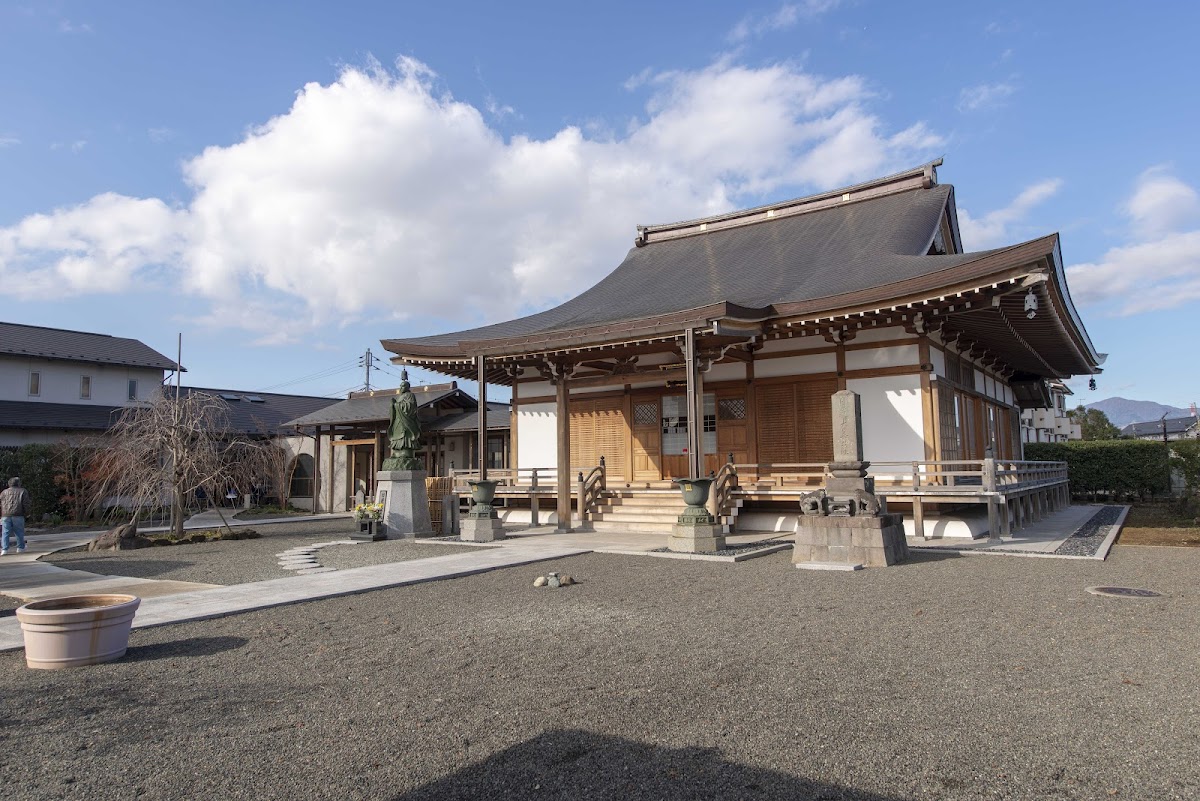
The main hall of Jōkenji Temple maintains the traditional style of Nichiren Buddhist temples while being adapted to the climate and environment of the Echigo region. Inside the main hall are enshrined writings attributed to Risshō Daishi Nichiren, as well as the Tenpai Daimandala Gohonzon (main image of worship).
Nature of the Temple Grounds
Upon passing through the temple gate, visitors are greeted by rows of cedar trees and large ginkgo trees. Especially in autumn, the temple grounds are adorned with bush clover blossoms, creating a beautiful landscape. During this season, Jōkenji Temple is not only a place of worship but also a healing space where one can feel the beauty of nature.
Cultural Assets
Jōkenji Temple houses valuable writings and letters believed to be in the handwriting of Risshō Daishi Nichiren, as well as the Tenpai Daimandala Gohonzon (main image of worship). These are important materials for studying the history of the Nichiren sect and speak to the high status of the temple.
Annual Events and Activities of Jōkenji Temple (Jōetsu City, Niigata Prefecture)
Training Classes for Boys and Girls
Jōkenji Temple holds “Training Classes for Boys and Girls” to foster the development of local youth. In today’s busy world, where it’s easy to lose sight of what’s important and what one desires, this provides an opportunity to re-examine one’s heart through the teachings of Buddhism.
This activity is not merely religious education; it also functions as a place for character development and moral education, and is part of the temple’s contribution to the local community.
Annual Events
As a Nichiren Buddhist temple, Jōkenji Temple holds various memorial services and events throughout the year. Religious events based on Nichiren Buddhist traditions are preserved, including the Hanamatsuri (Flower Festival) celebrating the birth of Buddha, and memorial services related to the birthday and death anniversary of Nichiren Shonin.
Perpetual Memorial Services and Columbarium
In response to modern needs, Jōkenji Temple also offers perpetual memorial services and columbarium services. With the declining birthrate and aging population, more families are facing difficulties in inheriting graves, but perpetual memorial services provide peace of mind in entrusting the care of their loved ones.
History and Overview of Jōkenji Temple (Chigasaki City, Kanagawa Prefecture)
Established during the Kamakura Period
Jōkenji Temple, located in Hagizono, Chigasaki City, Kanagawa Prefecture, has the mountain name Honryūzan and is said to have been established around the Gen’ō to Shōchū periods (1319-1326). This ancient temple, belonging to the Nichiren sect, was founded between the late Kamakura period and the early Muromachi period.
Historical Site of Mahayana Ajari Nichijō
Jōkenji Temple in Chigasaki is known as the historical site of Mahayana Ajari Nichijō. Nichijō was one of the nine senior monks who were direct disciples of Nichiren Shonin, and a high-ranking monk who played an important role in establishing the doctrines of the Nichiren sect.
Its former head temple was Myōhonji Temple in Hikigaya, Kamakura, and it belongs to the Datsushi Hōen lineage. This lineage has particularly strong ties to Kamakura within the Nichiren sect and holds historical importance.
Contribution to Local Education
In 1874 (Meiji 7), Shōkyō Gakusha (later Hagizono School) was established on the grounds of Jōkenji Temple. This is an important historical example demonstrating the role that temples played as centers of education in the region after the promulgation of the Meiji-era education system.
The fact that temples functioned as educational institutions demonstrates that Buddhism was not merely a religious activity, but also contributed to the cultural and educational development of local communities.
Cultural Properties and Highlights of Jōkenji Temple (Chigasaki City, Kanagawa Prefecture)
Chigasaki City Important Cultural Property: Statue of Nichiren Shonin
The statue of Nichiren Shonin housed at Jōkenji Temple in Chigasaki is designated as an important cultural property of Chigasaki City. This statue is a valuable cultural asset that conveys the image of Nichiren Shonin and is an important work that exhibits the characteristics of Buddhist sculpture from the Kamakura to Muromachi periods.
Many statues of Nichiren Shonin depict the saint reading scriptures or preaching, embodying the reverence for the saint in Nichiren Buddhism.
Atmosphere of the Temple Grounds
Despite being located in the residential area of Hagizono in Chigasaki City, the grounds of Jōkenji Temple maintain a quiet and peaceful atmosphere. In the increasingly urbanized Shonan region, it serves as a spiritual center for the community as a historic temple.
Information on Cemeteries and Memorial Services at Jōkenji Temple (Chigasaki City, Kanagawa Prefecture)
Characteristics of the Temple Cemetery
Jōkenji Temple in Chigasaki operates a temple cemetery, adopting a modern model that accommodates contemporary needs by not requiring temple membership and being available to people of any religious sect. This reflects a commitment to more open temple management amidst changing traditional temple-parishioner relationships.
However, co-burial with pets is not permitted, maintaining traditional Buddhist principles.
Facilities and Environment
The temple does not provide facilities such as dining/memorial service venues, parking lots, or shuttle buses, emphasizing a quiet and simple environment for memorial services. This reflects a policy of valuing the original Buddhist spirit of remembering the deceased in silence rather than extravagant facilities.
The Teachings of Nichiren Buddhism and Jōkenji Temple
Basic Philosophy of Nichiren Buddhism
The Nichiren Buddhism, to which Jōkenji Temple belongs, is a Buddhist sect founded by Nichiren (1222-1282), a monk from the Kamakura period. The Lotus Sutra (Myoho Renge Kyo) is the fundamental scripture, and the central practice is chanting the title “Namu Myoho Renge Kyo.”
Nichiren Shonin taught that the Lotus Sutra is the true teaching of Shakyamuni Buddha, and that by believing in and practicing this scripture, not only individual enlightenment but also national peace and world peace can be achieved.
Faith Practice at Jokenji Temple
At both Jokenji temples, faith practices based on the traditions of the Nichiren sect are preserved. Morning and evening services, chanting of the title, and recitation of the Lotus Sutra are performed daily, and parishioners and visitors can participate in these practices.
Furthermore, religious services such as prayers and memorial services are provided to meet individual needs, addressing the spiritual needs of people in modern society.
Access to Jōkenji Temple (Jōetsu City, Niigata Prefecture)
Address and Phone Number
- Address: 3-7-31 Teramachi, Jōetsu City, Niigata Prefecture 943-0892
- Phone Number: 025-524-7338
Transportation Access Information
Access by Train:
- Approximately 15 minutes on foot from JR Shin’etsu Main Line “Takada Station”
- Approximately 15 minutes on foot from Echigo Tokimeki Railway Myōkō Hanema Line “Takada Station”
Takada Station is the central station of Jōetsu City, and is conveniently accessible from Niigata and Nagano. From the station to the Teramachi area, you can enjoy a walk while experiencing the atmosphere of a historic castle town.
Access by Car:
- Approximately 15 minutes from the Hokuriku Expressway “Joetsu IC”
- Approximately 10 minutes from the Joshinetsu Expressway “Joetsu Takada IC”
Joetsu City has a well-developed highway network, making it easily accessible not only from within Niigata Prefecture but also from Nagano and Toyama Prefectures.
Parking:
Parking is available on the temple grounds or nearby, but it is recommended to check with the temple in advance for details.
Visiting Temples and Shrines in Takada-dera-machi
Jokenji Temple is located in Takada-dera-machi, surrounded by many other temples. Takada-dera-machi is a historical temple district in Joetsu City, an attractive area where you can visit multiple temples in a single day.
When visiting Jokenji Temple, visiting other temples in conjunction will allow you to gain a deeper understanding of Joetsu’s Buddhist culture.
Access to Jōkenji Temple (Chigasaki City, Kanagawa Prefecture)
Address
- Address: 1441 Hagizono, Chigasaki City, Kanagawa Prefecture
Transportation Access Information
Access by Train:
- Take a bus from the North Exit of JR Tokaido Line “Chigasaki Station”
- Take a Kanagawa Chuo Kotsu bus bound for “Bunkyo University” or “Kotani”
- Get off at the “Hagizono” bus stop and walk for approximately 5 minutes.
Chigasaki Station is approximately 1 hour from Tokyo Station and approximately 30 minutes from Yokohama Station, and is one of the major stations in the Shonan area.
Access by Car:
- Approximately 10 minutes from the Shin-Shonan Bypass “Chigasaki Nishi IC”
- Accessible via Prefectural Road from National Route 1
Due to heavy traffic in the Shonan area, it is recommended to allow ample time for your visit, especially on weekends and holidays.
Parking:
Please contact the temple directly for details.
Temple Visiting Etiquette and Inquiries
Basic Temple Visiting Etiquette
When visiting a temple, please observe the following basic etiquette:
- Dress Code: Clean, understated clothing is preferred.
- Bow at the Temple Gate: Bow before entering the temple grounds.
- Quietness: Remain quiet within the temple grounds and avoid disturbing other visitors.
- Photography: Refrain from taking photographs outside of designated areas.
- Worship at the Main Hall: Join your hands in prayer and offer a sincere prayer.
Inquiries
For inquiries regarding memorial services, prayers, memorial services, perpetual memorial services, cemeteries, etc., please contact each temple directly.
Jokenji Temple, Joetsu City, Niigata Prefecture:
- Phone: 025-524-7338
- Website: Official website available (details can be found via internet search)
Jokenji Temple, Chigasaki City, Kanagawa Prefecture:
- Please confirm the address and call before visiting.
The Modern Role of Jokenji Temples
Community Hubs
Both Jokenji Temples serve not merely as religious institutions in their respective regions, but also as spiritual hubs for the local communities.
Jokenji Temple in Joetsu City, Niigata Prefecture, contributes to youth development through training classes for boys and girls, while Jokenji Temple in Chigasaki City, Kanagawa Prefecture, has a history of contributing to education, including having a school on its grounds.
Preservation and Transmission of Cultural Properties
The cultural properties held by both temples, including writings attributed to Nichiren and Buddhist statues designated as Important Cultural Properties, are valuable assets that convey Japanese Buddhist culture and history to future generations.
The proper preservation of these cultural assets and the provision of learning opportunities for researchers and the general public are also important roles of temples in modern times.
Healing for the Soul in Modern Society
Although modern society is materially affluent, many people still seek spiritual fulfillment and peace of mind. Historic temples like Jōkenji serve as places where such people can find peace and reflect on themselves.
The tranquil grounds, traditional architecture, natural beauty, and centuries-old atmosphere of faith provide visitors with deep tranquility.
Summary
The two temples bearing the name Jōkenji have followed different historical paths in different regions, but both are important Nichiren Buddhist temples that have contributed to their local communities throughout their long histories.
Jōkenji in Joetsu City, Niigata Prefecture, as the first Nichiren Buddhist temple in Echigo Province and as the head temple of Echigo Province, has played a central role in the region’s Buddhist culture. Jōkenji Temple in Chigasaki City, Kanagawa Prefecture, is deeply etched in the history of the Shonan region as the former site of Nichijō, one of the nine senior monks, and through its contributions to local education.
Both temples possess valuable cultural assets, boast beautiful grounds, and continue to function as places of faith, culture, and spiritual healing even today.
If you are interested in Nichiren Buddhism, wish to visit a historical temple, or seek tranquility in a peaceful environment, please visit Jōkenji Temple. The unique charm of each temple and the solemn atmosphere cultivated over a long history will warmly welcome visitors.