Complete Guide to Hanjo Shrine (Kyoto Prefecture) | Information on Goshuin (Shrine Seals), History, and Access to Japan’s Only Shrine for Business Prosperity
Nestled quietly in the bustling downtown area of Shimogyo Ward, Kyoto City, Hanjo Shrine is known as the only shrine in Japan specializing in “business prosperity.” This shrine, with its unique spelling “Hanjo” (繁昌) rather than “Hanjo” (繁盛), was formerly called Hannyo Shrine (班女神社), and its name evolved into the current Hanjo Shrine through a linguistic shift.
This article comprehensively covers everything you need to know before visiting Hanjo Shrine, including its history, enshrined deities, blessings, goshuin information, annual festivals, and access methods.
Basic Information about Hanjo Shrine
Official Name: Hanjo Shrine
Former Name: Hannyo Shrine
Common Name: Hanjo-no-miya, Kyoto’s Benzaiten, Hannyo-no-yashiro
Location: 308 Hanjo-cho, Takatsuji-dori Muromachi Nishi-iru, Shimogyo-ku, Kyoto City, Kyoto Prefecture
Main Deities: Munakata Three Goddesses (Tagorihime-no-Mikoto, Ichikishimahime-no-Mikoto, Takitsuhime-no-Mikoto)
Founding: Details unknown (believed to be before the Heian period)
Benefits: Business prosperity, family safety, success in various arts, successful marriage
History and Origins of Hanjo Shrine
From Hannyo Shrine to Hanjo Shrine
Hanjo Shrine has a long history, originally called “Hannyo Shrine” or “Hanjo no Yashiro.” It is believed that the name “Hannyo” became corrupted over time, transforming into the auspicious “Hanjo.”
Located in the heart of Kyoto, west of Karasuma-Takatsuji, between Muromachi-dori and Shinmachi-dori, the shrine grounds are small and quiet. However, its history is profound, making it a venerable shrine dating back to the Heian period.
Connection to the Uji Shūi Monogatari
Hanjo Shrine also appears in the Uji Shūi Monogatari, a collection of tales compiled in the early Kamakura period. Its inclusion in this classical literary work suggests that it was already a place of worship from the late Heian period through the Kamakura period.
Separation of Shinto and Buddhism in the Meiji Period
Before the Meiji era, Hanjo Shrine was called “Kūtokuin” and was managed by Shingon Buddhist monks. During the era of syncretism of Shinto and Buddhism, shrines and temples operated together. However, with the Meiji government’s decree separating Shinto and Buddhism, the temple portion was abolished, leaving only the shrine.
Due to this historical background, the current Hanjo Shrine is a purely Shinto shrine, attracting worshippers as a place to enshrine the god of business prosperity.
Deities Enshrined: About the Munakata Three Goddesses
The deities enshrined at Hanjo Shrine are the three goddesses known as the Munakata Three Goddesses.
Tagorihime-no-Mikoto
She is considered the eldest of the Munakata Three Goddesses and is revered as the guardian deity of maritime traffic.
Ichikishima-hime-no-Mikoto
She is a particularly important deity among the three goddesses, and because she is identified with the Buddhist deity “Benzaiten,” Hanjo Shrine is also known as “Kyoto’s Benzaiten.” Believed to bring prosperity in business and improvement in various arts, she is worshipped as a god of performing arts and wealth.
Tagitsuhime-no-Mikoto
She is a goddess known for maritime traffic and water.
Why is she a goddess of business prosperity?
The Munakata Three Goddesses were originally worshipped as goddesses of maritime traffic. In ancient times, maritime traffic was essential for the distribution of goods, and from there, the worship developed into that of a “god of the market,” a guardian deity of commerce. In particular, the syncretism of Ichikishimahime-no-Mikoto with Benzaiten strengthened her character as a goddess of wealth and business prosperity.
Hanjo Shrine is known as the only shrine in Japan that specializes in the “business prosperity” aspect of the Munakata Three Goddesses.
Benefits of Hanjo Shrine
Business Prosperity
The greatest feature of Hanjo Shrine is that it is the only shrine in Japan that claims to be “a shrine dedicated to business prosperity.” The shrine uses the kanji character “繁昌” (hansho) rather than “繁盛” (hanjo), and is deeply revered by business owners and entrepreneurs who wish for the prosperity of their businesses.
Located close to Shijo Karasuma, a bustling area of Kyoto, it is regularly visited by local shop owners and business executives.
Family Safety
It is believed that this shrine grants blessings for both business prosperity and family safety. Because it allows people to pray for both business success and peace at home, it is popular among family-run businesses.
Success in Various Arts
Since Ichikishimahime-no-Mikoto is identified with Benzaiten, it is believed to grant blessings for improvement in various arts such as music, art, and academics. Many people involved in the entertainment industry and artists visit the shrine.
Success in Finding a Good Partner
As it enshrines a goddess, it is also believed to grant blessings for finding a good partner. It is worshipped as a deity that connects people in various “connections,” such as good business relationships and meeting a life partner.
Shrine Grounds and Highlights
Compact Yet Charming Grounds
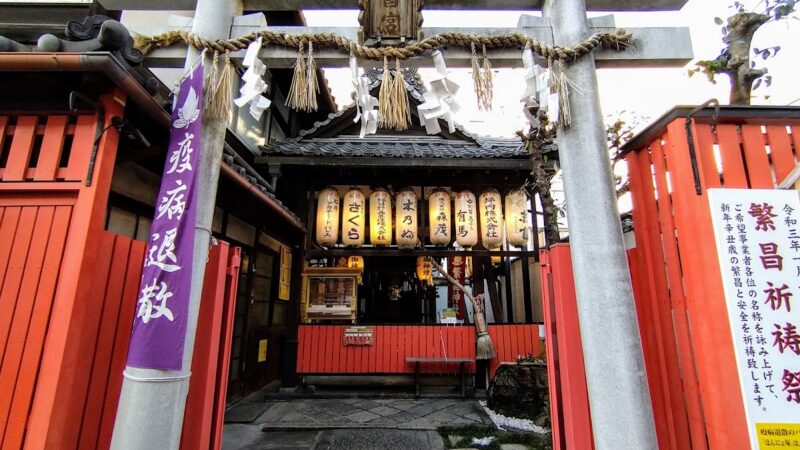
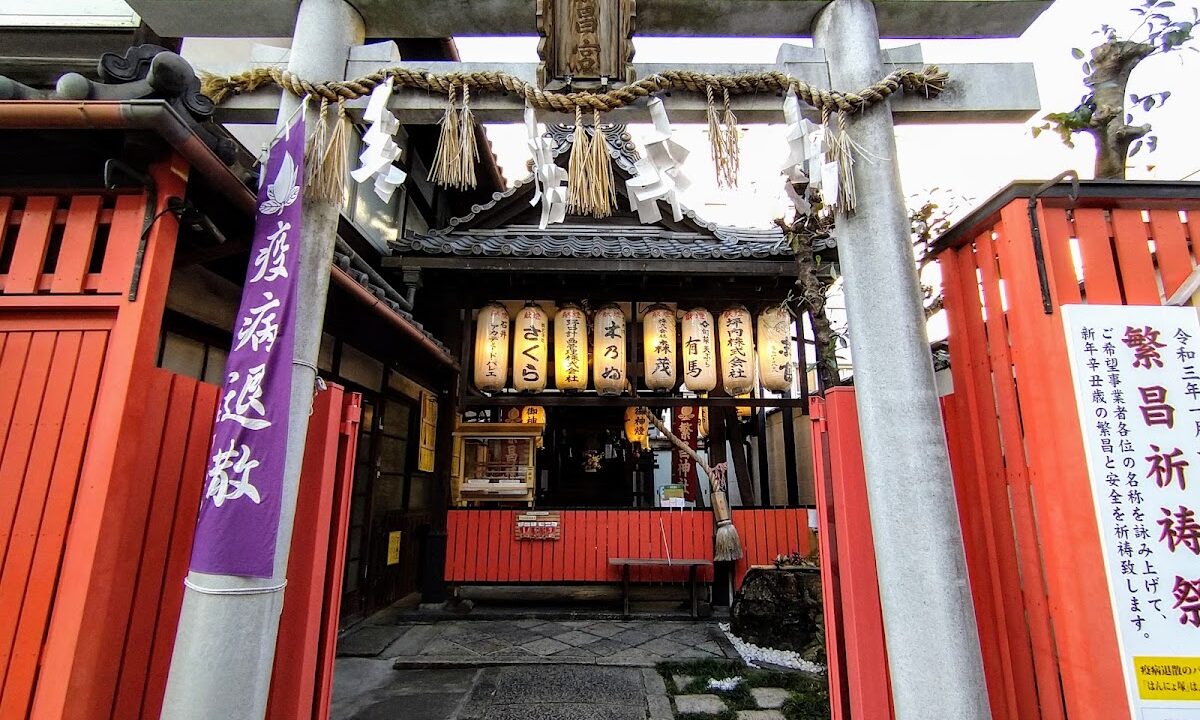
The grounds of Hanjo Shrine are very compact, quietly nestled in a residential area of the city. While not flashy, this contributes to its tranquil and peaceful atmosphere, making it a space for leisurely worship.
Main Hall
The small but meticulously maintained main hall enshrines the three Munakata goddesses. Worshippers seeking business prosperity visit continuously, quietly offering their prayers.
Amulets and Charms
Hanjo Shrine offers amulets and charms specifically for business prosperity. Many worshippers display these charms and talismans in their shops and offices, making them popular lucky charms.
Since the shrine office is not always open, it is recommended to check the visiting hours in advance if you wish to purchase any amulets or charms.
Goshuin (Shrine Seal) Information
About Goshuin
Hanjo Shrine offers goshuin, but as it is a small shrine, it is not always available. If you wish to receive a goshuin, it is recommended to check by phone before visiting.
The goshuin features the calligraphy of “Hanjo Shrine” and the shrine’s seal, characterized by a simple yet powerful style. Befitting a shrine dedicated to business prosperity, it is a popular goshuin among goshuin notebook collectors as an auspicious seal.
Goshuin Notebooks
It is unclear whether Hanjo Shrine’s original goshuin notebooks are always available. Please check at the shrine office during your visit.
Annual Festivals and Rituals
Annual Festival “Shinkosai”
Every May, the annual festival, “Shinkosai,” is held. During this festival, a portable shrine is paraded through the town, praying for the prosperity of the region and business success.
Although a small shrine, it is carefully preserved as a traditional event deeply rooted in the community, and is bustling with local residents and shop owners participating. During the Shinko-sai festival, the normally quiet shrine grounds become filled with a lively atmosphere.
Daily Visits
Outside of the annual festival, the shrine offers a peaceful environment for worship. Visiting during less crowded times, such as early morning or evening, will allow for a more tranquil prayer experience.
Access Information
Access by Train
Kyoto Municipal Subway Karasuma Line
- Get off at Shijo Station, approximately 7 minutes on foot
- Get off at Gojo Station, approximately 7 minutes on foot
The shrine is located roughly halfway between Shijo Station and Gojo Station, and is within walking distance from either station. Head west from Karasuma Street, and you will find it along Takatsuji Street between Muromachi Street and Shinmachi Street.
Hankyu Kyoto Line
- Get off at Karasuma Station, approximately 7 minutes on foot (directly connected to Shijo Subway Station)
Access by Bus
Kyoto City Bus
- Get off at Karasuma Matsubara (Route 5), approximately 2 minutes on foot
- Get off at Karasuma Matsubara (Route 26), approximately 2 minutes on foot
The Karasuma Matsubara bus stop is the closest, and the shrine is located immediately after getting off.
Access from Kyoto Station
By Subway
Take the Kyoto Municipal Subway Karasuma Line north from Kyoto Station and get off at Gojo Station or Shijo Station. The journey takes approximately 5 minutes, and it’s about a 7-minute walk from there.
By Bus
Take Route 5 or 26 from the Kyoto Station Bus Terminal and get off at Karasuma Matsubara. The journey takes approximately 10 minutes, and it’s about a 2-minute walk after getting off.
Access by Car / Parking
Hanjo Shrine does not have its own parking lot. If you are visiting by car, you will need to use a nearby coin-operated parking lot. However, traffic in central Kyoto is heavy and parking lots are often crowded, so we recommend using public transportation.
Landmarks in the vicinity
- Head west from Karasuma Street, along Takatsuji Street
- Between Muromachi Street and Shinmachi Street
- Look for the address sign “Hanjo-cho”
It’s a small shrine and easy to miss, but the name “Hanjo-cho” itself is derived from the shrine, so it should be easy to find if you follow the address sign.
Manners and Points for Visiting a Shrine
Proper Way to Visit a Shrine
- Bow before passing through the torii gate.
- Purify your body and mind at the water basin (if available).
- Bow twice, clap twice, and bow once in front of the main shrine.
- Silently recite your specific wish, such as business prosperity or family safety.
Best Time to Visit a Shrine
- Early Morning: You can visit in peace and pray with a refreshing feeling.
- Weekdays: There are fewer tourists, allowing for a more relaxed visit.
- During the May Festival: Experience the lively atmosphere of the Shinko-sai (procession of the deity).
- New Year: The shrine is bustling with visitors praying for business prosperity.
Regarding Photography
Photography is generally permitted on the shrine grounds, but please be considerate of other visitors. It is considered good manners to refrain from taking photos inside the main shrine.
Nearby Shrines and Temples
Numerous historical temples and shrines characteristic of Kyoto can be found around Hanjo Shrine.
Bukkoji Temple
Approximately a 5-minute walk from Hanjo Shrine. This is the head temple of the Jodo Shinshu Bukkoji sect, and its beautiful grounds are a major attraction.
Around Bukkoji Street
Bukkoji Street, located south of Hanjo Shrine, is dotted with traditional townhouse cafes and general stores, making it ideal for a stroll after visiting the shrine.
Nishiki Market
Nishiki Market, known as “Kyoto’s Kitchen,” is approximately a 10-minute walk away, where you can enjoy Kyoto’s food culture. After praying for business prosperity, it would be interesting to observe the actual business operations.
Points to Note When Visiting Hanjo Shrine
Shrine Office Opening Hours
Because it is a small shrine, the shrine office is not always open. If you wish to obtain a Goshuin (shrine stamp) or other items, it is recommended to check in advance.
Size of the Shrine Grounds
Due to its very compact size, the shrine grounds are not suitable for large groups. If visiting as a group, please be considerate and take turns praying.
Located in a Residential Area
As the surrounding area is a residential neighborhood, please be mindful of not disturbing nearby residents with noise.
Summary of the Charms of Hanjo Shrine
Hanjo Shrine has established a unique position as the only shrine in Japan specializing in “business prosperity.” Its charm lies in the following points:
- Unique Specialization: The only shrine in Japan dedicated to business prosperity.
- Deep History: A long history dating back to the Heian period and its appearance in the “Uji Shūi Monogatari” (Tales of Uji).
- Faith in the Munakata Three Goddesses: A lineage of deities that developed from maritime transport to commerce.
- Easy Access: Within walking distance of Shijo Karasuma in central Kyoto.
- Tranquil Atmosphere: A small shrine grounds, yet a peaceful environment for worship.
- Diverse Blessings: Not only business prosperity, but also family safety, success in various arts, and successful relationships.
When sightseeing in Kyoto, visiting small, locally rooted shrines like this, in addition to famous temples and shrines, allows you to experience Kyoto’s faith culture more deeply.
For business owners, those seeking to improve their career or financial luck, and those seeking good relationships, the Prosperity Shrine will be a special place to visit.
Frequently Asked Questions (FAQ)
Q1: What is the difference between “Hanjo” and “Hanjo” in the name of Hanjo Shrine?
A1: It is believed that the name originally came from “Hannyo Jinja” (羽女神社), which was corrupted into “Hanjo.” While both “Hanjo” and “Hanjo” have the same meaning, this shrine uses the spelling “Hanjo” due to historical reasons.
Q2: Can I get a Goshuin (shrine stamp) anytime?
A2: As it is a small shrine, the shrine office is not always open. If you wish to receive a Goshuin, we recommend checking in advance by phone or other means.
Q3: How long does it take to visit the shrine?
A3: Because the grounds are small, the visit itself can be completed in about 10-15 minutes. However, if you wish to pray slowly or explore the surrounding area, it is advisable to allow 30 minutes to an hour.
Q4: Is there a parking lot?
A4: There is no dedicated parking lot. If you are visiting by car, you will need to use a nearby coin-operated parking lot, but since it is in the central part of Kyoto City, we recommend using public transportation.
Q5: When is the annual festival held?
A5: The annual festival, “Shinkosai,” is held every May, and the portable shrine is paraded through the town. The exact date may vary from year to year, so we recommend checking in advance.
Q6: Can I visit even if I don’t run a business?
A6: Of course. Besides business prosperity, the shrine is believed to offer blessings for family safety, success in various arts, and finding a good partner, so anyone can visit.
Q7: Are there any places nearby to enjoy lunch or coffee?
A7: The Shijo Karasuma area is Kyoto’s bustling downtown and has many restaurants. Also, there are traditional townhouse cafes around Bukkoji-dori, perfect for a break after visiting the shrine.
Summary
Hanjo Shrine (Kyoto Prefecture) is Japan’s only shrine dedicated to business prosperity, maintaining a long history and unique faith. Enshrining the three Munakata goddesses, this shrine offers blessings for business prosperity, family safety, success in various arts, and successful relationships. Despite its prime location in the heart of Kyoto, it provides a quiet and peaceful environment for worship.
Its convenient location, within walking distance of Shijo Karasuma, is another attractive feature, making it easy to visit during Kyoto sightseeing. Those wishing for business prosperity, improved career luck, or good relationships should definitely consider visiting.
Although the grounds are small, a long history and the deep faith of the local people breathe life into them. A visit to Hanjo Shrine will be a valuable experience, allowing you to connect with Kyoto’s profound religious culture.