Complete Guide to Kuhonji Temple (Gose City, Nara Prefecture) | Highlights of the Ancient Temple with a Thousand Stone Buddhas and Connections to Gyoki
Kuhonji Temple, located in Narahara, Gose City, Nara Prefecture, is a historically significant Jodo sect temple said to have been founded by Gyoki during the Nara period. Situated at the foot of the Kongo-Katsuragi mountain range, it was once the central figure of a large group of temples known as “Kaina Senbo.” The seated Amida Buddha statue from the Fujiwara period, enshrined in the main hall, is designated as an Important Cultural Property. The temple grounds and the hillside behind it boast a breathtaking landscape of over 1600 stone Buddhas, known as the “Thousand Stone Buddhas.” During the autumnal equinox, spider lilies bloom profusely in the surrounding area, making it a hidden gem of Nara, attracting many worshippers and photography enthusiasts.
History and Origins of Kyuhonji Temple
Founding in the Nara Period and Established by Gyoki
The founding of Kyuhonji Temple dates back to the Nara period. It is said to have been established by Gyoki, a high-ranking monk known for his efforts in the construction of the Great Buddha of Todaiji Temple, at the command of Emperor Shomu. At that time, this region was a thriving center of Buddhist culture, and many temples were built in the foothills of the Kongo-Katsuragi mountain range.
Gyoki is known as a monk who not only spread Buddhism among the common people but also actively engaged in social work. Kyuhonji Temple was founded as part of Gyoki’s activities and became a center of faith in the region. While detailed records of its founding are not available, various historical materials suggest that it flourished greatly from the Nara period to the Heian period.
The Prosperity of Kaina Senbo and the Restoration by Kukai
In the Heian period, the area centered around Kyuhonji Temple developed into a large group of temples called “Kaina Senbo” (a thousand temples). As the name “Senbo” (meaning “thousand temples”) suggests, numerous temple buildings and monks’ quarters stood side by side, making it a major center of Buddhist culture in the Kongo-Katsuragi mountain range.
The person who played a key role in the revival of Kaina Senbo was Kukai (Kobo Daishi), the founder of the Shingon sect. Kukai dedicated himself to the development of temples and the promotion of Buddhist culture throughout Japan, and it is said that he also contributed to the development of Kaina Senbo in this region. At that time, Kyuhonji Temple is thought to have functioned as a Shingon sect temple and a place for esoteric Buddhist practice.
Conversion to the Jodo Sect and Kanyo Kosei
After the medieval period and into the Sengoku period (Warring States period), many temples in Kaina Senbo declined and fell into ruin. Kyuhonji Temple was no exception, and it is said that it was once on the brink of collapse.
Amidst these circumstances, in 1558 (Eiroku 1), a Jodo sect monk named Kanyo Kosei rebuilt Kuhonji Temple as a training ground for exclusive Nembutsu practice and converted it to the Jodo sect. This marked a new chapter in Kuhonji Temple’s history, and to this day, it continues to attract local devotion as a Jodo sect temple. Its mountain name is “Kaina-san,” a testament to the former glory of the Kaina Senbo (a thousand temples).
The Wars of the Nanboku-cho Period and Kuhonji Temple
An essential part of understanding the history of Kuhonji Temple is its connection to the wars of the Nanboku-cho period. This region was one of the important strongholds of the Southern Court, and fierce battles took place around Kuhonji Temple.
During the turbulent Nanboku-cho period, many soldiers lost their lives in this area. In later generations, numerous stone Buddha statues were dedicated to commemorate these war dead and those who perished in the region. This is considered one of the origins of the current “Thousand Stone Buddhas,” demonstrating that Kuhonji Temple is not merely a religious facility but is deeply intertwined with the history of the region.
Origin of the Name of Kuhonji Temple
The temple name “Kuhon” (九品) embodies an important doctrine in Pure Land Buddhism. Pure Land Buddhism has a concept called “Kuhon Ojo” (九品往生), which classifies human character and the way of rebirth into nine stages.
Specifically, human character is broadly divided into three categories: “Jōbon” (上品), “Chūbon” (中品), and “Gebon” (下品). Each of these is further divided into three stages: upper, middle, and lower, resulting in a total of nine ranks. These are called “Jōbon Jōsei” (上品上生), “Jōbon Chūsei” (上品中生), “Jōbon Gesei” (上品下生), “Chūbon Jōsei” (中品中生), “Chūbon Gesei” (中品下生), “Gebon Jōsei” (下品上生), “Gebon Chūsei” (下品中生), and “Gebon Gesei” (下品下生). This represents the teaching that anyone, regardless of their circumstances, can be reborn in the Pure Land through the compassion of Amida Buddha. The temple’s name, Kyuhonji, perfectly embodies the teaching of nine levels of rebirth in paradise, clearly demonstrating its character as a Jodo sect temple dedicated to the salvation of all people. The enshrinement of Amida Buddha as the principal image is also based on this doctrine.
Highlights of Kyuhonji Temple
Principal Image: Seated Amida Buddha Statue (Important Cultural Property)
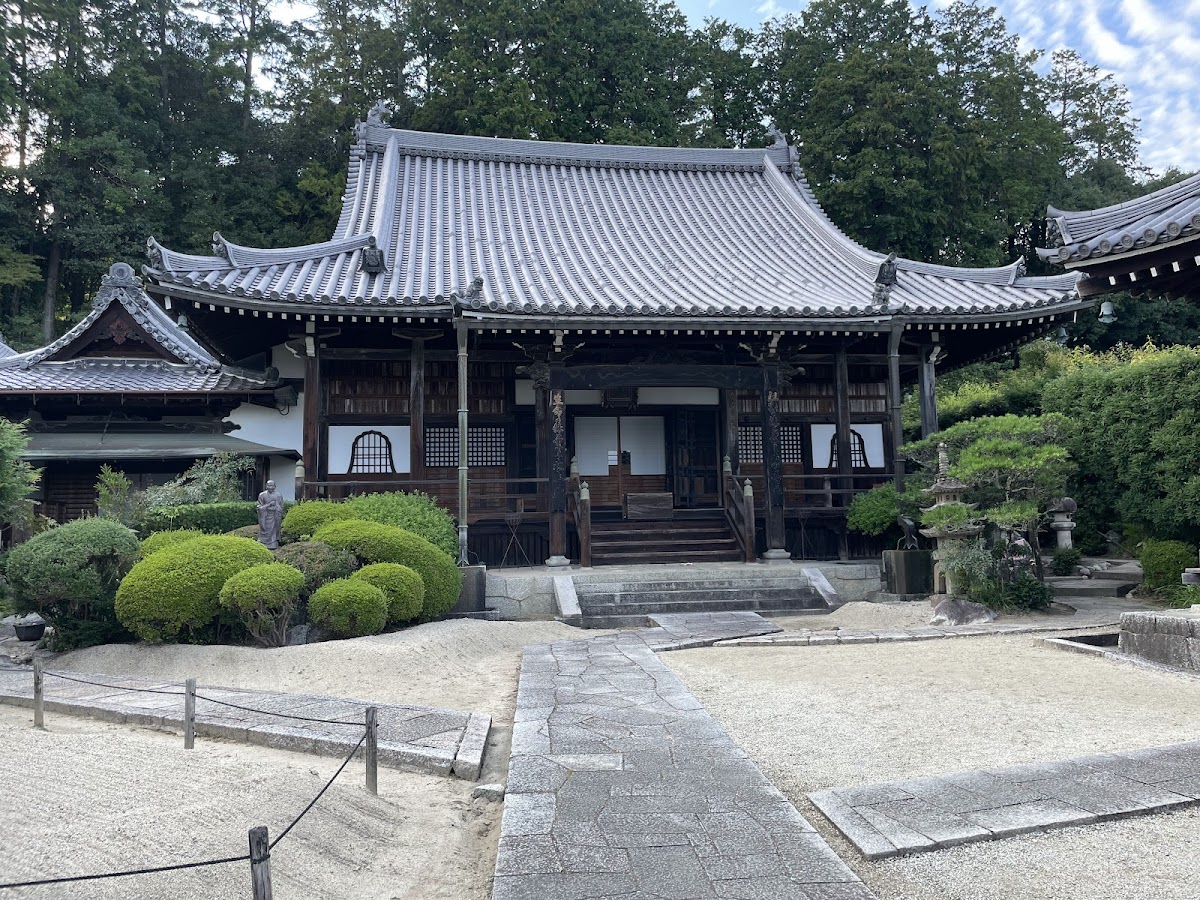
The principal image, a seated Amida Buddha statue, enshrined in the main hall of Kyuhonji Temple, is a Buddhist statue created during the Fujiwara period (late Heian period) and designated as a National Important Cultural Property.
This Amida Buddha statue is depicted with the mudra of meditation, characterized by its gentle and compassionate expression. It possesses the elegant and refined form characteristic of Fujiwara period Buddhist sculpture, and is a valuable cultural asset that conveys the advanced Buddhist statue-making techniques of that time. While detailed information such as the statue’s height and material is limited, it has maintained its beautiful form through its long history and attracts the devotion of many worshippers.
For visits to the main hall, prior contact is recommended. Those who wish to guarantee a visit should check in advance.
The Breathtaking Thousand Stone Buddhas
The greatest highlight of Kyuhonji Temple is the enormous collection of stone Buddhas known as the “Thousand Stone Buddhas.” Between 1600 and 1700 stone Buddhas are enshrined from the temple grounds to the back hill, a sight that overwhelms visitors.
These stone Buddhas were mainly donated during the Edo and Meiji periods, and depict various Buddhist deities such as Jizo Bodhisattva, Kannon Bodhisattva, and Amida Buddha. Each stone Buddha has a different expression, and while some are weathered, this only enhances the sense of historical weight and the depth of faith.
The background to the donation of these stone Buddhas includes the commemoration of those who died in battle during the Nanboku-cho period, as well as the rise of popular faith during the Edo period. People donated stone Buddhas as substitutes for themselves or their families, or for ancestral veneration and making wishes. Many of the stone Buddha statues were worshipped as “substitute Jizo,” and it is said that there was a custom of praying for healing by touching the same part of the statue as the part of one’s own body that was ailing.
The rows of stone Buddha statues on the slope of the back mountain are truly magnificent. The sight of countless stone Buddha statues standing in the tranquil mountain valley deeply touches the hearts of visitors and makes one feel the richness of Japanese folk beliefs.
Statue of Gyoki beside the main hall
Beside the main hall is a statue of Gyoki, who is considered the founder of Kyuhonji Temple. Interestingly, there is a legend that this statue was moved from another location, and it tells the story of the region’s history and the changes in its beliefs.
Gyoki was a prominent Buddhist monk of the Nara period, who dedicated his life to spreading Buddhism to the common people and to social work. He also contributed to the fundraising for the construction of the Great Buddha of Todaiji Temple and was revered as “Gyoki Bodhisattva.” The statue of Gyōki at Kyūhonji Temple serves to illustrate the temple’s history and conveys the deep-rooted faith in Gyōki in the region.
Jūtoku-en Garden (Stroll Garden)
Within the grounds of Kyūhonji Temple is a stroll garden called “Jūtoku-en.” Known as a renowned garden, it is designed to allow visitors to enjoy the beauty of nature throughout the seasons, providing a peaceful and relaxing time for worshippers.
A stroll garden is a style of Japanese garden designed with paths winding around a central pond, allowing visitors to enjoy various landscapes as they walk. Jūtoku-en Garden has a similar structure, with skillfully arranged stones and plants. The garden displays different expressions with each season—fresh greenery in spring, deep green in summer, autumn leaves, and snowscapes in winter—offering new discoveries with each visit.
Saigoku Thirty-Three Kannon Pilgrimage
Within the grounds of Kyūhonji Temple are statues of Kannon, modeled after the thirty-three Kannon pilgrimage sites of Saigoku. It is believed that visiting these statues grants the same merit as completing the Saigoku pilgrimage.
The Saigoku Thirty-Three Kannon Pilgrimage is Japan’s oldest pilgrimage route, visiting 33 Kannon temples primarily in the Kinki region. While actually visiting all the temples requires considerable time and effort, Kyuhonji Temple has created a “replica pilgrimage” by placing Kannon statues within its grounds, allowing anyone to easily experience the merits of the pilgrimage.
This type of “mini-pilgrimage” became common at temples throughout Japan after the Edo period, reflecting the growing religious devotion of ordinary people.
Famous for Spider Lilies
Kyuhonji Temple is also widely known as a “famous spot for spider lilies.” Especially during the autumn equinox in September, the rice paddies and paths surrounding the temple are covered in a magnificent display of bright red spider lilies (Lycoris radiata).
A cluster of spider lilies can be found in the rural area north of the parking lot, and the contrast between the stone Buddha statues and the flowers creates a unique and beautiful sight. During this time of year, many photography enthusiasts and tourists visit, and it is a beloved autumn tradition.
Red spider lilies (Higanbana) have various names such as “dead man’s flower” and “ghost flower,” and have been widely planted around cemeteries and temples. Their vibrant red color and the fact that they bloom during the O-Higan period (autumn equinox) have led to their recognition as a flower with Buddhist symbolism. The combination of the thousand stone Buddha statues at Kuhonji Temple and the red spider lilies is truly a landscape that symbolizes Japanese spiritual culture.
Annual Events and Seasonal Events at Kuhonji Temple
O-Higan (Spring and Autumn)
Kuhonji Temple holds memorial services during the spring and autumn O-Higan periods. The autumn O-Higan, in particular, coincides with the peak blooming season of red spider lilies, attracting many visitors. O-Higan is an important time for ancestor worship, and the custom of visiting graves and participating in temple services continues to this day.
Other Annual Events
As a Jodo sect temple, we also hold Obon (Buddhist festival) memorial services and New Year’s events. For detailed dates and content, we recommend contacting the temple directly before your visit.
Visiting Information
Basic Information
- Temple Name: Kuhonji Temple
- Sect: Jodo Sect
- Mountain Name: Kainasan Mountain
- Principal Image: Seated Amida Buddha Statue (Important Cultural Property)
- Address: 1188 Narahara, Gose City, Nara Prefecture 639-2313
- Telephone: It is recommended to contact the temple office through the Gose City Tourism Association or similar.
- Visiting Hours: Grounds are freely accessible (Please check in advance for viewing the interior of the main hall).
- Admission Fee: Generally free (Donations may be required for viewing the interior of the main hall).
- Parking: Available (Free)
- Restrooms: None (Please use nearby facilities).
Notes on Visiting
- If you wish to view the interior of the main hall, it is advisable to contact the temple in advance.
- Some of the stone Buddha statues are weathered, so please handle them with care.
- Photography is generally permitted, but please check beforehand if taking pictures inside the main hall.
- As this is a quiet temple nestled in the mountains, please be considerate of noise levels during your visit.
Access Information
Access by Public Transportation
Kyuhonji Temple is located at the foot of a mountain, making access by public transportation somewhat inconvenient.
- From Kintetsu Gosho Station:
- Get off at Kintetsu Gosho Station on the Kintetsu Gosho Line.
- Take a Nara Kotsu bus bound for Gojo Bus Center or Kobayashi.
- Get off at the Narahara bus stop and walk for approximately 15 minutes.
- Alternatively, take a taxi for approximately 15 minutes.
- From JR Gosho Station:
- Get off at Gosho Station on the JR Wakayama Line.
- Walk approximately 5 minutes to Kintetsu Gosho Station, then proceed as described above.
Since bus services are limited, we strongly recommend checking the timetable in advance.
Access by Car
Access by car is the most convenient.
- From Osaka:
- Approximately 20 minutes from Katsuragi IC on the Minami-Hanna Expressway via National Route 24 and Prefectural Route 30.
- Approximately 30 minutes from Kashiwara IC on the Nishi-Meihan Expressway via National Route 165 and Prefectural Route 30.
- From Nara City:
- Approximately 50 minutes south on National Route 24, then onto Prefectural Route 30 (Mountain Foot Line) in Gose City.
- From Wakayama:
- Approximately 15 minutes from Gose-Minami IC on the Keina-Wa Expressway via Prefectural Route 30.
Car Navigation Settings: Search for “1188 Narahara, Gose City, Nara Prefecture” or “Kyuhonji Temple”.
Parking is available in front of the temple, but it can get crowded during the peak season for spider lilies.
Nearby Tourist Attractions
When visiting Kyuhonji Temple, we recommend also visiting the nearby tourist attractions.
- Hitokotonushi Shrine: A famous ancient shrine known for granting “one wish” (approximately 10 minutes by car)
- Takakamo Shrine: The head shrine of all Kamo (Kamo) shrines nationwide (approximately 15 minutes by car)
- Katsuragi Ancient Road: A hiking course along a historical path dating back to ancient times
- Takamahiko Shrine: An ancient shrine situated on the slopes of Mt. Katsuragi (approximately 20 minutes by car)
Recommended Points When Visiting Kyuhonji Temple
Best Season
Kyuhonji Temple is worth visiting throughout the year, but the best times are:
- Late September (Autumn Equinox): The spider lilies are in full bloom, offering the most spectacular scenery.
- Spring (Late March to Early April): The spring equinox coincides with the cherry blossom season, creating a peaceful spring atmosphere.
- Early Summer (May to June): The fresh greenery is beautiful, allowing for a quiet visit.
- Late Autumn (November): The contrast between the autumn leaves and the stone Buddha statues is magnificent.
Estimated Time Required
- A leisurely visit to the temple grounds and stone Buddha statues: Approximately 60-90 minutes
- A detailed visit including photography: Approximately 2 hours
- A stroll including the surrounding cluster of spider lilies: Approximately 2-3 hours
Photography Tips
- It is recommended to photograph the thousand stone Buddha statues in the soft morning light.
- Spider lilies are beautiful in the slanted light of early morning or evening.
- A wide-angle lens is useful for capturing the overall picture of the stone Buddha statues on the hillside behind the temple.
- Taking close-ups of the expressions of individual stone Buddha statues is also interesting.
The Charm and Historical Significance of Kyuhonji Temple
Kyuhonji Temple is an ancient temple with a history of approximately 1300 years, from its founding in the Nara period to the present day. The history of Kyuhonji Temple, founded by Gyōki, a key figure in Japanese Buddhist history, and later revived by Kūkai, and flourishing as the center of the large temple complex known as Kaina Senbō, speaks volumes about the richness of Buddhist culture in this region.
Its turbulent history, including experiencing the wars of the Nanboku-chō period and being revived as a Jōdo sect temple during the Sengoku period, is a valuable example of the relationship between religion and society during Japan’s transition from the medieval to the early modern period.
Above all, the more than 1,600 stone Buddha statues are a precious cultural heritage that demonstrates the depth and breadth of popular faith from the Edo period to the Meiji period. The prayers and wishes of the people embodied in each stone Buddha, and their history of being worshipped as substitutes for others, provide important clues to understanding the Japanese spirituality and view of life and death.
The seated Amida Buddha statue, a designated Important Cultural Property, is of high art historical value as an excellent example of Buddhist sculpture from the Fujiwara period, demonstrating that Kyuhonji Temple is not merely a small local temple, but a historically and culturally significant temple.
Summary
Kyuhonji Temple in Gose City, Nara Prefecture, is a Jodo sect temple with a history dating back to its founding by Gyoki, boasting an impressive collection of over a thousand stone Buddha statues. The seated Amida Buddha statue (a designated Important Cultural Property), the beautiful Jutokuen Garden, and the interplay of these statues with the autumn spider lilies create a deeply moving experience for visitors.
Located in a quiet mountainside somewhat removed from Nara’s main tourist areas, it’s a “hidden gem” where visitors can escape the hustle and bustle and enjoy a peaceful visit. It’s popular with a wide range of people, including history buffs, Buddhist statue enthusiasts, and photography lovers.
Visiting during the autumn equinox period, in particular, offers a unique landscape created by the thousand stone Buddha statues and the vibrant red spider lilies. This temple is highly recommended for those who wish to experience Nara’s deep history and culture, and the spirituality of the Japanese people.
When visiting Gose City, why not explore the surrounding ancient shrines and the Katsuragi Ancient Road in addition to Kyuhonji Temple, and experience the rich history and culture of this region?