Complete Guide to Chūgūji Temple: A Thorough Explanation of the Charms of the National Treasure Bodhisattva in a Contemplative Pose and the Nunnery Associated with Prince Shōtoku
Located in Ikaruga-cho, Ikoma-gun, Nara Prefecture, Chūgūji Temple is one of Japan’s oldest nunneries, said to have been founded by Prince Shōtoku during the Asuka period. Adjacent to the Hōryūji Temple East Precinct, this temple houses two precious cultural treasures: the National Treasure Bodhisattva in a Contemplative Pose and the Tenjukoku Shūchō (Embroidery of the Heavenly Kingdom). It is known as a highly prestigious temple, counted among the three main temples of Yamato. This article comprehensively introduces everything you need to know before visiting Chūgūji Temple, from its history and highlights to visiting information and access methods.
What is Chūgūji Temple?: An Overview of the Nunnery Associated with Prince Shōtoku
Chūgūji Temple belongs to the Shōtoku sect, its mountain name is “Hōkōzan,” and it has also been called “Ikaruga Niji” (Ikaruga Nunnery). According to temple tradition, the temple originated from a palace built by Prince Shōtoku for his mother, Empress Anahobe no Hashihito, which was later converted into a temple after the Empress’s death.
History and Background of Founding
While there are various theories regarding the exact founding date of Chūgū-ji Temple, it is believed to have been built in the early 7th century during the Asuka period, roughly at the same time as the Wakakusa Garan of Hōryū-ji Temple. A leading theory suggests that it was built as part of Prince Shōtoku’s policy to promote Buddhism, with Hōryū-ji Temple serving as a monastery and Chūgū-ji Temple as a nunnery, forming a pair.
Empress Anahobe no Hashihito was a princess of Emperor Yōmei and is known as the birth mother of Prince Shōtoku. As a temple built by the Prince for his mother, Chūgū-ji Temple can be seen as a testament to his deep filial piety.
Relocation from the Former Site to the Current Site
Currently, Chūgū-ji Temple is located adjacent to the east side of Hōryū-ji Temple’s East Precinct (Yumedono Hall). However, at the time of its founding, it was located approximately 500 meters to the east, in the area now known as the “Chūgū-ji Temple Ruins Historical Park.” Archaeological excavations at the former site revealed that Chūgū-ji Temple adopted a Shitenno-ji style temple layout.
During the medieval period, it suffered a fire, and it is estimated that it was relocated to its current location around the end of the 16th century, during the late Muromachi and Azuchi-Momoyama periods, when it became a monzeki temple (a temple headed by a member of the imperial family). This relocation resulted in its status as a sub-temple of Hōryū-ji Temple, and it borrowed the grounds of the East Precinct where the Yumedono Hall is located.
Status as a Monzeki Temple
Chūgū-ji Temple is counted as one of the three monzeki temples of Yamato Province. A monzeki temple is a high-status temple where members of the imperial family or nobility have traditionally served as abbots (monzeki). Chūgū-ji Temple has been a nunnery since its founding and continues to be a monzeki temple with nuns as its abbots. This tradition has been preserved for over 1400 years and is an extremely valuable part of the history of Japanese Buddhism.
National Treasure Bodhisattva in Half-Lotus Position: The Charm of One of the World’s Three Great Smiling Statues
The Bodhisattva in Half-Lotus Position, the principal image of Chūgū-ji Temple, is a wooden Buddha statue believed to have been created in the late Asuka period (7th century) and is designated a National Treasure. This statue is sometimes referred to as one of the “World’s Three Great Smiling Statues,” alongside Leonardo da Vinci’s “Mona Lisa” and the Egyptian “Sphinx.”
The Half-Lotus Position and its Meaning
The half-lotus position refers to a posture in which the right leg is crossed over the left knee, and the fingertips of the right hand are lightly touched to the cheek, in a state of deep contemplation. This posture is said to represent Shakyamuni Buddha’s deep contemplation of life’s suffering before his renunciation of worldly life, or it is said to represent Maitreya Bodhisattva contemplating the salvation of humanity while practicing asceticism in Tusita Heaven.
The Bodhisattva statue at Chūgū-ji Temple has traditionally been identified as Nyoirin Kannon, but currently, the possibility of it being Maitreya Bodhisattva has also been suggested. In any case, its serene and compassionate expression deeply touches the hearts of those who behold it.
Sculptural Beauty and Technical Characteristics
The statue is 132.0 centimeters tall. It is believed to have originally been covered in gold leaf, but now the blackened wood grain is exposed. This lustrous black surface is a result of the wood’s transformation over many years, but it actually imbues the statue with a profound spirituality and mystique.
The material is a single piece of camphor wood, demonstrating the advanced sculptural techniques of the Asuka period. Particularly noteworthy is its graceful curves. From the fingertips of the right hand to the cheek, neck, the curves of the body, and the flow of the drapery, everything forms a harmonious beauty.
The Mystery of the Expression: The “Archaic Smile”
The greatest reason why the Bodhisattva statue at Chūgū-ji Temple is highly regarded worldwide lies in its mystical smile. This smile is called the “Archaic Smile,” and it has the characteristic of changing expression depending on the viewing angle and the way the light hits it.
When viewed from the front, it shows a gentle, compassionate expression; when viewed from an angle, it conveys a deep contemplation; and depending on the lighting, it can even appear to have a melancholic expression. This diverse range of expressions is why it is considered one of the greatest masterpieces of Buddhist sculpture.
The philosopher Tetsurō Watsuji, in his book “Pilgrimage to Ancient Temples,” described the Bodhisattva statue at Chūgū-ji Temple as “extremely quiet and profound,” praising its high level of spirituality.
Exhibition Environment and Viewing Points
Currently, the Bodhisattva in a contemplative pose is enshrined in a shrine within the main hall and can be viewed through glass. The hall’s lighting is moderately subdued, creating a tranquil atmosphere where you can slowly contemplate the statue.
When viewing, we recommend viewing the statue from various angles, not just from the front, as much as possible. Experiencing how the expression changes depending on the angle will allow you to understand the true charm of this Buddha statue.
Tenjukoku Embroidery: Japan’s Oldest Embroidery Work
Another national treasure of Chūgū-ji Temple is the Tenjukoku Mandala Embroidery. This is of extremely high historical value as Japan’s oldest embroidered work.
Origin and History of the Creation
According to temple tradition, when Prince Shotoku died in 622 AD (the 30th year of Empress Suiko’s reign), his consort, Tachibana no Ōiratsume, commissioned the creation of this tapestry by court ladies to commemorate the appearance of the Tenjukoku (the Pure Land of Heavenly Longevity) where the prince attained rebirth.
“Tenjukoku” refers to one of the Pure Lands in Buddhism, the ideal land where the prince is said to have attained rebirth. The tapestry depicted the magnificent appearance of Tenjukoku through embroidery.
Existing Fragments and Restoration
Unfortunately, the original tapestry does not remain in its complete form, and only fragments survive today. The existing portion measures 88.8 centimeters vertically and 82.2 centimeters horizontally, and is thought to be only a small part of the original tapestry.
During the Edo period, the fragments were collected and preserved by pasting them into ledgers. The fragments are embroidered with images of people, buildings, trees, birds, and other figures, as well as inscriptions, making them valuable resources for understanding the artistic style and thought of the Asuka period.
Technique and Art Historical Value
The Tenjukoku Embroidery is made using silk thread embroidery techniques. Although the colors have faded over time, it demonstrates the advanced dyeing and embroidery techniques of the time.
The inscriptions include the names of those involved in its creation, making it important for understanding the realities of ancient craft production. It also has value as a visual resource for conveying the clothing and architectural styles of the Asuka period.
Highlights and Architecture of the Temple Grounds
The grounds of Chūgū-ji Temple are adjacent to the Hōryū-ji Temple East Precinct, creating a dignified yet compact space.
Main Hall (Important Cultural Property)
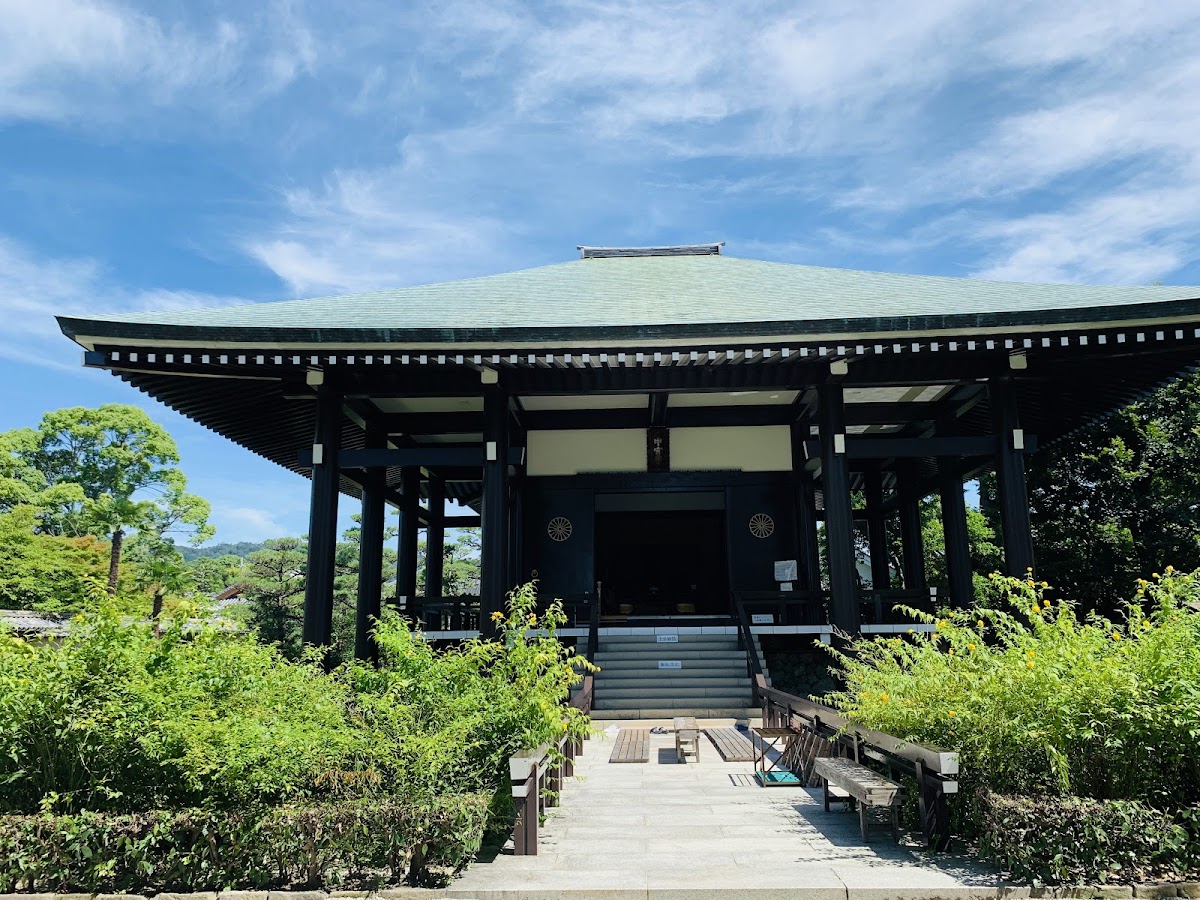
The current main hall was rebuilt in 1968 (Showa 43) at the request of Princess Takamatsu, and designed by architect Isoya Yoshida. While adhering to the traditional style of temple architecture, this elegant building incorporates modern architectural techniques.
The main hall features a hipped roof covered with cypress bark shingles, and the interior is a spacious single room. The principal image, a Bodhisattva in a contemplative pose, is enshrined in the center, and visitors can enter the hall to view it up close.
Garden and Grounds Atmosphere
The temple grounds boast a well-maintained garden where visitors can enjoy the beauty of nature throughout the seasons. It is particularly beautiful during the cherry blossom season in spring, the fresh greenery of early summer, and the autumn foliage season, offering a peaceful and tranquil experience.
A refined and serene atmosphere, befitting a nunnery, permeates the entire grounds, providing solace to visitors.
Chūgūji Temple Ruins Historical Park
The original site of Chūgūji Temple is located approximately 500 meters east of the current location and has been developed as the “Chūgūji Temple Ruins Historical Park.” Archaeological excavations have confirmed the foundation stones of a Shitennoji-style temple layout, allowing us to imagine the scale of the temple in its heyday.
Those with ample time are encouraged to visit the former site in addition to the current Chūgūji Temple to gain a deeper understanding of the temple’s history.
Visiting Information: Hours, Fees, and Notes
This section summarizes practical information for visiting Chūgūji Temple.
Visiting Hours
- March 21st – September 30th (Spring/Summer): 9:00 AM – 4:30 PM (Gates close at 5:00 PM)
- October 1st – March 20th (Autumn/Winter): 9:00 AM – 4:00 PM (Gates close at 4:30 PM)
Admission is accepted until 30 minutes before closing time, so we recommend visiting with plenty of time to spare.
Admission Fees
- Adults: 600 yen
- Junior High School Students: 400 yen
- Elementary School Students: 200 yen
Group discounts (30 or more people) and disability discounts are available. Please check the official website or inquire at the admission desk for details.
Notes for Visitors
- Photography is prohibited inside the hall.
- Please refrain from loud conversations to maintain a solemn atmosphere.
- The main image is a national treasure and can only be viewed through glass.
- The temple grounds are still a nunnery where religious activities take place, so please visit with respect.
Annual Events
Chūgūji Temple holds various Buddhist services throughout the year. In particular, services are held around February 22nd, the anniversary of Prince Shōtoku’s death. Some events are open to the general public, so it is recommended to check in advance if you are interested.
Access Information: How to Get to Chūgūji Temple
Chūgūji Temple is located at 1-1-2 Hōryūji-kita, Ikaruga-chō, Ikoma-gun, Nara Prefecture. Because it is adjacent to Horyuji Temple, many people visit both temples together.
Access by Train and Bus
From JR Horyuji Station
- Approximately 20 minutes on foot north from the station, or approximately 5 minutes by Nara Kotsu bus bound for “Horyuji-monzen,” then approximately 8 minutes on foot from the “Horyuji-monzen” bus stop.
- Approximately 8 minutes on foot from Horyuji South Gate to Chuguji Temple.
From Kintetsu Tsutsui Station
- Approximately 20 minutes by Nara Kotsu bus bound for “Oji Station” or “Horyuji-mae,” then approximately 10 minutes on foot from the “Horyuji-mae” bus stop.
Note: There is also a bus stop called “Chuguji-mae,” but the route from there to Chuguji Temple is complicated, so first-time visitors are advised to go via Horyuji South Gate. The entrance to Chuguji Temple is located northeast of the East Precinct (Yumedono) after passing through the Horyuji Temple grounds.
Access by Car
- Nishi-Meihan Expressway: Approximately 10 minutes from Horyuji IC
- Dai-ni Hanna Expressway: Approximately 20 minutes from Horai IC
Parking: There is no dedicated parking lot for Chuguji Temple, but you can use the Horyuji Temple parking lot (paid). This is convenient if you are visiting both Horyuji Temple and Chuguji Temple.
Directions from Horyuji Temple
Directions to Chuguji Temple if you visit Horyuji Temple first:
- Enter through the South Gate of Horyuji Temple and visit the Western Precinct
- Proceed east to the East Precinct (Yumedono Hall)
- The entrance to Chuguji Temple is on the northeast side of Yumedono Hall
- Approximately 5-8 minutes on foot
Since Horyuji Temple and Chuguji Temple are adjacent, it is recommended to allow about half a day if you plan to visit both.
Tourist Attractions Around Chuguji Temple
When visiting Chuguji Temple, we recommend also visiting the other attractions in the surrounding Ikaruga area.
Horyuji Temple
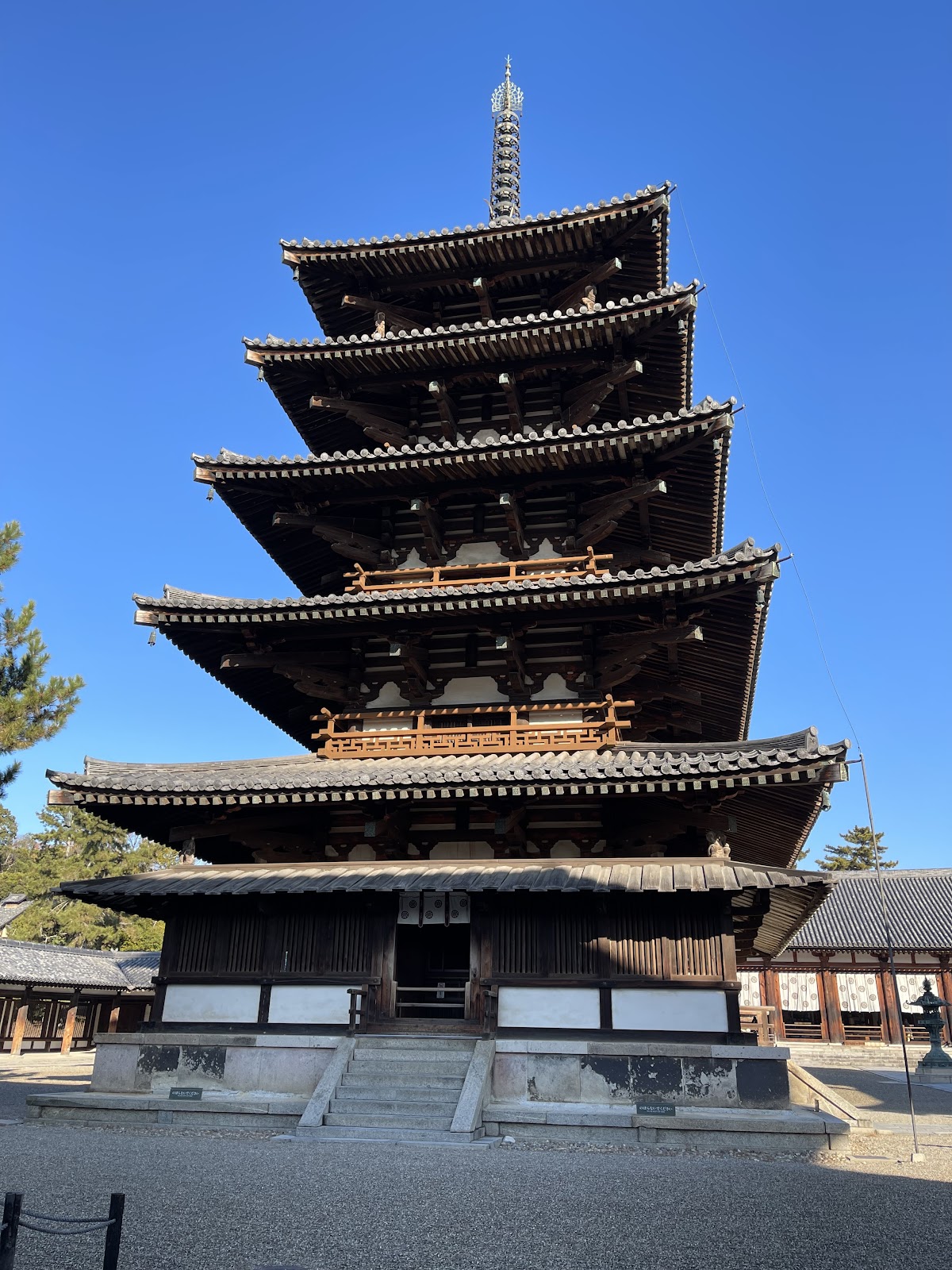
Registered as a World Heritage Site as the world’s oldest wooden buildings, Horyuji Temple, like Chuguji Temple, is a temple associated with Prince Shotoku. Many National Treasure buildings remain, including the five-story pagoda and main hall in the Western Precinct, and the Yumedono Hall in the Eastern Precinct. Most visitors visit it together with Chuguji Temple.
Horinji Temple
Located about 1 kilometer north of Chuguji Temple, Horinji Temple is also considered one of the seven temples established by Prince Shotoku. It is a beautiful temple with a reconstructed three-story pagoda.
Hokiji Temple
Located about 1.5 kilometers northeast of Horyuji Temple, Hokiji Temple is home to Japan’s oldest three-story pagoda (National Treasure) and is included in the World Heritage Site “Buddhist Monuments in the Horyuji Area.” Its appearance amidst the tranquil rural landscape is beautiful, and it is especially spectacular during the autumn cosmos season.
Fujinoki Tumulus
Located approximately 500 meters west of Horyu-ji Temple, this circular burial mound dates back to the late 6th century and is known for the discovery of lavish burial goods in an unlooted stone sarcophagus. Replicas of the excavated artifacts can be seen at the Ikaruga Cultural Properties Center.
The Cultural Significance and Modern Value of Chūgū-ji Temple
Chūgū-ji Temple is not merely a tourist destination; it holds a significant position in the history of Japanese Buddhism, art, and women’s history.
The Pinnacle of Asuka Buddhist Art
The Bodhisattva in a Half-Lotus Position is extremely important in art history as a work that represents the pinnacle of Buddhist sculpture during the Asuka period. It is a masterpiece of Japanese Buddhist sculpture that expresses a unique spirituality while being influenced by the Korean Peninsula and mainland China.
The Inheritance of Japanese Nunnery Culture
Chūgū-ji Temple, which has continued as a nunnery for over 1400 years since its founding, is a valuable institution that conveys the history of women’s religious activities in Japan. Its history as a monzeki temple, where female members of the imperial family served as abbesses, is also an important example of the relationship between religion and the imperial family in Japan.
Tetsuro Watsuji’s “Pilgrimage to Ancient Temples” and Chūgū-ji Temple
Tetsuro Watsuji’s masterpiece, “Pilgrimage to Ancient Temples” (1919), is a renowned travelogue about ancient temples in Nara, and it contains a detailed discussion of the Bodhisattva statue at Chūgū-ji Temple. Watsuji’s writing made the statue widely known, attracting many visitors.
A Healing Space in the Modern Age
In modern society, Chūgū-ji Temple has become a special place for those seeking peace of mind. Sitting quietly before the Bodhisattva statue in a contemplative pose and contemplating its smile provides a precious opportunity to escape the hustle and bustle of everyday life and reflect on oneself.
Summary: A Recommendation to Visit Chūgū-ji Temple
Chūgū-ji Temple is a historic nunnery associated with Prince Shōtoku, possessing the national treasure, the Bodhisattva statue in a contemplative pose, a masterpiece of Japanese Buddhist art. Although a small temple adjacent to Horyu-ji Temple, its profound spiritual significance and the value of its cultural artifacts are immeasurable.
The mystical smile of the Bodhisattva statue, considered one of the world’s three greatest smiling statues, speaks to us today, transcending 1400 years. Its expression changes depending on the viewing angle, and it evokes different impressions depending on the viewer’s state of mind. This wondrous experience can only be gained by actually visiting.
When visiting Nara and Ikaruga, be sure to visit Chūgū-ji Temple and take some time to contemplate the Bodhisattva statue in its tranquil grounds. There, a deep sense of spiritual fulfillment awaits, something difficult to find in our busy modern society.
By visiting Chūgū-ji Temple in conjunction with Horyu-ji Temple, you can touch upon Prince Shōtoku’s ideals for the flourishing of Buddhism and the essence of Buddhist culture during the Asuka period. Chūgū-ji Temple is an essential place that cannot be missed on a journey to the origins of the Japanese spirit.