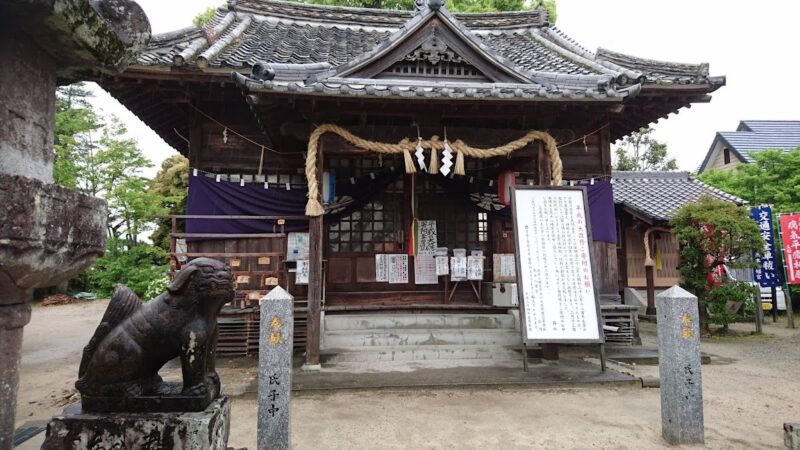
Tenman Shrine (Wakamiya, Hyogo-cho, Saga City, Saga Prefecture) Complete Guide
Tenman Shrine, located in Wakamiya, Hyogo-cho, Saga City, Saga Prefecture, is a community-based shrine dedicated to Sugawara no Michizane, known as the god of learning. Despite its convenient location—just a 3-minute walk from Igaya Station on the JR Nagasaki Main Line—it boasts a tranquil environment surrounded by a creek (waterway), attracting the faith of local residents. This article provides a detailed guide to Tenman Shrine, including its history, enshrined deities, highlights within the grounds, access information, and details on obtaining its Goshuin (shrine stamp).
Basic Information about Tenman Shrine
Location: Wakamiya, Hyogo-cho, Saga City, Saga Prefecture (Fujiki, Tobimatsu area)
Deity Enshrined: Sugawara no Michizane
Shrine Rank: Village Shrine
Nearest Station: Igaya Station, JR Nagasaki Main Line (approx. 3-minute walk)
Parking: Limited parking space available around the shrine grounds
Visiting Hours: Open all day (Shrine office may be unattended)
About the Deity and Benefits
About Sugawara no Michizane
Sugawara no Michizane, the deity enshrined at Tenman Shrine, was a scholar and politician who was active during the Heian period. He displayed exceptional talent from a young age, excelling in poetry and Chinese studies, and rose to the position of Minister of the Right. However, due to slander from political enemies, he was exiled to Dazaifu, where he spent the rest of his life. After his death, a series of natural disasters occurred in Kyoto. To appease the vengeful spirit of Michizane, a Tenmangu shrine was built, and later, he became widely worshipped as “Tenjin-sama,” the god of learning and literature.
Expected Benefits
- Academic Achievement: Passing entrance exams, improving grades, passing qualification exams
- Literary Improvement: Improving calligraphy, poetry, and writing skills
- Protection from Misfortune: Protection from disasters and evil spirits
- Sincerity: Cultivating a sincere heart
- Good Fortune and Prosperity: Improved luck, family safety
Especially during exam season, local students and their parents can be seen visiting to pray for success.
History and Origins of Tenman Shrine
Founding History
The exact founding date of Tenman Shrine in Wakamiya, Hyogo-cho, Saga City, is unclear due to the loss of historical records. However, according to local tradition, it is believed to have begun in the mid-to-late Edo period when villagers in this area (formerly Wakamiya Village) invited Sugawara no Michizane, the god of learning, and enshrined him as the guardian deity of the village.
The Saga Plain has long been a thriving agricultural area with a well-developed network of creeks (waterways). This Tenman Shrine also exhibits a typical settlement pattern of the Saga Plain, with the shrine built on a slightly elevated area surrounded by creeks. This served both to protect the sacred area from floods and to provide a practical purpose for managing agricultural water.
Changes After the Meiji Era
Due to the reform of the shrine system during the Meiji era, this Tenman Shrine was ranked as a village shrine. While the surrounding environment changed significantly after the land reform following World War II and the period of rapid economic growth, the shrine itself has been carefully preserved by the local residents. In recent years, local parishioners’ organizations have taken the lead in regularly cleaning and maintaining festivals, playing a role as a spiritual pillar of the local community, albeit on a small scale.
Highlights of the Shrine Grounds
Myojin Torii Gate and Approach
A magnificent Myojin Torii gate stands at the entrance to the approach to Tenman Shrine. The Myojin Torii is a representative style of torii gate, alongside the Shinmei Torii, characterized by its vertical pillars and upward-curving kasagi (top beam) and shimaki (crossbeam). Passing through this gate, visitors are greeted by a sacred bridge spanning a creek.
Creek and Sacred Bridge
Creeks (waterways) unique to the Saga Plain surround the shrine grounds, serving as a boundary separating the sacred realm from the secular world. When crossing the sacred bridge, the reflections of the sky and trees on the water’s surface are beautiful, allowing visitors to enjoy the changing scenery of the seasons. Especially during the cherry blossom season in spring and the autumn foliage season, the reflections on the water’s surface present a picturesque beauty.
Main Shrine and Worship Hall
Beyond the sacred bridge lies a small worship hall and main shrine. While the architectural style is simple, it is meticulously maintained, reflecting the deep faith of the local people. A donation box is placed in front of the worship hall, and worshippers can pray using the traditional two bows, two claps, and one bow ritual.
Natural Environment of the Shrine Grounds
The shrine grounds are planted with trees such as camphor trees and hackberry trees, creating a small but lush green space. The sounds of wild birds can be heard, making it a precious place to experience nature despite being in an urban area.
Annual Events and Festivals
Grand Festival
At Tenman Shrine, the Grand Festival is held every autumn (October or November). Local parishioners gather, and after a solemn Shinto ritual, a celebratory feast (naorai) is held to foster community interaction. Although small in scale, it is an important event that strengthens community bonds.
New Year’s Visit and Prayer for Success in Exams
In the New Year, local residents visit the shrine for their first shrine visit of the year. During exam season (January to March), students and their parents can be seen visiting to pray for academic success and passing exams. Tenmangu Shrine is widely known as “Tenjin-sama,” the god of learning, and despite its small size, it provides emotional support for students taking exams.
Access
Access by Train
Approximately 3 minutes on foot from Igaya Station on the JR Nagasaki Main Line
- Exit the west exit of Igaya Station
- Cross the railroad crossing west of the station building
- Proceed towards the Nakanoyoshi settlement
- You will see the shrine grounds surrounded by a creek near the entrance to the settlement
Igaya Station is approximately 10 minutes from Saga Station on the Nagasaki Main Line, two stops away by local train. It is very close to the station, making it easily accessible by public transport.
Access by Car
Approximately 15 minutes from the center of Saga City
- Accessible via National Route 34 and a prefectural road.
- Set your car navigation system to “Wakamiya, Hyogo-cho, Saga City” or “Igaya Station”.
- Parking space is limited, so using public transportation is recommended whenever possible.
Landmarks in the Area
- JR Igaya Station (3-minute walk)
- Entrance to Nakanoyoshi settlement
- Look for the creek (waterway) as a landmark.
About Goshuin (Shrine Seals)
Tenman Shrine (Wakamiya, Hyogo-cho, Saga City) is a small shrine without a resident priest, so goshuin are not usually issued. If you wish to receive a goshuin, we recommend checking with a nearby managing shrine or a major shrine in Saga City.
Main shrines in Saga City where you can receive Goshuin (shrine stamps):
- Saga Shrine (Matsubara, Saga City)
- Yotohime Shrine (Yamato-cho, Saga City)
- Chikuri Hachimangu Shrine (Miyaki-cho)
Manners and Etiquette for Visiting Shrines
Basic Etiquette for Visiting Shrines
- Bow before passing through the torii gate: As a sign of respect before entering the sacred area.
- Walk along the edge of the path: The center is considered the path for the gods.
- Purify your hands if there is a water basin: If there is no water basin, purify your heart before proceeding.
- Etiquette in front of the main hall: Two bows, two claps, one bow
- Bow deeply twice
- Clap your hands twice
- Convey your wishes and gratitude in your heart
- Finally, bow deeply once more.
- Bow at the torii gate on your way out: With gratitude.
Regarding Photography
Photography is generally permitted on the temple grounds, but please observe the following points:
- Refrain from taking photos inside the main hall.
- During festivals, be considerate and avoid disrupting religious ceremonies.
- Respect the privacy of other worshippers.
- Be mindful of location information when posting on social media.
Nearby Tourist Attractions
Major Shrines and Temples in Saga City
Saga Shrine (approx. 15 minutes by car)
A shrine dedicated to Nabeshima Naomasa, the 10th lord of the Saga Domain. Known as the guardian shrine of Saga, its vast grounds house eight other shrines, including Matsubara Shrine.
Yotohime Shrine (approx. 20 minutes by car)
An ancient shrine that has long been revered as the Ichinomiya (first-ranked shrine) of Hizen Province. Located on the banks of the Kase River, it is worshipped as the god of water.
Kodenji Temple (approx. 10 minutes by car)
An ancient Rinzai Zen temple known as the family temple of the Nabeshima family. Its beautiful gardens and historical buildings are highlights.
Tourist Facilities in Saga City
Saga Castle Honmaru History Museum (approx. 15 minutes by car)
A museum where you can learn about the history of the Saga Domain. The restored Honmaru Palace is well worth seeing.
Saga Prefectural Museum & Art Museum (approx. 15 minutes by car)
A comprehensive exhibition of Saga’s history, culture, and art. Free admission (excluding special exhibitions).
Chokokan Museum (approx. 15 minutes by car)
A museum exhibiting art and craft items passed down through the Nabeshima family. You can experience the high level of culture of the Saga Domain.
History and Culture of Hyogo-cho, Saga City
Origin of the Place Name of Hyogo-cho
There are two theories about the origin of the place name Hyogo-cho in Saga City: one is that it originates from the fact that there was once an armory called “Hyogo” in this area, and the other is that it is related to the ancient official position of “Hyogo.” During the Edo period, it was part of the Saga Domain and a village centered on agriculture was formed.
Creek Culture
The Saga Plain is known as one of Japan’s leading creek regions. These creeks are a network of waterways that have been used for multiple purposes, including securing agricultural water, drainage, transportation, and firefighting, supporting the agricultural development of the Saga Plain. The area around Tenman Shrine is also surrounded by these creeks, forming a unique landscape characteristic of the Saga Plain.
In recent years, many creeks have been filled in or reinforced with concrete embankments, but in this area, the traditional creek scenery still remains, making it a valuable cultural landscape.
The Relationship Between Tenman Shrines and Saga
Tenman Shrines in Saga Prefecture
There are many Tenman shrines dedicated to Sugawara no Michizane in Saga Prefecture. This is related to the fact that Dazaifu, where Michizane was exiled, is located in Kyushu, and therefore Tenman shrine worship is prevalent throughout the Kyushu region.
Major Tenmangu Shrines in Saga Prefecture:
- Matsubara Tenmangu Shrine (Saga City)
- Tenmangu Shrine (Kinryu-cho, Saga City)
- Small-scale Tenmangu Shrines enshrined in various settlements
The Tenmangu Shrine in Wakamiya, Hyogo-cho, Saga City, has also been carefully preserved by local residents since the Edo period as part of this regional faith.
Spread of the Faith in Learning
During the Edo period, the Saga Domain, under the 10th lord Nabeshima Naomasa, focused on education, establishing the domain school “Kodokan,” and fostering a culture that valued learning. Against this backdrop, it is believed that the faith in Tenjin-sama, the god of learning, naturally spread, leading to the establishment of Tenmangu shrines in various regions.
Visitor Feedback and Reviews
The following are comments from visitors who have actually visited Tenman Shrine:
- “It’s conveniently located near the station. I went there almost every day before my entrance exams.” (Local high school student)
- “The quiet environment surrounded by the creek is very calming.” (Woman in her 30s)
- “It’s small, but it’s carefully maintained, and you can feel the faith of the local people.” (Man in his 60s)
- “It’s a community-based shrine that you can stop by on your walking route.” (Local resident)
How to Enjoy Visiting Tenman Shrine
Seasonal Scenery
Spring (March-May)
Cherry blossoms bloom along the creek, and the petals reflected on the water’s surface are beautiful. The fresh greenery is also vibrant, giving a sense of vitality.
Summer (June-August)
Aquatic plants grow lushly along the creek, and you can see dragonflies and waterfowl. The shade of the trees provides coolness.
Autumn (September-November)
The trees in the shrine grounds begin to change color, creating a beautiful contrast with the clear autumn sky. The annual festival is also held during this time.
Winter (December-February)
The atmosphere becomes more tranquil, and during exam season, visitors come to pray for success. Visiting the shrine in the crisp winter air is refreshing.
Recommended Walking Course
The area around Igaya Station retains the typical rural landscape of the Saga Plain. We recommend strolling along the surrounding creeks and rice fields before or after visiting Tenman Shrine. The lighting is particularly beautiful in the early morning and at dusk, making it ideal for photography.
Message to Students Taking Exams
Tenman Shrine, dedicated to Sugawara no Michizane, the god of learning, supports all students taking exams. When visiting to pray for success in exams, please keep the following points in mind:
- Prayers are based on effort: God supports those who make an effort. Your own effort comes first.
- Gratitude: Don’t forget to be grateful not only for your prayers for success, but also for the environment in which you can learn every day.
- Continuous visits: It’s good to stop by not just once, but also on your daily commute to school.
- Thank-you visit after passing: If your wish is granted, be sure to offer your thanks.
Sugawara no Michizane himself mastered his studies through steady effort from a young age. Inheriting that spirit, you too should continue to build upon your daily efforts.
Summary: A place of faith rooted in the community
Tenman Shrine, located in Wakamiya, Hyogo-cho, Saga City, Saga Prefecture, is small in scale, but it is a shrine that has been carefully preserved through the faith and efforts of the local residents. Located just a 3-minute walk from JR Igaya Station, this shrine, nestled amidst a creek, offers a tranquil escape from the hustle and bustle of the city.
Dedicated to Sugawara no Michizane, the god of learning, it’s a popular spot for students praying for success in their exams, providing a source of comfort and support for local students. While not flashy, its simple and warm atmosphere soothes the hearts of visitors.
If you’re visiting Saga City, or if you have exams or qualification tests coming up, be sure to visit Tenman Shrine. You might find renewed energy by calming your mind in its peaceful grounds and offering your prayers to the god of learning.
Tenman Shrine, steeped in local history, culture, and the faith of its people, quietly reminds us of the importance of community bonds, which are becoming increasingly rare in modern society.